
6-MethoxytryptamineCAS# 3610-36-4 |
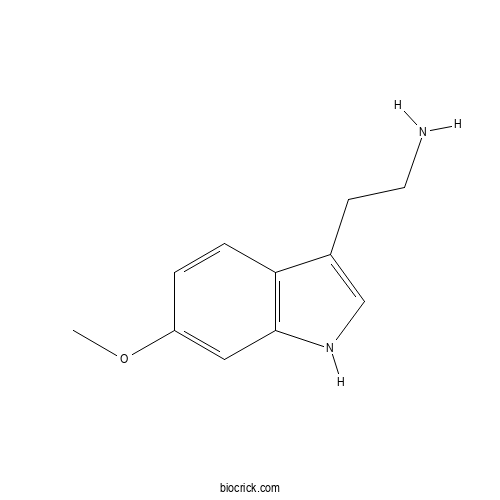
| Cas No. | 3610-36-4 | SDF | File under preparation. |
| PubChem ID | 17654.0 | Appearance | Powder |
| Formula | C11H14N2O | M.Wt | 190.2 |
| Type of Compound | N/A | Storage | Desiccate at -20°C |
| Solubility | Soluble in Chloroform,Dichloromethane,Ethyl Acetate,DMSO,Acetone,etc. | ||
| Chemical Name | 2-(6-methoxy-1H-indol-3-yl)ethanamine | ||
| SMILES | COC1=CC2=C(C=C1)C(=CN2)CCN | ||
| Standard InChIKey | VOCGEKMEZOPDFP-UHFFFAOYSA-N | ||
| Standard InChI | InChI=1S/C11H14N2O/c1-14-9-2-3-10-8(4-5-12)7-13-11(10)6-9/h2-3,6-7,13H,4-5,12H2,1H3 | ||
| General tips | For obtaining a higher solubility , please warm the tube at 37 ℃ and shake it in the ultrasonic bath for a while.Stock solution can be stored below -20℃ for several months. We recommend that you prepare and use the solution on the same day. However, if the test schedule requires, the stock solutions can be prepared in advance, and the stock solution must be sealed and stored below -20℃. In general, the stock solution can be kept for several months. Before use, we recommend that you leave the vial at room temperature for at least an hour before opening it. |
||
| About Packaging | 1. The packaging of the product may be reversed during transportation, cause the high purity compounds to adhere to the neck or cap of the vial.Take the vail out of its packaging and shake gently until the compounds fall to the bottom of the vial. 2. For liquid products, please centrifuge at 500xg to gather the liquid to the bottom of the vial. 3. Try to avoid loss or contamination during the experiment. |
||
| Shipping Condition | Packaging according to customer requirements(5mg, 10mg, 20mg and more). Ship via FedEx, DHL, UPS, EMS or other couriers with RT, or blue ice upon request. | ||
Quality Control & MSDS
3D structure
Package In Stock

Number of papers citing our products


6-Methoxytryptamine Dilution Calculator
6-Methoxytryptamine Molarity Calculator
| 1 mg | 5 mg | 10 mg | 20 mg | 25 mg | |
| 1 mM | 5.2576 mL | 26.2881 mL | 52.5762 mL | 105.1525 mL | 131.4406 mL |
| 5 mM | 1.0515 mL | 5.2576 mL | 10.5152 mL | 21.0305 mL | 26.2881 mL |
| 10 mM | 0.5258 mL | 2.6288 mL | 5.2576 mL | 10.5152 mL | 13.1441 mL |
| 50 mM | 0.1052 mL | 0.5258 mL | 1.0515 mL | 2.103 mL | 2.6288 mL |
| 100 mM | 0.0526 mL | 0.2629 mL | 0.5258 mL | 1.0515 mL | 1.3144 mL |
| * Note: If you are in the process of experiment, it's necessary to make the dilution ratios of the samples. The dilution data above is only for reference. Normally, it's can get a better solubility within lower of Concentrations. | |||||
- Lactitol
Catalog No.:BCX2736
CAS No.:585-86-4
- p-Coumaraldehyde
Catalog No.:BCX2735
CAS No.:20711-53-9
- Glaberide I
Catalog No.:BCX2734
CAS No.:77790-52-4
- 5-(3-(Hydroxymethyl)-2,4-dimethylphenyl)-2-methylpentane-2,3-diol
Catalog No.:BCX2733
CAS No.:2182900-78-1
- Salicifoliol
Catalog No.:BCX2732
CAS No.:125564-65-0
- Blestrianol A
Catalog No.:BCX2731
CAS No.:136966-83-1
- Bulbocodin D
Catalog No.:BCX2730
CAS No.:211229-85-5
- erythro-4-(1-Hydroxy-2-(2-methoxy-4-((E)-prop-1-en-1-yl)phenoxy)propyl)-2-methoxyphenol
Catalog No.:BCX2729
CAS No.:50393-88-9
- Shancigusin B
Catalog No.:BCX2728
CAS No.:1174157-26-6
- Collinsonidin
Catalog No.:BCX2727
CAS No.:116107-25-6
- 4'-demethylpicropodophyllin
Catalog No.:BCX2726
CAS No.:112066-16-7
- Juglanbioside E
Catalog No.:BCX2725
CAS No.:2349377-83-7
- Farnesylacetone
Catalog No.:BCX2738
CAS No.:762-29-8
- Dihydrolanosterol
Catalog No.:BCX2739
CAS No.:79-62-9
- Methyl coumalate
Catalog No.:BCX2740
CAS No.:6018-41-3
- Brevianamide N
Catalog No.:BCX2741
CAS No.:1174538-71-6
- 2-Hydroxymusaitinerin A
Catalog No.:BCX2742
CAS No.:3118515-52-6
- 5,7,2'-Trimethoxyflavone
Catalog No.:BCX2743
CAS No.:4308-57-0
- 7,2'-Trimethoxyflavone
Catalog No.:BCX2744
CAS No.:62536-78-1
- 7,2'-Dihydroxyflavone
Catalog No.:BCX2745
CAS No.:77298-66-9
- Rubone
Catalog No.:BCX2746
CAS No.:73694-15-2
- Orixalone A
Catalog No.:BCX2747
CAS No.:797788-72-8
- 3-Sulfotaurolithocholic acid disodium salt
Catalog No.:BCX2748
CAS No.:64936-83-0
- (11β,16α)-9,21-Dichloro-17-[(2-furanylcarbonyl)oxy]-11-hydroxy-16-methylpregna-1,4-diene-3,6,20-trione
Catalog No.:BCX2749
CAS No.:1305334-30-8
Divergent Asymmetric Total Synthesis of (-)-Voacafricines A and B.[Pubmed:36825653]
Angew Chem Int Ed Engl. 2023 Apr 11;62(16):e202301517.
A divergent asymmetric total synthesis of voacafricines A and B, hexacyclic monoterpene indole alkaloids, has been accomplished featuring the following key steps: a) a catalyst-controlled asymmetric Pictet-Spengler reaction of 6-Methoxytryptamine with a chiral alpha-ketoester affording a 1,1-disubstituted tetrahydro-beta-carboline in excellent yield and diastereoselectivity; b) oxidative cleavage of a 3,5-disubstituted cyclopentene furnishing a dialdehyde intermediate, which was effectively differentiated through spontaneous cyclization with the neighboring hydroxy and secondary amine functions; c) intramolecular nucleophilic addition of a tertiary amino nitrogen atom to the in situ generated oxonium species generating stereoselectively an unprecedented 8-alkyl octahydro-2H-5,8-methanofuro[2,3-b]azepin-8-ium motif bearing five contiguous stereocenters. The synthesis confirmed the absolute configuration of these two natural products.
Evaluation of different internal standardization approaches for the quantification of melatonin in cell culture samples by multiple heart-cutting two dimensional liquid chromatography tandem mass spectrometry.[Pubmed:34954534]
J Chromatogr A. 2022 Jan 25;1663:462752.
We evaluate here different analytical strategies for the chromatographic separation and determination of N-acetyl-5-methoxytryptamine (MEL) and its oxidative metabolites N1-acetyl-N2-formyl-5-methoxykynuramine (AFMK), N1-acetyl-5-methoxykynuramine (AMK) and cyclic 3-hydroxymelatonin (c3OHM) in cell culture samples. Two dimensional liquid chromatography (2D-LC) in the multiple heart-cutting mode was compared with regular 1D chromatographic separations of MEL and its oxidative metabolites. Our results showed that the use of trifluoroacetic acid (TFA) as mobile phase modifier was required to obtain a satisfactory resolution and peak shapes particularly for c3OHM. As TFA is not compatible with ESI ionization the application of the MHC mode was mandatory for a proper chromatographic separation. We evaluate also different internal standardization approaches based on the combined use of a surrogate standard (5-methoxytryptophol) and an internal standard (6-Methoxytryptamine) for MEL quantification in cell culture samples obtaining unsatisfactory results both by 1D- and 2D-LC-ESI-MS/MS (from 9 +/- 2 to 186 +/- 38%). We demonstrate that only the application of isotope dilution Mass Spectrometry through the use of an in house synthesized (13)C isotopically labelled analogue provided quantitative MEL recoveries both by using 1D- and 2D-LC-ESI-MS/MS (99+/-1 and 98+/-1. Respectively) in androgen-insensitive human prostate carcinoma PC3 cells.
Nine-step total synthesis of (-)-strychnofoline.[Pubmed:29334094]
Chem Commun (Camb). 2018 Jan 25;54(9):1125-1128.
Strychnofoline is a Strychnos alkaloid that has unique spirooxindole architecture and possesses important anticancer activity. Here, we have, for the first time, reported the enantioselective synthesis of strychnofoline proceeding in only nine steps from commercially available 6-Methoxytryptamine. The efficiency of the synthesis derives from the use of two sequential transformation steps in the catalytic asymmetric construction of the spiro[pyrrolidine-3,3'-oxindole] motif in a facile manner. Our route is amenable to the synthesis of other natural and synthetic analogs of bioactive spirooxindole alkaloids to access their therapeutic potential.
Enantioselective Synthesis of (+)-Peganumine A.[Pubmed:27558528]
J Am Chem Soc. 2016 Sep 7;138(35):11148-51.
A gram-scale enantioselective total synthesis of (+)-peganumine A was accomplished in 7 steps from commercially available 6-Methoxytryptamine. Key steps included (a) a Liebeskind-Srogl cross-coupling; (b) a one-pot construction of the tetracyclic skeleton from an omega-isocyano-gamma-oxo-aldehyde via a sequence of an unprecedented C-C bond forming lactamization and a transannular condensation; (c) a one-pot organocatalytic process merging two achiral building blocks into an octacyclic structure via a sequence of enantioselective Pictet-Spengler reaction followed by a transannular cyclization. This last reaction created two spirocycles and a 2,7-diazabicyclo[2.2.1]heptan-3-one unit with excellent control of both the absolute and relative stereochemistry of the two newly created quaternary stereocenters.
Enantioselective total synthesis of (+)-reserpine.[Pubmed:23331099]
Org Lett. 2013 Feb 1;15(3):706-9.
A catalytic, enantioselective synthesis of (+)-reserpine is reported. The route features a highly diastereoselective, chiral catalyst-controlled formal aza-Diels-Alder reaction between a 6-Methoxytryptamine-derived dihydro-beta-carboline and an enantioenriched alpha-substituted enone to form a key tetracyclic intermediate. This approach addresses the challenge of setting the C3 stereogenic center by using catalyst control. Elaboration of the tetracycle to (+)-reserpine includes an intramolecular aldol cyclization and a highly diastereoselective hydrogenation of a sterically hindered enoate.
Total synthesis of (+/-)-trigonoliimine C via oxidative rearrangement of an unsymmetrical bis-tryptamine.[Pubmed:21671591]
J Am Chem Soc. 2011 Jul 6;133(26):10050-3.
We report the first total synthesis of (+/-)-trigonoliimine C, a member of a family of structurally complex alkaloids, in 10 steps from tryptamine and 6-Methoxytryptamine. Our convergent synthetic strategy relies on a selective oxidative rearrangement of an unsymmetrical 2,2'-bis-tryptamine.
Tandem intramolecular photocycloaddition-retro-Mannich fragmentation as a route to spiro[pyrrolidine-3,3'-oxindoles]. Total synthesis of (+/-)-coerulescine, (+/-)-horsfiline, (+/-)-elacomine, and (+/-)-6-deoxyelacomine.[Pubmed:20429523]
J Org Chem. 2010 Jun 4;75(11):3569-77.
Irradiation of a tryptamine linked through its side-chain nitrogen to an alkylidene malonate residue results in an intramolecular [2 + 2] cycloaddition to the indole 2,3-double bond. The resultant cyclobutane undergoes spontaneous retro-Mannich fission to produce a spiro[indoline-3,3'-pyrrolenine] with relative configuration defined by the orientation of substituents in the transient cyclobutane. The tandem intramolecular photocycloaddition-retro-Mannich process, abbreviated as TIPCARM, leads to a spiropyrrolidine which is poised to undergo a second retro-Mannich fragmentation that expels the malonate unit and generates transiently an indolenine. The latter undergoes rearrangement to a beta-carboline, which upon brominative oxidation undergoes further rearrangement to an oxindole. With tryptamine as starting material, the entire sequence leads to the alkaloid (+/-)-coerulescine. Starting from 5-methoxytryptamine, a parallel series affords (+/-)-horsfiline. Modification of the malonylidene unit to include an isobutyl substituent at C3 affords a photosubstrate which also undergoes the TIPCARM process. In this case, a 2'-isobutyl-substituted spiro[indoline-3,3'-pyrrolenine] results. This undergoes stereoselective hydride reduction to give a product with relative orientation at the spiro carbon and the new stereocenter bearing the isobutyl appendage corresponding to that of the alkaloid elacomine. From tryptamine, the sequence paralleling that leading to coerulescine and horsfiline terminates at 6-deoxyelacomine, whereas 6-Methoxytryptamine as starting material affords (+/-)-elacomine itself.
Determination of melatonin in saliva using automated solid-phase extraction, high-performance liquid chromatography and fluorescence detection.[Pubmed:16714247]
Scand J Clin Lab Invest. 2006;66(3):181-90.
A sensitive bioanalytical method for the determination of melatonin in saliva by solid-phase extraction (SPE), high-performance liquid chromatography (HPLC) and fluorescence detection has been developed and validated. Saliva was collected with a Salivette sampling device (Sarstedt) and a mixed-mode SPE column was used for the extraction of melatonin and internal standard (N-acetyl-6-Methoxytryptamine) from the saliva. Chromatographic separation was performed using a HyPurity C18 LC column (150 x 2.1 mm) with mobile phase acetonitrile-ammonium hydrogen carbonate buffer, 0.015 M, pH 6.8 (23:77, v/v). Excitation and emission wavelengths were set to 285 nm and 345 nm, respectively. The within-day precision for the method at 50 pmol/L was 7.9 % and the between-day precision was 10.5 %. The limit of quantification was 50 pmol/L.
Screening for endogenous substrates reveals that CYP2D6 is a 5-methoxyindolethylamine O-demethylase.[Pubmed:12777961]
Pharmacogenetics. 2003 Jun;13(6):307-19.
The objective of this investigation was to screen for potential endogenous substrates for CYP2D6. Using recombinant CYP2D6, together with hepatic microsomes from CYP2D6-transgenic mice, human liver microsomes, and a specific anti-CYP2D6 monoclonal antibody, it was ascertained that CYP2D6 does not significantly metabolize the endogenous phenylethylamines 2-phenylethylamine, octopamine, synephrine, 3-methoxy-p-tyramine, 4-methoxy-m-tyramine, metanephrine, and normetanephrine, nor the indolethylamines tryptamine, serotonin, 6-Methoxytryptamine, and melatonin, nor the beta-carbolines harman, norharman and tryptoline. However, the indolethylamines 5-methoxy-N,N-dimethyltryptamine (5-MDMT) and pinoline (6-methoxy-1,2,3,4-tetrahydro-beta-carboline) showed relatively high affinity for CYP2D6 in a spectral binding assay (K(s) 28 +/- 5, and 0.5 +/- 0.3 microm (mean +/- SEM), respectively) and were O-demethylated only by CYP2D6 in a panel of 15 recombinant common human P450s. Pinoline and 5-MDMT O-demethylase activities were 35- and 11-fold greater in liver microsomes from CYP2D6-humanized mice, respectively, than those in liver microsomes from control mice. Moreover, the increased activities were completely inhibited by an anti-CYP2D6 monoclonal antibody. Kinetic analysis with recombinant CYP2D6 gave K(m) and k(cat) values for 5-MDMT and pinoline O-demethylations of 12 +/- 1 microm and 65 +/- 1 min(-1) and 1.8 +/- 0.3 microm and 26 +/- 1 min(-1), respectively. These two substrates can be added to 5-methoxytryptamine, which we have recently reported to be an endogenous CYP2D6 substrate. CYP2D6 is therefore a relatively highly specific, high-affinity, high-capacity 5-methoxyindolethylamine O-demethylase. Polymorphic cytochrome CYP2D6 may therefore exert an influence on mood and behavior by the O-demethylation of these 5-methoxyindolethylamines found in the brain and pineal gland. These processes may also impact on mental and neurological health. The findings may open new vistas for the determination of CYP2D6 phenotype.
Inhibitory influence of late afternoon melatonin injections and the counter-inhibitory action of melatonin-containing pellets on thyroid growth process in male Wistar rats: comparison with effects of other indole substances.[Pubmed:1287191]
J Pineal Res. 1992 Nov;13(4):158-66.
Previous studies performed in our laboratory indicated that melatonin, when administered in late afternoon (1600-1800) as s.c. injections for 10 days, exerted an inhibitory effect on thyroid growth in mice and Sprague-Dawley rats. The goal of the present study was to examine the effects of melatonin and other indole substances (5-methoxytryptophol, N-acetylserotonin, 6-Methoxytryptamine), administered for 10 days, for either 4, 8, or 10 weeks, on thyroid growth processes in adult male Wistar rats. We have also compared the action of melatonin administered in late afternoon as s.c. injections with effects of the melatonin-released chronically from s.c. implanted beeswax pellets containing 1 mg of the hormone. Additionally, the effects of melatonin injections in animals with the pineal gland removed and in thyroid stimulating hormone (TSH)-injected rats have been studied. We examined the mean mitotic activity rates (MMARs) of thyroid follicular cells (TFC) and the wet thyroid weights. We concluded that melatonin, of the examined substances, is the most potent inhibitor of thyroid growth; the hormone reduced the MMAR of TFC and the thyroid weight at all time-points. 5-Methoxytryptophol, like melatonin, exerted the inhibitory influence on the mitotic activity; however, it did not affect thyroid weight. The influence of other indole substances was much less pronounced. It was shown that melatonin-pellets prevented the inhibitory effect of late afternoon melatonin injections on thyroid growth processes. This observation is consistent with results of other authors concerning the counter-antithyroid effect of melatonin on thyroid hormone secretion. Pinealectomy revealed the stimulatory effect on thyroid growth processes, while melatonin treatment reversed the effect of the surgery.(ABSTRACT TRUNCATED AT 250 WORDS)

Calcutta University

University of Minnesota

University of Maryland School of Medicine

University of Illinois at Chicago

The Ohio State University

University of Zurich

Harvard University

Colorado State University

Auburn University

Yale University

Worcester Polytechnic Institute

Washington State University

Stanford University

University of Leipzig

Universidade da Beira Interior

The Institute of Cancer Research

Heidelberg University

University of Amsterdam

University of Auckland

TsingHua University

The University of Michigan

Miami University

DRURY University

Jilin University

Fudan University

Wuhan University

Sun Yat-sen University

Universite de Paris

Deemed University

Auckland University

The University of Tokyo

Korea University



