
RuboneCAS# 73694-15-2 |
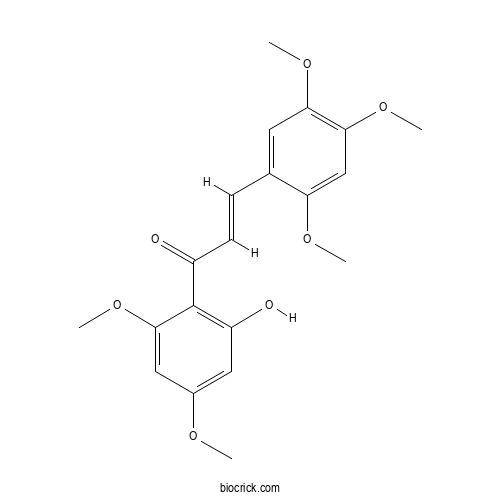
| Cas No. | 73694-15-2 | SDF | File under preparation. |
| PubChem ID | 5951499.0 | Appearance | Powder |
| Formula | C20H22O7 | M.Wt | 374.4 |
| Type of Compound | N/A | Storage | Desiccate at -20°C |
| Solubility | Soluble in Chloroform,Dichloromethane,Ethyl Acetate,DMSO,Acetone,etc. | ||
| Chemical Name | (E)-1-(2-hydroxy-4,6-dimethoxyphenyl)-3-(2,4,5-trimethoxyphenyl)prop-2-en-1-one | ||
| SMILES | COC1=CC(=C(C(=C1)OC)C(=O)C=CC2=CC(=C(C=C2OC)OC)OC)O | ||
| Standard InChIKey | VHCQVGQULWFQTM-VOTSOKGWSA-N | ||
| Standard InChI | InChI=1S/C20H22O7/c1-23-13-9-15(22)20(19(10-13)27-5)14(21)7-6-12-8-17(25-3)18(26-4)11-16(12)24-2/h6-11,22H,1-5H3/b7-6+ | ||
| General tips | For obtaining a higher solubility , please warm the tube at 37 ℃ and shake it in the ultrasonic bath for a while.Stock solution can be stored below -20℃ for several months. We recommend that you prepare and use the solution on the same day. However, if the test schedule requires, the stock solutions can be prepared in advance, and the stock solution must be sealed and stored below -20℃. In general, the stock solution can be kept for several months. Before use, we recommend that you leave the vial at room temperature for at least an hour before opening it. |
||
| About Packaging | 1. The packaging of the product may be reversed during transportation, cause the high purity compounds to adhere to the neck or cap of the vial.Take the vail out of its packaging and shake gently until the compounds fall to the bottom of the vial. 2. For liquid products, please centrifuge at 500xg to gather the liquid to the bottom of the vial. 3. Try to avoid loss or contamination during the experiment. |
||
| Shipping Condition | Packaging according to customer requirements(5mg, 10mg, 20mg and more). Ship via FedEx, DHL, UPS, EMS or other couriers with RT, or blue ice upon request. | ||
Quality Control & MSDS
3D structure
Package In Stock

Number of papers citing our products


Rubone Dilution Calculator
Rubone Molarity Calculator


| 1 mg | 5 mg | 10 mg | 20 mg | 25 mg | |
| 1 mM | 2.6709 mL | 13.3547 mL | 26.7094 mL | 53.4188 mL | 66.7735 mL |
| 5 mM | 0.5342 mL | 2.6709 mL | 5.3419 mL | 10.6838 mL | 13.3547 mL |
| 10 mM | 0.2671 mL | 1.3355 mL | 2.6709 mL | 5.3419 mL | 6.6774 mL |
| 50 mM | 0.0534 mL | 0.2671 mL | 0.5342 mL | 1.0684 mL | 1.3355 mL |
| 100 mM | 0.0267 mL | 0.1335 mL | 0.2671 mL | 0.5342 mL | 0.6677 mL |
| * Note: If you are in the process of experiment, it's necessary to make the dilution ratios of the samples. The dilution data above is only for reference. Normally, it's can get a better solubility within lower of Concentrations. | |||||
- 7,2'-Dihydroxyflavone
Catalog No.:BCX2745
CAS No.:77298-66-9
- 7,2'-Trimethoxyflavone
Catalog No.:BCX2744
CAS No.:62536-78-1
- 5,7,2'-Trimethoxyflavone
Catalog No.:BCX2743
CAS No.:4308-57-0
- 2-Hydroxymusaitinerin A
Catalog No.:BCX2742
CAS No.:3118515-52-6
- Brevianamide N
Catalog No.:BCX2741
CAS No.:1174538-71-6
- Methyl coumalate
Catalog No.:BCX2740
CAS No.:6018-41-3
- Dihydrolanosterol
Catalog No.:BCX2739
CAS No.:79-62-9
- Farnesylacetone
Catalog No.:BCX2738
CAS No.:762-29-8
- 6-Methoxytryptamine
Catalog No.:BCX2737
CAS No.:3610-36-4
- Lactitol
Catalog No.:BCX2736
CAS No.:585-86-4
- p-Coumaraldehyde
Catalog No.:BCX2735
CAS No.:20711-53-9
- Glaberide I
Catalog No.:BCX2734
CAS No.:77790-52-4
- Orixalone A
Catalog No.:BCX2747
CAS No.:797788-72-8
- 3-Sulfotaurolithocholic acid disodium salt
Catalog No.:BCX2748
CAS No.:64936-83-0
- (11β,16α)-9,21-Dichloro-17-[(2-furanylcarbonyl)oxy]-11-hydroxy-16-methylpregna-1,4-diene-3,6,20-trione
Catalog No.:BCX2749
CAS No.:1305334-30-8
- 7,4'-dihydroxy-3'-methoxyflavanone
Catalog No.:BCX2750
CAS No.:13192-07-9
- Isomogroside VI
Catalog No.:BCX2751
CAS No.:2496376-70-4
- Onjisaponin Fg
Catalog No.:BCX2752
CAS No.:1009314-47-9
- Onjisaponin Vg
Catalog No.:BCX2753
CAS No.:1078708-70-9
- Senegasaponin B
Catalog No.:BCX2754
CAS No.:167933-49-5
- Oxyberberrubine
Catalog No.:BCX2755
CAS No.:29580-82-3
- 6'-Hydroxy-3,4,2',3',4'-pentamethoxychalcone
Catalog No.:BCX2756
CAS No.:65602-54-2
- 3-Hydroxyphloretin
Catalog No.:BCX2757
CAS No.:57765-66-9
- 6-Isopentenyl apigenin trimethyl ether
Catalog No.:BCX2758
CAS No.:109605-85-8
Dual responsive micelles capable of modulating miRNA-34a to combat taxane resistance in prostate cancer.[Pubmed:30447399]
Biomaterials. 2019 Feb;192:95-108.
There is a direct correlation between increase in the number of cancer stem cells CSCs and chemoresistance that impedes successful chemotherapy. Synergistic therapy by targeting both bulk tumor cells and CSCs has shown promise in reversing chemoresistance and treating resistant prostate cancer. Herein, we demonstrated the fabrication of a pH and glutathione (GSH) sensitive nanocarrier for co-delivery of docetaxel (DTX) and Rubone (RUB), a miR-34 activator for targeting CSCs, for the treatment of taxane resistant (TXR) prostate cancer. DTX loaded P-RUB (DTX/P-RUB) micelles were prepared by encapsulating DTX into pH responsive diisopropylaminoethanol (DIPAE) and GSH responsive RUB prodrug conjugated polycarbonate based micelles. The self-assembled DTX/P-RUB micelles displayed good stability in vitro and could efficiently target to tumors by enhanced permeability and retention (EPR) effect. After endocytosis by tumor cells, the micelles underwent expansion and disassembly due to the protonation of DIPAE and GSH induced cleavage of disulfide bond in acidic endocytic vesicles, resulting in fast release of DTX and RUB. The released RUB then upregulated the intracellular miR-34a, which then affected the expression of proteins involved in chemoresistance, thus sensitizing the tumor cells towards DTX and further leading to significant inhibition of TXR tumor progression. Thus, DTX/P-RUB micelles have the potential to treat TXR prostate cancer. By taking advantage of this dual responsive strategy, the successful delivery of many other hydrophobic drugs can be achieved for cancer treatment.
Micellar Delivery of miR-34a Modulator Rubone and Paclitaxel in Resistant Prostate Cancer.[Pubmed:28428276]
Cancer Res. 2017 Jun 15;77(12):3244-3254.
Treatment of prostate cancer with paclitaxel often fails due to the development of chemoresistance caused by downregulation of the tumor suppressor gene miR-34a. In this study, we demonstrate that codelivery of paclitaxel and 2'-hydroxy-2,4,4',5,6'-pentamethoxychalcone (termed Rubone) drives upregulation of miR-34a and chemosensitizes paclitaxel-resistant prostate cancer cells, killing both cancer stem-like cells (CSC) and bulk tumor cells. Rubone upregulated miR-34a and reversed its downstream target genes in DU145-TXR and PC3-TXR cells. Paclitaxel and Rubone combination therapy inhibited tumor cell growth, migration, and CSC population growth. We synthesized poly(ethylene glycol)-block-poly(2-methyl-2-carboxyl-propylene carbonate-graft-dodecanol; PEG-PCD) to prepare micelles. The drug-loading capacities were 9.70% +/- 0.10% and 5.34% +/- 0.02% for paclitaxel and Rubone, respectively, controlling a drug release of 60.20% +/- 2.67% and 60.62% +/- 4.35% release of paclitaxel and Rubone at 24 hours. Delivery of miR-34a and Rubone decreased PC3-TXR cell viability with increasing paclitaxel concentration. Coincubation with a miR-34a inhibitor diminished the effect of Rubone. Paclitaxel IC(50) in PC3 and PC3-TXR cells was 55.6 and 2,580 nmol/L, respectively, but decreased to 49.8 and 93.2 nmol/L when treated in combination with Rubone, demonstrating a reversal of paclitaxel resistance by Rubone. Systemic administration of micelles carrying paclitaxel and Rubone inhibited orthotopic prostate tumor growth in nude mice, compared with monotherapy, by reversing the expression of miR-34a, SIRT1, cyclin D1, and E-cadherin. In summary, our results showed how Rubone acts as an efficient small-molecule modulator of miR-34a to reverse chemoresistance and further enhance the therapeutic efficacy of paclitaxel in paclitaxel-resistant prostate cancer. Cancer Res; 77(12); 3244-54. (c)2017 AACR.
Carboxymethyl Dextran-Stabilized Polyethylenimine-Poly(epsilon-caprolactone) Nanoparticles-Mediated Modulation of MicroRNA-34a Expression via Small-Molecule Modulator for Hepatocellular Carcinoma Therapy.[Pubmed:27300477]
ACS Appl Mater Interfaces. 2016 Jul 13;8(27):17068-79.
MicroRNA-34a (miR-34a) modulation therapy has shown great promise to treat hepatocellular carcinoma (HCC). 2'-Hydroxy-2,4,4',5,6'-pentamethoxychalcone, termed Rubone, has been shown to specifically upregulate miR-34a expression in HCC cells and considered as novel anticancer agent. However, the extremely low aqueous solubility of Rubone hampers its use in cancer treatment. In the present study, surface-stabilized nanoparticles-based delivery strategy was engaged to overcome this impediment. In our preparation, Rubone was encapsulated in the micelles composed of polyethylenimine-poly(epsilon-caprolactone) (PEI-PCL) through hydrophobic interactions, which were subsequently stabilized with anionic carboxymethyl dextran CMD via electronic interaction. We found that Rubone-encapsulating nanoparticles are dispersed well in aqueous solution. The results further demonstrated that Rubone could be efficiently delivered in HCC cells by nanoparticles and upregulate miR-34a expression, which in turn led to inhibition of proliferation, migration, and increased apoptosis of HCC cells. In vivo experiments showed that Rubone can be preferentially delivered into tumor tissues by CMD-stabilized PEI-PCL nanoparticles after intravenous administration and significantly inhibited tumor growth. Furthermore, low cytotoxicity of the nanoparticles was observed in vitro and in vivo analyses, indicating a good compatibility of generated nanoparticles. The obtained results suggest that CMD-stabilized PEI-PCL nanoparticles may serve as a novel approach for small-molecule-modulator-mediated miR-34a restoration for HCC therapy.
Small molecule targeting miR-34a for cancer therapy.[Pubmed:27308410]
Mol Cell Oncol. 2015 Feb 24;2(1):e977160.
miR-34a functions as a tumor suppressor in many cancers. In a recent issue of Cancer Research, we describe a small molecule, Rubone, with strong anticancer activity. Rubone selectively restored miR-34a expression in hepatocellular carcinoma cells in which miR-34a was silenced. Restoration of miR-34a by Rubone represents a promising therapeutic approach against cancer.
A small-molecule modulator of the tumor-suppressor miR34a inhibits the growth of hepatocellular carcinoma.[Pubmed:25217526]
Cancer Res. 2014 Nov 1;74(21):6236-47.
Small molecules that restore the expression of growth-inhibitory microRNAs (miRNA) downregulated in tumors may have potential as anticancer agents. miR34a functions as a tumor suppressor and is downregulated or silenced commonly in a variety of human cancers, including hepatocellular carcinoma (HCC). In this study, we used an HCC cell-based miR34a luciferase reporter system to screen for miR34a modulators that could exert anticancer activity. One compound identified as a lead candidate, termed Rubone, was identified through its ability to specifically upregulate miR34a in HCC cells. Rubone activated miR34a expression in HCC cells with wild-type or mutated p53 but not in cells with p53 deletions. Notably, Rubone lacked growth-inhibitory effects on nontumorigenic human hepatocytes. In a mouse xenograft model of HCC, Rubone dramatically inhibited tumor growth, exhibiting stronger anti-HCC activity than sorafenib both in vitro and in vivo. Mechanistic investigations showed that Rubone decreased expression of cyclin D1, Bcl-2, and other miR34a target genes and that it enhanced the occupancy of p53 on the miR34a promoter. Taken together, our results offer a preclinical proof of concept for Rubone as a lead candidate for further investigation as a new class of HCC therapeutic based on restoration of miR34a tumor-suppressor function.

Calcutta University

University of Minnesota

University of Maryland School of Medicine

University of Illinois at Chicago

The Ohio State University

University of Zurich

Harvard University

Colorado State University

Auburn University

Yale University

Worcester Polytechnic Institute

Washington State University

Stanford University

University of Leipzig

Universidade da Beira Interior

The Institute of Cancer Research

Heidelberg University

University of Amsterdam

University of Auckland

TsingHua University

The University of Michigan

Miami University

DRURY University

Jilin University

Fudan University

Wuhan University

Sun Yat-sen University

Universite de Paris

Deemed University

Auckland University

The University of Tokyo

Korea University



