
FarnesylacetoneCAS# 762-29-8 |
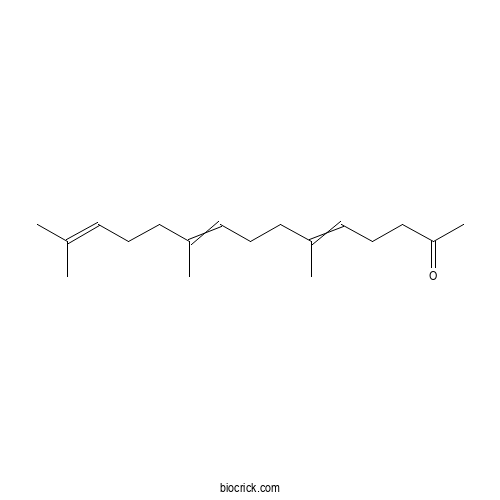
| Cas No. | 762-29-8 | SDF | File under preparation. |
| PubChem ID | 61206.0 | Appearance | Oil |
| Formula | C18H30O | M.Wt | 262.4 |
| Type of Compound | N/A | Storage | Desiccate at -20°C |
| Solubility | Soluble in Chloroform,Dichloromethane,Ethyl Acetate,DMSO,Acetone,etc. | ||
| Chemical Name | 6,10,14-trimethylpentadeca-5,9,13-trien-2-one | ||
| SMILES | CC(=CCCC(=CCCC(=CCCC(=O)C)C)C)C | ||
| Standard InChIKey | LTUMRKDLVGQMJU-UHFFFAOYSA-N | ||
| Standard InChI | InChI=1S/C18H30O/c1-15(2)9-6-10-16(3)11-7-12-17(4)13-8-14-18(5)19/h9,11,13H,6-8,10,12,14H2,1-5H3 | ||
| General tips | For obtaining a higher solubility , please warm the tube at 37 ℃ and shake it in the ultrasonic bath for a while.Stock solution can be stored below -20℃ for several months. We recommend that you prepare and use the solution on the same day. However, if the test schedule requires, the stock solutions can be prepared in advance, and the stock solution must be sealed and stored below -20℃. In general, the stock solution can be kept for several months. Before use, we recommend that you leave the vial at room temperature for at least an hour before opening it. |
||
| About Packaging | 1. The packaging of the product may be reversed during transportation, cause the high purity compounds to adhere to the neck or cap of the vial.Take the vail out of its packaging and shake gently until the compounds fall to the bottom of the vial. 2. For liquid products, please centrifuge at 500xg to gather the liquid to the bottom of the vial. 3. Try to avoid loss or contamination during the experiment. |
||
| Shipping Condition | Packaging according to customer requirements(5mg, 10mg, 20mg and more). Ship via FedEx, DHL, UPS, EMS or other couriers with RT, or blue ice upon request. | ||
Quality Control & MSDS
3D structure
Package In Stock

Number of papers citing our products


Farnesylacetone Dilution Calculator
Farnesylacetone Molarity Calculator
-
 BombiprenoneCatalog No.: BCN4940CAS No.: 21978-49-4
-
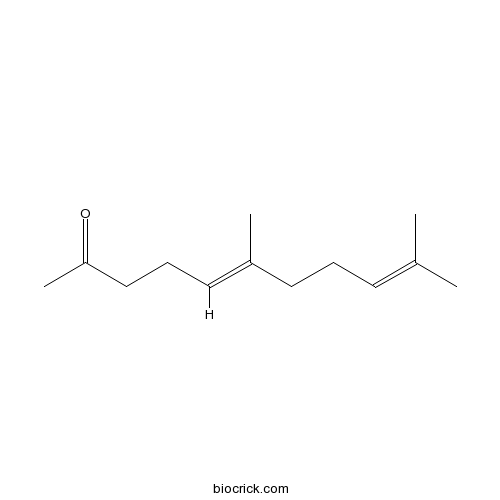 GeranylacetoneCatalog No.: BCN7567CAS No.: 3796-70-1
-
 SqualeneCatalog No.: BCN5995CAS No.: 111-02-4
-
 Ficaprenol 11Catalog No.: BCN5140CAS No.: 26296-50-4
-
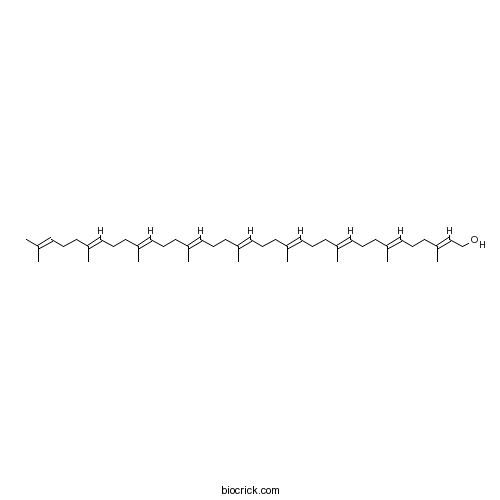 SolanesolCatalog No.: BCN2596CAS No.: 13190-97-1
-
 (2Z,6Z,10E,14E,18E)-FarnesylfarnesolCatalog No.: BCN9671CAS No.: 90695-03-7
-
 (2E,6E)-Farnesyl acetateCatalog No.: BCX0390CAS No.: 4128-17-0
-
 (2Z,6E)-Farnesyl acetateCatalog No.: BCX0433CAS No.: 40266-29-3
-
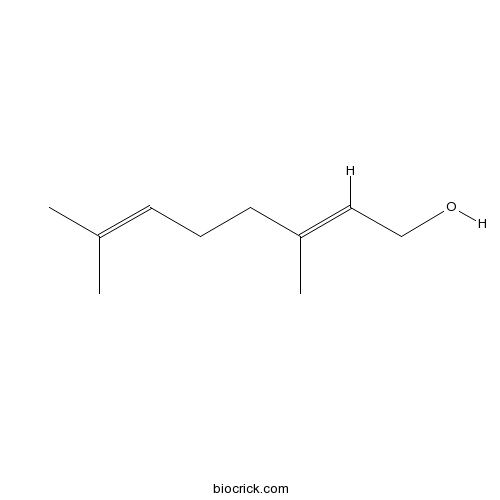 GeraniolCatalog No.: BCN2631CAS No.: 106-24-1
-
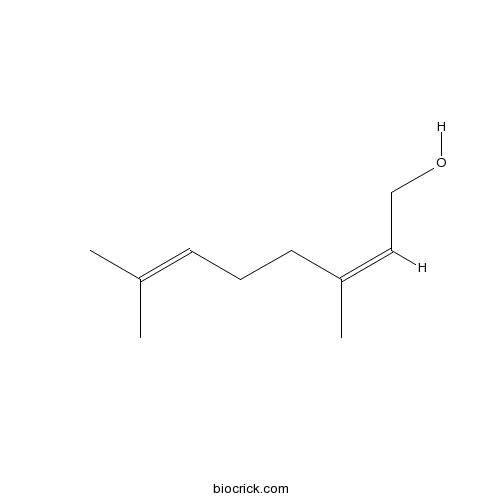 NerolCatalog No.: BCN8517CAS No.: 106-25-2
| 1 mg | 5 mg | 10 mg | 20 mg | 25 mg | |
| 1 mM | 3.811 mL | 19.0549 mL | 38.1098 mL | 76.2195 mL | 95.2744 mL |
| 5 mM | 0.7622 mL | 3.811 mL | 7.622 mL | 15.2439 mL | 19.0549 mL |
| 10 mM | 0.3811 mL | 1.9055 mL | 3.811 mL | 7.622 mL | 9.5274 mL |
| 50 mM | 0.0762 mL | 0.3811 mL | 0.7622 mL | 1.5244 mL | 1.9055 mL |
| 100 mM | 0.0381 mL | 0.1905 mL | 0.3811 mL | 0.7622 mL | 0.9527 mL |
| * Note: If you are in the process of experiment, it's necessary to make the dilution ratios of the samples. The dilution data above is only for reference. Normally, it's can get a better solubility within lower of Concentrations. | |||||
- 6-Methoxytryptamine
Catalog No.:BCX2737
CAS No.:3610-36-4
- Lactitol
Catalog No.:BCX2736
CAS No.:585-86-4
- p-Coumaraldehyde
Catalog No.:BCX2735
CAS No.:20711-53-9
- Glaberide I
Catalog No.:BCX2734
CAS No.:77790-52-4
- 5-(3-(Hydroxymethyl)-2,4-dimethylphenyl)-2-methylpentane-2,3-diol
Catalog No.:BCX2733
CAS No.:2182900-78-1
- Salicifoliol
Catalog No.:BCX2732
CAS No.:125564-65-0
- Blestrianol A
Catalog No.:BCX2731
CAS No.:136966-83-1
- Bulbocodin D
Catalog No.:BCX2730
CAS No.:211229-85-5
- erythro-4-(1-Hydroxy-2-(2-methoxy-4-((E)-prop-1-en-1-yl)phenoxy)propyl)-2-methoxyphenol
Catalog No.:BCX2729
CAS No.:50393-88-9
- Shancigusin B
Catalog No.:BCX2728
CAS No.:1174157-26-6
- Collinsonidin
Catalog No.:BCX2727
CAS No.:116107-25-6
- 4'-demethylpicropodophyllin
Catalog No.:BCX2726
CAS No.:112066-16-7
- Dihydrolanosterol
Catalog No.:BCX2739
CAS No.:79-62-9
- Methyl coumalate
Catalog No.:BCX2740
CAS No.:6018-41-3
- Brevianamide N
Catalog No.:BCX2741
CAS No.:1174538-71-6
- 2-Hydroxymusaitinerin A
Catalog No.:BCX2742
CAS No.:3118515-52-6
- 5,7,2'-Trimethoxyflavone
Catalog No.:BCX2743
CAS No.:4308-57-0
- 7,2'-Trimethoxyflavone
Catalog No.:BCX2744
CAS No.:62536-78-1
- 7,2'-Dihydroxyflavone
Catalog No.:BCX2745
CAS No.:77298-66-9
- Rubone
Catalog No.:BCX2746
CAS No.:73694-15-2
- Orixalone A
Catalog No.:BCX2747
CAS No.:797788-72-8
- 3-Sulfotaurolithocholic acid disodium salt
Catalog No.:BCX2748
CAS No.:64936-83-0
- (11β,16α)-9,21-Dichloro-17-[(2-furanylcarbonyl)oxy]-11-hydroxy-16-methylpregna-1,4-diene-3,6,20-trione
Catalog No.:BCX2749
CAS No.:1305334-30-8
- 7,4'-dihydroxy-3'-methoxyflavanone
Catalog No.:BCX2750
CAS No.:13192-07-9
Integrating GC-MS, Network Pharmacology, and Efficacy Evaluation to Explore Quality Markers and the Compatible Regularity of Zhideke Granules.[Pubmed:42002992]
Comb Chem High Throughput Screen. 2026 Apr 14.
INTRODUCTION: Zhideke granules (ZDKG) are a widely used Traditional Chinese Medicine Formula (TCMF) in clinical practice for treating various diseases caused by wind-heat invading the lung. However, identifying quality markers (Q-markers) and elucidating their compatible regularity are challenging due to the complex composition of ZDKG, which involves multiple active ingredients acting on diverse targets. This study aimed to understand the compatible regularity of ZDKG and identify quality markers among its volatile components. METHODS: The volatile components of ZDKG and compatibility prescriptions were analyzed by GC-MS, and then the Q-markers were screened by network pharmacology and molecular docking. Additionally, animal experiments were conducted to investigate the antitussive, antiinflammation and expectorant effects of ZDKG and compatibility prescriptions. RESULTS: A total of 78 volatile components were identified from ZDKG and compatibility prescriptions. Based on the results of GC-MS and network pharmacology studies, Farnesylacetone, diosphenol, tetradecanoic acid, (-)-menthol, p-menthan-3-one, piperitone, etc., can be determined as the Q-Markers for the volatile components of ZDKG. Animal experiments demonstrated that ZDKG had significant antitussive, anti-inflammation and expectorant effects, and the contribution of monarch medicines was the most prominent. DISCUSSION: Each functional unit in ZDKG has different degrees of regulation in volatile component analysis and animal experiments, but its intervention effect is not as good as that of the whole prescription, which is due to the synergistic effect of the bioactive components of 10 traditional Chinese medicines in ZDKG. CONCLUSION: The Q-Markers of volatile components in ZDKG, such as Farnesylacetone and diosphenol, may exert antitussive, anti-inflammation, and expectorant effects by mediating MAPK3, MAPK1, PIK3CA, AKT1 targets and regulating PI3K-Akt, MAPK signaling pathways. The compatibility of different functional units can increase the types of volatile components of ZDKG and enhance its efficacy. This study clearly revealed the Q-Markers for the volatile components and the compatible regularity of ZDKG.
Molecular Docking and Simulation of Bioactive Molecules from Antiepileptic Plant Extract Presenting Significant Result in in-vivo Study.[Pubmed:41045351]
Cell Biochem Biophys. 2026 Mar;84(1):985-1002.
Moringa oleifera (Lam), Bacopa monnieri (Lam), and Ipomoea aquatica (Forssk) have long been utilized in traditional medicine for their antiepileptic properties. This study investigates the efficacy of these plant extracts in mitigating seizures and associated physiological alterations, aiming to identify potential bioactive compounds through combined in vivo and in silico approaches. Behavioral assessments revealed that seizures significantly impair spatial memory and neuromuscular coordination. Hormonal profiling indicated notable disruptions in reproductive hormones-luteinizing hormone (LH), follicle-stimulating hormone (FSH), and prolactin-while thyroid-stimulating hormone (TSH) remained unaffected. Among the tested extracts, M. oleifera leaf extract exhibited the most pronounced therapeutic effect, demonstrating significant reversal of seizure-induced behavioral and hormonal abnormalities. Phytochemical screening and molecular docking of selected eleven terpenoid compounds in M. oleifera extract were evaluated for their binding affinity to Gamma-Aminobutyric Acid (GABA) transaminase, a key enzyme implicated in seizure pathology. Subsequent in silico stability analyses highlighted three compounds; Farnesylacetone, 6,10,14-Trimethylpentadecan-2-one, and Citronellyl Valerate-as promising candidates, showing higher binding affinity and stability in Molecular Dynamics Simulation and MMGBSA analysis compared to established antiepileptic drugs. These findings suggest that M. oleifera leaf extract, particularly its terpenoid constituents, holds significant potential for the development of novel antiepileptic therapeutics targeting GABA metabolism.
Copaifera mildbraedii Desf.: Phytochemical Composition of Extracts, Essential Oil, and In Vitro Biological Activities of Bark.[Pubmed:38592880]
Plants (Basel). 2024 Mar 19;13(6):877.
Copaifera mildbraedii Desf. is an evergreen tree with an umbrella-like crown. It is distributed from south-eastern Nigeria eastward to the Central African Republic (CAR). The aim of this study was to assess the chemical composition and biological activities of C. mildbraedii bark, as well as the chemical composition of the essential oil. Ethyl acetate (EtOAc) and methanol (MeOH) extracts showed a high total phenolic content (TPC) (149.9 and 148.8 mg GAE/g dry residue (dr), respectively), which was related to good antioxidant activity (DPPH) with an IC(50) of 21.2 and 12.9 microg/mL, respectively. High-performance liquid chromatography coupled with diode array detector (HPLC-DAD) analysis revealed seven phenolic compounds with myricitrin (13.3 mg/g dr) and 2,4-dihydroxy-3,6-dimethyl benzoic acid (30.7 mg/g dr) as major compounds, while gas chromatography-mass spectrometry (GC-MS) analysis enabled detection of 13 volatile compounds (3 before and 10 after derivatization). Thirty compounds were identified in the essential oil, which corresponds to 65% of all identified compounds. Among the latter, E,E-Farnesylacetone and gamma-gurjunene were considered as major compounds (8.08 and 10.43%, respectively). The EtOAc extract showed a potent potential, simultaneously, against anti-acetylcholinesterase (AChE), anti-15-lipoxygenase (15-LOX), anti-xanthine oxidase (XOD), and cytotoxic (OVCAR) activities, whereas cyclohexane (CYHA) and dichloromethane (DCM) extracts showed a cytotoxic effect with high percentages of inhibition (95.2%).
Chemical composition variability and vascular endothelial growth factor receptors inhibitory activity of Inulaviscosa essential oils from Algeria.[Pubmed:33228462]
J Biomol Struct Dyn. 2022 May;40(8):3462-3480.
Angiogenes is therefore appears to be a complex phenomenon, finely regulated by various activators (pro-angiogenic factors) and inhibitors (anti-angiogenic factors). Among the pro-angiogenic factors, VEGF (Vascular Endothelial Growth Factor) seems to be one of the main players in tumor angiogenesis. It exerts its pro-angiogenic activity by attaching to the surface of receptors with tyrosine kinase activity (VEGFR). The aim of this research was the bioinformatical study of VEGFR inhibition by essential oils of the Inula viscosa.Analyses of essential oils obtained by hydrodistillation from the aerial parts of the plant were performed using GC and GC/MS analysis. We used molecular modeling approaches as molecular mechanics to theoretical investigation VEGF receptors by natural inhibitors.Nineteen compounds were identified, constituting 90.1-98.8% of the total essential oils. The main components of the plants were (E)-nerolidol (15.5-20.2 %), caryophyllene oxide (10.6-18.1%), (E)-Z-farnesyl acetone (13.2-25.1%) and (E)-beta-farnesene (1.5-5.6%). Essential oil samples were clustered into two groups according to their chemical compositions. The molecular dynamics study was conducted for the best inhibitors. A few key residues were identified at the binding site of VEGFR. The Pharmacokinetics was justified by means of lipophilicity and high coefficient of skin permeability. The in silico evaluation of ADME revealed that L19 has high absorption. The essential oil of I. viscosa presents a significant variability. This study revealed that (E)-Z-Farnesylacetone is a functional inhibitor of VEGF activities and subsequently can be the best inhibitors candidate to be scrutinized in vivo and in vitro.Communicated by Ramaswamy H. Sarma.
Metabonomic analysis of the hepatic injury suffer from hexavalent chromium poisoning in broilers.[Pubmed:31037529]
Environ Sci Pollut Res Int. 2019 Jun;26(18):18181-18190.
Chromium is used in daily life and has a wide range of functions. It plays an important role in protein synthesis and carbohydrate and lipid metabolism. Chromium is found in trivalent Cr(III) and hexavalent Cr(VI) form; Cr(III) is relatively stable and intimately participates with many phenomena of metabolisms. Whereas, Cr(VI) is toxic, which results in growth inhibition and leading to changes in components of antioxidant systems as well as secondary metabolites. However, the molecular mechanism that is involved in Cr (VI)-induced hepatotoxicity is still unclear. For this purpose, 40 chickens were randomly assigned into two groups: the normal group (feeding the basic diet and clear water), the chromium group (16%LD(50), 74.24 mg/kg/day K(2)Cr(2)O(7) ). The samples were subjected to pathological examination and UHPLC-QE-MS non-target metabolomics method for metabolomics analysis of broiler liver using principal component analysis (PCA) and partial least squares discriminant analysis (OPLS-DA). The central venous cells of the broiler liver in the chromium poisoning group showed turbidity and flaky necrosis, nuclear condensation, nuclear rupture, and even nuclear dissolution. The differential metabolite analysis between the chromium poisoning and the control group showed that 32 differential metabolites were upregulated and 15 were downregulated in positive ion mode. Whereas,17 differential metabolites were downregulated, and 35 were downregulated in negative ion mode (P Farnesylacetone, betaine, taurine, choline, and galactinol. Additionally, Kyoto Encyclopedia of Genes and Genomes (KEGG) pathways showed that the lipid metabolism, carbohydrate metabolism, nucleotide metabolism, amino acid metabolism, energy metabolism, membrane transport, digestive system, and nervous system were the most important metabolic pathways in the liver. This study provides a theoretical basis for the future understanding of the pathogenesis of chromium poisoning and a new insight of the subsequent molecular mechanism of chromium hepatotoxicity.
A Non-Enzymatic Pathway with Superoxide in Intracellular Terpenoid Synthesis.[Pubmed:29927025]
Angew Chem Int Ed Engl. 2018 Aug 6;57(32):10347-10351.
Non-C(5) -units terpenoids (norisoprenoids) with an acetonyl group are widely distributed in nature. However, studies on the biosynthesis of norisoprenoids are scarce. Now, the C(33) norisoprenoid, (all-E)-farnesylFarnesylacetone, was identified from Bacillus spp. and it was elucidated for the first time that superoxide mediates the cleavage of menaquinones (vitamin K) to form norisoprenoids in saponification treatment. From in vivo experiments using gene-disrupted Bacillus subtilis strains targeted for enzymes responsible for menaquinone biosynthesis and for superoxide dismutase, it was suggested that the non-enzymatic cleavage (autoxidation) of menaquinone with superoxide resulted in norisoprenoid synthesis in Bacillus cells. Furthermore, the bioactive norisoprenoids, Farnesylacetone and phytone, were produced in Bacillus cells by this novel synthesis system.
Chemical Composition, Antimicrobial and Antioxidant Activities of the Flower Volatile Oils of Fagopyrum esculentum, Fagopyrum tataricum and Fagopyrum Cymosum.[Pubmed:29361741]
Molecules. 2018 Jan 22;23(1):182.
The purpose of this study was to investigate the chemical composition and biological activity of the volatile oils (VOs) from the flowers of three buckwheat species, Fagopyrum esculentum, Fagopyrum tataricum and Fagopyrum cymosum. The VOs were obtained from the fresh buckwheat flowers by hydrodistillation, and were analyzed for their chemical composition by gas chromatography-mass spectrometry (GC-MS). Nonanoic acid (7.58%), (E)-3-hexen-1-ol (6.52%), and benzothiazole (5.08%) were the major constituents among the 28 identified components which accounted for 92.89% of the total oil of F. esculentum. 2-Pentadecanone (18.61%), eugenol (17.18%), 1,2-benzenedicarboxylic acid, bis(2-methylpropyl) ester (13.19%), and (E,E)-Farnesylacetone (7.15%) were the major compounds among the 14 identified components which accounted for 88.48% of the total oil of F. tataricum. Eugenol (12.22%), (E)-3-hexen-1-yl acetate (8.03%), linalool oxide (7.47%), 1-hexanol (7.07%), and benzothiazole (6.72%) were the main compounds of the 20 identified components which accounted for 90.23% of the total oil of F. cymosum. The three VOs were screened to have broad spectrum antibacterial activity with minimum inhibitory concentration (MIC) values ranged from 100.0 mug/mL to 800.0 mug/mL against the tested bacteria, and their median inhibitory concentration (IC(50)) values were from 68.32 mug/mL to 452.32 mug/mL. Xanthomonas vesicatoria was the most sensitive bacterium. Moreover, the flower VOs of F. esculentum, F. tataricum and F. cymosum also exhibited noteworthy antioxidant capacity with the IC(50) value of 354.15 mug/mL, 210.63 mug/mL, and 264.92 mug/mL for the 1,1-diphenyl-2-picrylhydrazyl (DPPH) free radical scavenging assay, and the value of 242.06 mug/mL, 184.13 mug/mL, and 206.11 mug/mL respectively for the beta-carotene-linoleic bleaching test. These results suggested the volatile oils of buckwheat flowers could be potential resource of natural antimicrobial and antioxidant agents.
New Metabolites from the South China Sea Sponge Diacarnus megaspinorhabdosa.[Pubmed:26027468]
Chem Pharm Bull (Tokyo). 2015;63(6):438-42.
Chemical investigation on CH2Cl2 extract of the marine sponge Diacarnus megaspinorhabdosa resulted in the isolation of two new Farnesylacetone derivatives 1-2, a new gamma-lactone 3, a known dinorditerpenone 4 and four known norsesterterpene peroxides 5-8. Their structures were elucidated by using one and two dimensional (1D and 2D)-NMR, high resolution-electrospray ionization (HR-ESI)-MS, and comparison with the literature. Compounds 1 and 2 were cis/trans-olefinic isomers and determined through nuclear Overhauser effect spectroscopy (NOESY) experiment. The absolute configuration of 3 was established by comparison of circular dichroism (CD) data with known lactones. The cytotoxic activities of the compounds were evaluated against five cancer cell lines, and compound 3 showed moderate cytotoxicity activities against cancer cell lines HeLa, H446, NCI-H460, SGC-7901 and MCF-7, with IC50 values in the range of 18.5 to 47.1 microM.
Chemical composition of the leaf oil of Actephila excelsa from Vietnam.[Pubmed:25918811]
Nat Prod Commun. 2014 Sep;9(9):1359-60.
Fresh leaves of Actephila excelsa (Dazl.) Muell. from Vietnam were steam distilled to produce an oil in a yield of 0.15% (v/w). The essential oil was analyzed by a combination of capillary gas chromatography-flame ionization detection (GC-FID) and gas chromatography coupled with mass spectrometry (GC/MS). The main constituents of the oil were the sesquiterpenes gamma-elemene (25.7%) and beta-caryophyllene (11.2%). Other significant compounds were methyl salicylate (5.8%), benzyl benzoate (5.2%), (E,E)-Farnesylacetone (4.9%), anisole (4.7%), sabinene (4.1%) and menthone (4.0%). This is the first report on the volatile constituents of this plant.
Monoamine Oxidase Inhibitors Extracted from Tobacco Smoke as Neuroprotective Factors for Potential Treatment of Parkinson's Disease.[Pubmed:25808895]
CNS Neurol Disord Drug Targets. 2015;14(6):777-85.
Parkinson's disease (PD) is a neurodegenerative disease characterized by the loss of mainly the nigrostriatal dopaminergic neurons, which leads to motor dysfunction. Although, most of the drugs are currently used for symptomatic treatment, there are at least three FDA-approved drugs for the treatment of PD that have been suggested preclinically to have neuroprotective effects. Among these drugs are monoamine oxidase (MAO) type B inhibitors such as selegiline and rasagiline, and non-ergot derivative dopamine agonist, pramipexole. In this review article, we focused on the potential uses of non-selective reversible MAO inhibitor, 2,3,6-trimethyl-1,4-naphthoquinone, from flue-cured tobacco leaves extract and two beta- carboline alkaloids (harman and norharman) as potent, reversible and non-selective MAO inhibitors for the treatment of PD. In addition, we discussed the potential uses of farnesol as a potent inhibitor of MAO-B and Farnesylacetone as a less potent selective MAO-B inhibitor. Furthermore, adducts of 1,2,3,4-tetrahydroisoquinoline have shown to have competitive inhibitory effects for both MAO-A and MAO-B. These inhibitors have potential neuroprotective effects, which might be mediated at least through nerve growth factor, neurotrophin 3, brain derived neurotrophic factor, and glial-cell-line-derived neurotrophic factor. We suggest here the neuroprotective implication of extracted MAO inhibitors from smoke tobacco; however, it is important to note that there are several existing compounds in tobacco smoke that have toxic effects in the brain, these include and not limited to the induction of neuropathological features observed in individuals suffering from Alzheimer's disease and dementia.
Tomato carotenoid cleavage dioxygenases 1A and 1B: Relaxed double bond specificity leads to a plenitude of dialdehydes, mono-apocarotenoids and isoprenoid volatiles.[Pubmed:25057464]
FEBS Open Bio. 2014 Jun 25;4:584-93.
The biosynthetic processes leading to many of the isoprenoid volatiles released by tomato fruits are still unknown, though previous reports suggested a clear correlation with the carotenoids contained within the fruit. In this study, we investigated the activity of the tomato (Solanum lycopersicum) carotenoid cleavage dioxygenase (SlCCD1B), which is highly expressed in fruits, and of its homolog SlCCD1A. Using in vitro assays performed with purified recombinant enzymes and by analyzing products formed by the two enzymes in carotene-accumulating Escherichia coli strains, we demonstrate that SlCCD1A and, to a larger extent, SlCCD1B, have a very relaxed specificity for both substrate and cleavage site, mediating the oxidative cleavage of cis- and all-trans-carotenoids as well as of different apocarotenoids at many more double bonds than previously reported. This activity gives rise to a plenitude of volatiles, mono-apocarotenoids and dialdehyde products, including cis-pseudoionone, neral, geranial, and Farnesylacetone. Our results provide a direct evidence for a carotenoid origin of these compounds and point to CCD1s as the enzymes catalyzing the formation of the vast majority of tomato isoprenoid volatiles, many of which are aroma constituents.
Formation of norisoprenoid flavor compounds in carrot (Daucus carota L.) roots: characterization of a cyclic-specific carotenoid cleavage dioxygenase 1 gene.[Pubmed:24289159]
J Agric Food Chem. 2013 Dec 18;61(50):12244-52.
Carotenoids are isoprenoid pigments that upon oxidative cleavage lead to the production of norisoprenoids that have profound effect on flavor and aromas of agricultural products. The biosynthetic pathway to norisoprenoids in carrots (Daucus carota L.) is still largely unknown. We found the volatile norisoprenoids Farnesylacetone, alpha-ionone, and beta-ionone accumulated in Nairobi, Rothild, and Purple Haze cultivars but not in Yellowstone and Creme de Lite in a pattern reflecting their carotenoid content. A cDNA encoding a protein with carotenoid cleavage dioxygenase activity, DcCCD1, was identified in carrot and was overexpressed in Escherichia coli strains previously engineered to produce different carotenoids. The recombinant DcCCD1 enzyme cleaves cyclic carotenes to generate alpha- and beta-ionone. No cleavage products were found when DcCCD1 was co-expressed in E. coli strains accumulating non-cyclic carotenoids, such as phytoene or lycopene. Our results suggest a role for DcCCD1 in carrot flavor biosynthesis.
5E- and 5Z-farnesylacetones from Sargassum siliquastrum as novel selective L-type calcium channel blockers.[Pubmed:23416245]
Vascul Pharmacol. 2013 Apr;58(4):299-306.
A specific blocker of L-type Ca(2+) channels may be useful in decreasing arterial tone by reducing the open-state probability of L-type Ca(2+) channels. The aim of the present study was to evaluate the Farnesylacetones, which are major active constituents of Sargassum siliquastrum, regarding their vasodilatation efficacies, selectivities toward L-type Ca(2+) channels, and in vivo antihypertensive activities. The application of 5E-(Farnesylacetone 311) or 5Z-Farnesylacetone (Farnesylacetone 312) induced concentration-dependent vasodilatation effects on the basilar artery that was pre-contracted with depolarization and showed an ignorable potential role of endothelial-derived nitric oxide. We also tested Farnesylacetone 311 or 312 to determine their pharmacological profiles for the blockade of native L-type Ca(2+) channels in basilar arterial smooth muscle cells (BASMCs) and ventricular myocytes (VMCs), cloned L- (alpha1C/beta2a/alpha2delta), N- (alpha1B/beta1b/alpha2delta), and T-type Ca(2+) channels (alpha1G, alpha1H, and alpha1I). Farnesylacetone 311 or 312 showed greater selectivity toward the L-type Ca(2+) channels among the tested voltage-gated Ca(2+) channels. The ranked order of the potency for Farnesylacetone 311 was cloned alpha1C falling dotsL-type (BASMC) falling dotsL-type (VMCs)>alpha1B>alpha1H>alpha1I>alpha1G and that for Farnesylacetone 312 was cloned alpha1C falling dotsL-type (BASMCs) falling dotsL-type (VMCs)>alpha1H>alpha1G>alpha1B>alpha1I. The oral administration of the Farnesylacetone 311 (80mg/kg) conferred potent, long-lasting antihypertensive activity in spontaneous hypertensive rats, but it did not alter the heart rate.
Vasodilatation effect of farnesylacetones, active constituents of Sargassum siliquastrum, on the basilar and carotid arteries of rabbits.[Pubmed:19006667]
Bioorg Med Chem Lett. 2008 Dec 15;18(24):6324-6.
Two Farnesylacetones, 311 and 312, major active constituents of Sargassum siliquastrum collected from the coast of the East Sea in Korea, showed a moderate vasodilatation effect on the basilar arteries of rabbits. Therefore, treatment with Farnesylacetones 311 and 312 may selectively accelerate cerebral blood flow through dilatation of the basilar artery.
Linear and cyclic C18 terpenoids from the southern Australian marine brown alga Cystophora moniliformis.[Pubmed:18687007]
J Nat Prod. 2008 Aug;71(8):1441-6.
Chemical investigation of the Southern Australian marine brown alga Cystophora moniliformis resulted in the isolation of two new cyclic epimeric terpene diols, moniliforminol A (25) and moniliforminol B (26), a new linear Farnesylacetone derivative (27), and the previously described terpenoids 19-24. This study also resulted in the first complete 2D NMR characterization for compounds 21 to 24 as well as the first report of 24 as a natural product. All structures were elucidated by detailed spectroscopic analysis, with the relative configurations of 25 and 26 being established by selective 1D NOE NMR experiments. The absolute configuration of 26 was assigned on the basis of circular dichroism (CD), which also permitted that of 25 to be tentatively assigned.

Calcutta University

University of Minnesota

University of Maryland School of Medicine

University of Illinois at Chicago

The Ohio State University

University of Zurich

Harvard University

Colorado State University

Auburn University

Yale University

Worcester Polytechnic Institute

Washington State University

Stanford University

University of Leipzig

Universidade da Beira Interior

The Institute of Cancer Research

Heidelberg University

University of Amsterdam

University of Auckland

TsingHua University

The University of Michigan

Miami University

DRURY University

Jilin University

Fudan University

Wuhan University

Sun Yat-sen University

Universite de Paris

Deemed University

Auckland University

The University of Tokyo

Korea University



