
Methyl coumalateCAS# 6018-41-3 |
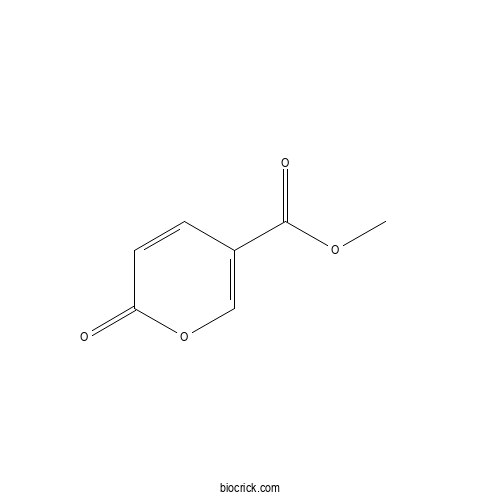
| Cas No. | 6018-41-3 | SDF | File under preparation. |
| PubChem ID | 80113.0 | Appearance | Powder |
| Formula | C7H6O4 | M.Wt | 154.1 |
| Type of Compound | N/A | Storage | Desiccate at -20°C |
| Solubility | Soluble in Chloroform,Dichloromethane,Ethyl Acetate,DMSO,Acetone,etc. | ||
| Chemical Name | methyl 6-oxopyran-3-carboxylate | ||
| SMILES | COC(=O)C1=COC(=O)C=C1 | ||
| Standard InChIKey | HHWWWZQYHPFCBY-UHFFFAOYSA-N | ||
| Standard InChI | InChI=1S/C7H6O4/c1-10-7(9)5-2-3-6(8)11-4-5/h2-4H,1H3 | ||
| General tips | For obtaining a higher solubility , please warm the tube at 37 ℃ and shake it in the ultrasonic bath for a while.Stock solution can be stored below -20℃ for several months. We recommend that you prepare and use the solution on the same day. However, if the test schedule requires, the stock solutions can be prepared in advance, and the stock solution must be sealed and stored below -20℃. In general, the stock solution can be kept for several months. Before use, we recommend that you leave the vial at room temperature for at least an hour before opening it. |
||
| About Packaging | 1. The packaging of the product may be reversed during transportation, cause the high purity compounds to adhere to the neck or cap of the vial.Take the vail out of its packaging and shake gently until the compounds fall to the bottom of the vial. 2. For liquid products, please centrifuge at 500xg to gather the liquid to the bottom of the vial. 3. Try to avoid loss or contamination during the experiment. |
||
| Shipping Condition | Packaging according to customer requirements(5mg, 10mg, 20mg and more). Ship via FedEx, DHL, UPS, EMS or other couriers with RT, or blue ice upon request. | ||
Quality Control & MSDS
3D structure
Package In Stock

Number of papers citing our products


Methyl coumalate Dilution Calculator
Methyl coumalate Molarity Calculator
| 1 mg | 5 mg | 10 mg | 20 mg | 25 mg | |
| 1 mM | 6.4893 mL | 32.4465 mL | 64.8929 mL | 129.7859 mL | 162.2323 mL |
| 5 mM | 1.2979 mL | 6.4893 mL | 12.9786 mL | 25.9572 mL | 32.4465 mL |
| 10 mM | 0.6489 mL | 3.2446 mL | 6.4893 mL | 12.9786 mL | 16.2232 mL |
| 50 mM | 0.1298 mL | 0.6489 mL | 1.2979 mL | 2.5957 mL | 3.2446 mL |
| 100 mM | 0.0649 mL | 0.3245 mL | 0.6489 mL | 1.2979 mL | 1.6223 mL |
| * Note: If you are in the process of experiment, it's necessary to make the dilution ratios of the samples. The dilution data above is only for reference. Normally, it's can get a better solubility within lower of Concentrations. | |||||
- Dihydrolanosterol
Catalog No.:BCX2739
CAS No.:79-62-9
- Farnesylacetone
Catalog No.:BCX2738
CAS No.:762-29-8
- 6-Methoxytryptamine
Catalog No.:BCX2737
CAS No.:3610-36-4
- Lactitol
Catalog No.:BCX2736
CAS No.:585-86-4
- p-Coumaraldehyde
Catalog No.:BCX2735
CAS No.:20711-53-9
- Glaberide I
Catalog No.:BCX2734
CAS No.:77790-52-4
- 5-(3-(Hydroxymethyl)-2,4-dimethylphenyl)-2-methylpentane-2,3-diol
Catalog No.:BCX2733
CAS No.:2182900-78-1
- Salicifoliol
Catalog No.:BCX2732
CAS No.:125564-65-0
- Blestrianol A
Catalog No.:BCX2731
CAS No.:136966-83-1
- Bulbocodin D
Catalog No.:BCX2730
CAS No.:211229-85-5
- erythro-4-(1-Hydroxy-2-(2-methoxy-4-((E)-prop-1-en-1-yl)phenoxy)propyl)-2-methoxyphenol
Catalog No.:BCX2729
CAS No.:50393-88-9
- Shancigusin B
Catalog No.:BCX2728
CAS No.:1174157-26-6
- Brevianamide N
Catalog No.:BCX2741
CAS No.:1174538-71-6
- 2-Hydroxymusaitinerin A
Catalog No.:BCX2742
CAS No.:3118515-52-6
- 5,7,2'-Trimethoxyflavone
Catalog No.:BCX2743
CAS No.:4308-57-0
- 7,2'-Trimethoxyflavone
Catalog No.:BCX2744
CAS No.:62536-78-1
- 7,2'-Dihydroxyflavone
Catalog No.:BCX2745
CAS No.:77298-66-9
- Rubone
Catalog No.:BCX2746
CAS No.:73694-15-2
- Orixalone A
Catalog No.:BCX2747
CAS No.:797788-72-8
- 3-Sulfotaurolithocholic acid disodium salt
Catalog No.:BCX2748
CAS No.:64936-83-0
- (11β,16α)-9,21-Dichloro-17-[(2-furanylcarbonyl)oxy]-11-hydroxy-16-methylpregna-1,4-diene-3,6,20-trione
Catalog No.:BCX2749
CAS No.:1305334-30-8
- 7,4'-dihydroxy-3'-methoxyflavanone
Catalog No.:BCX2750
CAS No.:13192-07-9
- Isomogroside VI
Catalog No.:BCX2751
CAS No.:2496376-70-4
- Onjisaponin Fg
Catalog No.:BCX2752
CAS No.:1009314-47-9
A Solvent-free, Catalyst-free Formal [3+3] Cycloaddition Dearomatization Strategy: Towards New Fluorophores for Biomolecules Labelling.[Pubmed:33651919]
ChemSusChem. 2021 Apr 22;14(8):1821-1824.
A general, sustainable dearomatization reaction for nitrogen-containing heterocycles was developed. Under solvent free conditions and without catalyst, the biorenewable Methyl coumalate (MC) reacted as an efficient C(3) partner to convert nine types of basic aromatic rings into their pyrido[1,2-a] fused derivatives in good to excellent yields. The fluorescence properties of some of the products were harnessed to conjugate fluorescent tags to bovine serum albumin (BSA) and immunoglobulin G.
The bio-based methyl coumalate involved Morita-Baylis-Hillman reaction.[Pubmed:30789178]
Org Biomol Chem. 2019 Mar 6;17(10):2784-2791.
We report the first use of renewable, bio-based, non-hazardous feedstock Methyl coumalate (MC) in organocatalyzed Morita-Baylis-Hillman (MBH) reactions. This atom-economical pathway employs inexpensive Et3N as a catalyst in ethanol. Synthon MC efficiently constructs C-C bonds with various imines and aldehydes in moderate to good yields. This catalytic process is triggered via an unprecedented 1,6-conjugated addition, as opposed to the classical MBH reaction. Moreover, this methodology expands Morita-Baylis-Hillman donor capabilities to a 2-pyrone derivative for the first time. MBH adducts described herein could be applied to the synthesis of fine chemicals with biologically active structural cores, such as diphenylmethanol, hydroisobenzofurans, and hydroisoindoles.
Organocatalytic Enantioselective Cross-Vinylogous Rauhut-Currier Reaction of Methyl Coumalate with Enals.[Pubmed:29873432]
Angew Chem Int Ed Engl. 2018 Jul 20;57(30):9505-9509.
The organocatalytic enantioselective intermolecular cross-vinylogous Rauhut-Currier (RC) reaction of Methyl coumalate with alpha,beta-unsaturated aldehydes is reported, and the enals are activated by iminium catalysis to serve as the Michael acceptors and Methyl coumalate is used as an activated diene to generate a latent enolate. The excellent selectivity is driven by the aromaticity of Methyl coumalate, and the post transformation of this heterocyclic structure into other electron-deficient arenes and heterocycles have addressed, in part, the challenging selectivity issues of the intermolecular cross-RC reactions and the limited scope of iminium catalysis.
Cyclization of Methyl-Coumalate-Derived Methyl 1-Benzamido-6-oxo-1,6-dihydropyridine-3-carboxylates: Assembly of the [1,2,4]Triazolo[1,5-a]pyridine Ring System.[Pubmed:28494588]
J Org Chem. 2017 Jun 16;82(12):6279-6288.
An efficient three-step synthesis of a series of fused bicyclic s-[1,2,4]triazolo[1,5-a]pyridines 1 was accomplished utilizing novel intermediates derived from inexpensive, commercially available hydrazides A and Methyl coumalate B. A significant feature of this approach was the formation of a dihydrazide intermediate 2, bypassing the need for oxidative N-N bond formation in the 1,2,4-triazole synthesis. Further purification of the dihydrazides 2, beyond simple isolation, proved to be unnecessary owing to the impurity rejection afforded by the crystalline oxadiazolium salts 3. Additionally, the prepared oxadiazolium perchlorate salts showed excellent moisture stability, an unusual feature in compounds of this type.
Preparation of Substituted 2H-Pyrans via a Cascade Reaction from Methyl Coumalate and Activated Methylene Nucleophiles.[Pubmed:28471191]
J Org Chem. 2017 May 19;82(10):5499-5505.
The reaction of Methyl coumalate with a wide range of methylene active compounds, such as keto-esters or keto-sulfones and cyclic or acyclic diketones, afforded more than 30 2,3,5,6-tetrasubstituted 2H-pyrans. The reaction proceeds via a cascade reaction involving a Michael addition-6pi-electrocyclic ring opening-proton transfer and 6pi electrocyclization, in which a variety of functional groups were tolerated.
Understanding the domino reaction between 3-chloroindoles and methyl coumalate yielding carbazoles. A DFT study.[Pubmed:25520216]
Org Biomol Chem. 2015 Feb 21;13(7):2034-43.
The molecular mechanism of the reaction between N-methyl-3-chloroindole and Methyl coumalate yielding carbazole has been studied using DFT methods at the MPWB1K/6-311G(d,p) level in toluene. This reaction is a domino process that comprises three consecutive reactions: (i) a polar Diels-Alder (P-DA) reaction between indole and Methyl coumalate yielding two stereoisomeric [2 + 4] cycloadducts (CAs); (ii) the elimination of HCl from these CAs affording two stereoisomeric intermediates; and (iii) the extrusion of CO2 in these intermediates, finally yielding the carbazole. This P-DA reaction proceeds in a completely regioselective and slightly exo selective fashion. In spite of the highly polar character of this P-DA reaction, it presents a high activation enthalpy of 21.8 kcal mol(-1) due to the loss of the aromatic character of the indole during the C-C bond formation. Thermodynamic calculations suggest that the P-DA reaction is the rate-determining step of this domino reaction; in addition, the initial HCl elimination in the formal [2 + 4] CAs is kinetically favoured over the extrusion of CO2. Although the P-DA reaction is kinetically and thermodynamically very unfavourable, the easier HCl and CO2 elimination from the [2 + 4] CAs together with the strong exergonic character of the CO2 extrusion makes the P-DA reaction irreversible. An ELF topological analysis of the bonding changes along the P-DA reaction supports a two-stage one-step mechanism. An analysis of the global DFT reactivity indices at the ground state of the reagents confirms the highly polar character of this P-DA reaction. Finally, the complete regioselectivity of the studied reactions can be explained using the Parr functions.
Et3N-catalyzed tandem formal [4 + 3] annulation/decarboxylation/isomerization of methyl coumalate with imine esters: access to functionalized azepine derivatives.[Pubmed:25144855]
Org Lett. 2014 Sep 5;16(17):4508-11.
An unprecedented catalytic tandem formal [4 + 3] cycloaddition/decarboxylation/isomerization of Methyl coumalate and imine esters is successfully developed. This tandem reaction only requires Et3N as the mild base affording a series of highly functionalized seven-membered heterocyclic azepine derivatives in good yields with excellent regioselectivities.
First inverse electron-demand Diels-Alder methodology of 3-chloroindoles and methyl coumalate to carbazoles.[Pubmed:24495130]
Org Lett. 2014 Feb 21;16(4):1124-7.
The first successful inverse electron-demand Diels-Alder has been demonstrated with the 2-pyrone Methyl coumalate in conjunction with substituted indoles. Utilizing 1-alkyl-3-chloroindoles as the electron-rich dienophile efficiently generates carbazoles without the need for additional metal catalysts. Through a thermal, one-pot Diels-Alder/decarboxylation/elimination domino sequence, access to a class of 3-methylcarbazoles is rapidly generated with exclusive regiocontrol in up to 90% yield.
Phosphine-catalyzed [4 + 3] annulation for the synthesis of highly functionalized bicyclo[3.2.2]nonadienes.[Pubmed:19670854]
Org Lett. 2009 Sep 3;11(17):3978-81.
A phosphine-catalyzed [4 + 3] annulation of modified allylic carbonates with Methyl coumalate was developed. This strategy offered a powerful method for the construction of bicyclo[3.2.2]nonadiene skeleton with high stereoselectivity.

Calcutta University

University of Minnesota

University of Maryland School of Medicine

University of Illinois at Chicago

The Ohio State University

University of Zurich

Harvard University

Colorado State University

Auburn University

Yale University

Worcester Polytechnic Institute

Washington State University

Stanford University

University of Leipzig

Universidade da Beira Interior

The Institute of Cancer Research

Heidelberg University

University of Amsterdam

University of Auckland

TsingHua University

The University of Michigan

Miami University

DRURY University

Jilin University

Fudan University

Wuhan University

Sun Yat-sen University

Universite de Paris

Deemed University

Auckland University

The University of Tokyo

Korea University



