
LactitolCAS# 585-86-4 |
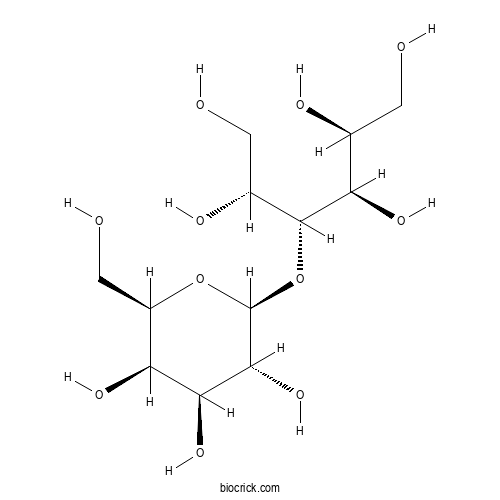
| Cas No. | 585-86-4 | SDF | File under preparation. |
| PubChem ID | 157355.0 | Appearance | Powder |
| Formula | C12H24O11 | M.Wt | 344.3 |
| Type of Compound | N/A | Storage | Desiccate at -20°C |
| Solubility | Soluble in Chloroform,Dichloromethane,Ethyl Acetate,DMSO,Acetone,etc. | ||
| Chemical Name | (2S,3R,4R,5R)-4-[(2S,3R,4S,5R,6R)-3,4,5-trihydroxy-6-(hydroxymethyl)oxan-2-yl]oxyhexane-1,2,3,5,6-pentol | ||
| SMILES | C(C1C(C(C(C(O1)OC(C(CO)O)C(C(CO)O)O)O)O)O)O | ||
| Standard InChIKey | VQHSOMBJVWLPSR-JVCRWLNRSA-N | ||
| Standard InChI | InChI=1S/C12H24O11/c13-1-4(16)7(18)11(5(17)2-14)23-12-10(21)9(20)8(19)6(3-15)22-12/h4-21H,1-3H2/t4-,5+,6+,7+,8-,9-,10+,11+,12-/m0/s1 | ||
| General tips | For obtaining a higher solubility , please warm the tube at 37 ℃ and shake it in the ultrasonic bath for a while.Stock solution can be stored below -20℃ for several months. We recommend that you prepare and use the solution on the same day. However, if the test schedule requires, the stock solutions can be prepared in advance, and the stock solution must be sealed and stored below -20℃. In general, the stock solution can be kept for several months. Before use, we recommend that you leave the vial at room temperature for at least an hour before opening it. |
||
| About Packaging | 1. The packaging of the product may be reversed during transportation, cause the high purity compounds to adhere to the neck or cap of the vial.Take the vail out of its packaging and shake gently until the compounds fall to the bottom of the vial. 2. For liquid products, please centrifuge at 500xg to gather the liquid to the bottom of the vial. 3. Try to avoid loss or contamination during the experiment. |
||
| Shipping Condition | Packaging according to customer requirements(5mg, 10mg, 20mg and more). Ship via FedEx, DHL, UPS, EMS or other couriers with RT, or blue ice upon request. | ||
Quality Control & MSDS
3D structure
Package In Stock

Number of papers citing our products


Lactitol Dilution Calculator
Lactitol Molarity Calculator


| 1 mg | 5 mg | 10 mg | 20 mg | 25 mg | |
| 1 mM | 2.9044 mL | 14.5222 mL | 29.0444 mL | 58.0889 mL | 72.6111 mL |
| 5 mM | 0.5809 mL | 2.9044 mL | 5.8089 mL | 11.6178 mL | 14.5222 mL |
| 10 mM | 0.2904 mL | 1.4522 mL | 2.9044 mL | 5.8089 mL | 7.2611 mL |
| 50 mM | 0.0581 mL | 0.2904 mL | 0.5809 mL | 1.1618 mL | 1.4522 mL |
| 100 mM | 0.029 mL | 0.1452 mL | 0.2904 mL | 0.5809 mL | 0.7261 mL |
| * Note: If you are in the process of experiment, it's necessary to make the dilution ratios of the samples. The dilution data above is only for reference. Normally, it's can get a better solubility within lower of Concentrations. | |||||
- p-Coumaraldehyde
Catalog No.:BCX2735
CAS No.:20711-53-9
- Glaberide I
Catalog No.:BCX2734
CAS No.:77790-52-4
- 5-(3-(Hydroxymethyl)-2,4-dimethylphenyl)-2-methylpentane-2,3-diol
Catalog No.:BCX2733
CAS No.:2182900-78-1
- Salicifoliol
Catalog No.:BCX2732
CAS No.:125564-65-0
- Blestrianol A
Catalog No.:BCX2731
CAS No.:136966-83-1
- Bulbocodin D
Catalog No.:BCX2730
CAS No.:211229-85-5
- erythro-4-(1-Hydroxy-2-(2-methoxy-4-((E)-prop-1-en-1-yl)phenoxy)propyl)-2-methoxyphenol
Catalog No.:BCX2729
CAS No.:50393-88-9
- Shancigusin B
Catalog No.:BCX2728
CAS No.:1174157-26-6
- Collinsonidin
Catalog No.:BCX2727
CAS No.:116107-25-6
- 4'-demethylpicropodophyllin
Catalog No.:BCX2726
CAS No.:112066-16-7
- Juglanbioside E
Catalog No.:BCX2725
CAS No.:2349377-83-7
- Juglanbioside B
Catalog No.:BCX2724
CAS No.:2349377-78-0
- 6-Methoxytryptamine
Catalog No.:BCX2737
CAS No.:3610-36-4
- Farnesylacetone
Catalog No.:BCX2738
CAS No.:762-29-8
- Dihydrolanosterol
Catalog No.:BCX2739
CAS No.:79-62-9
- Methyl coumalate
Catalog No.:BCX2740
CAS No.:6018-41-3
- Brevianamide N
Catalog No.:BCX2741
CAS No.:1174538-71-6
- 2-Hydroxymusaitinerin A
Catalog No.:BCX2742
CAS No.:3118515-52-6
- 5,7,2'-Trimethoxyflavone
Catalog No.:BCX2743
CAS No.:4308-57-0
- 7,2'-Trimethoxyflavone
Catalog No.:BCX2744
CAS No.:62536-78-1
- 7,2'-Dihydroxyflavone
Catalog No.:BCX2745
CAS No.:77298-66-9
- Rubone
Catalog No.:BCX2746
CAS No.:73694-15-2
- Orixalone A
Catalog No.:BCX2747
CAS No.:797788-72-8
- 3-Sulfotaurolithocholic acid disodium salt
Catalog No.:BCX2748
CAS No.:64936-83-0
Hydrogen bonding implications on sweetness behavior of sugar alcohols in food model systems: A thermophysical and FTIR study.[Pubmed:42680289]
Food Res Int. 2026 Oct 31;242(Pt 3):119973.
Sugar alcohols play an important role in the pharmaceutical and food industry due to their dominant effect on blood glucose levels and are used as artificial sweeteners in dairy products. The present study was conducted to explore the hydrogen bonding effect and sweetness response on structure-based properties of sugar alcohols (Lactitol) in aqueous dimethyl sulfoxide (DMSO) using volumetric, acoustic, and FTIR techniques to get better considerations about mechanisms of sweet taste chemoreception and give valuable information about Lactitol stabilization in the presence of DMSO, and solute-solvent interactions. Densities and sound velocities of sugar alcohol in aqueous DMSO solution have been measured at different temperatures, i.e., 293.15 K to 318.15 K and pressure 101 kPa. The experimental data has been further used to compute partial molar volume (slashed circle(v)(o)), partial specific volume (SV(o)), transfer of partial molar volume ∆(t)slashed circle(v)(0), partial compressibility (slashed circle(K)(0)) and partial expansibility (slashed circle(E)( degrees )) etc. The positive partial molar volumes (slashed circle(v)(o)) results indicated the importance of the sulfoxide group in expanding the structure and strengthening interactions. The partial specific volume (SV(o)) values (0.671-0.688 cm(3) g(-1)), can predict the taste quality which is consistent with their ability to evoke a pure sweet taste. The negative values obtained from Hepler's equation confirmed the structure-breaking behavior of the Lactitol in the presence of DMSO. The volumetric and acoustic results were verified by FTIR analyses, which showed strong correlations between the measurements and the FTIR spectra.
The mechanism of reducing the oil content of fried instant noodles by adding sugar alcohol: microstructure, surface properties and molecular structure.[Pubmed:41763796]
Food Res Int. 2026 Apr 1;229:118474.
Sugar alcohols are characterized by anti-caries properties, low glycemic response, low calorie value and non-participation in the Maillard reaction. Our preliminary experimental demonstrated that erythritol (ET), xylitol (XT), and Lactitol (LT) significantly reduce the oil content of fried instant noodles, though the mechanism was unclear. This study therefore aimed to elucidate how these sugar alcohols reduce oil content by examining the alterations in oil distribution, pore characteristics, and molecular structures of starch and protein from macro-, micro-, and molecular levels. Low-field nuclear magnetic resonance and magnetic resonance imaging confirmed that sugar alcohols effectively lowered the fat content and reduced the macroscopic oil distribution within instant noodles. Sugar alcohols increased the contact angle between oil and the dough sheet, thereby decreasing oil wettability and spreading capacity. The incorporation of sugar alcohols also reduced the surface roughness of instant noodles, yielding a more compact internal structure with lower open porosity and total porosity. This relatively intact, less porous microstructure formed an effective physical barrier, inhibiting oil absorption and penetration, and consequently reducing the fat content of instant noodles. The Fourier transform infrared spectra of starch demonstrated that sugar alcohols significantly intensified the peak at 1653 cm(-1), indicating enhanced hydrogen bonding within the system. Furthermore, the addition of sugar alcohols promoted a more tightly packed molecular arrangement of starch during frying, which consequently reduced starch's capacity for oil absorption and limited the formation of starch-lipid complexes. Additionally, sugar alcohols enhanced the beta-sheet content, suggesting an improved secondary structure of protein.
Coordination zinc ion deposition kinetics through interfacial hydrogen bonding network for high-performance aqueous zinc ion batteries.[Pubmed:41391298]
J Colloid Interface Sci. 2026 Apr;707:139652.
Uncontrolled dendritic deposition combined with water-induced side reactions accelerates interfacial degradation of Zn anodes, restricting the practical application of aqueous zinc-ion batteries (AZIBs). Here, Lactitol (LACT) serves as a multifunctional additive to stabilize Zn anodes. The hydroxyl groups of LACT strongly adsorb on the Zn anode, forming a uniform interfacial field that guides Zn(2+) migration and suppresses dendrite growth. Concurrently, the adsorbed LACT layer blocks direct contact between water and Zn, mitigating corrosion, while its hydrogen-bond interactions with free water reduce water activity and inhibit the hydrogen evolution reaction (HER). In addition, LACT regulates the Zn(2+) solvation sheath by replacing water ligands and lowering the nucleation energy barrier, thereby accelerating deposition kinetics and enhancing rate performance. Both theoretical calculations and experimental results consistently confirm these mechanisms. As a result, the Zn//Zn symmetric cell with the LACT/Zn(OTf)(2) electrolyte exhibited 3840 h of stable cycling at 0.5 mA cm(-2)/0.5 mAh cm(-2), while Zn//AVO cell delivered an initial capacity of 256 mAh g(-1) and 76.40 % retention over 500 cycles at 2 A g(-1). Even at 10 A g(-1), the cell sustained 133 mAh g(-1) with 91.66 % retention after 2000 cycles. Overall, this study demonstrates a facile yet effective interfacial regulation strategy, offering valuable guidance for high-performance AZIBs.
Targeting gut microbiota in liver disease: A pharmacological approach for hepatic encephalopathy and beyond.[Pubmed:41378067]
World J Gastrointest Pharmacol Ther. 2025 Dec 5;16(4):110271.
The gut microbiota plays a pivotal role in the pathogenesis of liver diseases, particularly hepatic encephalopathy (HE), in which dysbiosis contributes to ammonia production, systemic inflammation, and neurocognitive dysfunction. Emerging evidence suggests that targeting the gut-liver axis through pharmacological and microbiota-based interventions can mitigate liver disease progression and HE severity. This review explored the latest therapeutic strategies aimed at modulating gut microbiota in liver disease, focusing on traditional approaches such as non-absorbable disaccharides (lactulose, Lactitol), antibiotics (rifaximin), and probiotics as well as novel interventions, including postbiotics, synbiotics, and fecal microbiota transplantation. Additionally, bile acid modulators, short-chain fatty acid derivatives, and microbiome-targeted small molecules are being investigated for their potential to restore gut-liver homeostasis. We also discussed the implications of gut microbiota modulation in conditions beyond HE, such as metabolic dysfunction-associated steatotic liver disease and cirrhosis. By integrating gut microbiota-targeted therapies into liver disease management, we may develop more effective, personalized approaches to improve patient outcomes and reduce complications.
Lactitol-Induced Acute Kidney Injury with Oxalate Nephropathy: A Case Report.[Pubmed:41231736]
Nephron. 2026;150(2):99-106.
INTRODUCTION: Oxalate nephropathy, characterized by calcium oxalate crystal deposition in renal tissue, represents an underrecognized etiology of acute and chronic kidney injury. Secondary hyperoxaluria can emerge from diverse pathogenetic mechanisms, including excessive oxalate precursor intake, augmented intestinal absorption, or iatrogenic interventions. The therapeutic potential of glucocorticoids in managing this condition remains incompletely elucidated. CASE PRESENTATION: A 66-year-old man with no significant prior medical history developed acute kidney injury (AKI), manifesting as a profound serum creatinine elevation from 81 micromol/L to 1,140.4 micromol/L. The patient had consumed a "corn germ powder" supplement containing Lactitol for five consecutive months, concurrently experiencing persistent diarrhea. Initial laboratory investigations revealed severe renal dysfunction without notable proteinuria or hematuria. Renal ultrasonography demonstrated normal kidney morphology and dimensions. Definitive kidney biopsy revealed extensive calcium oxalate crystal deposition within renal tubular structures, conclusively diagnosing oxalate nephropathy. Therapeutic intervention comprised prednisone (60 mg daily) and comprehensive supportive management. Following a 3-month treatment protocol with gradual corticosteroid dose reduction, the patient's renal function demonstrated substantial improvement, with serum creatinine declining to 118.2 micromol/L. CONCLUSION: This case underscores Lactitol-induced secondary oxalate nephropathy as a rare yet clinically significant contributor to AKI. Prompt diagnostic recognition and targeted therapeutic intervention, potentially incorporating glucocorticoid therapy, may substantially facilitate renal functional recovery. Clinicians should maintain heightened awareness of nephrotoxic risks associated with over-the-counter laxative supplements and consider oxalate nephropathy in cryptogenic renal dysfunction scenarios.
Stabilisation of waterlogged archaeological wood: the analysis of structural and dimensional changes of different conservation methods using magnetic resonance imaging and X-ray micro-computed tomography.[Pubmed:41188470]
Sci Rep. 2025 Nov 4;15(1):38481.
Waterlogged archaeological wood can be preserved for many years in the absence of air, as decomposition is substantially slowed down. After excavation, conservation is necessary to prevent damage of objects due to uncontrolled drying. In this study, the following conservation methods were tested to investigate their ability to stabilise the objects: alcohol-ether resin, melamine-formaldehyde (Kauramin 800), Lactitol/trehalose, saccharose, polyethylene glycol (PEG 2000 with air-drying and PEG 2000 or 400 and 4000 with subsequent freeze-drying). In order to precisely understand the changes caused by conservation and drying, 40 samples each of pine wood and oak wood were documented using magnetic resonance imaging and X-ray micro-computed tomography before and after conservation. This imaging made it possible to quantitatively record changes in the wood structure, for example due to shrinkage, collapse and cracks, which could not be prevented by conservation. The alcohol-ether-resin method with solvent drying had the best stabilizing effect and no damage of the wood structure was visible. The two PEG treatments followed by freeze drying showed effective volume stabilisation. In both cases, however, the treatment led to cracks in the wood structure, which occurred less frequently when the cryoprotectant PEG 400 was used. In comparison, the other methods with air drying did not show consistently good results in stabilizing the volume or wood structure.
Formulation optimization of a sucrose-free probiotic dark chocolate; rheological characteristics and viability of Saccharomyces boulardi.[Pubmed:40896517]
Curr Res Food Sci. 2025 Aug 19;11:101174.
The use of polyols as sucrose-replacer in chocolate formulation has increased in the last years because of the high occurrence of the metabolic syndrome. Furthermore, chocolate is a qualified vehicle of functional ingredients such as probiotics that improve health in people with diabetes. The first objective of this study was to evaluate the optimal formulation of sucrose-free dark chocolate (SFDC) using a mixture design. The impact of polyols (maltitol, Lactitol, and xylitol) as sucrose replacers on the main quality properties of SFDC was determined. In the second stage, Saccharomyces boulardii was incorporated in the optimized formulation of SFDC as a probiotic product. Chocolates were stored at two temperatures (4 degrees C and 20 degrees C) for 180 days and the viability of probiotics was determined. The optimization data revealed that using 29.49 % maltitol, 51.46 % Lactitol, and 19.05 % xylitol ended in the optimum SFDC with the highest desirability. The number of probiotics were retained at the functional amount after maintenance for 6 months. The highest probiotic viability was determined in the chocolates stored at 4 degrees C. The SFDCs possessing probiotics showed to be a promising sucrose-free functional chocolate.
Tris(2,2'-bipyridyl)ruthenium(II) Electrochemiluminescence of Sugar Alcohols.[Pubmed:40812322]
Anal Chem. 2025 Aug 26;97(33):18159-18166.
Sugar alcohols are low-calorie sugar substitutes commonly used in sugar-free products. In this study, we report for the first time Ru(bpy)(3)(2+) electrochemiluminescence (ECL) of sugar alcohols. Ru(bpy)(3)(2+) ECL of sugar alcohols, including sorbitol, mannitol, isbitol (also called isomalt, isomaltitol, and palatinitol), maltitol, Lactitol, xylitol, and erythritol, was investigated. The applicability of the Ru(bpy)(3)(2+) ECL system for sugar alcohol detection was demonstrated by using sorbitol as a representative analyte. The optimized system exhibited excellent analytical performance, with a wide linear detection range from 0.5 muM to 5 mM and a low detection limit of 0.026 muM (S/N = 3). In practical applications, the system demonstrated outstanding accuracy in detecting sorbitol in pharmaceutical samples, with recovery rates ranging from 97.75 to 104.00%. These findings establish the Ru(bpy)(3)(2+) ECL as an effective and sensitive method for the detection of sugar alcohols.
Lactitol may improve the prognosis of hepatocellular carcinoma through the proliferation of Megasphaera as well as Bifidobacterium.[Pubmed:40438352]
Front Med (Lausanne). 2025 May 14;12:1567849.
BACKGROUND: Increasing evidence suggests that gut microbiota and their metabolites can modulate antitumor immunity. However, sufficient evidence from human studies is lacking. We evaluated the association of Lactitol and lactulose as prebiotics with the progression of hepatocellular carcinoma (HCC). METHODS: In Study 1, the effects of Lactitol and lactulose on overall survival (OS) of patients with HCC with Child-Pugh scores of B or C were investigated in patients diagnosed at the Nagasaki Medical Center between 2003 and 2020. In Study 2, the effects of these substances on the gut microbiota of patients with cirrhosis were analyzed. Study 3 examined the effect of these substances on serum albumin levels in patients with cirrhosis. RESULTS: In Study 1, a total of 321 patients were evaluated, and 55 pairs of Lactitol and Non-Lactitol groups and 80 pairs of Lactulose and Non-Lactulose groups were created using one to one propensity score matching. The Lactitol group showed a significant improvement (p < 0.05) in OS compared to the Non-Lactitol group, but the Lactulose group did not show any significance compared to the Non-Lactulose group. In Study 2, the number of Bifidobacterium was higher in the Lactitol group and the Lactulose group than in the Control group, but the number of Megasphaera was significantly higher only in the Lactitol group. In addition, in a study of 10 cases in which the gut microbiota was examined before and after Lactitol use, an increase in Bifidobacterium and Megasphaera was observed after Lactitol use. Study 3 found that Lactitol had no beneficial effect on serum albumin levels. CONCLUSION: Lactitol may improve the prognosis of HCC through the proliferation of Megasphaera as well as Bifidobacterium.
Efficacy and safety of rifaximin in preventing hepatic encephalopathy: A systematic review and meta-analysis.[Pubmed:40378134]
PLoS One. 2025 May 16;20(5):e0323359.
Rifaximin (RFX) is recommended for the treatment of hepatic encephalopathy (HE). However, evidence on whether RFX application could yield additional benefits for preventing HE in patients with cirrhosis is limited. In this study, we aimed to assess the safety and efficacy of RFX in preventing HE. We conducted a systematic search of randomized controlled trials to evaluate the use of RFX by analyzing HE incidence, hospitalization, all-cause mortality, and adverse events. Compared with the control group, RFX had a beneficial effect on the primary prevention of HE (RR = 0.58, 95% CI: 0.50-0.68), with noncomparable effects to NADs (including lactulose and Lactitol, RR = 0.65, 95% CI: 0.38-1.11), but more effective than placebo (RR = 0.57, 95% CI: 0.47-0.69). After more than 1 month of RFX treatment, the risk of HE decreased significantly (RR = 0.55, 95% CI: 0.47-0.65). In secondary prevention of HE, RFX decreased the recurrence risk (RR = 0.49, 95% CI: 0.40-0.61). RFX helped to reduce the incidence of HE after transjugular intrahepatic portosystemic stent shunt (TIPSS) (RR = 0.70, 95% CI: 0.51-0.96). In terms of adverse effects, RFX was associated with a lower risk of diarrhea than NADs (RR = 0.04, 95% CI: 0.00-0.25). So, RFX therapy is effective and well-tolerated in preventing HE, and can be used as the first choice in the prophylaxis of HE after TIPSS.
Small intestinal bacterial overgrowth in variant transthyretin amyloidosis (A-ATTRv).[Pubmed:40317002]
Orphanet J Rare Dis. 2025 May 2;20(1):210.
Variant transthyretin amyloidosis (A-ATTRv) can lead to sensory, motor, and autonomic neuropathy, as well as a variety of gastrointestinal (GI) disorders. While previous studies have explored gastrointestinal symptoms in A-ATTRv, no studies have definitively examined the role of bacterial overgrowth, such as SIBO, in exacerbating these symptoms. Identifying the presence of SIBO in A-ATTRv patients could lead to better-targeted treatments for gastrointestinal complications.We conducted a cross-sectional, unicentric observational pilot study, analysing the presence of SIBO using a Lactitol breath test in 39 individuals carrying the V30M mutation: 21 asymptomatic carriers and 18 patients with A-ATTRv. We did not find a higher prevalence of SIBO, among patients with A-ATTRv compared to asymptomatic carriers. Though no significant relationship between SIBO and A-ATTRv was found, notable differences in gastrointestinal symptoms suggest these may be independent of SIBO. Furthermore, no relationship was found between the presence of SIBO and gender.Given the limitations of this pilot study, we did not find a relationship between A-ATTRv and intestinal microbiota disorders. Future research with larger sample sizes and more sensitive diagnostic tools is required to further explore this potential link.
Small intestine bacterial overgrowth breath test does not predict symptom severity in gut-brain interaction disorders: role of anxiety, depression and inflammatory biomarkers.[Pubmed:40276984]
Rev Esp Enferm Dig. 2025 Aug;117(8):433-440.
BACKGROUND: the high prevalence of disorders of the gut-brain interaction (DGBI), the availability of breath tests for the diagnosis of small intestine bacterial overgrowth (SIBO) together with some confusion about the concept of SIBO have led to an increase in the number of SIBO diagnoses. OBJECTIVE: this study aimed to analyze factors associated with the severity of gastrointestinal symptoms in patients undergoing a SIBO breath test. METHODS: a cross-sectional observational study including 70 patients who underwent a SIBO test with Lactitol and completed questionnaires including the ROME IV criteria for irritable bowel syndrome (IBS), the Irritable Bowel Syndrome Severity Score (IBSSS), and HAD anxiety and depression scales. Additionally, blood levels of histamine, citrulline, ghrelin, intestinal-fatty acid binding protein (I-FABP) and transient receptor potential cation channel subfamily V, member 1 (TRPV-1) were measured. RESULTS: the mean age of the cohort was 45 +/- 16 years and 70 % were female. Abdominal pain and/or abdominal distension were present in 85 % of patients and 44 % met IBS Rome IV criteria. IBSSS total score correlated with age (-0.354, p < 0.001), HAD-A (0.391, p < 0.001) and HAD-D (0.409, p < 0.001) scores, and histamine levels (0.279, p = 0.019). Abdominal pain correlated with levels of histamine (0.320, p < 0.05; 0.282, p < 0.05) and ghrelin (0.252, p < 0.05, 0.347, p < 0.05), while abdominal distension correlated with I-FABP levels (0.314, p < 0.05). The SIBO test was positive in 75 % but did not correlate with symptom severity. CONCLUSION: this study unveiled some factors associated with the severity of abdominal pain and distension such as age, auto-perceived anxiety and depression and some biomarkers but not the SIBO test result.
Hepatic Encephalopathy: Current Thoughts on Pathophysiology and Management.[Pubmed:40153081]
Curr Neurol Neurosci Rep. 2025 Mar 28;25(1):28.
PURPOSE OF REVIEW: This review highlights the causes, types and clinical staging of hepatic encephalopathy (HE). Current concepts on the probable pathogenetic mechanisms and currently practiced therapeutic options are discussed. RECENT FINDINGS: HE may be covert and overt. Also known as minimal HE. Covert HE, where there are behavioral abnormalities and impairment in activities of daily living with intact sensorium. The pathophysiology of HE remains poorly understood. There is disturbance of the urea cycle due to liver disease leading to increased production of ammonia. The ammonium ion enters the astrocytes along with glutamate (converted to glutamine by ammonia) and myo-inositol, thereby increasing the osmolality of the astrocytic cytoplasm. This osmotic gradient results in accumulation of water inside the astrocytes resulting in cerebral edema and increase in brain volume. Additionally, current research has noted the role of cerebral oxidative/nitrosative stress and the synergistic effects of increased cerebral ammonia and alteration in neurotransmitters, neurometabolites, and cortical excitability due to systemic inflammation. In advanced liver disease with systemic infection or inflammation, neuroinflammatory processes play significant role in the development of HE. Inflammatory cytokines like TNF-alpha, IL-6, IL-17 in presence of hyperammonemia have been found to induce neurotoxicity of ammonia by passing through the blood brain barrier and causing enlarged/swollen pale astrocytes, resulting in HE. Disrupted enterohepatic circulation in end stage liver disease also causes elevation of bile acids which induces neuroinflammation. Manganese and zinc play as co-factors of enzymatic reaction. These metal deposition causes multiple psychomotor symptoms observed in HE. The gut environment has a major impact on brain function in patients with HE. Toxins such as ammonia and inflammatory cytokines produced by this impaired intestinal flora access the circulation through porto-systemic anastomoses and exacerbate or precipitate HE. Finally, as a result of recurrent cerebral edema from astrocytic dysfunction and neuroinflammation, permanent neurodegeneration occurs with cognitive decline and motor disturbances, especially parkinsonian features and gait disturbances. This is the stage of chronic hepatic encephalopathy. Currently L-ornithine L-aspartate (LOLA) is being used to lower the ammonia level by stimulating the urea cycle. HE comprises a broad spectrum of neurological and/or psychiatric abnormalities caused by hepatic insufficiency and/or portal-systemic shunting in the absence of any other causes of brain dysfunction. HE may be caused or precipitated by several factors like infections, intoxications and drugs. The encephalopathic features may be covert or overt. The pathogenetic mechanisms for HE may be different. In the presence of liver disease, HE primarily results from disturbed urea cycle with hyperammonemia causing astrocytic swelling and cerebral edema. Porto-systemic anastomoses with intact liver function can cause HE by allowing ammonia and other toxins produced by the gut microbial flora and allowing these to bypass detoxification by the liver and exposing the brain to their harmful effects. Principles of therapy are twofold. First protecting the liver and the brain from gut generated ammonia and other toxins by ensuring smooth bowel function and avoiding stagnation with the use of osmotic laxatives like lactulose or Lactitol and also reducing the gut microbial load with use of anti-bacterials/bacteriophages like neomycin and rifaximin along with metronidazole. Second, reducing the already generated cerebral edema by use of mannitol and appropriate ventilatory support. Currently L-ornithine L-aspartate (LOLA) is being used to reduce the ammonia load to the liver. LOLA is a stable compound formed from two amino acids. L-ornithine plays a crucial role in stimulating the urea cycle, leading to a reduction in ammonia levels. Both L-ornithine and L-aspartate serve as substrates for the enzyme glutamate transaminase, and their administration results in elevated glutamate concentrations. Ammonia is subsequently utilized in the conversion of glutamate to glutamine through the action of glutamine synthetase. Finally in resistant cases the use of liver transplant needs to be considered. Alternatively extracorporeal liver assist devices may be used like Molecular Adsorbent Recirculating System (MARS) or Single-Pass Albumin Dialysis (SPAD).
Synbiotic combination of fructooligosaccharides and probiotics ameliorates the metabolic dysfunction-associated steatotic liver disease.[Pubmed:40044134]
J Microbiol. 2025 Feb;63(2):e2411002.
Synbiotics have become a new-age treatment tool for limiting the progression of metabolic dysfunction-associated steatotic liver disease; however, inclusive comparisons of various synbiotic treatments are still lacking. Here, we have explored and evaluated multiple synbiotic combinations incorporating three distinctive prebiotics, Lactitol, lactulose and fructooligosaccharides. Of the synbiotic treatments evaluated, a combination of fructooligosaccharides and probiotics (FOS+Pro) exhibited superior protection against western diet-induced liver degeneration. This synbiotic (FOS+Pro) combination resulted in the lowest body weight gains, liver weights and liver/body weight ratios. The FOS+Pro synbiotic combination substantially alleviated liver histopathological markers and reduced serum AST and cholesterol levels. FOS+Pro ameliorated hepatic inflammation by lowering expression of proinflammatory markers including TNF-alpha, IL-1beta, IL-6, and CCL2. FOS+Pro significantly improved steatosis by restricting the expression of lipid metabolic regulators (ACC1, FAS) and lipid transporters (CD36) in the liver. These findings are critical in suggesting that synbiotic treatments are capable of restraining western diet-induced metabolic dysfunction in the liver. Additionally, this study demonstrated that adding probiotic strains amplified the effectiveness of fructooligosaccharides but not all prebiotics.
Drug Utilization of Rifaximin-alpha in Patients with Hepatic Encephalopathy: Evidence from Real Clinical Practice in Italy.[Pubmed:40005338]
Medicina (Kaunas). 2025 Jan 26;61(2):221.
Background and Objectives: This analysis described rifaximin utilization in Italian patients with hepatic encephalopathy (HE). Although rifaximin is effective in preventing HE relapses, therapeutic management and prescriptive attitudes might be improved. Materials and Methods: Between Oct-2020 and Sep-2021, approximately 12.7 million citizens, patients hospitalized for HE, were identified through the ICD-9-CM code 572.2. Among those discharged alive, utilization of rifaximin 550 mg vs. rifaximin 200 mg for two months post-admission was compared. Results: Of 634 patients hospitalized for HE, 447 (70.5%) were discharged alive. In the two following months, 276 (61.7%) received rifaximin, of whom 117 (26.2%) received rifaximin 550 mg (two daily tablets) and 159 (35.6%) received rifaximin 200 mg (six daily tablets); among 171 patients without rifaximin, 56 (32.7%) received lactulose/Lactitol. One year after rifaximin initiation, patients on rifaximin 550 mg (vs. 200 mg) were more frequently persistent (i.e., did not interrupt therapy) (78.6% vs. 46.9%, p < 0.001), showed a lower switching proportion (21.4% vs. 40.7%, p < 0.050), and had a mean monthly dose closer to the recommendations of 36,000 mg/month (~33,000 mg/month vs. 11,629 mg/month, respectively). Conclusions: This analysis suggests suboptimal rifaximin utilization for HE management. Although rifaximin 550 mg is the only formulation with specific indication and reimbursability to prevent HE relapses in Italy, rifaximin 200 mg is more largely used. The need to improve rifaximin prescribing choices is supported by higher persistence, lower switching rates, and average doses aligned to recommendations in patients treated with rifaximin 550 mg.

Calcutta University

University of Minnesota

University of Maryland School of Medicine

University of Illinois at Chicago

The Ohio State University

University of Zurich

Harvard University

Colorado State University

Auburn University

Yale University

Worcester Polytechnic Institute

Washington State University

Stanford University

University of Leipzig

Universidade da Beira Interior

The Institute of Cancer Research

Heidelberg University

University of Amsterdam

University of Auckland

TsingHua University

The University of Michigan

Miami University

DRURY University

Jilin University

Fudan University

Wuhan University

Sun Yat-sen University

Universite de Paris

Deemed University

Auckland University

The University of Tokyo

Korea University



