
CollinsonidinCAS# 116107-25-6 |
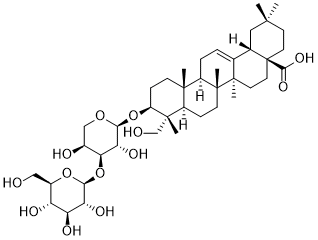
| Cas No. | 116107-25-6 | SDF | File under preparation. |
| PubChem ID | N/A | Appearance | Powder |
| Formula | C41H66O13 | M.Wt | 766.9 |
| Type of Compound | N/A | Storage | Desiccate at -20°C |
| Solubility | Soluble in Chloroform,Dichloromethane,Ethyl Acetate,DMSO,Acetone,etc. | ||
| General tips | For obtaining a higher solubility , please warm the tube at 37 ℃ and shake it in the ultrasonic bath for a while.Stock solution can be stored below -20℃ for several months. We recommend that you prepare and use the solution on the same day. However, if the test schedule requires, the stock solutions can be prepared in advance, and the stock solution must be sealed and stored below -20℃. In general, the stock solution can be kept for several months. Before use, we recommend that you leave the vial at room temperature for at least an hour before opening it. |
||
| About Packaging | 1. The packaging of the product may be reversed during transportation, cause the high purity compounds to adhere to the neck or cap of the vial.Take the vail out of its packaging and shake gently until the compounds fall to the bottom of the vial. 2. For liquid products, please centrifuge at 500xg to gather the liquid to the bottom of the vial. 3. Try to avoid loss or contamination during the experiment. |
||
| Shipping Condition | Packaging according to customer requirements(5mg, 10mg, 20mg and more). Ship via FedEx, DHL, UPS, EMS or other couriers with RT, or blue ice upon request. | ||
Quality Control & MSDS
Package In Stock

Number of papers citing our products


Collinsonidin Dilution Calculator
Collinsonidin Molarity Calculator
| 1 mg | 5 mg | 10 mg | 20 mg | 25 mg | |
| 1 mM | 1.304 mL | 6.5198 mL | 13.0395 mL | 26.079 mL | 32.5988 mL |
| 5 mM | 0.2608 mL | 1.304 mL | 2.6079 mL | 5.2158 mL | 6.5198 mL |
| 10 mM | 0.1304 mL | 0.652 mL | 1.304 mL | 2.6079 mL | 3.2599 mL |
| 50 mM | 0.0261 mL | 0.1304 mL | 0.2608 mL | 0.5216 mL | 0.652 mL |
| 100 mM | 0.013 mL | 0.0652 mL | 0.1304 mL | 0.2608 mL | 0.326 mL |
| * Note: If you are in the process of experiment, it's necessary to make the dilution ratios of the samples. The dilution data above is only for reference. Normally, it's can get a better solubility within lower of Concentrations. | |||||
- 4'-demethylpicropodophyllin
Catalog No.:BCX2726
CAS No.:112066-16-7
- Juglanbioside E
Catalog No.:BCX2725
CAS No.:2349377-83-7
- Juglanbioside B
Catalog No.:BCX2724
CAS No.:2349377-78-0
- Tricin 7-O-rutinoside
Catalog No.:BCX2723
CAS No.:102208-64-0
- 7'-Methoxylariciresinol
Catalog No.:BCX2722
CAS No.:1426550-86-8
- 7'-Ethoxylariciresinol
Catalog No.:BCX2721
CAS No.:1907632-04-5
- Cycloramoside A
Catalog No.:BCX2720
CAS No.:2170496-95-2
- 9,10-Dehydrogymconopin C
Catalog No.:BCX2719
CAS No.:1454585-38-6
- Rourinoside
Catalog No.:BCX2718
CAS No.:906670-57-3
- Blestrianol B
Catalog No.:BCX2717
CAS No.:136966-84-2
- 10,11-Dihydroxydracaenone
Catalog No.:BCX2716
CAS No.:944262-68-4
- 7,4'-Dihydroxy-5-methoxy-8-methylflavan
Catalog No.:BCX2715
CAS No.:1993394-52-7
- Shancigusin B
Catalog No.:BCX2728
CAS No.:1174157-26-6
- erythro-4-(1-Hydroxy-2-(2-methoxy-4-((E)-prop-1-en-1-yl)phenoxy)propyl)-2-methoxyphenol
Catalog No.:BCX2729
CAS No.:50393-88-9
- Bulbocodin D
Catalog No.:BCX2730
CAS No.:211229-85-5
- Blestrianol A
Catalog No.:BCX2731
CAS No.:136966-83-1
- Salicifoliol
Catalog No.:BCX2732
CAS No.:125564-65-0
- 5-(3-(Hydroxymethyl)-2,4-dimethylphenyl)-2-methylpentane-2,3-diol
Catalog No.:BCX2733
CAS No.:2182900-78-1
- Glaberide I
Catalog No.:BCX2734
CAS No.:77790-52-4
- p-Coumaraldehyde
Catalog No.:BCX2735
CAS No.:20711-53-9
- Lactitol
Catalog No.:BCX2736
CAS No.:585-86-4
- 6-Methoxytryptamine
Catalog No.:BCX2737
CAS No.:3610-36-4
- Farnesylacetone
Catalog No.:BCX2738
CAS No.:762-29-8
- Dihydrolanosterol
Catalog No.:BCX2739
CAS No.:79-62-9
Oleanane triterpenoids from Akebiae Caulis exhibit inhibitory effects on Abeta42 induced fibrillogenesis.[Pubmed:28054176]
Arch Pharm Res. 2017 Mar;40(3):318-327.
Previous phytochemical investigations of Akebiae Caulis resulted in the isolation of triterpenes, triterpene glycosides, phenylethanoid glycosides and megastigmane glycoside. Amyloid beta (Abeta), the main component of the senile plaques detected in Alzheimer's disease, induces cell death. However, only a limited number of studies have addressed the biological and pharmacological effects of Akebiae Caulis. In particular, the inhibitory activity of Akebiae Caulis against Abeta42 fibrillogenesis remains unclear. Herein, a new triterpene glycoside, akequintoside F (1), along with nine known compounds pulsatilla saponin A (2), Collinsonidin (3), akebonic acid (4), hederagenin (5), 1-(3',4'-dihydroxycinnamoyl) cyclopentane-2,3-diol (6), asperosaponin C (7), leontoside A (8), quinatic acid (9), and quinatoside A (10) were isolated from Akebiae Caulis using repeated column chromatography with silica gel, LiChroprep RP-18, and MCI gel. The chemical structures of compounds 1-10 were illustrated based on 1D and 2D NMR spectroscopy, including (1)H-(1)H COSY, HSQC, HMBC and NOESY spectroscopic analyses. Compound 1 a novel compound and known compounds 6 and 7 were isolated for the first time from this plant. Among these compounds, 1, 3, 4, 5 and 7 displayed significant inhibitory effects on Abeta42 induced fibrillogenesis. We present the first report of new compound 1 and the inhibitory effects of components from Akebiae Caulis on Abeta42 fibrillogenesis.
A new triterpenoid saponin from the stem of Akebia trifoliata var. australis.[Pubmed:20183270]
J Asian Nat Prod Res. 2009 Dec;11(12):1013-8.
A new triterpene glycoside mutongsaponin F (1), together with five known saponins and two known lipids, was isolated from the 70% ethanol extract of the stems of Akebia trifoliata (Thunb.) Koidz. var. australis (Diels) Rehd. Their structures were elucidated on the basis of the spectroscopic analysis and physicochemical properties as 3-beta-[(beta-D-glucopyranosyl-(1-->2)-O-[beta-D-glucopyranosyl-(1-->3)-O-]-alpha-L-arabinopyranosyl)oxy]-30-norolean-12-en-28-oic acid alpha-L-rhamnopyranosyl-(1-->4)-O-beta-D-glucopyranosyl-(1-->6)-O-beta-D-glucopyranosyl ester (1), 3-beta-[(beta-D-glucopyranosyl-(1-->2)-O-[beta-D-glucopyranosyl-(1-->3)-O-]-alpha-L-arabinopyranosyl)oxy]-30-norolean-12-en-28-oic acid (2), leonticin E (3), Collinsonidin (4), arjunolic acid 28-O-glucopyranoside (5), asiatic acid 28-O-glucopyranoside (6), soya-cerebroside I (7), and 1-O-alpha-L-galactosyl-(1-->6)-O-beta-D-galactosyl-3-O-hexadecanoyl-glycerol (8), respectively.
Saponins and other constituents from the leaves of Aralia elata.[Pubmed:15930787]
Chem Pharm Bull (Tokyo). 2005 Jun;53(6):696-700.
A new triterpenoid saponin, together with five known saponins, were isolated from the nonpolar n-hexane fraction of the leaves of Aralia elata. The structure of the new saponin, durupcoside C, was elucidated as hederagenin 3-O-beta-D-glucopyranosyl(1-->3)-beta-D-glucopyranosyl(1-->3)-alpha-L-arabinopyranoside on the basis of spectroscopic analysis. The known saponins were characterized as 3-O-alpha-L-rhamnopyranosyl(1-->2)-alpha-L-arabinopyranosyl hederagenin 28-O-beta-D-xylopyranosyl(1-->6)-beta-D-glucopyranosyl ester, hederagenin 3-O-beta-D-glucopyranosyl(1-->3)-alpha-L-rhamnopyranosyl(1-->2)-alpha-L-arabinopyranoside, oleanolic acid 3-O-beta-D-glucopyranosyl(1-->3)-alpha-L-rhamnopyranosyl(1-->2)-alpha-L-arabinopyranoside, hederagenin 3-O-alpha-L-rhamnopyranosyl(1-->2)-alpha-L-arabinopyranoside (alpha-hederin), and hederagenin 3-O-beta-D-glucopyranosyl(1-->3)-alpha-L-arabinopyranoside (Collinsonidin). In addition, two known lipids, Arisaema glyceride 3 and ceramide mixtures were also isolated and characterized. Collinsonidin and two known lipids were isolated for the first time from this plant.
Structure-activity relationship of oleanane disaccharides isolated from Akebia quinata versus cytotoxicity against cancer cells and NO inhibition.[Pubmed:15133259]
Biol Pharm Bull. 2004 May;27(5):744-7.
In order to further determine the nature of structure-activity relationship on the cytotoxicities of saponins with 1-->2 and 1-->3 linkages of disaccharides, we isolated guaianin N, Collinsonidin, kalopanaxsaponin A and hederoside D(2) as disaccharides, and patrinia glycoside B-II as a trisaccharide, from the n-BuOH extract of Akebia quinata (Lardizabalaceae). Complete acid hydrolysis of the extract afforded oleanolic acid (1) and hederagenin (2). By sulforhodamine B (SRB) assay, kalopanaxsaponin A containing an alpha-L-rhap-(1-->2)-alpha-L-arap moiety exhibited distinctly higher cytotoxicity (IC(50) 1.8-2.7 microg/ml) against all of the tested cell lines than the other saponins (IC(50), 4-8 microg/ml). These results suggest that the alpha-L-rhap-(1-->2)-alpha-L-arap moiety has a unique structural significance in terms of its cell biochemistry, compared to those oleanane glycosides with other sugar linkages. On the other hand, kalopanaxsaponin A exhibited a significant inhibitory effect on nitric oxide production by lipopolysaccharide (LPS)-activated macrophage 264.7, whereas other saponins had weaker activities.

Calcutta University

University of Minnesota

University of Maryland School of Medicine

University of Illinois at Chicago

The Ohio State University

University of Zurich

Harvard University

Colorado State University

Auburn University

Yale University

Worcester Polytechnic Institute

Washington State University

Stanford University

University of Leipzig

Universidade da Beira Interior

The Institute of Cancer Research

Heidelberg University

University of Amsterdam

University of Auckland

TsingHua University

The University of Michigan

Miami University

DRURY University

Jilin University

Fudan University

Wuhan University

Sun Yat-sen University

Universite de Paris

Deemed University

Auckland University

The University of Tokyo

Korea University



