
p-CoumaraldehydeCAS# 20711-53-9 |
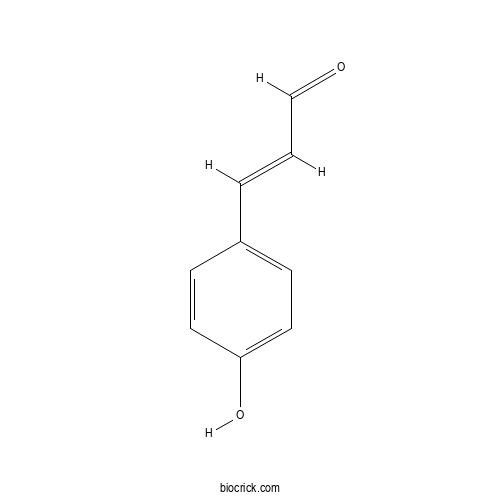
| Cas No. | 20711-53-9 | SDF | File under preparation. |
| PubChem ID | 641301.0 | Appearance | Powder |
| Formula | C9H8O2 | M.Wt | 148.2 |
| Type of Compound | N/A | Storage | Desiccate at -20°C |
| Solubility | Soluble in Chloroform,Dichloromethane,Ethyl Acetate,DMSO,Acetone,etc. | ||
| Chemical Name | (E)-3-(4-hydroxyphenyl)prop-2-enal | ||
| SMILES | C1=CC(=CC=C1C=CC=O)O | ||
| Standard InChIKey | CJXMVKYNVIGQBS-OWOJBTEDSA-N | ||
| Standard InChI | InChI=1S/C9H8O2/c10-7-1-2-8-3-5-9(11)6-4-8/h1-7,11H/b2-1+ | ||
| General tips | For obtaining a higher solubility , please warm the tube at 37 ℃ and shake it in the ultrasonic bath for a while.Stock solution can be stored below -20℃ for several months. We recommend that you prepare and use the solution on the same day. However, if the test schedule requires, the stock solutions can be prepared in advance, and the stock solution must be sealed and stored below -20℃. In general, the stock solution can be kept for several months. Before use, we recommend that you leave the vial at room temperature for at least an hour before opening it. |
||
| About Packaging | 1. The packaging of the product may be reversed during transportation, cause the high purity compounds to adhere to the neck or cap of the vial.Take the vail out of its packaging and shake gently until the compounds fall to the bottom of the vial. 2. For liquid products, please centrifuge at 500xg to gather the liquid to the bottom of the vial. 3. Try to avoid loss or contamination during the experiment. |
||
| Shipping Condition | Packaging according to customer requirements(5mg, 10mg, 20mg and more). Ship via FedEx, DHL, UPS, EMS or other couriers with RT, or blue ice upon request. | ||
Quality Control & MSDS
3D structure
Package In Stock

Number of papers citing our products


p-Coumaraldehyde Dilution Calculator
p-Coumaraldehyde Molarity Calculator
| 1 mg | 5 mg | 10 mg | 20 mg | 25 mg | |
| 1 mM | 6.7476 mL | 33.7382 mL | 67.4764 mL | 134.9528 mL | 168.691 mL |
| 5 mM | 1.3495 mL | 6.7476 mL | 13.4953 mL | 26.9906 mL | 33.7382 mL |
| 10 mM | 0.6748 mL | 3.3738 mL | 6.7476 mL | 13.4953 mL | 16.8691 mL |
| 50 mM | 0.135 mL | 0.6748 mL | 1.3495 mL | 2.6991 mL | 3.3738 mL |
| 100 mM | 0.0675 mL | 0.3374 mL | 0.6748 mL | 1.3495 mL | 1.6869 mL |
| * Note: If you are in the process of experiment, it's necessary to make the dilution ratios of the samples. The dilution data above is only for reference. Normally, it's can get a better solubility within lower of Concentrations. | |||||
- Glaberide I
Catalog No.:BCX2734
CAS No.:77790-52-4
- 5-(3-(Hydroxymethyl)-2,4-dimethylphenyl)-2-methylpentane-2,3-diol
Catalog No.:BCX2733
CAS No.:2182900-78-1
- Salicifoliol
Catalog No.:BCX2732
CAS No.:125564-65-0
- Blestrianol A
Catalog No.:BCX2731
CAS No.:136966-83-1
- Bulbocodin D
Catalog No.:BCX2730
CAS No.:211229-85-5
- erythro-4-(1-Hydroxy-2-(2-methoxy-4-((E)-prop-1-en-1-yl)phenoxy)propyl)-2-methoxyphenol
Catalog No.:BCX2729
CAS No.:50393-88-9
- Shancigusin B
Catalog No.:BCX2728
CAS No.:1174157-26-6
- Collinsonidin
Catalog No.:BCX2727
CAS No.:116107-25-6
- 4'-demethylpicropodophyllin
Catalog No.:BCX2726
CAS No.:112066-16-7
- Juglanbioside E
Catalog No.:BCX2725
CAS No.:2349377-83-7
- Juglanbioside B
Catalog No.:BCX2724
CAS No.:2349377-78-0
- Tricin 7-O-rutinoside
Catalog No.:BCX2723
CAS No.:102208-64-0
- Lactitol
Catalog No.:BCX2736
CAS No.:585-86-4
- 6-Methoxytryptamine
Catalog No.:BCX2737
CAS No.:3610-36-4
- Farnesylacetone
Catalog No.:BCX2738
CAS No.:762-29-8
- Dihydrolanosterol
Catalog No.:BCX2739
CAS No.:79-62-9
- Methyl coumalate
Catalog No.:BCX2740
CAS No.:6018-41-3
- Brevianamide N
Catalog No.:BCX2741
CAS No.:1174538-71-6
- 2-Hydroxymusaitinerin A
Catalog No.:BCX2742
CAS No.:3118515-52-6
- 5,7,2'-Trimethoxyflavone
Catalog No.:BCX2743
CAS No.:4308-57-0
- 7,2'-Trimethoxyflavone
Catalog No.:BCX2744
CAS No.:62536-78-1
- 7,2'-Dihydroxyflavone
Catalog No.:BCX2745
CAS No.:77298-66-9
- Rubone
Catalog No.:BCX2746
CAS No.:73694-15-2
- Orixalone A
Catalog No.:BCX2747
CAS No.:797788-72-8
Identification and In Vitro Functional Characterization of the CCR Gene Family Reveals Their Regulatory Roles in Lignin Biosynthesis of Pinus yunnanensis.[Pubmed:42588756]
Plants (Basel). 2026 Jul 23;15(15):2253.
Cinnamoyl coenzyme A reductase (CCR) is the first rate-limiting enzyme in the monolignol-specific pathway and plays a pivotal role in lignin biosynthesis. However, CCR genes in Pinus yunnanensis remain uncharacterized, and their undefined substrate specificity further impedes mechanistic insights into lignin regulation while restricting strategies for wood property optimization. Using conserved domain and homology analysis, with a focus on the characteristic NAD(P)-binding motif (KNWYCYGK), we identified 12 CCR family members from the transcriptome data of P. yunnanensis. Phylogenetic analysis clustered the PyCCRs into two distinct clades: PyCCR1~6 fall into the CCR clade, while the remaining members form a CCR-like clade. In this study, twelve ORF regions of the P. yunnanensis CCR genes were cloned, and nine purified recombinant PyCCR proteins were obtained through prokaryotic expression. In vitro enzymatic assays demonstrated that PyCCR1, PyCCR2, PyCCR5, and PyCCR6 catalyzed the conversion of p-coumaroyl-CoA, feruloyl-CoA, and sinapoyl-CoA to p-Coumaraldehyde, coniferaldehyde, and sinapaldehyde, respectively. Molecular docking of PyCCR1 to 6 with three substrates identified substrate-binding pocket domains. Within these domains, hydrogen bonds formed between ligands and residues in the R(X)5K motif of PyCCR1 to 6, whereas PyCCRL7 to 12 lacked the complete motif. RT-qPCR analysis showed tissue-specific expression patterns of the 12 genes across buds, stems, leaves, roots, and fruits. Collectively, these findings suggest that the presence of a complete R(X)5K motif may play a crucial role in maintaining the catalytic activity of PyCCRs. Our present study established a mechanistic foundation for elucidating lignin biosynthesis regulation in P. yunnanensis and offer genetic resources for improvement programs.
Functional characterization of double bond reductase involved in bisbibenzyl biosynthesis in Marchantia polymorpha.[Pubmed:42462269]
Biosci Biotechnol Biochem. 2026 Sep 25;90(10):1339-1346.
Bisbibenzyls are a family of characteristic secondary metabolites found in liverworts. In this study, we identified a double bond reductase (DBR) involved in the biosynthesis of bisbibenzyls in Marchantia polymorpha. Phylogenetic analysis suggests that Mp1g20080, which is highly homologous to the known DBR from Marchantia paleacea, is a candidate for the MpDBR in M. polymorpha. UV-C irradiation, which induces the accumulation of bisbibenzyls, significantly increased MpDBR expression. The recombinant MpDBR exhibited double bond reduction activity against p-Coumaraldehyde. Wilting and brown thalli were observed in the Mpdbr knock-out lines, and metabolite analysis confirmed the accumulation of p-coumaric acid and a decrease in lunularic acid and bisbibenzyl levels in the Mpdbr knock-out lines. Our results demonstrated that Mp1g20080 is a major DBR in the bisbibenzyl biosynthetic pathway of M. polymorpha.
Integrative multi-omics analysis uncovers the critical role of plant-derived ferulic acid influencing the occurrence of tomato Fusarium foot rot disease.[Pubmed:42424811]
Microbiol Res. 2026 Nov;312:128618.
Fusarium foot rot, caused by Fusarium solani (Mart.) Sacc., is a major threat to tomato production resulting in a tremendous loss of yield. The interaction between tomato and F. solani has not been well studied. Here we apply an integrative approach with physiological, transcriptomic, and metabolomic analysis to investigate the molecular basis of tomato defense responses to F. solani infection. Pathogen-infected plants have reduced leaf chlorophyll fluorescence, plant elongation, stem thickness and root growth compared to non-infected control. Transcriptome analysis reveals 5654 differentially expressed genes (DEGs) in tomato after the pathogen infection, in which genes associated with the phenylpropanoid biosynthesis such as SlPAL, SlC4H, Sl4CL, and SlCCoAOMT are significantly enriched in KEGG pathway enrichment analysis. Metabolome analysis identifies 1130 differentially accumulated metabolites (DAMs), in which the accumulation of two metabolites from the phenylpropanoid biosynthesis pathway, ferulic acid (FA) and p-Coumaraldehyde have dramatic changes after the pathogen infection. Addition of FA in the medium inhibits the fungal growth of F. solani with a concentration-dependent manner. Exogenous application of FA on tomato plants significantly enhanced the resistance to F. solani infection, in which the disease symptoms and plant growth reduction are mitigated compared to the water control plants. Taken together, our study for the first time demonstrates the role of ferulic acid in tomato - F. solani interaction using an integrated multi-omics approach, which benefits the resistance breeding and disease control of Fusarium foot rot in tomato.
Study on biosynthesis pathway and accumulation mechanism of the dihydrochalcones in Lithocarpus litseifolius.[Pubmed:42273266]
Hortic Res. 2026 Feb 27;13(6):uhag061.
Dihydrochalcones (DHCs) are highly accumulated in tender leaves of Lithocarpus litseifolius but their biosynthetic pathway and accumulation mechanism remain unclear. In this study, candidate genes including one cinnamoyl-CoA reductase (LlCCR), two double bond reductases (LlDBR1 ~ 2), three aldehyde hydrogenases (LlALDH1 ~ 3), two 4-coumaroyl:CoA ligases (Ll4CL1 ~ 2) and four phloretin glycosyltransferases (LlP4'GT, LlP2'GT1 ~ 3) were comprehensively investigated. The substrate specificities and catalytic kinetics of these gene-encoded enzymes were achieved. Through successive catalysis of LlALDH1, Ll4CL2, and chalcone synthase 1 (LlCHS1) or combined action of LlCCR and LlCHS1, phloretin was biosynthesized from direct precursor dihydro-p-Coumaraldehyde, which had been converted from initial precursor p-coumaroyl-CoA by LlCCR-mediated carboxylic acid reduction and LlDBR1-catalyzed alpha,beta-double bond saturation. High accumulation of the DHCs in tender leaves of L. litseifolius was mainly driven by efficient catalysis of LlCCR toward p-coumaroyl-CoA and highly expressed genes in the pathway, especially the LlP4'GT and LlP2'GT1 which contributed to biosynthesis of trilobatin and phlorizin, respectively. Antisense oligodeoxyribonucleotide treatments against the LlCCR, LlDBR1, LlALDH1, Ll4CL2, LlP4'GT, and LlP2'GT1 significantly reduced transcripts of the target genes and content of DHCs, confirming these genes might be involved in the pathway. This finding provides insight into the biosynthesis and accumulation mechanism of DHCs in planta.
Functional Characterization of PlC4H1 and PlC3H1: Essential for Furofuran Lignan Biosynthesis in Phryma leptostachya.[Pubmed:41510744]
J Agric Food Chem. 2026 Jan 21;74(2):2098-2110.
This study aimed to elucidate the enzymatic basis of furofuran lignan biosynthesis in Phryma leptostachya. By integration of bioinformatics, molecular biology, and metabolic engineering approaches, two critical cytochrome P450 enzymes, PlC4H1 (trans-cinnamate 4-hydroxylase) and PlC3H1 (p-coumarate 3-hydroxylase), were identified and functionally characterized. Bioinformatic analyses revealed conserved P450 motifs across candidate enzymes. Tissue-specific expression profiling showed that PlC4H1 and PlC3H1 were highly expressed in roots, aligning with regions of lignans accumulation. Yeast functional assays demonstrated that PlC4H1 catalyzes the hydroxylation of trans-cinnamic acid to p-coumaric acid. Notably, PlC3H1 exhibited broader substrate flexibility, hydroxylating 5-O-p-coumaroylquinic acid to 5-O-caffeoylquinic acid and p-Coumaraldehyde to caffeic aldehyde, with a marked preference for 5-O-p-coumaroylquinic acid. In planta assays, further substantiation of the involvement of these enzymes in the phenylpropanoid pathway highlighted their enzymatic contribution to lignan biosynthesis. These findings not only uncover two key molecular players in furofuran lignan biosynthesis but also establish a foundation for engineering sustainable biosynthetic platforms to enhance lignan yields and develop novel bioactive metabolites.
Annual Dynamic Changes in Lignin Synthesis Metabolites in Catalpa bungei 'Jinsi'.[Pubmed:40863112]
Metabolites. 2025 Jul 22;15(8):493.
Background: Catalpa bungei 'Jinsi' has excellent wood properties and golden texture, which is widely used in producing furniture and crafts. The lignin content and structural composition often determine the use and value of wood. Hence, investigating the characteristics of the annual dynamics of lignin anabolic metabolites in C. bungei 'Jinsi' and analyzing their synthesis pathways are particularly important. Methods: We carried out targeted metabolomics analysis of lignin synthesis metabolites using ultra-performance liquid chromatography-tandem mass spectrometry (UPLC-MS/MS) on the xylem samples of C. bungei 'Jinsi' in February, April, July, October 2022, and January 2023. Results: A total of 10 lignin synthesis-related metabolites were detected: L-phenylalanine, cinnamic acid, p-Coumaraldehyde, sinapic acid, p-coumaric acid, coniferaldehyde, ferulic acid, sinapaldehyde, caffeic acid, and sinapyl alcohol (annual total content from high to low). These metabolites were mainly annotated to the synthesis of secondary metabolites and phenylpropane biosynthesis. The annual total content of the 10 metabolites showed the tendency of "decreasing, then increasing, and then decreasing". Conclusions: C. bungei 'Jinsi' is a typical G/S-lignin tree species, and the synthesis of G-lignin occurs earlier than that of S-lignin. The total metabolite content decreased rapidly, and the lignin anabolism process was active from April to July; the metabolites were accumulated, and the lignin anabolism process slowed down from July to October; the total metabolite content remained basically unchanged, and lignin synthesis slowed down or stagnated from October to January of the following year. This reveals the annual dynamic pattern of lignin biosynthesis, which contributes to improving the wood quality and yield of C. bungei 'Jinsi' and provides a theoretical basis for its targeted breeding.
Integrated metabolomics and serum pharmacochemistry reveal Q-markers of Zhigancao decoction for antiarrhythmic efficacy.[Pubmed:40738293]
J Ethnopharmacol. 2025 Sep 25;353(Pt A):120331.
ETHNOPHARMACOLOGICAL RELEVANCE: Zhigancao decoction (ZGCD) is a classic plant-derived compound traditional Chinese medicine, which is widely used in the treatment of arrhythmia, palpitation, weakness of spleen and stomach, and deficiency of qi and blood. However, there are still some deficiencies in the current quality assessment system, especially the lack of systematic selection of quality control indicators. It is urgent to establish a robust quality control paradigm based on multi-dimensional analysis. AIM OF THE STUDY: In this study, combined with the effect of Yiqi Fumai of ZGCD, the Q-marker of ZGCD for the treatment of arrhythmia was effectively identified by multi-dimensional integration of its absorption components and metabolomics data. MATERIALS AND METHODS: In this study, a rat model of arrhythmia with heart yin deficiency was used to study the pharmacodynamics of ZGCD. UPLC-Q-TOF/MS was utilized to characterize serum migration components, while integrative metabolomic correlation studies identified critical quality markers (Q-Markers) underlying ZGCD's antiarrhythmic efficacy. RESULTS: Pharmacodynamic evaluation revealed that ZGCD effectively restored dysregulated levels of Malondialdehyde (MDA), Superoxide dismutase (SOD), Lactate dehydrogenase (LDH), Na(+)/K(+)-ATPase, Calmodulin (CaM), and Calcium/Calmodulin-Dependent Protein Kinase-II (CAMK2) in arrhythmia models. Subsequent investigations demonstrated ZGCD's capacity to ameliorate cardiac pathology in arrhythmia models, corroborating its traditional efficacy in "replenishing qi and restoring pulse rhythm". In ZGCD-containing serum, a total of 105 components were identified as absorbed into the blood. Among them, 42 were prototype components and 63 were metabolites. In addition, endogenous metabolic marker analysis showed that 29 components showed significant correlation with these biomarkers. CONCLUSION: ZGCD demonstrates efficacy in relieving cardiac arrhythmia and the efficacy of tonifying spleen and stomach is related to the regulation of substance/energy metabolism. Key Q-markers: Glycyrrhizae Radix et Rhizoma Praeparata Cum Melle (Liquiritigenin, Isoliquiritin, 18alpha-glycyrrhetinic acid); Ginger (Gingerol); Cinnamomum cassia (3,4,5-trimethoxycinnamic acid, cis-cinnamic acid, p-Coumaraldehyde, sinapaldehyde, cinnamyl acetate); Ginseng ((20R)-ginsenoside Rh2, F1, ginsenoside); Rehmanniae Radix (Methyl cis-9,10-methylenehexadecanoate); Ass-hide Gelatin (l-Isoleucine, Asp, Leu, Tyr, Met, Pro, His, Lys); Radix Ophiopogonis (L-glutamic acid, linolenic acid); Cannabis Fructus (gamma-linolenic acid, THC, cannabidiolate); Zizyphus jujuba (L-alpha-leucine, L-proline zwitterion, Asp).
Correlation between follicle diameter and pre-ovulatory metabolic profile in Bos grunniens.[Pubmed:39936077]
Front Vet Sci. 2025 Jan 28;12:1498703.
INTRODUCTION: In this study, we investigated the metabolic profiles of yak (Bos grunniens) follicles during the development period from the perspective of metabolomics, aiming to screen out the differential metabolites of yak follicles in different sizes and potential pathways during yak follicle development and to provide a basis for the study of follicle development and developmental mechanisms in the further stage of development. METHODS: A total of 20 four-year-old female yaks were selected, and follicles of different sizes were collected after slaughter and divided into d < 3 mm, 3-6 mm and d > 6 mm. The follicular fluid was collected, 6 replicates per group and subjected to LC-MS assay, combined with multidimensional and unidimensional statistical analyses to screen the differential metabolites between follicles of different sizes. Differential metabolites enriched KEGG pathways to screen the pathways that might be related to follicle development. RESULTS: We found that most of the metabolites were mainly enriched in amino acid metabolism pathways, energy metabolism pathways and other pathways of cofactor synthesis, and that during the development of the small follicle to the large follicle, 2-Lysophosphatidylcholine, PC (17:0/0:0), PC (16:0/0:0), and LysoPC (18:0/0:0) were down-regulated; Dioctyl succinate, p-Coumaraldehyde, ISOPRENE, L-Isoleucine, Dioctyl succinate up-regulated. CONCLUSION: These results suggest that amino acid metabolism, the production of steroid hormones and their metabolites, and the metabolic activity of granulosa cells play important roles in follicle development. The results provide a theoretical basis for further exploration of follicular development in yak.
Defense-Related Enzyme Activities and Metabolomic Analysis Reveal Differentially Accumulated Metabolites and Response Pathways for Sheath Blight Resistance in Rice.[Pubmed:39771252]
Plants (Basel). 2024 Dec 19;13(24):3554.
Rice sheath blight (RSB), caused by the pathogenic fungus Rhizoctonia solani, poses a significant threat to global food security. The defense mechanisms employed by rice against RSB are not well understood. In our study, we analyzed the interactions between rice and R. solani by comparing the phenotypic changes, ROS content, and metabolite variations in both tolerant and susceptible rice varieties during the early stages of fungal infection. Notably, there were distinct phenotypic differences in the response to R. solani between the tolerant cultivar Zhengdao22 (ZD) and the susceptible cultivar Xinzhi No.1 (XZ). We observed that the activities of five defense-related enzymes in both tolerant and susceptible cultivars changed dynamically from 0 to 72 h post-infection with R. solani. In particular, the activities of superoxide dismutase and peroxidase were closely associated with resistance to RSB. Metabolomic analysis revealed 825 differentially accumulated metabolites (DAMs) between the tolerant and susceptible varieties, with 493 DAMs responding to R. solani infection. Among these, lipids and lipid-like molecules, organic oxygen compounds, phenylpropanoids and polyketides, organoheterocyclic compounds, and organic acids and their derivatives were the most significantly enriched. One DAM, p-Coumaraldehyde, which responded to R. solani infection, was found to effectively inhibit the growth of R. solani, Magnaporthe grisea, and Ustilaginoidea virens. Additionally, multiple metabolic pathways, including amino acid metabolism, carbohydrate metabolism, metabolism of cofactors and vitamins, and metabolism of terpenoids and polyketides, are likely involved in RSB resistance. Our research provides valuable insights into the molecular mechanisms underlying the interaction between rice and R. solani.
Investigation of Effects of Cushioning Packaging on the Physiological and Quality Changes in Chinese Olive Fruits During Cold Chain Transportation.[Pubmed:39767075]
Foods. 2024 Dec 20;13(24):4133.
To gain a deeper understanding of the mechanisms by which cushioning packaging preserves the quality of Chinese olive fruits during cold chain transportation and extends their shelf life, this study simulated cold chain conditions and investigated the effects of cushioning packaging on the physiology, antioxidant capacity, and secondary metabolites of fruits during a 20-day shelf life. The results indicated that the decay rate in cushioning-packaging-treated fruit was 75% lower than that in the unbuffered packaging fruit at day 20 of shelf life. Simultaneously, cushioning packaging treatment mitigated the damage severity of the cell membrane structure and kept the cell membrane permeability at a low level, which was 15.34% lower than that in the unbuffered packaging fruit at day 20 of shelf life. Additionally, cushioning packaging effectively restrained the increases in malondialdehyde (MDA) content and alleviated the decline in chlorophyll and total flavonoid contents. It kept a balance among reactive oxygen species (ROS), antioxidant levels, and antioxidant enzyme activities, thereby reducing mechanical-damage-induced decay rates in Chinese olive fruits during the shelf life. Furthermore, metabolome analysis of Chinese olives during the shelf life was performed comparing those without buffered packaging to those with buffered packaging. The metabolome analysis found that the flavonoid biosynthetic pathway exhibited a higher accumulation of chrysin, neohesperidin, naringenin chalcone, sakuranetin, quercetin, catechin, and naringenin metabolites in cushion-packaging treatment compared to those without cushioning treatment. Furthermore, within the phenylalanine metabolic pathway, the accumulation of phenylalanine, p-Coumaraldehyde, p-coumaric acid, coniferin and caffeoyl quinic acid metabolites was significantly higher in buffered-packaging groups compared to those without buffering. Together, these findings suggest that cushioning packaging can effectively sustain the integrity of cell membranes and enhance the shelf-life quality of Chinese olive fruits by regulating the balance of ROS and mitigating oxidative stress during cold chain transportation.

Calcutta University

University of Minnesota

University of Maryland School of Medicine

University of Illinois at Chicago

The Ohio State University

University of Zurich

Harvard University

Colorado State University

Auburn University

Yale University

Worcester Polytechnic Institute

Washington State University

Stanford University

University of Leipzig

Universidade da Beira Interior

The Institute of Cancer Research

Heidelberg University

University of Amsterdam

University of Auckland

TsingHua University

The University of Michigan

Miami University

DRURY University

Jilin University

Fudan University

Wuhan University

Sun Yat-sen University

Universite de Paris

Deemed University

Auckland University

The University of Tokyo

Korea University



