
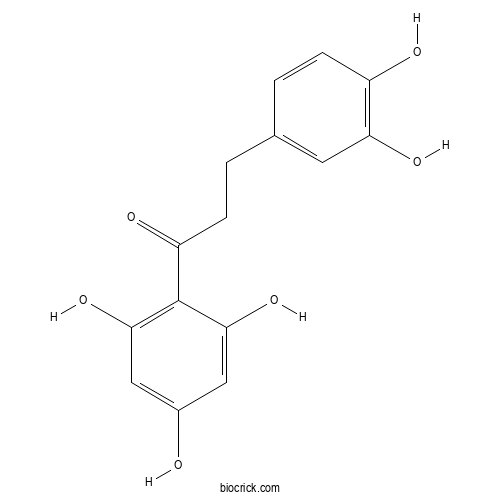
3-HydroxyphloretinCAS# 57765-66-9 |
| Cas No. | 57765-66-9 | SDF | File under preparation. |
| PubChem ID | 11778945.0 | Appearance | Powder |
| Formula | C15H14O6 | M.Wt | 290.3 |
| Type of Compound | N/A | Storage | Desiccate at -20°C |
| Solubility | Soluble in Chloroform,Dichloromethane,Ethyl Acetate,DMSO,Acetone,etc. | ||
| Chemical Name | 3-(3,4-dihydroxyphenyl)-1-(2,4,6-trihydroxyphenyl)propan-1-one | ||
| SMILES | C1=CC(=C(C=C1CCC(=O)C2=C(C=C(C=C2O)O)O)O)O | ||
| Standard InChIKey | CNABJBYLQABXJR-UHFFFAOYSA-N | ||
| Standard InChI | InChI=1S/C15H14O6/c16-9-6-13(20)15(14(21)7-9)11(18)4-2-8-1-3-10(17)12(19)5-8/h1,3,5-7,16-17,19-21H,2,4H2 | ||
| General tips | For obtaining a higher solubility , please warm the tube at 37 ℃ and shake it in the ultrasonic bath for a while.Stock solution can be stored below -20℃ for several months. We recommend that you prepare and use the solution on the same day. However, if the test schedule requires, the stock solutions can be prepared in advance, and the stock solution must be sealed and stored below -20℃. In general, the stock solution can be kept for several months. Before use, we recommend that you leave the vial at room temperature for at least an hour before opening it. |
||
| About Packaging | 1. The packaging of the product may be reversed during transportation, cause the high purity compounds to adhere to the neck or cap of the vial.Take the vail out of its packaging and shake gently until the compounds fall to the bottom of the vial. 2. For liquid products, please centrifuge at 500xg to gather the liquid to the bottom of the vial. 3. Try to avoid loss or contamination during the experiment. |
||
| Shipping Condition | Packaging according to customer requirements(5mg, 10mg, 20mg and more). Ship via FedEx, DHL, UPS, EMS or other couriers with RT, or blue ice upon request. | ||
Quality Control & MSDS
3D structure
Package In Stock

Number of papers citing our products


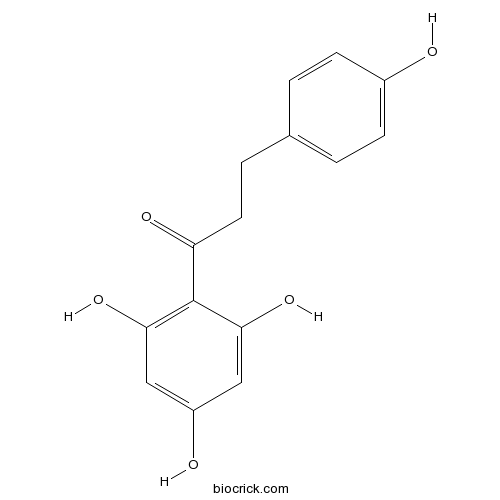
3-Hydroxyphloretin Dilution Calculator
3-Hydroxyphloretin Molarity Calculator


| 1 mg | 5 mg | 10 mg | 20 mg | 25 mg | |
| 1 mM | 3.4447 mL | 17.2236 mL | 34.4471 mL | 68.8942 mL | 86.1178 mL |
| 5 mM | 0.6889 mL | 3.4447 mL | 6.8894 mL | 13.7788 mL | 17.2236 mL |
| 10 mM | 0.3445 mL | 1.7224 mL | 3.4447 mL | 6.8894 mL | 8.6118 mL |
| 50 mM | 0.0689 mL | 0.3445 mL | 0.6889 mL | 1.3779 mL | 1.7224 mL |
| 100 mM | 0.0344 mL | 0.1722 mL | 0.3445 mL | 0.6889 mL | 0.8612 mL |
| * Note: If you are in the process of experiment, it's necessary to make the dilution ratios of the samples. The dilution data above is only for reference. Normally, it's can get a better solubility within lower of Concentrations. | |||||
- 6'-Hydroxy-3,4,2',3',4'-pentamethoxychalcone
Catalog No.:BCX2756
CAS No.:65602-54-2
- Oxyberberrubine
Catalog No.:BCX2755
CAS No.:29580-82-3
- Senegasaponin B
Catalog No.:BCX2754
CAS No.:167933-49-5
- Onjisaponin Vg
Catalog No.:BCX2753
CAS No.:1078708-70-9
- Onjisaponin Fg
Catalog No.:BCX2752
CAS No.:1009314-47-9
- Isomogroside VI
Catalog No.:BCX2751
CAS No.:2496376-70-4
- 7,4'-dihydroxy-3'-methoxyflavanone
Catalog No.:BCX2750
CAS No.:13192-07-9
- (11β,16α)-9,21-Dichloro-17-[(2-furanylcarbonyl)oxy]-11-hydroxy-16-methylpregna-1,4-diene-3,6,20-trione
Catalog No.:BCX2749
CAS No.:1305334-30-8
- 3-Sulfotaurolithocholic acid disodium salt
Catalog No.:BCX2748
CAS No.:64936-83-0
- Orixalone A
Catalog No.:BCX2747
CAS No.:797788-72-8
- Rubone
Catalog No.:BCX2746
CAS No.:73694-15-2
- 7,2'-Dihydroxyflavone
Catalog No.:BCX2745
CAS No.:77298-66-9
- 6-Isopentenyl apigenin trimethyl ether
Catalog No.:BCX2758
CAS No.:109605-85-8
- 2',4',6'-Trihydroxy-3,4-dimethoxydihydrochalcone
Catalog No.:BCX2759
CAS No.:29287-31-8
- Norbelladine
Catalog No.:BCX2760
CAS No.:6053-00-5
- Olean-12-ene-3β,28-diol diacetate
Catalog No.:BCX2761
CAS No.:1896-77-1
- 4'-Demethyldehydropodophyllotoxin
Catalog No.:BCX2762
CAS No.:117669-31-5
- Idesolidine
Catalog No.:BCX2763
CAS No.:911697-92-2
- 10,13-Bissidechainpaclitaxel
Catalog No.:BCX2764
CAS No.:2157462-42-3
- 2-Debenzoylpaclitaxel 2-Pentanoate
Catalog No.:BCX2765
CAS No.:213767-22-7
- IsocephaloMannine
Catalog No.:BCX2766
CAS No.:173101-54-7
- 19-Hydroxypaclitaxel
Catalog No.:BCX2767
CAS No.:409319-62-6
- 7-Acetylpaclitaxel
Catalog No.:BCX2768
CAS No.:92950-39-5
- 7-epi-Cephalomannine
Catalog No.:BCX2769
CAS No.:150547-36-7
Regiospecific biosynthesis of natural sweetener hesperetin dihydrochalcone from phloretin via designed dual-enzyme whole-cell cascade.[Pubmed:41687887]
Bioresour Technol. 2026 Apr;446:134194.
Hesperetin dihydrochalcone (HDHC) is a high-value natural sweetener but its sustainable and efficient production from renewable bioresources remains challenging. Here, a dual-enzyme cascade catalysis process was developed for HDHC synthesis from phloretin via 3'-hydroxylation and O-methylation. Although the previous work achieved 51% conversion from phloretin to 3-Hydroxyphloretin, subsequent methylation of 3-Hydroxyphloretin is difficult due to the limited substrate specificity of most O-methyltransferases (OMTs), which favor dihydroflavonoids over dihydrochalcones such as 3-Hydroxyphloretin. Herein, using a dihydroflavonoid substrate probe strategy, we identified a mutant of isoeugenol O-methyltransferase (IeOMT_ML) from Clarkia breweri that successfully catalyzed the methylation of 3-Hydroxyphloretin to synthesize its C3'-O-methylated derivative. To meet the requirement for C4'-O-methylation in HDHC, additional engineering of the substrate A ring-binding pocket generated the IeOMT_ML_L139A mutant possessing 100% selectivity for C4'-O-methylation. Molecular dynamics simulations and quantum mechanical calculations revealed precise control over methylation site specificity by fine-tuning the cavity architecture to induce a substrate mirror-flip within the binding pocket. A dual-enzyme cascade was thereby established for in vitro synthesis of HDHC, achieving a final product yield of 0.55 mM and a molar conversion rate of 30%. This efficient and selective biocatalytic process for HDHC production holds promise for high-value utilization of phloretin from sustainable apple processing by-products, promoting green manufacturing of flavonoid sweeteners.
Sustainable synthesis of catechol compounds using tyrosinase in ethanol cosolvent system.[Pubmed:40744177]
Int J Biol Macromol. 2025 Sep;321(Pt 2):146401.
Ethanol is environmentally friendly, not hazardous, and can be produced from renewable sources. In this study, ethanol was applied as a cosolvent for the tyrosinase-catalyzed synthesis of catechol compounds from phenolic compounds, which are abundant in fruit pomace. To investigate the cosolvent function of ethanol on tyrosinase, six types of tyrosinase from Priestia megaterium and water-insoluble phenolic substrates (i.e., phloretin and resveratrol) were used. Biocatalytic activity and stability of tyrosinase were maintained in the ethanol-water system up to 80 % (v/v) ethanol with an optimum of 40 %. The production of catechol compounds using tyrosinase's monophenolase activity was enhanced by optimization of several reaction parameters. Furthermore, the enhanced supply of oxygen to the reaction mixture of tyrosinase by aeration increased the productivity of catechol products. Phloretin and resveratrol were converted to up to 52.5 and 33.7 mM of corresponding catechol products, 3-Hydroxyphloretin and piceatannol, with productivities of 7.6 and 4.1 g L(-1) h(-1), respectively, by the optimization of tyrosinase activity and ethanol concentration. Both catechol products are considered bioactive compounds having significant beneficial biological effects on human health. This study is not only applicable to efficient and practical catechol synthesis but also provides a promising method for sustainable and green chemistry.
De Novo Artificial Biosynthesis of 3-Hydroxyphloretin in Escherichia coli.[Pubmed:40262167]
J Agric Food Chem. 2025 May 7;73(18):11180-11190.
3-Hydroxyphloretin (3-OH phloretin), a dihydrochalcone compound containing a catechol moiety, is naturally present in apples and exhibits potent anti-adipogenic, anti-obesity, and anticancer activities. In this study, we developed a modular co-culture platform enabling the de novo biosynthesis of 3-OH phloretin from glucose in Escherichia coli. We demonstrated that 4-coumarate 3-hydroxylase (Sam5), derived from Saccharothrix espanaensis, efficiently catalyzes the hydroxylation of phloretin to 3-OH phloretin. The engineered co-culture system comprised two functional modules: an upstream module that converts l-tyrosine to phloretic acid through the expression of tyrosine ammonia-lyase and enoate reductase genes, and a downstream module that converts phloretic acid to 3-OH phloretin via the sequential action of 4-coumarate-CoA ligase, a mutated chalcone synthase, and Sam5. Using this system, we successfully achieved the de novo production of 3-OH phloretin at a titer of 4.69 mg/L from glucose. In parallel, the artificial biosynthetic pathway also yielded phloretic acid and 3-hydroxyphloretic acid (3-OH phloretic acid) at titers of 161.7 and 176.2 mg/L, respectively, in an engineered l-tyrosine-overproducing E. coli strain. To the best of our knowledge, this study represents the first successful establishment of an artificial biosynthetic route for the production of both 3-OH phloretic acid and 3-OH phloretin directly from glucose in E. coli. This platform lays the groundwork for the microbial production of valuable dihydrochalcone compounds and holds promise for further optimization toward industrial-scale applications.
Effect of microwave heating on the phenolic and carotenoid composition and antioxidant properties of Momordica charantia.[Pubmed:39145031]
Heliyon. 2024 Jul 20;10(15):e34982.
Momordica charantia L. (MC) is a widely consumed vegetable known for its nutritional benefits, as it is a rich source of carotenoids and phenolic compounds. Various cooking methods are use in domestic settings, including microwave cooking. Therefore, it is crucial to investigate the impact of microwave cooking on the bioactive composition of MC. MC fruits were subjected to microwave heat for 5-, 10-, and 15-min. High performance liquid chromatography was used to identify of carotenoids and phenolic compounds, and total bioactive composition and antioxidant assays were conducted using spectroscopic techniques. There were 17 carotenoids and chlorophylls identified in MC fruit, including lutein, violaxanthin, antheraxanthin, pheophytin a, and all-E-beta-carotene. The levels of these compounds significantly increased upon exposure to microwave heating. Similarly, 16 phenolic compounds were identified, and their amounts increased during the treatments, except for 3-Hydroxyphloretin-6'-hexoside, quercetin-3-(6''-acetyl)-glucoside, petunidin-3-(6''-acetyl)-glucoside and petunidin-3-(6''-acetyl)-glucoside. The sample subjected to microwave treatment for 15 min exhibited the highest concentration of total phenolic compounds (TPC) at 754.5 mg/100g. The total flavonoid content (TFC) reached 94.6 mg/100g after 10 min of treatment. Additionally, the maximum total anthocyanin content, reported as 54.8 mg/L, was observed in the sample exposed to microwave heating for 15 min.
Comparative metabolomic profiling and nutritional chemistry of Chenopodium quinoa of diverse panicle architecture and agroecological zones.[Pubmed:38222284]
Physiol Mol Biol Plants. 2023 Dec;29(12):1959-1979.
Chenopodium quinoa possesses remarkable nutritional value and adaptability to various agroecological conditions. Panicle architecture influences the number of spikelets and grains in a panicle, ultimately leading to productivity and yield. Therefore, this study aimed to investigate the metabolites, nutrients, and minerals in Chenopodium quinoa accessions of varying panicle architecture. Metabolic profiling using liquid chromatography-mass spectrometry (LC-MS) analysis identified seventeen metabolites, including flavonoids, phenolics, fatty acids, terpenoids, phenylbutenoid dimers, amino acids, and saccharides. Eight metabolic compounds were reported in this study for the first time in quinoa. Some metabolites were detected as differentially expressed. The compound (Z)-1-(2,4,5-trimethoxyphenyl) butadiene and chrysin were found only in SPrecm. Sodium ((2R,3S,4R,5R)-5-(6-amino-9H-purin-9-yl)-3,4-dihydroxtetrahydrofuran-2-yl) methyl hydrogen phosphate and elenolic acid were detected only in CHEN-33, and quercetin, 3-Hydroxyphloretin-3'-C-glucoside, kurarinone, and rosmarinic acid were identified only in D-12175. Variable importance in projection (VIP) scores annotated ten metabolites contributing to variability. Mineral analysis using atomic absorption spectrophotometry indicated that the quantity of magnesium and calcium is high in D-12175. In comparison, SPrecm showed a high quantity of magnesium compared to CHEN-33, while CHEN-33 showed a high quantity of calcium compared to SPrecm. However, the proximate composition showed no significant difference among quinoa accessions. SUPPLEMENTARY INFORMATION: The online version contains supplementary material available at 10.1007/s12298-023-01398-2.
Enzyme-Assisted Supercritical Fluid Extraction of Flavonoids from Apple Pomace (Malusxdomestica).[Pubmed:38084785]
ChemSusChem. 2024 Apr 8;17(7):e202301094.
Herein an enzyme-assisted supercritical fluid extraction (EA-SFE) was developed using the enzyme mix snailase to obtain flavonols and dihydrochalcones, subgroups of flavonoids, from globally abundant waste product apple pomace. Snailase, a commercially available mix of 20-30 enzymes, was successfully used to remove the sugar moieties from quercetin glycosides, kaempferol glycosides, phloridzin and 3-hydroxyphloridzin. The resulting flavonoid aglycones quercetin, kaempferol, phloretin and 3-Hydroxyphloretin were extracted using supercritical carbon dioxide (scCO(2)) and minimum amounts of polar cosolvents. A sequential process of enzymatic hydrolysis and supercritical fluid extraction was developed, and the influence of the amount of snailase, pre-treatment of apple pomace, the time for enzymatic hydrolysis, the amount and type of cosolvent and the time for extraction, was studied. This revealed that even small amounts of snailase (0.25 %) provide a successful cleavage of sugar moieties up to 96 % after 2 h of enzymatic hydrolysis followed by supercritical fluid extraction with small amounts of methanol as cosolvent, leading up to 90 % of the total extraction yields after 1 h extraction time. Ultimately, a simultaneous process of EA-SFE successfully demonstrates the potential of snailase in scalable scCO(2) extraction processes for dry and wet apple pomace with satisfactory enzyme activity, even under pressurized conditions.
Biosynthesis of 3-Hydroxyphloretin Using Rational Design of 4-Hydroxyphenylacetate 3-Monooxygenase.[Pubmed:38029276]
J Agric Food Chem. 2023 Dec 13;71(49):19457-19464.
The compound 3-Hydroxyphloretin is a typical dihydrochalcone that can be obtained in plants by the 3-hydroxylation of phloretin. Here, the flavin-dependent two-component monooxygenase (HpaBC) derived from Pseudomonas aeruginosa was used to convert phloretin into 3-Hydroxyphloretin. Following molecular docking and sequence alignment, modifications to the substrate pocket and loop of PaHpaBC were rationally designed, and mutant residues were selected. The results showed that the mutant Q212G/F292A/Q376N gave the best yield of 3-Hydroxyphloretin and showed improved catalytic efficiency. Under optimal reaction condition, 2.03 g/L of 3-Hydroxyphloretin was produced in the whole-cell catalysis experiment. Molecular docking and molecular dynamics simulations were used to analyze mutants and elucidate the potential mechanism. It was found that the increase in 3-Hydroxyphloretin yield was due to the improvement in the flexibility of the loop and the expansion of its substrate pocket. This strategy based on loop and substrate pocket modification has significance in the engineering of PaHpaB.
Comparative analysis of flavonoid metabolites from different parts of Hemerocallis citrina.[Pubmed:37828495]
BMC Plant Biol. 2023 Oct 13;23(1):491.
BACKGROUND: Hemerocallis citrina Baroni is a traditional medical and edible plant. It is rich in flavonoid compounds, which are a kind of important bioactive components with various health benefits and pharmaceutical value. However, the flavonoid metabolomics profile and the comparison of flavonoid compounds from different parts of H. citrina is scarce. RESULTS: In this study, flavonoid metabolites were investigated from roots, stems, leaves and flowers of H. citrina. A total of 364 flavonoid metabolites were identified by UPLC-MS/MS based widely targeted metabolomics, and the four plant parts showed huge differences at flavonoid metabolic level. Compared to roots, 185, 234, and 119 metabolites accounted for upregulated differential flavonoid metabolites (DFMs) in stems, leaves, and flowers, respectively. Compared to stems, 168 and 29 flavonoid metabolites accounted for upregulated DFMs in leaves and flowers, respectively. Compared to leaves, only 29 flavonoid metabolites accounted for upregulated DFMs in flowers. A number of 35 common flavonoid metabolites were observed among six comparison groups, and each comparison group had its unique differential metabolites. The most abundant flavonoid metabolites in the four parts are flavonols and flavones, followed by flavanones, chalcones, flavanols, flavanonols, anthocyanidins, tannin, and proanthocyanidins. 6,7,8-Tetrahydroxy-5-methoxyflavone, 7,8,3',4'-tetrahydroxyflavone, 1-Hydroxy-2,3,8-trimethoxyxanthone, Farrerol-7-O-glucoside, 3',7-dihydroxy-4'-methoxyflavone, 3,3'-O-Dimethylellagic Acid, 5-Hydroxy-6,7-dimethoxyflavone, Nepetin (5,7,3',4'-Tetrahydroxy-6-methoxyflavone), (2s)-4,8,10-trihydroxy-2-methoxy-1 h,2 h-furo[3,2-a]xanthen-11-one are dominant in roots. Isorhamnetin-3-O-(6''-malonyl)glucoside-7-O-rhamnoside, 7-Benzyloxy-5-hydroxy-3',4'-methylenedioxyflavonoid, 3-Hydroxyphloretin-4'-O-glucoside are dominant in stems. Chrysoeriol-7-O-glucoside, Epicatechin glucoside, Kaempferol-3-O-rhamnoside (Afzelin)(Kaempferin)*, Azaleatin (5-O-Methylquercetin), Chrysoeriol-5-O-glucoside, Nepetin-7-O-glucoside(Nepitrin), 3,5,7,2'-Tetrahydroxyflavone; Datiscetin, Procyanidin B2*, Procyanidin B3*, Procyanidin B1, Isorhamnetin-3-O-(6''-acetylglucoside) are dominant in leaves. kaempferol-3-p-coumaroyldiglucoside, Delphinidin-3-O-sophoroside-5-O-glucoside, Limocitrin-3-O-sophoroside, Kaempferol-3-O-rutinoside(Nicotiflorin), Luteolin-7-O-(6''-malonyl)glucoside-5-O-rhamnoside are dominant in flowers. CONCLUSION: There was significant difference in flavonoid metabolites among different parts of H. citrina. Leaves had relative higher metabolites contents than other parts. This study provided biological and chemical evidence for the different uses of various plant parts of H. citrina, and these informations are important theoretical basis for the food industry, and medical treatment.
Stability of labile xanthones and dihydrochalcones in a ready-to-drink honeybush beverage during storage.[Pubmed:37078979]
J Sci Food Agric. 2023 Sep;103(12):5697-5708.
BACKGROUND: The shelf-life of a functional herbal tea-based beverage is important not only for consumer acceptability, but also for the retention of bioactive compounds. The present study aimed to clarify the role of common iced tea beverage ingredients (citric and ascorbic acids) on the shelf-life stability of an herbal tea-based beverage. A hot water extract of green Cyclopia subternata, also used as honeybush tea, was selected as the main ingredient because it provides different types of phenolic compounds associated with bioactive properties (i.e. xanthones, benzophenones, flavanones, flavones and dihydrochalcones). RESULTS: The model solutions were stored for 180 and 90 days at 25 and 40 degrees C, respectively. Changes in their volatile profiles and color were also quantified as they contribute to product quality. 3',5'-Di-beta-d-glucopyranosyl-3-Hydroxyphloretin (HPDG; dihydrochalcone) and, to a lesser extent, mangiferin (xanthone), were the most labile compounds. Both compounds were thus identified as critical quality indicators to determine shelf-life. The stability-enhancing activity of the acids depended on the compound; ascorbic acid and citric acid enhanced the stability of HPDG and mangiferin, respectively. However, when considering all the major phenolic compounds, the base solution without acids was the most stable. This was also observed for the color and major volatile aroma-active compounds [alpha-terpineol, (E)-beta-damascenone, 1-p-menthen-9-al and trans-ocimenol]. CONCLUSION: The addition of acids, added for stability and taste in ready-to-drink iced tea beverages, could thus have unwanted consequences in that they could accelerate compositional changes and shorten the shelf-life of polyphenol-rich herbal tea beverages. (c) 2023 The Authors. Journal of The Science of Food and Agriculture published by John Wiley & Sons Ltd on behalf of Society of Chemical Industry.
De novo transcriptome assembly and functional analysis reveal a dihydrochalcone 3-hydroxylase(DHC3H) of wild Malus species that produces sieboldin in vivo.[Pubmed:36589107]
Front Plant Sci. 2022 Dec 16;13:1072765.
Sieboldin is a specialised secondary metabolite of the group of dihydrochalcones (DHC), found in high concentrations only in some wild Malus species, closely related to the domesticated apple (Malus x domestica L.). To date, the first committed step towards the biosynthesis of sieboldin remains unknown. In this study, we combined transcriptomic analysis and a de novo transcriptome assembly to identify two putative 3-hydroxylases in two wild Malus species (Malus toringo (K. Koch) Carriere syn. sieboldii Rehder, Malus micromalus Makino) whose DHC profile is dominated by sieboldin. We assessed the in vivo activity of putative candidates to produce 3-Hydroxyphloretin and sieboldin by de novo production in Saccharomyces cerevisiae. We found that CYP98A proteins of wild Malus accessions (CYP98A195, M. toringo and CYP98A196, M. micromalus) were able to produce 3-Hydroxyphloretin, ultimately leading to sieboldin accumulation by co-expression with PGT2. CYP98A197-198 genes of M. x domestica, however, were unable to hydroxylate phloretin in vivo. CYP98A195-196 proteins exerting 3-hydroxylase activity co-localised with an endoplasmic reticulum marker. CYP98A protein model from wild accessions showed mutations in key residues close to the ligand pocket predicted using phloretin for protein docking modelling. These mutations are located within known substrate recognition sites of cytochrome P450s, which could explain the acceptance of phloretin in CYP98A protein of wild accessions. Screening a Malus germplasm collection by HRM marker analysis for CYP98A genes identified three clusters that correspond to the alleles of domesticated and wild species. Moreover, CYP98A isoforms identified in M. toringo and M. micromalus correlate with the accumulation of sieboldin in other wild and hybrid Malus genotypes. Taken together, we provide the first evidence of an enzyme producing sieboldin in vivo that could be involved in the key hydroxylation step towards the synthesis of sieboldin in Malus species.
New Oligomeric Dihydrochalcones in the Moss Polytrichum commune: Identification, Isolation, and Antioxidant Activity.[Pubmed:36295876]
Metabolites. 2022 Oct 14;12(10):974.
One of the most widespread representatives of mosses in the temperate and boreal latitudes of the Northern Hemisphere is common haircap (Polytrichum commune), which is known as the largest moss in the world and widely used in traditional herbal medicine. Polyphenolic compounds constitute one of the most important groups of biologically active secondary metabolites of P. commune, however, the available information on their chemical composition is still incomplete and contradictory. In the present study, a group of dihydrochalcone polyphenolic derivatives that were not previously found in mosses was isolated from P. commune biomass using pressurized liquid extraction with aqueous acetone. The combination of two-dimensional NMR spectroscopy and high-performance liquid chromatography-high-resolution mass spectrometry allowed for identifying them as 3-Hydroxyphloretin oligomers formed through a carbon-carbon bond between phloroglucinol and pyrocatechol moieties ("head-to-tail" coupling), with a polymerization degree of 2-5. The individual compounds isolated by preparative reverse-phase HPLC had a purity of 71 to 97% and demonstrated high radical scavenging activity (17.5-42.5% with respect to Trolox) determined by the photochemiluminescence method. Along with the low toxicity predicted by QSAR/QSTR algorithms, this makes 3-Hydroxyphloretin oligomers a promising source for the production of biologically active food additives and pharmaceuticals.
HPLC-DAD analysis of Quercus leucotrichophora extract and appraisal of its antiasthmatic potential via modulation of aquaporins, inflammatory, and oxidative stress biomarkers in Albino mice.[Pubmed:36115113]
Biomed Pharmacother. 2022 Nov;155:113702.
Herbal drugs offer an alternative approach for the treatment of diseases like asthma due to low cost and comparatively less adverse effects in contrast to synthetic drugs. Leaves of Quercus leucotrichophora are traditionally used for the treatment of asthma. The study was aimed to assess the anti-asthmatic activity of Quercus leucotrichophora (QL) methanolic (QLME) and aqueous extracts (QLAE) in ovalbumin-(OVA) induced asthma and chemical characterization of QL extract by High Performance Liquid Chromatography-Diode array detector (HPLC-DAD). Animals were inoculated with OVA (i.p) on day 1 and 14 followed by intranasal challenge on 27th and 29th day. Both extracts of QL at 600, 300 and 150 mg/kg and dexamethasone (2 mg/kg) l were administered consecutively from days 15-26 via oral gavage. The QL extracts notably reduced (p < 0.0001-p < 0.05) total and differential leukocyte counts in blood and BALF and serum IgE levels in contrast to disease control. Both extracts and Dex substantially improved activities of superoxide dismutase, catalase, and GSH, while reduced malondialdehyde level in treated mice. Treatment with extracts and Dex caused significant (p < 0.0001-p < 0.05) downregulation of tumor necrosis factor-alpha, interleukin-4, - 5, - 13, - 6, - 1beta, and NF-kappaB whereas, increased expression of Aquaporin (AQP) 1 and AQP5 in contrast to disease control. It was inferenced from findings that both extract of QL exhibited notable antiasthmatic potential might be due to presence of Daidzein-glucuronic acid, 3-Hydroxyphloretin 6'-hexoside, Catechin, Quercetin, and Kaemferol.
In vitro comparison of various antioxidants and flavonoids from Rooibos as beta cell protectants against lipotoxicity and oxidative stress-induced cell death.[Pubmed:35580081]
PLoS One. 2022 May 17;17(5):e0268551.
Oxidative stress and lipotoxicity effects on pancreatic beta cells play a major role in the pathogenesis of type 2 diabetes (T2D). Flavonoids and antioxidants are under study for their cytoprotective effects and antidiabetic potential. In this study, we aimed to compare the protective effect of the Rooibos components aspalathin, isoorientin, 3-Hydroxyphloretin (3-OH) and green Rooibos extract (GRT) itself, and exendin-4 and N-acetylcysteine (NAC) as reference molecules, against lipotoxicity and oxidative stress. The insulin-producing beta cell line INS1E was exposed to hydrogen peroxide or streptozotocin (STZ) to induce oxidative stress, and palmitate to induce lipotoxicity. Cell viability was assessed by a MTS cell viability assay. Antioxidant response and antiapoptotic gene expression was performed by qRT-PCR. Glucose transporter 2 (GLUT 2) transporter inhibition was assessed through 2-NBDG uptake. GRT and the flavonoids aspalathin and 3-Hydroxyphloretin offered significant protection against oxidative stress and lipotoxicity. GRT downregulated expression of pro-apoptotic genes Txnip and Ddit3. The flavonoids aspalathin and 3-Hydroxyphloretin also downregulated these genes and in addition upregulated expression of antioxidant response genes Hmox1, Nqo1 and Sod1. Isoorientin gave no cytoprotection. Cytoprotection by Rooibos components was significantly higher than by NAC or exendin-4. Rooibos components strongly protect INS1E beta cells against diabetogenic stress. Cytoprotection was associated with the upregulation of antioxidant response genes of the NRF2/KEAP1 pathway or suppression of the TXN system. The Rooibos molecules offered better protection against these insults than exendin-4 and NAC, making them interesting candidates as beta cell cytoprotectants for therapeutic or nutraceutical applications.
Molecular and Enzymatic Characterization of Flavonoid 3'-Hydroxylase of Malus x domestica.[Pubmed:34579488]
Plants (Basel). 2021 Sep 19;10(9):1956.
Malus x domestica (apple) accumulates particularly high amounts of dihydrochalcones in various tissues, with phloridzin (phloretin 2'-O-glucoside) being prevalent, although small amounts of 3-Hydroxyphloretin and 3-hydroxyphloridzin are also constitutively present. The latter was shown to correlate with increased disease resistance of transgenic M. x domestica plants. Two types of enzymes could be involved in 3-hydroxylation of dihydrochalcones: polyphenol oxidases or the flavonoid 3'-hydroxylase (F3'H), which catalyzes B-ring hydroxylation of flavonoids. We isolated two F3'H cDNA clones from apple leaves and tested recombinant Malus F3'Hs for their substrate specificity. From the two isolated cDNA clones, only F3'HII encoded a functionally active enzyme. In the F3'HI sequence, we identified two putatively relevant amino acids that were exchanged in comparison to that of a previously published F3'HI. Site directed mutagenesis, which exchanged an isoleucine into methionine in position 211 restored the functional activity, which is probably because it is located in an area involved in interaction with the substrate. In contrast to high activity with various flavonoid substrates, the recombinant enzymes did not accept phloretin under assay conditions, making an involvement in the dihydrochalcone biosynthesis unlikely.
Inhibitory properties of polyphenols in Malus "Winter Red" crabapple fruit on alpha-glucosidase and alpha-amylase using improved methods.[Pubmed:34535900]
J Food Biochem. 2021 Oct;45(10):e13942.
To explore the inhibitory activity of polyphenols on alpha-glucosidase and alpha-amylase, 16 polyphenols were isolated, identified, and quantified in an edible Malus "Winter Red" crabapple fruit. The limitations of two traditional methods for alpha-glucosidase and alpha-amylase activity assay in vitro were assayed. An improved method based on an HPLC assay for alpha-glucosidase and a colorimetric method coupled with a custom-made mini-column for alpha-amylase were established. Compared with positive controls, acarbose and miglito, most polyphenols, especially the four aglycones (cyanidin, quercetin, phloretin, and 3-Hydroxyphloretin) showed higher inhibition rates on alpha-glucosidase. None of the polyphenols showed higher inhibition rates on alpha-amylase than acarbose, but most, especially the four aglycones, showed higher inhibition rates on alpha-amylase than miglito. The Malus Winter Red fruit has great potential for postprandial blood glucose management as a potential diet therapy for diabetic patients.

Calcutta University

University of Minnesota

University of Maryland School of Medicine

University of Illinois at Chicago

The Ohio State University

University of Zurich

Harvard University

Colorado State University

Auburn University

Yale University

Worcester Polytechnic Institute

Washington State University

Stanford University

University of Leipzig

Universidade da Beira Interior

The Institute of Cancer Research

Heidelberg University

University of Amsterdam

University of Auckland

TsingHua University

The University of Michigan

Miami University

DRURY University

Jilin University

Fudan University

Wuhan University

Sun Yat-sen University

Universite de Paris

Deemed University

Auckland University

The University of Tokyo

Korea University



