
19-HydroxypaclitaxelCAS# 409319-62-6 |
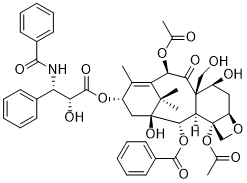
| Cas No. | 409319-62-6 | SDF | File under preparation. |
| PubChem ID | N/A | Appearance | Powder |
| Formula | C47H51NO15 | M.Wt | 869.9 |
| Type of Compound | N/A | Storage | Desiccate at -20°C |
| Solubility | Soluble in Chloroform,Dichloromethane,Ethyl Acetate,DMSO,Acetone,etc. | ||
| General tips | For obtaining a higher solubility , please warm the tube at 37 ℃ and shake it in the ultrasonic bath for a while.Stock solution can be stored below -20℃ for several months. We recommend that you prepare and use the solution on the same day. However, if the test schedule requires, the stock solutions can be prepared in advance, and the stock solution must be sealed and stored below -20℃. In general, the stock solution can be kept for several months. Before use, we recommend that you leave the vial at room temperature for at least an hour before opening it. |
||
| About Packaging | 1. The packaging of the product may be reversed during transportation, cause the high purity compounds to adhere to the neck or cap of the vial.Take the vail out of its packaging and shake gently until the compounds fall to the bottom of the vial. 2. For liquid products, please centrifuge at 500xg to gather the liquid to the bottom of the vial. 3. Try to avoid loss or contamination during the experiment. |
||
| Shipping Condition | Packaging according to customer requirements(5mg, 10mg, 20mg and more). Ship via FedEx, DHL, UPS, EMS or other couriers with RT, or blue ice upon request. | ||
Quality Control & MSDS
Package In Stock

Number of papers citing our products


19-Hydroxypaclitaxel Dilution Calculator
19-Hydroxypaclitaxel Molarity Calculator
| 1 mg | 5 mg | 10 mg | 20 mg | 25 mg | |
| 1 mM | 1.1496 mL | 5.7478 mL | 11.4956 mL | 22.9911 mL | 28.7389 mL |
| 5 mM | 0.2299 mL | 1.1496 mL | 2.2991 mL | 4.5982 mL | 5.7478 mL |
| 10 mM | 0.115 mL | 0.5748 mL | 1.1496 mL | 2.2991 mL | 2.8739 mL |
| 50 mM | 0.023 mL | 0.115 mL | 0.2299 mL | 0.4598 mL | 0.5748 mL |
| 100 mM | 0.0115 mL | 0.0575 mL | 0.115 mL | 0.2299 mL | 0.2874 mL |
| * Note: If you are in the process of experiment, it's necessary to make the dilution ratios of the samples. The dilution data above is only for reference. Normally, it's can get a better solubility within lower of Concentrations. | |||||
- IsocephaloMannine
Catalog No.:BCX2766
CAS No.:173101-54-7
- 2-Debenzoylpaclitaxel 2-Pentanoate
Catalog No.:BCX2765
CAS No.:213767-22-7
- 10,13-Bissidechainpaclitaxel
Catalog No.:BCX2764
CAS No.:2157462-42-3
- Idesolidine
Catalog No.:BCX2763
CAS No.:911697-92-2
- 4'-Demethyldehydropodophyllotoxin
Catalog No.:BCX2762
CAS No.:117669-31-5
- Olean-12-ene-3β,28-diol diacetate
Catalog No.:BCX2761
CAS No.:1896-77-1
- Norbelladine
Catalog No.:BCX2760
CAS No.:6053-00-5
- 2',4',6'-Trihydroxy-3,4-dimethoxydihydrochalcone
Catalog No.:BCX2759
CAS No.:29287-31-8
- 6-Isopentenyl apigenin trimethyl ether
Catalog No.:BCX2758
CAS No.:109605-85-8
- 3-Hydroxyphloretin
Catalog No.:BCX2757
CAS No.:57765-66-9
- 6'-Hydroxy-3,4,2',3',4'-pentamethoxychalcone
Catalog No.:BCX2756
CAS No.:65602-54-2
- Oxyberberrubine
Catalog No.:BCX2755
CAS No.:29580-82-3
- 7-Acetylpaclitaxel
Catalog No.:BCX2768
CAS No.:92950-39-5
- 7-epi-Cephalomannine
Catalog No.:BCX2769
CAS No.:150547-36-7
- N-Debenzoyl-N-cinnamoylpaclitaxel
Catalog No.:BCX2770
CAS No.:219783-77-4
- N-Debenzoyl-N-phenylacetylpaclitaxel
Catalog No.:BCX2771
CAS No.:173101-56-9
- N-Debenzoyl-N-[(3E)-hex-3-enoyl]paclitaxel
Catalog No.:BCX2772
CAS No.:502626-06-4
- 10-Acetoacetylpaclitaxel
Catalog No.:BCX2773
CAS No.:2757197-26-3
- Taxol E
Catalog No.:BCX2774
CAS No.:158948-96-0
- N-Acetyl-10-deacetyl-N-debenzoylpaclitaxel
Catalog No.:BCX2775
CAS No.:1144034-42-3
- 7-epi-10-Deacetylbaccatin III
Catalog No.:BCX2776
CAS No.:71629-92-0
- 10-Deacetyl-13-Oxobaccatin III
Catalog No.:BCX2777
CAS No.:92950-42-0
- 13-Oxobaccatin III
Catalog No.:BCX2778
CAS No.:32981-89-8
- 10-Dehydrobaccatin V
Catalog No.:BCX2779
CAS No.:151636-94-1
Metabolism of paclitaxel in mice.[Pubmed:12634614]
Anticancer Drugs. 2003 Mar;14(3):203-9.
Previous mass balance studies in humans and mice have shown that the fecal and urinary recovery of paclitaxel and known metabolites (3' -hydroxypaclitaxel, 6alpha-hydroxypaclitaxel and 3',6alpha-dihydroxypaclitaxel) was not complete. Obviously this discrepancy is caused by the existence of other yet unknown metabolites. Mdr1a/1b(-/-) mice excrete very low quantities of unchanged paclitaxel. We have therefore used these mice receiving i.v. [3H]paclitaxel to further study the metabolic fate of paclitaxel. The major part of the radiolabel, being 70%, was excreted in the feces. A lipophilic sample, containing about 70% of the radioactivity present in the feces sample, was obtained by diethyl ether extraction. The aqueous residue containing about 30% of the radioactivity was further extracted using methanol. The high-performance liquid chromatography (HPLC) chromatograms of the lipophilic and aqueous sample revealed two and five putative new metabolites of paclitaxel, respectively. The HPLC fractions containing substantial amounts of radioactivity were subjected to tandem mass spectrometry. Two novel monohydroxylated paclitaxel structures were identified, which are probably 2m-hydroxypaclitaxel and 19-Hydroxypaclitaxel, structures previously identified in rats. Including these metabolites, about 60% of the mass balance of paclitaxel could be quantified.

Calcutta University

University of Minnesota

University of Maryland School of Medicine

University of Illinois at Chicago

The Ohio State University

University of Zurich

Harvard University

Colorado State University

Auburn University

Yale University

Worcester Polytechnic Institute

Washington State University

Stanford University

University of Leipzig

Universidade da Beira Interior

The Institute of Cancer Research

Heidelberg University

University of Amsterdam

University of Auckland

TsingHua University

The University of Michigan

Miami University

DRURY University

Jilin University

Fudan University

Wuhan University

Sun Yat-sen University

Universite de Paris

Deemed University

Auckland University

The University of Tokyo

Korea University



