
Glutathione disulfideCAS# 27025-41-8 |
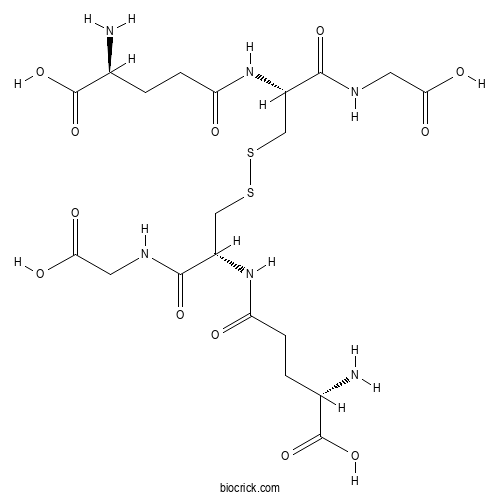
| Cas No. | 27025-41-8 | SDF | File under preparation. |
| PubChem ID | 65359.0 | Appearance | Powder |
| Formula | C20H32N6O12S2 | M.Wt | 612.6 |
| Type of Compound | N/A | Storage | Desiccate at -20°C |
| Solubility | Soluble in Chloroform,Dichloromethane,Ethyl Acetate,DMSO,Acetone,etc. | ||
| Chemical Name | (2S)-2-amino-5-[[(2R)-3-[[(2R)-2-[[(4S)-4-amino-4-carboxybutanoyl]amino]-3-(carboxymethylamino)-3-oxopropyl]disulfanyl]-1-(carboxymethylamino)-1-oxopropan-2-yl]amino]-5-oxopentanoic acid | ||
| SMILES | C(CC(=O)NC(CSSCC(C(=O)NCC(=O)O)NC(=O)CCC(C(=O)O)N)C(=O)NCC(=O)O)C(C(=O)O)N | ||
| Standard InChIKey | YPZRWBKMTBYPTK-BJDJZHNGSA-N | ||
| Standard InChI | InChI=1S/C20H32N6O12S2/c21-9(19(35)36)1-3-13(27)25-11(17(33)23-5-15(29)30)7-39-40-8-12(18(34)24-6-16(31)32)26-14(28)4-2-10(22)20(37)38/h9-12H,1-8,21-22H2,(H,23,33)(H,24,34)(H,25,27)(H,26,28)(H,29,30)(H,31,32)(H,35,36)(H,37,38)/t9-,10-,11-,12-/m0/s1 | ||
| General tips | For obtaining a higher solubility , please warm the tube at 37 ℃ and shake it in the ultrasonic bath for a while.Stock solution can be stored below -20℃ for several months. We recommend that you prepare and use the solution on the same day. However, if the test schedule requires, the stock solutions can be prepared in advance, and the stock solution must be sealed and stored below -20℃. In general, the stock solution can be kept for several months. Before use, we recommend that you leave the vial at room temperature for at least an hour before opening it. |
||
| About Packaging | 1. The packaging of the product may be reversed during transportation, cause the high purity compounds to adhere to the neck or cap of the vial.Take the vail out of its packaging and shake gently until the compounds fall to the bottom of the vial. 2. For liquid products, please centrifuge at 500xg to gather the liquid to the bottom of the vial. 3. Try to avoid loss or contamination during the experiment. |
||
| Shipping Condition | Packaging according to customer requirements(5mg, 10mg, 20mg and more). Ship via FedEx, DHL, UPS, EMS or other couriers with RT, or blue ice upon request. | ||
Quality Control & MSDS
3D structure
Package In Stock

Number of papers citing our products


Glutathione disulfide Dilution Calculator
Glutathione disulfide Molarity Calculator


| 1 mg | 5 mg | 10 mg | 20 mg | 25 mg | |
| 1 mM | 1.6324 mL | 8.1619 mL | 16.3239 mL | 32.6477 mL | 40.8097 mL |
| 5 mM | 0.3265 mL | 1.6324 mL | 3.2648 mL | 6.5295 mL | 8.1619 mL |
| 10 mM | 0.1632 mL | 0.8162 mL | 1.6324 mL | 3.2648 mL | 4.081 mL |
| 50 mM | 0.0326 mL | 0.1632 mL | 0.3265 mL | 0.653 mL | 0.8162 mL |
| 100 mM | 0.0163 mL | 0.0816 mL | 0.1632 mL | 0.3265 mL | 0.4081 mL |
| * Note: If you are in the process of experiment, it's necessary to make the dilution ratios of the samples. The dilution data above is only for reference. Normally, it's can get a better solubility within lower of Concentrations. | |||||
- N6-Isopentenyladenine
Catalog No.:BCX2319
CAS No.:2365-40-4
- Laurolitsine
Catalog No.:BCX2318
CAS No.:904927-11-3
- 9-Nitrocamptothecin
Catalog No.:BCX2317
CAS No.:86639-62-5
- Mandelic acid
Catalog No.:BCX2316
CAS No.:90-64-2
- D-Galacturonic acid hydrate
Catalog No.:BCX2315
CAS No.:685-73-4
- Isatin
Catalog No.:BCX2314
CAS No.:91-56-5
- 4-Hydroxypyridine-2,6-dicarboxylic acid
Catalog No.:BCX2313
CAS No.:499-51-4
- Zeatin
Catalog No.:BCX2312
CAS No.:1637-39-4
- Riboflavin sodium phosphate
Catalog No.:BCX2311
CAS No.:130-40-5
- Chavicol
Catalog No.:BCX2310
CAS No.:501-92-8
- Piperonylic acid
Catalog No.:BCX2309
CAS No.:94-53-1
- 2'-Deoxyadenosine
Catalog No.:BCX2308
CAS No.:958-09-8
- Naringenin chalcone
Catalog No.:BCX2321
CAS No.:73692-50-9
- Spilanthol
Catalog No.:BCX2322
CAS No.:25394-57-4
- Cathayanin C
Catalog No.:BCX2323
CAS No.:330195-61-4
- Taurodeoxycholic acid
Catalog No.:BCX2324
CAS No.:516-50-7
- Cathayanin B
Catalog No.:BCX2325
CAS No.:330195-60-3
- Sorocein H
Catalog No.:BCX2326
CAS No.:157382-82-6
- 3-Methyl-1-(3-methylfuran-2-yl)but-3-en-1-one
Catalog No.:BCX2327
CAS No.:78173-38-3
- Putrescine
Catalog No.:BCX2328
CAS No.:110-60-1
- L-Ornithine
Catalog No.:BCX2329
CAS No.:70-26-8
- Dopamine
Catalog No.:BCX2330
CAS No.:51-61-6
- Norcantharidin
Catalog No.:BCX2331
CAS No.:29745-04-8
- L-Arabinose
Catalog No.:BCX2332
CAS No.:5328-37-0
Deciphering cysteamine's impact on cashmere-producing traits of cashmere goats: a transcriptomic and metabolomic perspective.[Pubmed:42824821]
Front Vet Sci. 2026 Sep 17;13:1925080.
INTRODUCTION: This study addresses the practical production problem of inferior cashmere quality in cashmere goats. We supplemented cysteamine (CS) in diets to regulate cashmere‑production‑related traits and explore its underlying nutritional regulatory pathways, so as to support the scientific and rational application of cysteamine in cashmere goat production. METHODS: Sixty healthy 18‑month‑old female Inner Mongolia cashmere goats were selected for this single‑factor randomized trial and randomly allocated into three groups (n = 20 per group). The control group (CON) received basal diet; treatment groups were orally administrated cysteamine at 60 mg/kg body weight (BW)(LCS group) and 120 mg/kg BW (HCS group). Cashmere samples were collected from the designated trunk region. Fiber traits including diameter, staple length, breaking strength and elongation at break were measured, and fiber surface microstructure was observed by scanning electron microscopy (SEM). Skin tissues (n = 6 per group) were harvested for transcriptome and untargeted metabolomic sequencing to identify differentially expressed genes (DEGs) and differential metabolites (DEMs). KEGG enrichment and multi‑omics integrative analysis were further performed. RESULTS: Dietary CS numerically improved cashmere yield, weight and scale height without statistical significance. The LCS treatment significantly increased straightened length, while staple length slightly decreased in the HCS group but remained higher than in CON. Initial cashmere diameter, strength and elongation at break showed no inter‑group differences; these three indicators increased after CS supplementation compared with baseline values. In total, 426 DEGs and 72 DEMs were detected, indicating obvious transcriptional and metabolic changes induced by CS. KEGG analysis highlighted divergence in the cAMP signaling pathway and thyroid hormone synthesis. DEMs were mainly enriched in lipid metabolism, organic acid metabolism and heterocyclic compound metabolism; L‑cysteine‑Glutathione disulfide and alpha‑lipoic acid were key sulfur‑containing differential metabolites. Multi‑omics integration confirmed differences in lipid metabolism and cyclic nucleotide signaling pathways, with lipid‑related genes (PLA2G2C, VDAC3, CHRM5, SYT4) and cyclic‑nucleotide‑related gene IL24 significantly up‑regulated in CS groups. DISCUSSION: Multi‑omics results indicate that cysteamine may improve cashmere‑goat productive traits by providing endogenous organic sulfur sources, accumulating sulfur‑containing metabolic intermediates and coordinating hair‑follicle‑development‑related signaling pathways. This work supplies experimental evidence for cashmere fiber quality improvement.
Gene-Environment Interaction Mendelian Randomization Reveals Statin-Dependent Associations Between Metabolites and Lipid Traits.[Pubmed:42797520]
Pharmaceuticals (Basel). 2026 Sep 17;19(9):1475.
Introduction/Background: Observational links between circulating metabolites and lipid traits are often confounded by environmental factors. This study applied Mendelian randomization (MR) and gene-environment interaction MR (MR-GxE) to assess the average causal effects of genetically predicted metabolites on lipid traits and their modification by statin use. Methods: Participants (n = 2810) from Qatar Biobank were analyzed including genetics, metabolomics and lipid profiles. The cohort was divided into discovery (n = 1968) and validation (n = 842). One-sample MR using two-stage least squares regression was applied to estimate the average causal effect of metabolites on LDL, HDL, and Triglycerides, while MR-GxE analysis was also applied to investigate whether genetically predicted metabolite-LDL/HDL associations differ by statin use. Genetic variants associated with metabolites were used to generate a polygenic risk score (PRS). The interaction term between the PRS and statin use was incorporated in MR-GxE, while adjusting for confounders. Results: A total of 167 metabolites were commonly associated with LDL, HDL, and Triglycerides. One-sample MR showed no significant average causal effect of genetically predicted metabolites on lipid traits in the overall population. However, MR-GxE analysis revealed significant statin-dependent effects. Genetically predicted 2-amino-octanoate and cysteine-Glutathione disulfide demonstrated strong and reproducible positive interaction effects with LDL levels in statin users in both discovery and validation cohorts. While no overall average causal effects were observed, MR-GxE revealed that genetically predicted metabolites can influence LDL levels in the context of statin use. Conclusions: These findings highlight the importance of incorporating pharmacological exposures in MR analyses and support the role of drug-metabolite interactions in precision lipid management.

Calcutta University

University of Minnesota

University of Maryland School of Medicine

University of Illinois at Chicago

The Ohio State University

University of Zurich

Harvard University

Colorado State University

Auburn University

Yale University

Worcester Polytechnic Institute

Washington State University

Stanford University

University of Leipzig

Universidade da Beira Interior

The Institute of Cancer Research

Heidelberg University

University of Amsterdam

University of Auckland

TsingHua University

The University of Michigan

Miami University

DRURY University

Jilin University

Fudan University

Wuhan University

Sun Yat-sen University

Universite de Paris

Deemed University

Auckland University

The University of Tokyo

Korea University



