
Piperonylic acidCAS# 94-53-1 |
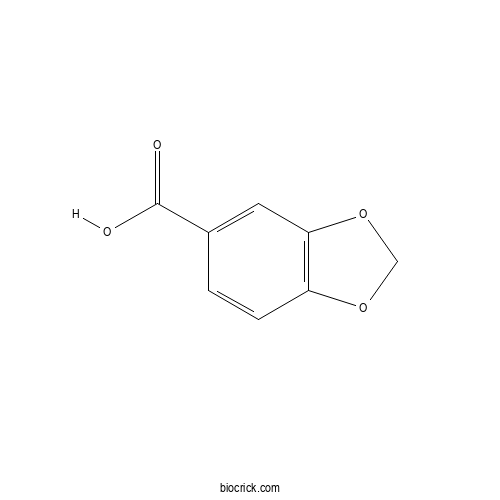
| Cas No. | 94-53-1 | SDF | File under preparation. |
| PubChem ID | 7196.0 | Appearance | Powder |
| Formula | C8H6O4 | M.Wt | 166.1 |
| Type of Compound | N/A | Storage | Desiccate at -20°C |
| Solubility | Soluble in Chloroform,Dichloromethane,Ethyl Acetate,DMSO,Acetone,etc. | ||
| Chemical Name | 1,3-benzodioxole-5-carboxylic acid | ||
| SMILES | C1OC2=C(O1)C=C(C=C2)C(=O)O | ||
| Standard InChIKey | VDVJGIYXDVPQLP-UHFFFAOYSA-N | ||
| Standard InChI | InChI=1S/C8H6O4/c9-8(10)5-1-2-6-7(3-5)12-4-11-6/h1-3H,4H2,(H,9,10) | ||
| General tips | For obtaining a higher solubility , please warm the tube at 37 ℃ and shake it in the ultrasonic bath for a while.Stock solution can be stored below -20℃ for several months. We recommend that you prepare and use the solution on the same day. However, if the test schedule requires, the stock solutions can be prepared in advance, and the stock solution must be sealed and stored below -20℃. In general, the stock solution can be kept for several months. Before use, we recommend that you leave the vial at room temperature for at least an hour before opening it. |
||
| About Packaging | 1. The packaging of the product may be reversed during transportation, cause the high purity compounds to adhere to the neck or cap of the vial.Take the vail out of its packaging and shake gently until the compounds fall to the bottom of the vial. 2. For liquid products, please centrifuge at 500xg to gather the liquid to the bottom of the vial. 3. Try to avoid loss or contamination during the experiment. |
||
| Shipping Condition | Packaging according to customer requirements(5mg, 10mg, 20mg and more). Ship via FedEx, DHL, UPS, EMS or other couriers with RT, or blue ice upon request. | ||
Quality Control & MSDS
3D structure
Package In Stock

Number of papers citing our products


Piperonylic acid Dilution Calculator
Piperonylic acid Molarity Calculator
| 1 mg | 5 mg | 10 mg | 20 mg | 25 mg | |
| 1 mM | 6.0205 mL | 30.1023 mL | 60.2047 mL | 120.4094 mL | 150.5117 mL |
| 5 mM | 1.2041 mL | 6.0205 mL | 12.0409 mL | 24.0819 mL | 30.1023 mL |
| 10 mM | 0.602 mL | 3.0102 mL | 6.0205 mL | 12.0409 mL | 15.0512 mL |
| 50 mM | 0.1204 mL | 0.602 mL | 1.2041 mL | 2.4082 mL | 3.0102 mL |
| 100 mM | 0.0602 mL | 0.301 mL | 0.602 mL | 1.2041 mL | 1.5051 mL |
| * Note: If you are in the process of experiment, it's necessary to make the dilution ratios of the samples. The dilution data above is only for reference. Normally, it's can get a better solubility within lower of Concentrations. | |||||
- 2'-Deoxyadenosine
Catalog No.:BCX2308
CAS No.:958-09-8
- Diosbulbin A
Catalog No.:BCX2307
CAS No.:20086-05-9
- Allylbenzene
Catalog No.:BCX2306
CAS No.:300-57-2
- 4-Hydroxy-3,5-diisopropylbenzaldehyde
Catalog No.:BCX2305
CAS No.:10537-86-7
- Ganoderic acid F
Catalog No.:BCX2304
CAS No.:98665-15-7
- 11-Oxocucurbita-5,24-diene-3,20-diol
Catalog No.:BCX2303
CAS No.:2491640-86-7
- 7β,20-Epoxyabieta-8,11,13-triene-6α,11,12-triol
Catalog No.:BCX2302
CAS No.:1353042-00-8
- threo-Anethole glycol
Catalog No.:BCX2301
CAS No.:112018-74-3
- Chantriolide C
Catalog No.:BCX2300
CAS No.:1206850-19-2
- Plantagiolide C
Catalog No.:BCX2299
CAS No.:913263-86-2
- erythro-Anethole glycol
Catalog No.:BCX2298
CAS No.:103687-27-0
- Foeniculoside I
Catalog No.:BCX2297
CAS No.:168010-10-4
- Chavicol
Catalog No.:BCX2310
CAS No.:501-92-8
- Riboflavin sodium phosphate
Catalog No.:BCX2311
CAS No.:130-40-5
- Zeatin
Catalog No.:BCX2312
CAS No.:1637-39-4
- 4-Hydroxypyridine-2,6-dicarboxylic acid
Catalog No.:BCX2313
CAS No.:499-51-4
- Isatin
Catalog No.:BCX2314
CAS No.:91-56-5
- D-Galacturonic acid hydrate
Catalog No.:BCX2315
CAS No.:685-73-4
- Mandelic acid
Catalog No.:BCX2316
CAS No.:90-64-2
- 9-Nitrocamptothecin
Catalog No.:BCX2317
CAS No.:86639-62-5
- Laurolitsine
Catalog No.:BCX2318
CAS No.:904927-11-3
- N6-Isopentenyladenine
Catalog No.:BCX2319
CAS No.:2365-40-4
- Glutathione disulfide
Catalog No.:BCX2320
CAS No.:27025-41-8
- Naringenin chalcone
Catalog No.:BCX2321
CAS No.:73692-50-9
Early-Stage Screening of Piperonylic Acid Analogues and Their Salts as Synergists for the Class of Pyrethroid Insecticides.[Pubmed:42729851]
ACS Omega. 2026 Aug 26;11(35):53010-53020.
This study presents an early-stage screening of Piperonylic acid analogues and their salts as synergists for the class of pyrethroid insecticides. Using the carbonate-based ionic liquid synthesis (CBILs) method, we synthesized 32 potential synergists from 4 Piperonylic acid analogues in a one-step process and experimentally determined general toxicity parameters and synergistic activity in comparison with the commercial synergist piperonyl butoxide (PBO). In vitro assays revealed structure-dependent activity of synergists on detoxification enzymes of Blattella germanica, with several candidates demonstrating similar or even higher activity compared to PBO. Subsequent in vivo testing of selected compounds confirmed their overall synergistic potential but showed lower activity than PBO, underscoring the need to validate in vitro findings in vivo. The reported synergistic activity of Piperonylic acid analogues and the ability for noncovalent modification can act as a starting point for future structure optimization to find alternatives for PBO in pyrethroid insecticide formulations.
Exogenous Inhibitors Enhance Plant Resistance to Rice Planthoppers Through Boosting Phenylpropanoid Pathway Under Elevated CO(2).[Pubmed:41236170]
Plant Cell Environ. 2026 Feb;49(2):1138-1150.
The damage caused by the Nilaparvata lugens to rice plants will become aggravated under elevated CO(2) (eCO(2)), emphasizing the urgent necessity to enhance rice defences against N. lugens under eCO(2) conditions. The phenylpropanoid pathway is composed of several branches and is known to enhance plant resistance. Inhibiting key enzymes in certain branches can compensatorily activate other branches, thereby strengthening plant defence. In this study, rice plants were treated with the cinnamic acid-4-hydroxylase (C4H) inhibitor Piperonylic acid (PA) and the 4-coumarate:CoA ligase (4CL) inhibitor 3,4-(methylenedioxy) cinnamic acid (MDCA), and their effects on N. lugens and rice plants were investigated under ambient CO(2) (aCO(2)) and eCO(2). The results demonstrated that PA and MDCA treatments reduced N. lugens feeding and survival, especially under eCO(2). Additionally, PA and MDCA treatments activated the ROS system and phenylpropanoid pathway in rice plants, and increased hydroxybenzoic acid derivatives contents under eCO(2), with only minor changes observed under aCO(2). Further analysis illustrated that these compounds suppressed N. lugens feeding and survival, and could bind to and induce the activities of detoxification enzymes in N. lugens. These findings demonstrate that PA and MDCA enhance rice resistance under eCO(2), providing a potential strategy to mitigate pest damage exacerbated by climate change.
A new amidohydrolase and beta-oxidation-like pathway for piperine catabolism in soil actinomycetes.[Pubmed:41203127]
J Biol Chem. 2025 Dec;301(12):110908.
Understanding the microbial degradation of plant-derived specialized metabolites is important for gaining insight into plant microbial diseases. Piperine is a unique alkaloid found in peppers and plays a protective role essential for pepper tree growth. However, how environmental microbiomes interact with pepper trees, especially via the interaction with piperine, has remained completely unknown. To elucidate microbial piperine metabolism, we previously screened Rhodococcus ruber No. 14, an actinomycete that catabolizes piperine from a surface soil sample containing detritus. In this actinomycete, here, we discovered a piperine hydrolase (named PipM) that catalyzes the hydrolysis of the tertiary amide bond in piperine. While no enzyme had been reported to hydrolyze the piperine-type tertiary amide bond, PipM showed amino acid sequence similarity to amidohydrolase family enzymes and, like them, required metal ions for its activity. The mRNA-Seq and genome analysis revealed a gene cluster of 48 genes, among which 42 genes, including pipM, were upregulated by adding piperine into the culture medium. Through gene expression and biochemical analysis, four genes (named pipU, V, W, and X) were identified to encode enzymes that catalyze the beta-oxidation-like reaction to convert piperic acid to Piperonylic acid. Our study unraveled microbial piperine metabolism and would provide insight into interactions between pepper trees and environmental microbiomes.
Metabolomic Profiling Identifies Key Metabolites and Defense Pathways in Rlm1-Mediated Blackleg Resistance in Canola.[Pubmed:40565092]
Int J Mol Sci. 2025 Jun 12;26(12):5627.
Blackleg disease poses a major threat to global canola production. The resistance gene Rlm1, corresponding to the avirulence gene AvrLm1 in the pathogen Leptosphaeria maculans, has been widely used to mitigate the impact of the disease. To investigate the biochemical basis of Rlm1-mediated resistance against blackleg, we conducted an LC-MS-based analysis of a susceptible Topas double haploid (DH) line and its isogenic Rlm1-carrying resistant counterpart for metabolomic profiles during the infection process. Samples were labeled with (12)C- and (13)C for LC-MS analyses to enhance both chemical and physical properties of metabolites for improved quantification and detection sensitivity. Resistant plants showed early and sustained accumulation of several defense metabolites, notably pipecolic acid (PA, up to 326-fold), salicylic acid (SA), and gentisic acid (GA) in L. maculans-inoculated Topas-Rlm1 plants compared to mock-inoculated Topas-Rlm1 controls (adjusted p < 0.05), indicating activation of lysine degradation and hormonal defense pathways. Elevated glucosinolates (GLS), gamma-aminobutyric acid (GABA), and melatonin precursors may further contribute to antimicrobial defense and cell-wall reinforcement. In contrast, flavonoid and phenylpropanoid pathways were down-regulated, suggesting metabolic reallocation during resistance. Exogenous application of PA, SA, GA, ferulic acid, and Piperonylic acid (a known inhibitor of the phenylpropanoid pathway in plants) significantly reduced infection in susceptible canola varieties, validating their defense roles against blackleg. These results offer new insights into Rlm1-mediated resistance and support metabolic targets for breeding durable blackleg resistance in canola.
Endodermal lignification coordinates with root calcium levels to govern lateral root emergence.[Pubmed:40484986]
New Phytol. 2025 Aug;247(3):1290-1307.
Calcium (Ca), an essential macronutrient, is crucial for the growth of young plant tissues, including the formation of lateral roots (LRs) that originate from pericycle cells in the inner root. The Casparian strip (CS) serves as an apoplastic barrier in the root endodermis, optimizing nutrient transport and facilitating plant adaptation to various environments. This study demonstrates that the integrity of the CS regulates local Ca-dependent LR emergence by controlling the lignification of the overlying endodermal cells in Arabidopsis. In mutants with disrupted CS integrity and compensatory lignin deposition, plants require sufficient Ca to maintain auxin gradients and the morphology of LR primordia, thereby promoting LR primordia through the endodermis. Both Piperonylic acid treatment and genetic evidence indicate that excessive lignification of the overlying endodermal cells significantly delays LR emergence under low-Ca conditions compared with sufficient Ca. The receptor-like kinase SGN3/GSO1 mediates this excessive lignification. Importantly, the function of the CS in LR emergence is independent of Ca translocation from roots to shoots and, consequently, shoot growth dynamics. Overall, our study highlights the direct involvement of CS integrity in modulating Ca-dependent LR emergence by controlling cell wall stiffness through the lignification of overlying endodermal cells.
Total Synthesis of Artapilosine A and Artapilosine B.[Pubmed:39656970]
J Nat Prod. 2024 Dec 27;87(12):2863-2871.
Artapilosines A and B, isolated from Artabotrys pilosus, demonstrated significant anti-HIV reverse transcriptase activity. In this work, we present the first asymmetric total synthesis of (-)-artapilosine A and of its enantiomer (+)-artapilosine A, achieved in 10 steps with overall yields of 0.9% and 0.7%, respectively, starting from commercially available Piperonylic acid. The key step in this synthesis involved a pivotal photocyclization reaction, providing an efficient protocol for constructing the phenanthrene ring system common to many natural products. Additionally, using the same photocyclization strategy, we successfully synthesized artapilosine B in 10 steps with an overall yield of 2.1%.
Landscaping DNA binding potential of piperine derivatives by computational and biophysical methods.[Pubmed:39617232]
Int J Biol Macromol. 2025 Jan;285:138180.
Piperine, the alkaloid from Black pepper, is known for its wide range of pharmacological effects. The DNA binding activity of piperine was reported earlier. In this work, we explore the DNA duplex binding properties of four piperine derivatives, piperonal, piperonyl alcohol, Piperonylic acid, and piperic acid using biophysical and computational techniques. Various spectroscopic and calorimetric techniques were employed for the experimental analysis. We employed UV - vis absorption and fluorescence spectroscopy to verify the binding of piperine to calf thymus DNA (ctDNA). The energetics of this interaction were analysed using isothermal titration calorimetry (ITC). Conformational changes in DNA resulting from ligand interactions were investigated using circular dichroism spectroscopy. All these experimental results consistently demonstrate that the piperine derivatives exhibit stronger binding affinity to DNA than piperine. Computational analyses, utilizing molecular docking and dynamics, revealed similar results to experimental studies, indicating that the compounds bind to the minor groove of DNA like piperine. Both in vitro and in silico investigations demonstrated the strong DNA binding potential of the examined piperine derivatives. This study is the first to report on the comparative interaction between these piperine derivatives and a DNA duplex.
Piperonylic Acid Promotes Hair Growth by Activation of EGFR and Wnt/beta-Catenin Pathway.[Pubmed:39409103]
Int J Mol Sci. 2024 Oct 7;25(19):10774.
Dermal papilla cells (DPCs) are located at the bottom of the hair follicle and play a critical role in hair growth, shape, and cycle. Epidermal growth factor receptor (EGFR) and Wnt/beta-catenin signaling pathways are essential in promoting keratinocyte activation as well as hair follicle formation in DPCs. Piperonylic acid is a small molecule that induces EGFR activation in keratinocytes. However, the effects of Piperonylic acid on DPCs in regard to the stimulation of hair growth have not been studied. In the present study, Piperonylic acid was shown to activate the Wnt/beta-catenin signaling pathway in addition to the EGFR signaling pathway in DPCs. Piperonylic acid suppressed DKK1 expression, which presumably promoted the accumulation of beta-catenin in the nucleus. In addition, Piperonylic acid promoted cyclin D upregulation and cell growth and increased the expression of alkaline phosphatase (ALP), a DPC marker. In a clinical study, the group that applied a formulation containing Piperonylic acid had a significantly higher number of hairs per unit area than the placebo group. These results identify Piperonylic acid as a promising new candidate for hair loss treatment.
Cell-free reduction of carboxylic acids with secreted carboxylic acid reductase.[Pubmed:38266924]
J Biotechnol. 2024 Feb 20;382:44-50.
Mycobacterium marinum CAR (MmCAR) is one of the most widely used CARs as the key enzyme for the synthesis of aldehydes, alcohols and further products from the respective carboxylic acids. Herein, we describe the first functionally secreted 131 kDa CAR and its isolated A-domain using Komagataella phaffii and a methanol-free constitutive expression strategy. Precipitated and lyophilized MmCAR (500 microg) was isolated from the culture supernatant and showed no decrease in activity for Piperonylic acid (80% conversion), even when stored for up to 3 weeks at 4 degrees C. Lyophilized MmCAR precipitate gave 48% yield of E/Z-nonanal-4-nitrobenzoyloxime from the reduction of nonanoic acid and in-situ derivatization with O-4-nitrobenzoyl-hydroxylamine. Furthermore, K. phaffii could successfully secrete the MmCAR adenylation domain. Its activity was confirmed by the amidation of benzoic acid with n-hexylamine. Neither enzyme variant was glycosylated by the yeast. In summary, functional CAR can be secreted by K. phaffii and used for cell free conversion of carboxylic acids to various products.
Targeted control of supporting pathways in paclitaxel biosynthesis with CRISPR-guided methylation.[Pubmed:37915547]
Front Bioeng Biotechnol. 2023 Oct 17;11:1272811.
Introduction: Plant cell culture biomanufacturing is rapidly becoming an effective strategy for production of high-value plant natural products, such as therapeutic proteins and small molecules, vaccine adjuvants, and nutraceuticals. Many of these plant natural products are synthesized from diverse molecular building blocks sourced from different metabolic pathways. Even so, engineering approaches for increasing plant natural product biosynthesis have typically focused on the core biosynthetic pathway rather than the supporting pathways. Methods: Here, we use both CRISPR-guided DNA methylation and chemical inhibitors to control flux through the phenylpropanoid pathway in Taxus chinensis, which contributes a phenylalanine derivative to the biosynthesis of paclitaxel (Taxol), a potent anticancer drug. To inhibit PAL, the first committed step in phenylpropanoid biosynthesis, we knocked down expression of PAL in Taxus chinensis plant cell cultures using a CRISPR-guided plant DNA methyltransferase (NtDRM). For chemical inhibition of downstream steps in the pathway, we treated Taxus chinensis plant cell cultures with Piperonylic acid and caffeic acid, which inhibit the second and third committed steps in phenylpropanoid biosynthesis: cinnamate 4-hydroxylase (C4H) and 4-coumaroyl-CoA ligase (4CL), respectively. Results: Knockdown of PAL through CRISPR-guided DNA methylation resulted in a profound 25-fold increase in paclitaxel accumulation. Further, through the synergistic action of both chemical inhibitors and precursor feeding of exogenous phenylalanine, we achieve a 3.5-fold increase in paclitaxel biosynthesis and a similar reduction in production of total flavonoids and phenolics. We also observed perturbations to both activity and expression of PAL, illustrating the complex transcriptional co-regulation of these first three pathway steps. Discussion: These results highlight the importance of controlling the metabolic flux of supporting pathways in natural product biosynthesis and pioneers CRISPR-guided methylation as an effective method for metabolic engineering in plant cell cultures. Ultimately, this work demonstrates a powerful method for rewiring plant cell culture systems into next-generation chassis for production of societally valuable compounds.
Sustainable valorization of pitaya (Hylocereus spp.) peel in a semi-continuous high-pressure hydrothermal process to recover value-added products.[Pubmed:37803643]
Food Res Int. 2023 Nov;173(Pt 1):113332.
This study evaluated the use of a semi-continuous high-pressure hydrothermal process for the recovery of value-added products from pitaya peel. The process was carried out at 15 MPa, a water flow rate of 2 mL/min, a solvent-to-feed ratio of 60 g water/g pitaya peel, and temperatures ranging from 40 to 210 degrees C. The results show that extraction temperatures (between 40 and 80 degrees C) promoted the recovery of betacyanin (1.52 mg/g), malic acid (25.6 mg/g), and citric acid (25.98 mg/g). The major phenolic compounds obtained were p-coumaric acid (144.63 +/- 0.42 microg/g), protocatechuic acid (91.43 +/- 0.32 microg/g), and Piperonylic acid (74.2 +/- 0.31 microg/g). The hydrolysis temperatures (between 150 and 210 degrees C) could produce sugars (18.09 mg/g). However, the hydrolysis process at temperatures above 180 degrees C generated Maillard reaction products, which increased the total phenolic compounds and antioxidant activity of the hydrolysates. Finally, the use of semi-continuous high-pressure hydrothermal process can be a sustainable and promising approach for the recovery of value-added compounds from pitaya peel, advocating a circular economy approach in the agri-food industry.
Potential of Exogenous Treatment with Dehydroascorbate to Control Root-knot Nematode Infection in Rice.[Pubmed:37380881]
Rice (N Y). 2023 Jun 29;16(1):29.
Induced resistance (IR) is a unique physiological state characterized by reduced plant susceptibility to (a)biotic stress. Our previous studies showed that exogenous foliar application of dehydroascorbate (DHA), the oxidized form of ascorbic acid, induces systemic resistance against root-knot nematode Meloidogyne graminicola in rice. In the present study, the potential of DHA in protecting rice plants against M. graminicola was evaluated in lab, pot, and field studies. In an experiment where the interval between foliar treatment and inoculation was varied, 20 mM DHA was found to protect rice plants from M. graminicola for at least 14 days. Pot and field studies confirmed that 10 or 20 mM DHA are highly effective in reducing gall formation and led to a significant increase in rice seed yield. A half dose of DHA (10 mM) combined with another IR-stimulus - Piperonylic acid (PA) 300 microM - was at par with DHA 20 mM, leading to reductions in gall formation of more than 80%. In in vitro bioassays, DHA was found to be highly nematicidal to the second-stage juveniles of M. graminicola, with more than 90% mortality within 3 h of exposure to 10 or 20 mM concentrations. While seed treatment had no effect, root drenching or root dipping was also effective in reducing rice susceptibility to M. graminicola, next to foliar treatment. As a dual-action compound with extended protection and ease of application, DHA has great potential for effective nematode management in rice.
Non-specific effects of the CINNAMATE-4-HYDROXYLASE inhibitor piperonylic acid.[Pubmed:37036146]
Plant J. 2023 Jul;115(2):470-479.
Chemical inhibitors are often implemented for the functional characterization of genes to overcome the limitations associated with genetic approaches. Although it is well established that the specificity of the compound is key to success of a pharmacological approach, off-target effects are often overlooked or simply neglected in a complex biological setting. Here we illustrate the cause and implications of such secondary effects by focusing on Piperonylic acid (PA), an inhibitor of CINNAMATE-4-HYDROXYLASE (C4H) that is frequently used to investigate the involvement of lignin during plant growth and development. When supplied to plants, we found that PA is recognized as a substrate by GRETCHEN HAGEN 3.6 (GH3.6), an amido synthetase involved in the formation of the indole-3-acetic acid (IAA) conjugate IAA-Asp. By competing for the same enzyme, PA interferes with IAA conjugation, resulting in an increase in IAA concentrations in the plant. In line with the broad substrate specificity of the GH3 family of enzymes, treatment with PA increased not only IAA levels but also those of other GH3-conjugated phytohormones, namely jasmonic acid and salicylic acid. Finally, we found that interference with the endogenous function of GH3s potentially contributes to phenotypes previously observed upon PA treatment. We conclude that deregulation of phytohormone homeostasis by surrogate occupation of the conjugation machinery in the plant is likely a general phenomenon when using chemical inhibitors. Our results hereby provide a novel and important basis for future reference in studies using chemical inhibitors.
Exploration of a library of piperonylic acid-derived hydrazones possessing variable aryl functionalities as potent dual cholinesterase and monoamine oxidase inhibitors.[Pubmed:36355337]
Mol Divers. 2023 Dec;27(6):2465-2489.
A library of Piperonylic acid-derived hydrazones possessing variable aryl moiety was synthesized and investigated for their multifunctional properties against cholinesterases (ChEs) and monoamine oxidases (MAOs). The in vitro enzymatic assay results revealed that the tested hydrazones have exhibited excellent cholinesterase inhibition profile. Compound 4i, (E)-N'-(2,3-dichlorobenzylidene)benzo[d][1,3]dioxole-5-carbohydrazide showed promising dual inhibitory profile against AChE (0.048 +/- 0.007 muM), BChE (0.89 +/- 0.018 muM), and MAO-B (0.95 +/- 0.12 muM) enzymes. SAR exploration revealed that the truncation of the linker connecting both the aryl binding sites of the semicarbazone scaffold, by one atom, has relatively suppressed the AChE inhibitory potential. Kinetic studies disclosed that the compound 4i reversibly inhibited AChE enzyme in a competitive manner (K(i) = 8.0 +/- 0.076 nM), while it displayed a non-competitive and reversible inhibition profile against MAO-B (K(i) = 9.6 +/- 0.021 microM). Moreover, molecular docking studies of synthesized compounds against ChEs and MAOs provided the crucial molecular features that enable their close association and interaction with the target enzymes. All atomistic simulation studies confirmed the stable association of compound 4i within the active sites of AChE and MAO-B. In addition, theoretical ADMET prediction studies demonstrated the acceptable pharmacokinetic profile of the dual inhibitors. In summary, the attempted lead simplification study afforded a potent dual ChE-MAO-B inhibitor compound that merits further investigation.

Calcutta University

University of Minnesota

University of Maryland School of Medicine

University of Illinois at Chicago

The Ohio State University

University of Zurich

Harvard University

Colorado State University

Auburn University

Yale University

Worcester Polytechnic Institute

Washington State University

Stanford University

University of Leipzig

Universidade da Beira Interior

The Institute of Cancer Research

Heidelberg University

University of Amsterdam

University of Auckland

TsingHua University

The University of Michigan

Miami University

DRURY University

Jilin University

Fudan University

Wuhan University

Sun Yat-sen University

Universite de Paris

Deemed University

Auckland University

The University of Tokyo

Korea University



