
1-PentacosanolCAS# 26040-98-2 |
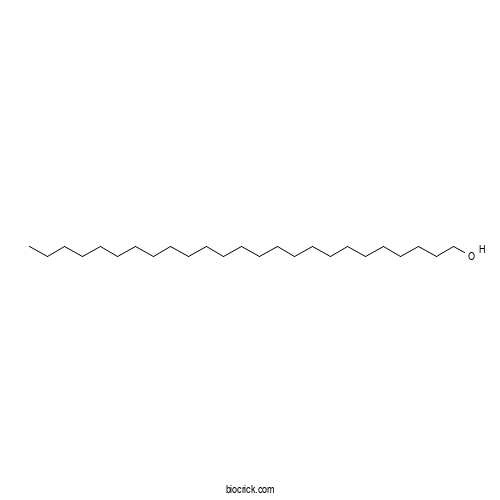
| Cas No. | 26040-98-2 | SDF | File under preparation. |
| PubChem ID | 92247.0 | Appearance | Powder |
| Formula | C25H52O | M.Wt | 368.7 |
| Type of Compound | N/A | Storage | Desiccate at -20°C |
| Solubility | Soluble in Chloroform,Dichloromethane,Ethyl Acetate,DMSO,Acetone,etc. | ||
| Chemical Name | pentacosan-1-ol | ||
| SMILES | CCCCCCCCCCCCCCCCCCCCCCCCCO | ||
| Standard InChIKey | IACKKVBKKNJZGN-UHFFFAOYSA-N | ||
| Standard InChI | InChI=1S/C25H52O/c1-2-3-4-5-6-7-8-9-10-11-12-13-14-15-16-17-18-19-20-21-22-23-24-25-26/h26H,2-25H2,1H3 | ||
| General tips | For obtaining a higher solubility , please warm the tube at 37 ℃ and shake it in the ultrasonic bath for a while.Stock solution can be stored below -20℃ for several months. We recommend that you prepare and use the solution on the same day. However, if the test schedule requires, the stock solutions can be prepared in advance, and the stock solution must be sealed and stored below -20℃. In general, the stock solution can be kept for several months. Before use, we recommend that you leave the vial at room temperature for at least an hour before opening it. |
||
| About Packaging | 1. The packaging of the product may be reversed during transportation, cause the high purity compounds to adhere to the neck or cap of the vial.Take the vail out of its packaging and shake gently until the compounds fall to the bottom of the vial. 2. For liquid products, please centrifuge at 500xg to gather the liquid to the bottom of the vial. 3. Try to avoid loss or contamination during the experiment. |
||
| Shipping Condition | Packaging according to customer requirements(5mg, 10mg, 20mg and more). Ship via FedEx, DHL, UPS, EMS or other couriers with RT, or blue ice upon request. | ||
Quality Control & MSDS
3D structure
Package In Stock

Number of papers citing our products


1-Pentacosanol Dilution Calculator
1-Pentacosanol Molarity Calculator
-
 1-OctacosanolCatalog No.: BCN2973CAS No.: 557-61-9
-
 Docosanol (Abreua)Catalog No.: BCC3769CAS No.: 661-19-8
-
 1-HexadecanolCatalog No.: BCC4616CAS No.: 36653-82-4
-
 N-dotriacontanolCatalog No.: BCC8218CAS No.: 6624-79-9
-
 TriacontanolCatalog No.: BCC8260CAS No.: 593-50-0
-
 1-HeptacosanolCatalog No.: BCN0107CAS No.: 2004-39-9
-
 butanolCatalog No.: BCN4976CAS No.: 71-36-3
-
 1,18-OctadecanediolCatalog No.: BCN5233CAS No.: 3155-43-9
-
 DecaneCatalog No.: BCN8138CAS No.: 124-18-5
-
 NonacosaneCatalog No.: BCC9102CAS No.: 630-03-5
-
 n-TridecaneCatalog No.: BCN9855CAS No.: 629-50-5
-
 DotriacontaneCatalog No.: BCX2353CAS No.: 544-85-4
| 1 mg | 5 mg | 10 mg | 20 mg | 25 mg | |
| 1 mM | 2.7122 mL | 13.5612 mL | 27.1223 mL | 54.2446 mL | 67.8058 mL |
| 5 mM | 0.5424 mL | 2.7122 mL | 5.4245 mL | 10.8489 mL | 13.5612 mL |
| 10 mM | 0.2712 mL | 1.3561 mL | 2.7122 mL | 5.4245 mL | 6.7806 mL |
| 50 mM | 0.0542 mL | 0.2712 mL | 0.5424 mL | 1.0849 mL | 1.3561 mL |
| 100 mM | 0.0271 mL | 0.1356 mL | 0.2712 mL | 0.5424 mL | 0.6781 mL |
| * Note: If you are in the process of experiment, it's necessary to make the dilution ratios of the samples. The dilution data above is only for reference. Normally, it's can get a better solubility within lower of Concentrations. | |||||
- 6'-O-Xylosyldianthoside
Catalog No.:BCX2514
CAS No.:1566606-35-6
- Scutebata P
Catalog No.:BCX2513
CAS No.:1616406-83-7
- 4-Hydroxy-2,6,6-trimethylcyclohex-1-ene-1-carbaldehyde
Catalog No.:BCX2512
CAS No.:42926-75-0
- Ovalifolin
Catalog No.:BCX2511
CAS No.:55303-88-3
- Scutebata Q
Catalog No.:BCX2510
CAS No.:1616406-84-8
- Phyllostacin D
Catalog No.:BCX2509
CAS No.:960621-59-4
- Rubescensin O
Catalog No.:BCX2508
CAS No.:602301-96-2
- Khaephuoside A
Catalog No.:BCX2507
CAS No.:142542-79-8
- Oresbiusin A
Catalog No.:BCX2506
CAS No.:136749-45-6
- Kanjone
Catalog No.:BCX2505
CAS No.:1094-12-8
- Cinnamyl 3,4-dimethoxycinnamate
Catalog No.:BCX2504
CAS No.:391682-57-8
- Maoyecrystal G
Catalog No.:BCX2503
CAS No.:675603-40-4
- 3-Hydroxy-3-phenyl-1-(4,6,7-trimethoxybenzofuran-5-yl)prop-2-en-1-one
Catalog No.:BCX2516
CAS No.:131694-13-8
- 4-(2-Nitroethyl)phenol
Catalog No.:BCX2517
CAS No.:37567-58-1
- Glucoindol B
Catalog No.:BCX2518
CAS No.:23099-32-3
- Pinobanksin 3-O-caffeate
Catalog No.:BCX2519
CAS No.:1220531-15-6
- Scutebata L
Catalog No.:BCX2520
CAS No.:1369525-17-6
- Scutolide K
Catalog No.:BCX2521
CAS No.:1651888-30-0
- N-Lauryldiethanolamine
Catalog No.:BCX2522
CAS No.:1541-67-9
- Cepharanthine 2'-β-N-oxide
Catalog No.:BCX2523
CAS No.:104386-92-7
- N-(2-Hydroxy-3-methylbutyl)adenine
Catalog No.:BCX2524
CAS No.:22662-00-6
- Jatrointelignan D
Catalog No.:BCX2525
CAS No.:1621072-64-7
- 5-Methoxyjatrointelignan D
Catalog No.:BCX2526
CAS No.:2170998-22-6
- Xanthohumol
Catalog No.:BCX2527
CAS No.:6754-58-1
New fatty acid and acyl glycoside from the aerial parts of Phyllanthus fraternus Webster.[Pubmed:26957868]
J Pharm Bioallied Sci. 2016 Jan-Mar;8(1):43-6.
BACKGROUND: Phyllanthus fraternus Webster (Euphorbiaceae) is used to treat dyspepsia, indigestion, jaundice, dysentery, diabetes, influenza, kidney stones, urinary tract diseases, vaginitis, and skin eruptions in traditional systems of medicine. MATERIALS AND METHODS: The methanol extract of aerial parts of P. fraternus was obtained by soxhlation method. Isolation of compounds was done by silica gel column chromatography. Analytical thin layer chromatography was used to check the homogeneity of eluted fractions. The structures of isolated compounds were established on the basis of spectral studies and chemical reactions. RESULTS: Phytochemical investigation of a methanolic extract of the aerial parts yielded a new fatty acid characterized as cis-n-octacos-17-enoic acid (5) and a new acyl tetraglycoside formulated as n-dodecanoyl-O-beta-D-glucopyranosyl-(2'-->1'')-O-beta-D-glucopyranosyl-(2''-->1''')-O-beta-D-glucopyranosyl-(2'''-->1'''')-O-beta-D-glucopyranoside (7) along with known compounds 1-Pentacosanol (1), beta-sitosteryl oleate (2), beta-sitosteryl linoleate (3), stigmasterol (4) and palmityl glucuronoside (6).
Chemometric profile of root extracts of Rhodiola imbricata Edgew. with hyphenated gas chromatography mass spectrometric technique.[Pubmed:23326358]
PLoS One. 2013;8(1):e52797.
Rhodiola imbricata Edgew. (Rose root or Arctic root or Golden root or Shrolo), belonging to the family Crassulaceae, is an important food crop and medicinal plant in the Indian trans-Himalayan cold desert. Chemometric profile of the n-hexane, chloroform, dichloroethane, ethyl acetate, methanol, and 60% ethanol root extracts of R. imbricata were performed by hyphenated gas chromatography mass spectrometry (GC/MS) technique. GC/MS analysis was carried out using Thermo Finnigan PolarisQ Ion Trap GC/MS MS system comprising of an AS2000 liquid autosampler. Interpretation on mass spectrum of GC/MS was done using the NIST/EPA/NIH Mass Spectral Database, with NIST MS search program v.2.0g. Chemometric profile of root extracts revealed the presence of 63 phyto-chemotypes, among them, 1-Pentacosanol; stigmast-5-en-3-ol, (3beta,24S); 1-teracosanol; 1-henteracontanol; 17-pentatriacontene; 13-tetradecen-1-ol acetate; methyl tri-butyl ammonium chloride; bis(2-ethylhexyl) phthalate; 7,8-dimethylbenzocyclooctene; ethyl linoleate; 3-methoxy-5-methylphenol; hexadecanoic acid; camphor; 1,3-dimethoxybenzene; thujone; 1,3-benzenediol, 5-pentadecyl; benzenemethanol, 3-hydroxy, 5-methoxy; cholest-4-ene-3,6-dione; dodecanoic acid, 3-hydroxy; octadecane, 1-chloro; ethanone, 1-(4-hydroxyphenyl); alpha-tocopherol; ascaridole; campesterol; 1-dotriacontane; heptadecane, 9-hexyl were found to be present in major amount. Eventually, in the present study we have found phytosterols, terpenoids, fatty acids, fatty acid esters, alkyl halides, phenols, alcohols, ethers, alkanes, and alkenes as the major group of phyto-chemotypes in the different root extracts of R. imbricata. All these compounds identified by GC/MS analysis were further investigated for their biological activities and it was found that they possess a diverse range of positive pharmacological actions. In future, isolation of individual phyto-chemotypes and subjecting them to biological activity will definitely prove fruitful results in designing a novel drug.

Calcutta University

University of Minnesota

University of Maryland School of Medicine

University of Illinois at Chicago

The Ohio State University

University of Zurich

Harvard University

Colorado State University

Auburn University

Yale University

Worcester Polytechnic Institute

Washington State University

Stanford University

University of Leipzig

Universidade da Beira Interior

The Institute of Cancer Research

Heidelberg University

University of Amsterdam

University of Auckland

TsingHua University

The University of Michigan

Miami University

DRURY University

Jilin University

Fudan University

Wuhan University

Sun Yat-sen University

Universite de Paris

Deemed University

Auckland University

The University of Tokyo

Korea University



