
N-LauryldiethanolamineCAS# 1541-67-9 |
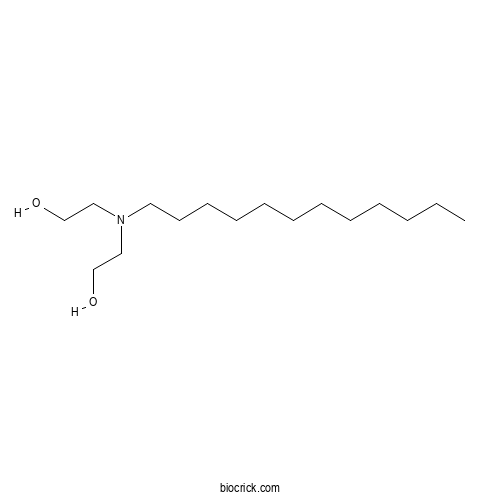
| Cas No. | 1541-67-9 | SDF | File under preparation. |
| PubChem ID | 352309.0 | Appearance | Powder |
| Formula | C16H35NO2 | M.Wt | 273.4 |
| Type of Compound | N/A | Storage | Desiccate at -20°C |
| Solubility | Soluble in Chloroform,Dichloromethane,Ethyl Acetate,DMSO,Acetone,etc. | ||
| Chemical Name | 2-[dodecyl(2-hydroxyethyl)amino]ethanol | ||
| SMILES | CCCCCCCCCCCCN(CCO)CCO | ||
| Standard InChIKey | NKFNBVMJTSYZDV-UHFFFAOYSA-N | ||
| Standard InChI | InChI=1S/C16H35NO2/c1-2-3-4-5-6-7-8-9-10-11-12-17(13-15-18)14-16-19/h18-19H,2-16H2,1H3 | ||
| General tips | For obtaining a higher solubility , please warm the tube at 37 ℃ and shake it in the ultrasonic bath for a while.Stock solution can be stored below -20℃ for several months. We recommend that you prepare and use the solution on the same day. However, if the test schedule requires, the stock solutions can be prepared in advance, and the stock solution must be sealed and stored below -20℃. In general, the stock solution can be kept for several months. Before use, we recommend that you leave the vial at room temperature for at least an hour before opening it. |
||
| About Packaging | 1. The packaging of the product may be reversed during transportation, cause the high purity compounds to adhere to the neck or cap of the vial.Take the vail out of its packaging and shake gently until the compounds fall to the bottom of the vial. 2. For liquid products, please centrifuge at 500xg to gather the liquid to the bottom of the vial. 3. Try to avoid loss or contamination during the experiment. |
||
| Shipping Condition | Packaging according to customer requirements(5mg, 10mg, 20mg and more). Ship via FedEx, DHL, UPS, EMS or other couriers with RT, or blue ice upon request. | ||
Quality Control & MSDS
3D structure
Package In Stock

Number of papers citing our products


N-Lauryldiethanolamine Dilution Calculator
N-Lauryldiethanolamine Molarity Calculator

| 1 mg | 5 mg | 10 mg | 20 mg | 25 mg | |
| 1 mM | 3.6576 mL | 18.2882 mL | 36.5764 mL | 73.1529 mL | 91.4411 mL |
| 5 mM | 0.7315 mL | 3.6576 mL | 7.3153 mL | 14.6306 mL | 18.2882 mL |
| 10 mM | 0.3658 mL | 1.8288 mL | 3.6576 mL | 7.3153 mL | 9.1441 mL |
| 50 mM | 0.0732 mL | 0.3658 mL | 0.7315 mL | 1.4631 mL | 1.8288 mL |
| 100 mM | 0.0366 mL | 0.1829 mL | 0.3658 mL | 0.7315 mL | 0.9144 mL |
| * Note: If you are in the process of experiment, it's necessary to make the dilution ratios of the samples. The dilution data above is only for reference. Normally, it's can get a better solubility within lower of Concentrations. | |||||
- Scutolide K
Catalog No.:BCX2521
CAS No.:1651888-30-0
- Scutebata L
Catalog No.:BCX2520
CAS No.:1369525-17-6
- Pinobanksin 3-O-caffeate
Catalog No.:BCX2519
CAS No.:1220531-15-6
- Glucoindol B
Catalog No.:BCX2518
CAS No.:23099-32-3
- 4-(2-Nitroethyl)phenol
Catalog No.:BCX2517
CAS No.:37567-58-1
- 3-Hydroxy-3-phenyl-1-(4,6,7-trimethoxybenzofuran-5-yl)prop-2-en-1-one
Catalog No.:BCX2516
CAS No.:131694-13-8
- 1-Pentacosanol
Catalog No.:BCX2515
CAS No.:26040-98-2
- 6'-O-Xylosyldianthoside
Catalog No.:BCX2514
CAS No.:1566606-35-6
- Scutebata P
Catalog No.:BCX2513
CAS No.:1616406-83-7
- 4-Hydroxy-2,6,6-trimethylcyclohex-1-ene-1-carbaldehyde
Catalog No.:BCX2512
CAS No.:42926-75-0
- Ovalifolin
Catalog No.:BCX2511
CAS No.:55303-88-3
- Scutebata Q
Catalog No.:BCX2510
CAS No.:1616406-84-8
- Cepharanthine 2'-β-N-oxide
Catalog No.:BCX2523
CAS No.:104386-92-7
- N-(2-Hydroxy-3-methylbutyl)adenine
Catalog No.:BCX2524
CAS No.:22662-00-6
- Jatrointelignan D
Catalog No.:BCX2525
CAS No.:1621072-64-7
- 5-Methoxyjatrointelignan D
Catalog No.:BCX2526
CAS No.:2170998-22-6
- Xanthohumol
Catalog No.:BCX2527
CAS No.:6754-58-1
- Ginsenoside Rs2
Catalog No.:BCX2528
CAS No.:87733-66-2
- Vinaginsenoside R2
Catalog No.:BCX2529
CAS No.:156980-42-6
- Majonoside R2
Catalog No.:BCX2530
CAS No.:81534-63-6
- Majonoside R1
Catalog No.:BCX2531
CAS No.:81534-62-5
- Notoginsenoside SFt3
Catalog No.:BCX2532
CAS No.:1351360-27-4
- Eudesmane-1β, 6α,11-triol
Catalog No.:BCX2533
CAS No.:1804930-14-0
- 12α-Hydroxyamoorastatone
Catalog No.:BCX2534
CAS No.:152013-84-8
Insecticidal potential of Areca catechu nut extract against multiple life stages of Aedes aegypti and Aedes albopictus.[Pubmed:41628172]
PLoS One. 2026 Feb 2;21(2):e0341897.
This study investigates the insecticidal efficacy of Areca catechu nut extract against Aedes aegypti and Aedes albopictus, in response to increasing insecticide resistance, declining effectiveness of conventional agents, and environmental safety concerns. The primary objectives were to evaluate the adulticidal, ovicidal, and oviposition deterrent activities of methanolic A. catechu nut extract across a concentration range of 300-2000 ppm, and to identify its major bioactive constituents. Laboratory bioassays were conducted following World Health Organization protocols. The extract induced dose-dependent adult mortality, with LC50 values of 767.501 ppm for Ae. aegypti and 758.278 ppm for Ae. albopictus. Ovicidal assays showed progressive increases in egg mortality, reaching 100% at 1600 ppm for Ae. aegypti and 1400 ppm for Ae. albopictus. In oviposition deterrent tests, complete inhibition of egg-laying occurred at concentrations of 900 ppm and above under both dual-choice and non-choice conditions. Observational data confirmed strong repellence, as gravid females avoided treated substrates even in the absence of alternatives. Liquid chromatography-mass spectrometry analysis identified arecoline, arecaidine, and N-Lauryldiethanolamine as key constituents with known inhibitory effects on neural and detoxification enzymes in insects. This research provides a comprehensive assessment of A. catechu nut extract across multiple mosquito life stages and behavioural endpoints, demonstrating its broad-spectrum efficacy. The results support its potential as a sustainable, plant-derived bioinsecticide for integrated vector control programs targeting Aedes mosquitoes and associated disease transmission.
The ethyl acetate extract from Trichoderma viride fermentation acts by downregulating the leukocyte transendothelial migration signaling pathway to induce ferroptosis in triple-negative breast cancer cells.[Pubmed:41518487]
Nat Prod Bioprospect. 2026 Jan 10;16(1):15.
PURPOSE: Triple-negative breast cancer (TNBC), characterized by the absence of estrogen receptor (ER), progesterone receptor (PR), and human epidermal growth factor receptor 2 (HER2) expression, remains clinically challenging due to the lack of effective targeted therapies. This investigation revealed the anti-TNBC potential of Trichoderma viride ethyl acetate extract (TVEAE) from the endophytic fungus Trichoderma viride isolated from Coreopsis basalis. METHODS: Pharmacological validation of TVEAE's anti-TNBC efficacy was conducted through in vitro and in vivo pharmacological models. The cell death mechanisms were systematically investigated using Hoechst staining, reactive oxygen species (ROS) detection, and lipid peroxidation assays. Potential therapeutic targets and signaling pathways were identified by integrating network pharmacology, transcriptomics, and weighted gene co-expression network analysis (WGCNA). Furthermore, this study validated key tumor-related proteins involved in tumor progression and cell death pathways via Western blotting. Finally, chemical constituents were characterized through molecular network coupled with Global Natural Products Social Molecular Networking (GNPS) analysis. RESULTS: Both in vitro and in vivo models established TVEAE's significant anti-TNBC efficacy. Mechanistic interrogation established TVEAE-mediated ferroptosis induction via selective modulation of leukocyte transendothelial migration (TEM) signaling cascades. Integrative analysis combining transcriptomics, WGCNA, and network pharmacology identified IL-6/TNF-alpha/HSP90AA1 as core therapeutic targets regulating TEM pathway dynamics. GNPS-assisted molecular networking uncovered six structurally novel anti-TNBC metabolites, including N-Lauryldiethanolamine, erucamide, and Gliotoxin. CONCLUSION: This study provides the first evidence of TVEAE's anti-TNBC activity through multi-target engagement along the leukocyte TEM signaling axis, effectively triggering ferroptosis. The mechanistic elucidation advances TNBC therapeutic development, offering a multi-dimensional targeting strategy against this recalcitrant malignancy.
Metabolomic Profiling of Iris palaestina via Molecular Networking and Its Anti-Diabetic Potential.[Pubmed:40572475]
Molecules. 2025 Jun 8;30(12):2509.
The Iris genus is known for its large blooms and significant conservation value, as well as its horticultural appeal. There are over 300 species of irises, which are widely distributed across the northern temperate zone. Iris palaestina (Baker) Barbey, commonly known as the Lebanese iris, is an endemic species of the Middle East with limited prior phytochemical research. This study was conducted to examine the metabolomic complexity and chemical profile of the flower extract of I. palaestina using advanced analytical tools. Molecular networking was employed to investigate its chemotaxonomy and phytochemical composition. In silico annotation tools-network annotation propagation (NAP), DEREPLICATOR, and MS2LDA-were applied to identify chemical classes and substructures within the extract. The flower extract of I. palaestina was found to contain diverse metabolite classes, including flavonoids, terpenoids, and lipids, with a total of 15 compounds annotated. Subsequent chromatographic separation yielded four major compounds, identified as the isoflavonoid irigenin, the flavonoid embinin, the xanthone mangiferin, and the lipid N-Lauryldiethanolamine. Among these, irigenin and mangiferin exhibited significant alpha-glucosidase inhibitory activity, with IC(50) values of 32.1 muM and 36.1 muM, respectively. This study provides the first comprehensive metabolomic characterization of I. palaestina, revealing it as a rich source of bioactive phytochemicals spanning multiple metabolite subclasses. These findings emphasize the possible use of I. palaestina for further pharmaceutical investigation and natural product discovery.
Unveiling Coformulants in Plant Protection Products by LC-HRMS Using a Polyhydroxy Methacrylate Stationary Phase.[Pubmed:37846851]
J Agric Food Chem. 2023 Oct 25;71(42):15842-15854.
A polyhydroxy methacrylate-based stationary reversed phase was used for the determination of coformulants in 20 plant protection products (PPPs). These samples were analyzed by liquid chromatography coupled to Q-Orbitrap high-resolution mass spectrometry (LC-Q-Orbitrap-HRMS) in full-scan MS and data-dependent acquisition (ddMS(2)) modes. A total of 92 coformulants were tentatively identified in these formulations by nontargeted and unknown analyses. Twelve out of them were quantified by analytical standards. The most concentrated coformulant was the anionic surfactant dodecylbenzenesulfonic acid, whose highest content was obtained in the Score 25 sample (6.87%, w/v). Furthermore, triethylene glycol monomethyl ether, 4-s-butyl-2,6-di-tert-butylphenol, 1-ethyl-2-pyrrolidone, sorbitan monostearate, 2,6-dimethylaniline, palmitamide, and N-Lauryldiethanolamine were quantified for the first time in these products. Hence, the polyhydroxy methacrylate-based stationary phase increased the identification of new coformulants in PPPs, being complementary to conventional C18. This strategy could be applied in future studies to estimate potential coformulant residues from PPPs applied to crops.
Identification of new interferences leached from plastic microcentrifuge tubes in electrospray ionization mass spectrometry.[Pubmed:30861230]
Rapid Commun Mass Spectrom. 2019 May 30;33(10):969-977.
RATIONALE: The incredible sensitivity of the modern mass spectrometry instrument enables scientists to detect a large number of molecules ranging from small organic compounds to biological macromolecules. However, the same sensitivity often throws up challenges with respect to background interferences and contaminants. The identification and source of these contaminants is very important for reducing background contamination and ensuring the accuracy of the analysis results. METHODS: The interfering compounds were analyzed by high-performance liquid chromatography coupled with a hybrid quadrupole-orbitrap mass spectrometer. The structural analysis was conducted by obtaining the accurate masses of precursors and their fragment ions. The retention time and MS/MS spectrum of one of the interfering compounds (N-Lauryldiethanolamine) were compared with an authentic standard to reach an unequivocal structural assignment. RESULTS: The interferences (m/z 274 and 318 in positive mode) were observed during the analysis of herbicides in tea samples by electrospray ionization mass spectrometry (ESI-MS). Their structures were identified to be N-Lauryldiethanolamine and N-(2-hydroxyethyl)-N-(2-(2-hydroxyethoxy)ethyl)dodecylamine by fragmentation interpretation and further confirmed by a standard compound. These interferences were found to be leached from the plastic microcentrifuge tubes used during sample pretreatment. The plastic tubes from two of the five suppliers tested were found to contain these two interferences. CONCLUSIONS: In this work, we presented an example about the observation, identification and source of interferences in ESI-MS. The N-Lauryldiethanolamine and other ethoxylated aliphatic alkylamines are common plastic antistatic agents. They possess high proton affinity so that they show a strong response in ESI positive mode. In order to avoid their interference during mass spectrometric analysis we need to choose plastic tubes (or other plastic materials) that do not contain such antistatic agents.

Calcutta University

University of Minnesota

University of Maryland School of Medicine

University of Illinois at Chicago

The Ohio State University

University of Zurich

Harvard University

Colorado State University

Auburn University

Yale University

Worcester Polytechnic Institute

Washington State University

Stanford University

University of Leipzig

Universidade da Beira Interior

The Institute of Cancer Research

Heidelberg University

University of Amsterdam

University of Auckland

TsingHua University

The University of Michigan

Miami University

DRURY University

Jilin University

Fudan University

Wuhan University

Sun Yat-sen University

Universite de Paris

Deemed University

Auckland University

The University of Tokyo

Korea University



