
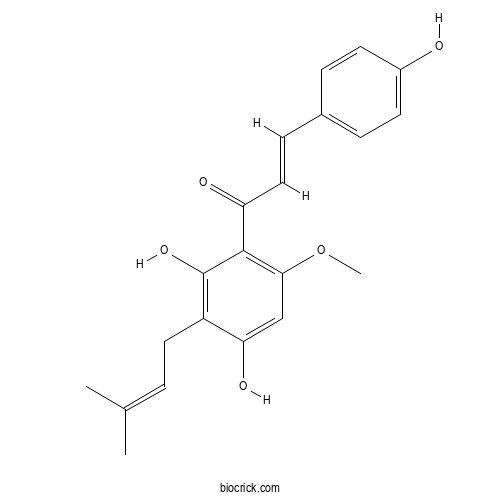
XanthohumolCAS# 6754-58-1 |
| Cas No. | 6754-58-1 | SDF | File under preparation. |
| PubChem ID | 639665.0 | Appearance | Orange powder |
| Formula | C21H22O5 | M.Wt | 354.4 |
| Type of Compound | N/A | Storage | Desiccate at -20°C |
| Solubility | Soluble in Chloroform,Dichloromethane,Ethyl Acetate,DMSO,Acetone,etc. | ||
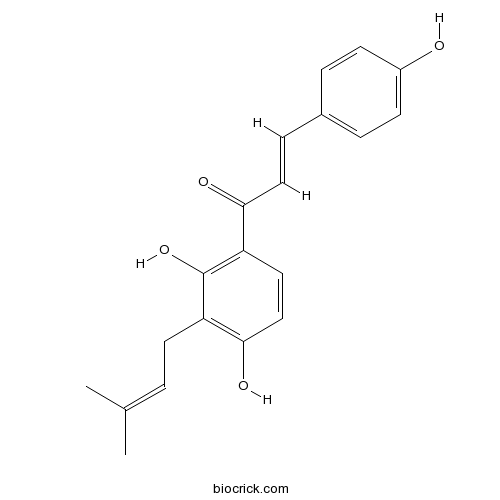
| Chemical Name | (E)-1-[2,4-dihydroxy-6-methoxy-3-(3-methylbut-2-enyl)phenyl]-3-(4-hydroxyphenyl)prop-2-en-1-one | ||
| SMILES | CC(=CCC1=C(C(=C(C=C1O)OC)C(=O)C=CC2=CC=C(C=C2)O)O)C | ||
| Standard InChIKey | ORXQGKIUCDPEAJ-YRNVUSSQSA-N | ||
| Standard InChI | InChI=1S/C21H22O5/c1-13(2)4-10-16-18(24)12-19(26-3)20(21(16)25)17(23)11-7-14-5-8-15(22)9-6-14/h4-9,11-12,22,24-25H,10H2,1-3H3/b11-7+ | ||
| General tips | For obtaining a higher solubility , please warm the tube at 37 ℃ and shake it in the ultrasonic bath for a while.Stock solution can be stored below -20℃ for several months. We recommend that you prepare and use the solution on the same day. However, if the test schedule requires, the stock solutions can be prepared in advance, and the stock solution must be sealed and stored below -20℃. In general, the stock solution can be kept for several months. Before use, we recommend that you leave the vial at room temperature for at least an hour before opening it. |
||
| About Packaging | 1. The packaging of the product may be reversed during transportation, cause the high purity compounds to adhere to the neck or cap of the vial.Take the vail out of its packaging and shake gently until the compounds fall to the bottom of the vial. 2. For liquid products, please centrifuge at 500xg to gather the liquid to the bottom of the vial. 3. Try to avoid loss or contamination during the experiment. |
||
| Shipping Condition | Packaging according to customer requirements(5mg, 10mg, 20mg and more). Ship via FedEx, DHL, UPS, EMS or other couriers with RT, or blue ice upon request. | ||
Quality Control & MSDS
3D structure
Package In Stock

Number of papers citing our products


Xanthohumol Dilution Calculator
Xanthohumol Molarity Calculator
-
 XanthohumolCatalog No.: BCN5768CAS No.: 569-83-5
-
 DesmethylxanthohumolCatalog No.: BCN2997CAS No.: 115063-39-3
-
 Xanthohumol DCatalog No.: BCN5162CAS No.: 274675-25-1
-
 4-HydroxyderricinCatalog No.: BCX1629CAS No.: 55912-03-3
-
 4'-O-Methylbroussochalcone BCatalog No.: BCN4908CAS No.: 20784-60-5
-
 3'-MethylflavokawinCatalog No.: BCN3990CAS No.: 1044743-35-2
-
 IsobavachalconeCatalog No.: BCN5415CAS No.: 20784-50-3
-
 2'-O-MethylhelichrysetinCatalog No.: BCN4792CAS No.: 123316-64-3
-
 HelichrysetinCatalog No.: BCN4149CAS No.: 62014-87-3
| 1 mg | 5 mg | 10 mg | 20 mg | 25 mg | |
| 1 mM | 2.8217 mL | 14.1084 mL | 28.2167 mL | 56.4334 mL | 70.5418 mL |
| 5 mM | 0.5643 mL | 2.8217 mL | 5.6433 mL | 11.2867 mL | 14.1084 mL |
| 10 mM | 0.2822 mL | 1.4108 mL | 2.8217 mL | 5.6433 mL | 7.0542 mL |
| 50 mM | 0.0564 mL | 0.2822 mL | 0.5643 mL | 1.1287 mL | 1.4108 mL |
| 100 mM | 0.0282 mL | 0.1411 mL | 0.2822 mL | 0.5643 mL | 0.7054 mL |
| * Note: If you are in the process of experiment, it's necessary to make the dilution ratios of the samples. The dilution data above is only for reference. Normally, it's can get a better solubility within lower of Concentrations. | |||||
- 5-Methoxyjatrointelignan D
Catalog No.:BCX2526
CAS No.:2170998-22-6
- Jatrointelignan D
Catalog No.:BCX2525
CAS No.:1621072-64-7
- N-(2-Hydroxy-3-methylbutyl)adenine
Catalog No.:BCX2524
CAS No.:22662-00-6
- Cepharanthine 2'-β-N-oxide
Catalog No.:BCX2523
CAS No.:104386-92-7
- N-Lauryldiethanolamine
Catalog No.:BCX2522
CAS No.:1541-67-9
- Scutolide K
Catalog No.:BCX2521
CAS No.:1651888-30-0
- Scutebata L
Catalog No.:BCX2520
CAS No.:1369525-17-6
- Pinobanksin 3-O-caffeate
Catalog No.:BCX2519
CAS No.:1220531-15-6
- Glucoindol B
Catalog No.:BCX2518
CAS No.:23099-32-3
- 4-(2-Nitroethyl)phenol
Catalog No.:BCX2517
CAS No.:37567-58-1
- 3-Hydroxy-3-phenyl-1-(4,6,7-trimethoxybenzofuran-5-yl)prop-2-en-1-one
Catalog No.:BCX2516
CAS No.:131694-13-8
- 1-Pentacosanol
Catalog No.:BCX2515
CAS No.:26040-98-2
- Ginsenoside Rs2
Catalog No.:BCX2528
CAS No.:87733-66-2
- Vinaginsenoside R2
Catalog No.:BCX2529
CAS No.:156980-42-6
- Majonoside R2
Catalog No.:BCX2530
CAS No.:81534-63-6
- Majonoside R1
Catalog No.:BCX2531
CAS No.:81534-62-5
- Notoginsenoside SFt3
Catalog No.:BCX2532
CAS No.:1351360-27-4
- Eudesmane-1β, 6α,11-triol
Catalog No.:BCX2533
CAS No.:1804930-14-0
- 12α-Hydroxyamoorastatone
Catalog No.:BCX2534
CAS No.:152013-84-8
- Homoaromoline
Catalog No.:BCX2535
CAS No.:17132-74-0
- 1-O-Linolenoylglycerol
Catalog No.:BCX2536
CAS No.:18465-99-1
- Methyl 6-methoxycarbazole-3-carboxylate
Catalog No.:BCX2537
CAS No.:132922-58-8
- 1-Monolinolein
Catalog No.:BCX2538
CAS No.:2277-28-3
- Desinapoylhazaleanin A
Catalog No.:BCX2539
CAS No.:147742-26-5
In Silico and In Vitro Evaluation of Calm Supplement Constituents on Antidepressant-Related Molecular Targets and Neuroplasticity-Associated Gene Expression.[Pubmed:42652132]
Biomedicines. 2026 Aug 3;14(8):1749.
Background: Depression-related mechanisms involve not only monoaminergic neurotransmission but also neurotrophic signaling, synaptic plasticity and intracellular survival pathways. Materials and Methods: In this study, the potential neuropharmacological properties of Calm, a multi-component supplement product, were evaluated using in silico and in vitro approaches. Molecular docking analyses were performed to estimate the binding profiles of Calm-derived constituents and reference antidepressants, sertraline and fluoxetine, against SLC6A4, MAOA, AKT1 and NTRK2. In parallel, SH-SY5Y human neuroblastoma cells were treated with Calm, and MTT-based metabolic activity and the relative expression levels of BDNF, NTRK2 and SYN1 were assessed after 24 h. Results: Docking results showed that several Calm constituents, particularly apigenin, rosmarinic acid, Xanthohumol and valerenic acid, exhibited favorable predicted interactions with SLC6A4 and NTRK2. Calm treatment increased MTT signal at low concentrations, with significant increases observed at 10, 30, and 60 microg/mL. However, 24 h exposure to 10 microg/mL Calm significantly reduced BDNF, NTRK2 and SYN1 expression levels. Conclusions: These findings suggest that Calm constituents may interact with antidepressant-related molecular targets and modulate neuroplasticity-associated transcriptional markers. However, the results should be considered preliminary and require protein-level and functional validation.
Xanthohumol and its non-estrogenic derivatives link to the gut-liver-brain axis to improve cognition in mice with diet-induced obesity.[Pubmed:42620357]
Front Physiol. 2026 Aug 5;17:1886058.
Obesity-associated cognitive decline represents a growing public health concern, yet the mechanisms linking high-fat diet (HFD) to neurological impairment remain incompletely understood. Xanthohumol (XN) and its non-estrogenic derivatives, tetrahydroXanthohumol (TXN) and alpha,beta-dihydro-Xanthohumol (DXN), improve metabolic dysfunction and cognitive impairment associated with diet-induced obesity. The mechanisms underlying these cognitive benefits remain poorly defined, but all three compounds improve glucose tolerance, spatial learning and memory in obese C57BL/6J mice. We hypothesized that the gut-liver-brain axis associates with these effects through modulation of gut microbial functional capacity and host ceramide metabolism. To test this, we integrated shotgun metagenomes with lipidomic and behavioral data from male C57BL/6J mice fed a HFD supplemented with XN, TXN, or DXN to determine (1) whether supplementation differentially alters gut metagenome functional capacity, (2) whether variation in the gut metagenome links to cognitive outcomes, and (3) whether supplementation-induced variation in the gut metagenome is associated with alterations in ceramide and bile acid levels in the liver and hippocampus. We found that microbial gene abundance was associated with spatial learning outcomes across all treatment groups, including genes involved in tryptophan metabolism. Gut microbiome composition was also linked to ceramide levels in both hepatic and hippocampal tissues, with C22 ceramide emerging as a shared biomarker. TXN supplementation additionally reduced secondary bile acids HDCA and a DCA-isomer, extending prior 16S rRNA-based findings to the level of microbial gene function. Collectively, these results are consistent with a model in which XN and its derivatives act upon the gut-liver-brain axis to improve cognition in obese mice in association with changes to gut microbial functional capacity (most notably in bile acid and ceramide metabolism, with tryptophan metabolism as a secondary observation).
Myco-assisted zinc oxide nanoparticles by Aspergillus sp. SA18: Chemical profiling, antimicrobial, anticancer, and computational insights into GyrA and GyrB inhibition with ADME physicochemical properties.[Pubmed:42542237]
Arch Biochem Biophys. 2026 Nov;785:110952.
This study aimed to biosynthesize zinc oxide nanoparticles (ZnONPs) using a marine-derived Aspergillus sp. SA18 fungal extract and assess their antimicrobial and anticancer properties. ZnONPs were characterized by UV-Vis. spectroscopy, FTIR, XRD, TEM, SEM, and zeta potential analyses. Characterization approved successful nanoparticle synthesis, with a crystalline structure and an average particle size of 75 nm based on XRD analysis, while TEM and SEM exposed polydisperse spherical particles ranging from 80 to 96 nm. The synthesized ZnONPs showed a zeta potential of -21.03 mV, demonstrating good colloidal stability. Antimicrobial test demonstrated prominent activity, with the fungal extract displaying the highest inhibition zones against Pseudomonas aeruginosa and Candida albicans (16 mm each). Cytotoxicity assessment disclosed strong anticancer activity of the fungal extract against MCF-7 and HepG2 cell lines, with IC(50) values of 9.75 +/- 0.7 and 22.81 +/- 1.7 muM, respectively, while ZnONPs displayed IC(50) values of 46.11 +/- 2.7 and 74.96 +/- 3.8 muM against the same cell lines. Chemical profiling identified 48 metabolites, including flavonoids and phenolic acids, which may contribute to the observed bioactivities. Molecular docking showed strong binding affinities of Xanthohumol toward E. coli GyrB (docking score = -8.47 kcal/mol) and herbacetin toward c-Src kinase (docking score = -8.81 kcal/mol), supported by molecular dynamics simulations and favorable ADME properties. These findings prove that Aspergillus sp. SA18-mediated ZnONPs possess auspicious antimicrobial and anticancer potential and highlight this marine fungal isolate as an efficient nanofactory for biomedical applications.
Biopolymer Surface Modification as a Strategy for Conferring "Stealth-like" Characteristics of Xanthohumol-Loaded Liposomes.[Pubmed:42514775]
Polymers (Basel). 2026 Jul 13;18(14):1724.
Xanthohumol (XN), a prenylated chalcone isolated from Humulus lupulus L., exhibits a wide range of biological activities, including antioxidant, anti-inflammatory, and chemopreventive effects. However, its therapeutic application is limited by poor aqueous solubility, low chemical stability, and rapid clearance from the systemic circulation. The present study aimed to develop and characterize a novel nano-sized drug-delivery system for XN that combines favourable colloidal stability, efficient encapsulation, sustained release, and reduced recognition by macrophages ("stealth-like" properties). To achieve this, XN-loaded cationic liposomes were coated with two marine polysaccharides, iota-carrageenan (CAR) and fucoidan (FUC), followed by Ca(2+)-mediated cross-linking. Liposomes were prepared by the ethanol injection method, and formulation parameters were optimized using a 2(3) + 1 full factorial design. Surface modification and cross-linking conditions were further optimized through polyelectrolyte titration and a Taguchi L9 orthogonal array. The resulting nanocarriers were evaluated for particle size, polydispersity, zeta-potential, encapsulation efficiency, release behavior, and cellular uptake. Both coatings significantly prolonged XN release compared with uncoated liposomes, with CAR-coated vesicles providing the most sustained release ( approximately 55% over 48 h). In RAW264.7 macrophages, 50 microg/mL CAR-coated liposomes reduced cellular uptake by approximately 74% following 1-h incubation relative to uncoated controls and maintained this reduction over 2 h whereas FUC-coated vesicles afforded only transient early evasion. The cross-linked iota-carrageenan coating thus represents a promising strategy for conferring stable "stealth-like" characteristics to XN-loaded liposomes intended for prolonged drug delivery.
Antimicrobial and antibiofilm activity of selected flavonoids against pathogenic Leptospira species.[Pubmed:42489895]
Arch Microbiol. 2026 Jul 23;208(10):506.
Leptospirosis is a widespread zoonotic disease where biofilm formation significantly hinders treatment, contributing to chronic infections. This preliminary study evaluated the antimicrobial and antibiofilm properties of four flavonoids-apigenin, Xanthohumol, quercetin, and luteolin-against Leptospira santarosai (sv. Guaricura), L. interrogans (sv. Copenhageni and Hardjoprajitno), and L. borgpetersenii (sv. Hardjobovis). Using microdilution methods, quercetin and apigenin exhibited superior antimicrobial activity, reaching MICs of
Bitter but beneficial: Hop-based feed additives for fighting antimicrobial resistance in poultry.[Pubmed:42468149]
Poult Sci. 2026 Oct;105(10):107376.
Antimicrobial resistance (AMR) is an increasing challenge in the global production of poultry, where antibiotics have traditionally been used to promote growth. Phytogenic feed additives (PFAs), particularly hop-based ones, could be a sustainable alternative due to their antimicrobial properties. The present study investigated two hop extracts from two sources, which are Type 90 hop pellets derived from fresh hops and residue of same hop pellets that had previously undergone CO(2) extraction, using a cross-model analysis combining in vitro (viability assay/broth dilution assay), ex ovo (shell-less hen's egg test) and in vivo tests. Both types of extracts exhibited antimicrobial activity in vitro and high biocompatibility in the ex ovo model. Notably, the biocompatibility was improved for ex ovo setup, compared to in vitro cytotoxicity, providing important insights regarding their potential application as PFAs. For in vivo studies, hop extracts were microencapsulated as solid lipid microspheres to increase their stability and bioavailability. Feeding animals microencapsulated hop extracts or Xanthohumol-rich residue from CO(2) extraction led to a significant reduction specifically of Gram-negative intestinal bacteria, with no change in animal performance. Overall, two promising products were identified that could potentially be used as a sustainable alternative to antibiotics in poultry production.
Metabolomics-based study of the preservation mechanism of a tea saponin-cinnamaldehyde nanoemulsion applied to Xinyu tangerines.[Pubmed:42399109]
J Sci Food Agric. 2026 Jul 3.
BACKGROUND: The Xinyu tangerine is a geographical indication agricultural product from Jiangxi province, China. During postharvest storage, nutrient loss and pathogen-induced decay reduce fruit quality. The selection of appropriate preservatives is therefore important for maintaining postharvest quality. Previous studies have shown that tea saponin-cinnamaldehyde nanoemulsion (TS-CNE) exhibits excellent antifungal activity and physicochemical properties suitable for citrus preservation. This study investigated the preservation efficacy and underlying mechanism of TS-CNE in Xinyu tangerines using metabolomics. RESULTS: The TS-CNE treatment maintained fruit firmness and color, reduced the decay rate, decreased malondialdehyde (MDA) and H(2)O(2) accumulation in the peel, and increased the total phenolic, flavonoid, and anthocyanin content in the pulp. Untargeted metabolomic analysis showed that the levels of nobiletin, 4'-methoxyflavanone, kaempferol, neoliquiritin, deoxyloganic acid, Xanthohumol, melilotoside, d-arabinose, and epigallocatechin in the peel were higher in the TS-CNE-treated group than in the control group. Treatment with TS-CNE can regulate pathways related to adenosine triphosphate-binding cassette (ABC) transporters, flavonoid biosynthesis, and phenylpropanoid biosynthesis. CONCLUSION: The TS-CNE treatment effectively preserved postharvest Xinyu tangerines. The preservation mechanism may involve reduced fruit decay during storage through increased accumulation of stress-responsive metabolites, including flavonoids and phenylalanine, in the peel. These findings provide a theoretical basis for the development and application of TS-CNE for postharvest disease control in citrus fruit. (c) 2026 The Author(s). Journal of the Science of Food and Agriculture published by John Wiley & Sons Ltd on behalf of Society of Chemical Industry.
In silico identification of DNMT1 inhibitors from the PlantCyc database through computational approach to assess the anti-cancer potential of nutraceutical compounds in breast cancer.[Pubmed:42323936]
J Mol Graph Model. 2026 Nov;148:109495.
Breast cancer accounts for a disproportionate share of global cancer-related deaths, with 670,000 fatalities and 2.3 million new diagnoses recorded in women during 2022 alone. Existing treatment modalities carry considerable toxicity burdens, and resistance to available agents remains an unresolved clinical problem. DNA methyltransferase 1 (DNMT1), the enzyme chiefly responsible for maintaining genome-wide methylation patterns during DNA replication, has been mapped out as a high-value target in breast cancer because its dysregulation silences tumour suppressor genes through promoter hypermethylation. The present work involves hierarchical in silico workflow to screen 4549 plant-derived compounds from the PlantCyc database (v16.0.3) against the human DNMT1 catalytic domain (PDB ID: 4WXX). Ten top-scoring compounds were taken forward for molecular docking via AutoDock Vina; Quercetin and Kaempferol both recorded the highest binding affinities at -9.5 kcal/mol, Wogonin (-9.3 kcal/mol) and Xanthohumol (-8.1 kcal/mol) also emerged as strong binders. Pharmacokinetic evaluation using ADMET-AI confirmed that all 10 compounds met Lipinski's rule of five, with human intestinal absorption values at or above 0.98. Wogonin and Xanthohumol were selected for a 100 ns all-atom molecular dynamics (MD) simulation in GROMACS due to their well-rounded ADMET profiles and limited existing data on their specific interactions with DNMT1 in breast cancer. Across all measured trajectory metrics, backbone RMSD, residue fluctuation, radius of gyration, solvent-accessible surface area, and intermolecular hydrogen bond count, Wogonin formed a more stable, compact complex. These findings suggest that Wogonin and Xanthohumol are non-toxic nutraceutical candidates suitable for DNMT1 targeted epigenetic therapy, with computational foundation strong enough to facilitate future in vitro and in vivo validation work.
Interactions of hop xanthohumols with model membranes and their toxicity to cancer and erythrocytes cells.[Pubmed:42235302]
Chem Biol Interact. 2026 Jul 25;435:112168.
Prenylated hydroxychalcones (Xanthohumols) are hop-derived flavonoids with promising anticancer activity; however, their membrane interactions and structure-activity relationships remain incompletely understood. Here, Xanthohumol C (XHC) and its semi-synthetic derivatives, 1'',2''-dihydroXanthohumol C (DHXHC) and 1'',2''-dihydroXanthohumol K (DHXHK), were evaluated for cytotoxic, pro-apoptotic, and membrane-modulating effects in comparison with Xanthohumol (XH). In vitro antiproliferative activity against eleven human and one murine cancer cell lines yielded IC(50) values in the micromolar range, with XHC showing the highest activity toward epidermoid carcinoma, urinary bladder carcinoma, and glioblastoma cells. Apoptosis induction was confirmed in MCC-13 Merkel carcinoma cells. Hemolytic activity toward human erythrocytes was concentration-dependent in the range of 10-100 muM, with XHC classified as toxic at 100 muM, while DHXHC and DHXHK were only slightly toxic. Membrane interactions were studied using fluorescence spectroscopy in cancer cell-mimicking lipid membranes. At low micromolar concentrations (0.5-5 muM), XHC and DHXHC increased DPH anisotropy, indicating membrane stiffening, while Laurdan generalized polarization decreased, consistent with enhanced interfacial hydration. In contrast, DHXHK showed negligible membrane effects. These results suggest that differences in molecular structure, including planarity, may contribute to the observed variation in membrane interactions and cytotoxic effects among Xanthohumol derivatives.
Mixture dependent correlation patterns in antibacterial and cytotoxic activities of five hop isolates.[Pubmed:42225839]
Sci Rep. 2026 May 30;16(1):16805.
Antimicrobial resistance (AMR) has resulted in the need for the development of alternative strategies for combating pathogens and growth promotion of poultry, including the use of plant-derived compounds such as hop (Humulus lupulus) isolates. The present study evaluates the correlation patterns of the biological activity of five major hop isolates (humulone, lupulone, isohumulone, Xanthohumol, and isoXanthohumol) against Bacillus subtilis, Micrococcus luteus, and a chicken cell line UMNSAH/DF-1 using a two-dimensional checkerboard assay. Fractional inhibitory concentrations ( summation operatorFIC) were used to classify interactions as additive, synergistic, or antagonistic, and selectivity indices assessed antibacterial versus cytotoxic effects. On B. subtilis, combinations were predominantly additive ( summation operatorFIC = 0.89-1.15), whereas M. luteus, in contrast, showed variable interactions, including also synergistic (humulone + lupulone, summation operatorFIC = 0.43 +/- 0.18) and antagonistic combinations (isohumulone + isoXanthohumol, summation operatorFIC = 1.53 +/- 0.38), demonstrating the impact of the metabolic resilience of the target organism. Cytotoxicity in UMNSAH/DF-1 cells was largely additive, with synergistic effects observed only for isomerized compounds ( summation operatorFIC = 0.50 +/- 0.23). Selectivity analysis highlighted humulone-lupulone combinations with selective indices of 3.2 for M. luteus and 1.3 for B. subtilis as most favorable, indicating moderate to good antibacterial selectivity. These results provide novel insights for selecting hop isolate combinations for the development of phytogenic feed additives (PFAs), emphasizing that both compound composition and target organism physiology critically shape efficacy and safety outcomes.
Cyclization of xanthohumol as a strategy for its gas chromatographic analysis.[Pubmed:42225031]
Food Chem. 2026 Aug 15;520:149882.
Xanthohumol is a prenylated flavonoid present in female hop inflorescences, attracting scientific interest due to its diverse bioactive properties. Its high boiling point (576.5 degrees C) renders liquid chromatography the primary analytical technique for its determination in various matrices. This study is the first to demonstrate that Xanthohumol can be successfully analyzed by gas chromatography after conversion to its cyclic pyran form via intramolecular addition of the phenolic OH group to the -C=C- bond. Experimental results indicate that BF(3).Et(2)O is the most effective catalyst, enabling nearly complete transformation of Xanthohumol into its pyran derivative. The developed method was validated, showing excellent linearity (R(2) >/= 0.985), precision (< 6%), accuracy (> 95%), and low detection limits (< 0.13 mug/mL). Its applicability was confirmed through analyses of beer, dietary supplements, hop cones, and plasma samples containing Xanthohumol. The described procedure can also be used for GC analysis of isoXanthohumol in the same matrices.
A phenotypic screen identifies xanthohumol and other flavonoids as killers of bladder cancer.[Pubmed:42221531]
Pharmacol Res Nat Prod. 2025 Jun;7:100236.
Bladder cancer accounts for 4 % of cancer diagnoses in the US. Current treatments primarily involve trans-urethral resection of bladder tumors (TURBT) and immunotherapy with Bacille Calmette-Guerin (BCG). Despite the efficacy of TURBT, issues with residual tumors persist. We chose to utilize Cell Painting to screen a set of 244 flavonoid compounds for bladder cancer cell toxicity. Using multiparametric high content analysis termed SPACe, we discover promising candidates underscoring the potential of flavonoids in targeting bladder cancer cells and elucidating their mechanisms of action. Notably, compounds such as Xanthohumol show promise in reducing cancer cell viability by altering lipid metabolism. We further show the effectiveness of hit compounds in subsequent spheroid and chorioallantoic membrane systems. Overall, this research emphasizes the role of innovative screening methods in drug discovery and potential synergistic effects of combining flavonoids with existing therapies like BCG for improved bladder cancer treatment outcomes.
The Influence of Hop Prenylated Chalcones on Mitochondrial Membrane Potential Depolarization and a Response to Oxidative Stress in MCC13 Merkel Cells.[Pubmed:42198360]
Pharmaceuticals (Basel). 2026 Apr 27;19(5):687.
Background: Prenylated chalcones are recognized for their beneficial nutritional properties and have attracted increasing interest due to their anticancer activities, which involve various mechanisms and pathways. In the current study, we investigated the influence of prenylated chalcone Xanthohumol (XH) and its two minor derivatives Xanthohumol C (XHC) and 1'',2''-dihydroxantohumol C (DHXHC) on the formation of reactive oxygen species (ROS), causing oxidative stress. Concomitantly, we studied the effect of mitochondrial transmembrane potential changes on human skin cancer, namely Merkel cell carcinoma (MCC13). Methods: The cancer cells were treated with the mentioned compounds for 24 and 48 h at various concentrations. Results: Our findings showed that ROS generation was dose-dependent at 24 h for Xanthohumol, whereas for Xanthohumol C and 1''2''-dihydroXanthohumol C, a significant increase in ROS occurred only at the highest concentration (100 muM) after 48 h. Mitochondrial membrane potential was significantly diminished by all the compounds. Conclusions: Taken together, our results indicate that the aforementioned chalcones exhibit cytotoxic activity against the MCC13 cell line and may be promising candidates for further investigation as anticancer agents.
Microbial production of xanthohumol driven by synthetic biology approaches.[Pubmed:42189397]
World J Microbiol Biotechnol. 2026 May 26;42(6):303.
Xanthohumol is a high-value natural product with unique features, such as its antioxidant, anti-inflammatory, and anticancer properties. The excellent features enable its wide utilization in the cosmetic, pharmaceutical, nutraceutical, and food industries. However, the low yields and high production costs impede its large-scale production significantly. Its sustainable production has been limited by inefficient, costly, and environmentally unfriendly conventional extraction processes. Recently, the development of microbial synthetic biology has provided a reliable, scalable, and eco-friendly mechanism for Xanthohumol production. In this paper, the development of bio-strategies for the commercial-scale production of Xanthohumol is summarized. Furthermore, the techno-economic feasibility was also evaluated. In the future, further attempt will still be required for Xanthohumol production using synthetic biology.

Calcutta University

University of Minnesota

University of Maryland School of Medicine

University of Illinois at Chicago

The Ohio State University

University of Zurich

Harvard University

Colorado State University

Auburn University

Yale University

Worcester Polytechnic Institute

Washington State University

Stanford University

University of Leipzig

Universidade da Beira Interior

The Institute of Cancer Research

Heidelberg University

University of Amsterdam

University of Auckland

TsingHua University

The University of Michigan

Miami University

DRURY University

Jilin University

Fudan University

Wuhan University

Sun Yat-sen University

Universite de Paris

Deemed University

Auckland University

The University of Tokyo

Korea University



