
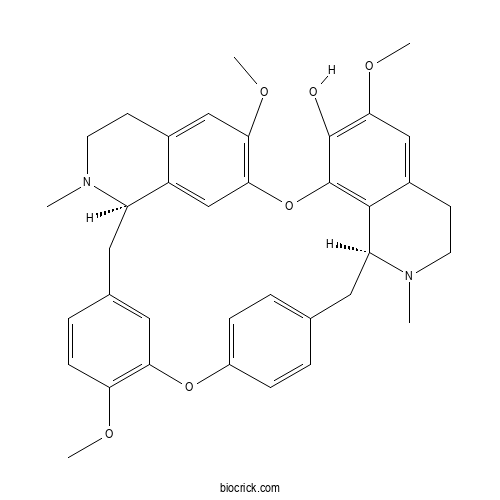
HomoaromolineCAS# 17132-74-0 |
| Cas No. | 17132-74-0 | SDF | File under preparation. |
| PubChem ID | 99620.0 | Appearance | Powder |
| Formula | C37H40N2O6 | M.Wt | 608.7 |
| Type of Compound | N/A | Storage | Desiccate at -20°C |
| Solubility | Soluble in Chloroform,Dichloromethane,Ethyl Acetate,DMSO,Acetone,etc. | ||
| Chemical Name | (1R,14S)-6,20,25-trimethoxy-15,30-dimethyl-8,23-dioxa-15,30-diazaheptacyclo[22.6.2.29,12.13,7.114,18.027,31.022,33]hexatriaconta-3(36),4,6,9(35),10,12(34),18,20,22(33),24,26,31-dodecaen-21-ol | ||
| SMILES | CN1CCC2=CC(=C(C3=C2C1CC4=CC=C(C=C4)OC5=C(C=CC(=C5)CC6C7=CC(=C(C=C7CCN6C)OC)O3)OC)O)OC | ||
| Standard InChIKey | YJRWQNIRFXVBRB-WDYNHAJCSA-N | ||
| Standard InChI | InChI=1S/C37H40N2O6/c1-38-14-12-24-19-31(42-4)33-21-27(24)28(38)17-23-8-11-30(41-3)32(18-23)44-26-9-6-22(7-10-26)16-29-35-25(13-15-39(29)2)20-34(43-5)36(40)37(35)45-33/h6-11,18-21,28-29,40H,12-17H2,1-5H3/t28-,29+/m1/s1 | ||
| General tips | For obtaining a higher solubility , please warm the tube at 37 ℃ and shake it in the ultrasonic bath for a while.Stock solution can be stored below -20℃ for several months. We recommend that you prepare and use the solution on the same day. However, if the test schedule requires, the stock solutions can be prepared in advance, and the stock solution must be sealed and stored below -20℃. In general, the stock solution can be kept for several months. Before use, we recommend that you leave the vial at room temperature for at least an hour before opening it. |
||
| About Packaging | 1. The packaging of the product may be reversed during transportation, cause the high purity compounds to adhere to the neck or cap of the vial.Take the vail out of its packaging and shake gently until the compounds fall to the bottom of the vial. 2. For liquid products, please centrifuge at 500xg to gather the liquid to the bottom of the vial. 3. Try to avoid loss or contamination during the experiment. |
||
| Shipping Condition | Packaging according to customer requirements(5mg, 10mg, 20mg and more). Ship via FedEx, DHL, UPS, EMS or other couriers with RT, or blue ice upon request. | ||
Quality Control & MSDS
3D structure
Package In Stock

Number of papers citing our products


Homoaromoline Dilution Calculator
Homoaromoline Molarity Calculator
-
 Demethyl tetrandrineCatalog No.: BCN2624CAS No.: 33889-68-8
-
 FangchinolineCatalog No.: BCN5956CAS No.: 436-77-1
-
 (-)-CurineCatalog No.: BCN2673CAS No.: 436-05-5
-
 BebeerineCatalog No.: BCX1620CAS No.: 477-60-1
-
 IsotetrandrineCatalog No.: BCN5538CAS No.: 477-57-6
-
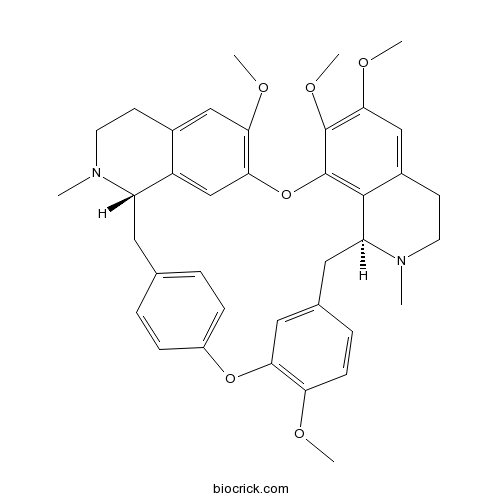 TetrandrineCatalog No.: BCN5955CAS No.: 518-34-3
-
 ThalidezineCatalog No.: BCN7763CAS No.: 18251-36-0
-
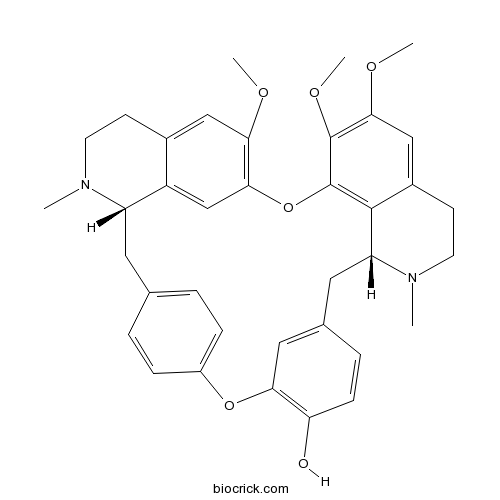 BerbamineCatalog No.: BCN5543CAS No.: 478-61-5
-
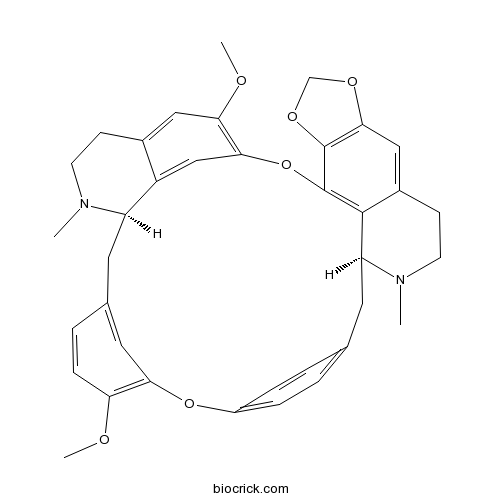 CepharanthineCatalog No.: BCN5393CAS No.: 481-49-2
-
 ThalrugosidineCatalog No.: BCN7785CAS No.: 33954-34-6
-
 Berbamine hydrochlorideCatalog No.: BCN2400CAS No.: 6078-17-7
-
 Oxyacanthine hydrochlorideCatalog No.: BCN9997CAS No.: 15352-74-6
-
 IsochondodendrineCatalog No.: BCC9234CAS No.: 477-62-3
-
 ThalrugosaminineCatalog No.: BCN7745CAS No.: 22226-73-9
-
 HernandezineCatalog No.: BCN7793CAS No.: 6681-13-6
-
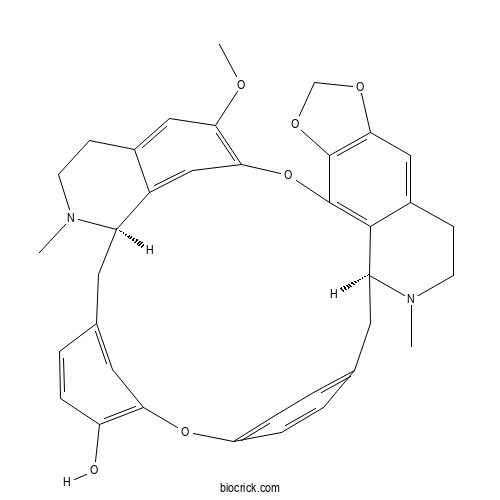 CepharanolineCatalog No.: BCX0931CAS No.: 27686-34-6
-
 Oxyacanthine sulfateCatalog No.: BCN9966CAS No.: 6183-91-1
-
 Isotetrandrine N-2'-oxideCatalog No.: BCN4264CAS No.: 70191-83-2
-
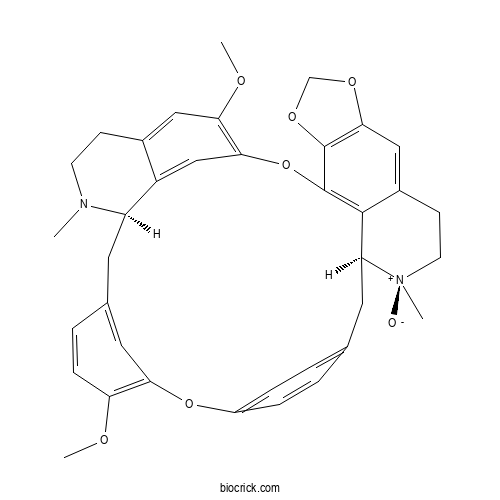 Cepharanthine 2'-β-N-oxideCatalog No.: BCX2523CAS No.: 104386-92-7
| 1 mg | 5 mg | 10 mg | 20 mg | 25 mg | |
| 1 mM | 1.6428 mL | 8.2142 mL | 16.4285 mL | 32.8569 mL | 41.0711 mL |
| 5 mM | 0.3286 mL | 1.6428 mL | 3.2857 mL | 6.5714 mL | 8.2142 mL |
| 10 mM | 0.1643 mL | 0.8214 mL | 1.6428 mL | 3.2857 mL | 4.1071 mL |
| 50 mM | 0.0329 mL | 0.1643 mL | 0.3286 mL | 0.6571 mL | 0.8214 mL |
| 100 mM | 0.0164 mL | 0.0821 mL | 0.1643 mL | 0.3286 mL | 0.4107 mL |
| * Note: If you are in the process of experiment, it's necessary to make the dilution ratios of the samples. The dilution data above is only for reference. Normally, it's can get a better solubility within lower of Concentrations. | |||||
- 12α-Hydroxyamoorastatone
Catalog No.:BCX2534
CAS No.:152013-84-8
- Eudesmane-1β, 6α,11-triol
Catalog No.:BCX2533
CAS No.:1804930-14-0
- Notoginsenoside SFt3
Catalog No.:BCX2532
CAS No.:1351360-27-4
- Majonoside R1
Catalog No.:BCX2531
CAS No.:81534-62-5
- Majonoside R2
Catalog No.:BCX2530
CAS No.:81534-63-6
- Vinaginsenoside R2
Catalog No.:BCX2529
CAS No.:156980-42-6
- Ginsenoside Rs2
Catalog No.:BCX2528
CAS No.:87733-66-2
- Xanthohumol
Catalog No.:BCX2527
CAS No.:6754-58-1
- 5-Methoxyjatrointelignan D
Catalog No.:BCX2526
CAS No.:2170998-22-6
- Jatrointelignan D
Catalog No.:BCX2525
CAS No.:1621072-64-7
- N-(2-Hydroxy-3-methylbutyl)adenine
Catalog No.:BCX2524
CAS No.:22662-00-6
- Cepharanthine 2'-β-N-oxide
Catalog No.:BCX2523
CAS No.:104386-92-7
- 1-O-Linolenoylglycerol
Catalog No.:BCX2536
CAS No.:18465-99-1
- Methyl 6-methoxycarbazole-3-carboxylate
Catalog No.:BCX2537
CAS No.:132922-58-8
- 1-Monolinolein
Catalog No.:BCX2538
CAS No.:2277-28-3
- Desinapoylhazaleanin A
Catalog No.:BCX2539
CAS No.:147742-26-5
- 11,13-Dehydrolanuginolide
Catalog No.:BCX2540
CAS No.:50764-09-5
- Trichotomoside
Catalog No.:BCX2541
CAS No.:881421-12-1
- Bisnorponcitrin
Catalog No.:BCX2542
CAS No.:158443-92-6
- 3β,16-Dihydroxycleroda-4(18),13-dien-15,16-olide
Catalog No.:BCX2543
CAS No.:935293-69-9
- HN saponin F
Catalog No.:BCX2544
CAS No.:39524-13-5
- 14-Acetoxycostunolide
Catalog No.:BCX2545
CAS No.:2755714-73-7
- Drypetesin B
Catalog No.:BCX2546
CAS No.:1909225-87-1
- 4-Megastigmene-3,9-dione
Catalog No.:BCX2547
CAS No.:74233-41-3
Identifying plant-derived antiviral alkaloids as dual inhibitors of SARS-CoV-2 main protease and spike glycoprotein through computational screening.[Pubmed:39086396]
Front Pharmacol. 2024 Jul 17;15:1369659.
COVID-19 is currently considered the ninth-deadliest pandemic, spreading through direct or indirect contact with infected individuals. It has imposed a consistent strain on both the financial and healthcare resources of many countries. To address this challenge, there is a pressing need for the development of new potential therapeutic agents for the treatment of this disease. To identify potential antiviral agents as novel dual inhibitors of SARS-CoV-2, we retrieved 404 alkaloids from 12 selected medicinal antiviral plants and virtually screened them against the renowned catalytic sites and favorable interacting residues of two essential proteins of SARS-CoV-2, namely, the main protease and spike glycoprotein. Based on docking scores, 12 metabolites with dual inhibitory potential were subjected to drug-likeness, bioactivity scores, and drug-like ability analyses. These analyses included the ligand-receptor stability and interactions at the potential active sites of target proteins, which were analyzed and confirmed through molecular dynamic simulations of the three lead metabolites. We also conducted a detailed binding free energy analysis of pivotal SARS-CoV-2 protein inhibitors using molecular mechanics techniques to reveal their interaction dynamics and stability. Overall, our results demonstrated that 12 alkaloids, namely, adouetine Y, evodiamide C, ergosine, hayatinine, (+)-Homoaromoline, isatithioetherin C, N,alpha-L-rhamnopyranosyl vincosamide, pelosine, reserpine, toddalidimerine, toddayanis, and zanthocadinanine, are shortlisted as metabolites based on their interactions with target proteins. All 12 lead metabolites exhibited a higher unbound fraction and therefore greater distribution compared with the standards. Particularly, adouetine Y demonstrated high docking scores but exhibited a nonspontaneous binding profile. In contrast, ergosine and evodiamide C showed favorable binding interactions and superior stability in molecular dynamics simulations. Ergosine demonstrated exceptional performance in several key pharmaceutical metrics. Pharmacokinetic evaluations revealed that ergosine exhibited pronounced bioactivity, good absorption, and optimal bioavailability. Additionally, it was predicted not to cause skin sensitivity and was found to be non-hepatotoxic. Importantly, ergosine and evodiamide C emerged as superior drug candidates for dual inhibition of SARS-CoV-2 due to their strong binding affinity and drug-like ability, comparable to known inhibitors like N3 and molnupiravir. This study is limited by its in silico nature and demands the need for future in vitro and in vivo studies to confirm these findings.
A new pyrrole alkaloid from the roots of Cissampelos pareira.[Pubmed:31135214]
Nat Prod Res. 2021 Jan;35(1):80-87.
Phytochemical investigation of the roots of Cissampelos pareira Linn. led to the isolation of one new pyrrole alkaloid, cissampeline (1), together with ten known alkaloids, (-)-curine (2), (-)-cyclanoline (3), (+)-tetrandrine (4), (+)-obaberine (5), (+)-obamegine (6), (-)-oblongine (7), (+)-Homoaromoline (8), (-)-nor-N׳-chondrocurine (9), trans-N-feruloyltyramine (10) and (+)-coclaurine (11). Their structures were elucidated by extensive NMR and MS spectroscopic analyses. Interestingly, compound 1 represents the first example of pyrrole alkaloid found in the genus Cissampelos. Moreover, compounds 5-11 were isolated for the first time from this genus. Among them, compound 6 showed the highest anti-acetylcholinesterase activity with an IC(50) value of 3.26 microM, whereas compound 8 displayed the most potent cytotoxicity against human colon cancer (HT29) cells with an IC(50) value of 7.89 microM.
Inhibition of Na(+),K(+)-ATPase by the extract of Stephania cephararantha HAYATA and bisbenzylisoquinoline alkaloid cycleanine, a major constituent.[Pubmed:12907236]
Biochem Pharmacol. 2003 Aug 1;66(3):379-85.
The Stephania cephararantha HAYATA extract, and its constituent bisbenzylisoquinoline alkaloids, such as cycleanine, cepharanthine, isotetrandrine, berbamine, Homoaromoline, and cepharanoline were studied for effects on Na(+),K(+)-ATPase activity. The S. cephararantha HAYATA extract inhibited Na(+),K(+)-ATPase activity with an apparent IC(50) value of 540 microg/mL. Cycleanine markedly inhibited Na(+),K(+)-ATPase activity with an IC(50) value of 6.2 x 10(-4)M. It slightly inhibited Mg(2+)-ATPase, H(+)-ATPase, and Ca(2+)-ATPase. No effects on alkaline and acid phosphatase activities were observed. The inhibition by isotetrandrine, Homoaromoline, cepharanthine, and berbamine was less marked, and cepharanoline showed no effect. Five synthetic analogues of cepharanthine slightly inhibited the activity. The mechanism of inhibition by cycleanine on Na(+),K(+)-ATPase activity was examined in detail, and the following results were obtained in the overall reaction: (1) the mode of inhibition was noncompetitive with respect to ATP; (2) the degree of inhibition was decreased with a decrease of K(+) concentration; (3) it was not affected by Na(+) concentration; (4) the inhibition mechanism was different from that of ouabain. The activity of K(+)-dependent p-nitrophenyl phosphatase, a partial reaction of Na(+),K(+)-ATPase, did not appear to have been inhibited by cycleanine in the reaction mixture containing 15 mM K(+) (optimum condition). However, cycleanine increased the K(0.5) value for K(+) and reduced the K(i) values for Na(+) and ATP, in K(+)-dependent p-nitrophenyl phosphatase. Cycleanine might interact with the enzyme in Na.E(1)-P form and prevents the reaction step from Na.E(1)-P to E(2)-P.
Cytotoxic and antimalarial bisbenzylisoquinoline alkaloids from Cyclea barbata.[Pubmed:8450318]
J Nat Prod. 1993 Jan;56(1):22-9.
An alkaloid extract derived from the roots of Cyclea barbata demonstrated cytotoxic and antimalarial activities, and five bisbenzylisoquinoline alkaloids, (+)-tetrandrine [1], (-)-limacine [2], (+)-thalrugosine [3], (+)-Homoaromoline [4], and (-)-cycleapeltine [5], were isolated as the active principles. The complete and unambiguous assignments of the 1H- and 13C-nmr data of these substances were made by 1D and 2D nmr techniques (COSY, phase-sensitive ROESY, HETCOR, and FLOCK).
Histamine release inhibition activity of bisbenzylisoquinoline alkaloids.[Pubmed:1484888]
Planta Med. 1992 Dec;58(6):505-8.
Eleven examples of bisbenzylisoquinoline alkaloids (head-to-head; 10, head-to-tail; 1) and one half molecule type (N-methylcoclaurine), were tested by in vitro histamine release inhibition assay. The order of the potency of the inhibitory effect was ranked thus: Homoaromoline, aromoline, isotetrandrine, cepharanthine, fangchinoline, obaberine, and tetrandrine. The following substances, cepharanoline, berbamine, oxyacanthine, and cycleanine (head-to-tail structure) had no inhibitory effect. N-Methylcoclaurine showed an inhibitory effect comparable to that of fangchinoline.
Displacement activity of bisbenzylisoquinoline alkaloids at striatal 3H-SCH 23390 and 3H-raclopride binding sites.[Pubmed:1431946]
J Nat Prod. 1992 Sep;55(9):1281-6.
Fifteen bisbenzylisoquinoline alkaloids (BBIQ) with one ether bridge (thaligrisine [1], berbamunine [2], dimethylgrisabine [3], pampulhamine [4], and methyl-dauricine [5]), with two ether bridges (Homoaromoline, isotetrandrine, and obaberine), with one ether bridge and one biphenyl bridge (oxandrine, dimethylpseudoxandrine, pseudoxandrine, and antioquine) or secoderivatives (secoobaberine, secoantioquine, and secolucidine), were tested for their ability to displace 3H-raclopride or 3H-SCH 23390 from their specific dopaminergic binding sites to rat striatal membranes. The most active compounds were found in the group of BBIQs with one ether bridge. Inactive or weakly active compounds were found in this group of BBIQs with one ether bridge and in the other groups. Analysis of tridimensional representations indicates that the differnt activities among the BBIQs with one ether bridge could be related to strong differences between the spatial occupancy of these compounds according to their stereochemistry.
Alkaloids of Thalictrum. XV. Isolation and identification of the hypotensive alkaloids of the root of Thalictrum lucidum.[Pubmed:957909]
Lloydia. 1976 Jul-Aug;39(4):204-12.
Sixteen alkaloids, namely Homoaromoline, obaberine, O-methyl-thalicberine, oxyberberine, thalidasine, thaliglucinone, thalrugosine, obamegine, oxyacanthine, berberine, columbamine, jatrorrhizine, magnoflorine, palmatine, thalifendine and base A chloride, plus the artifact, 8-trichloromethyldihydroberberine, were isolated from the alkaloid fraction of the roots of Thalictrum lucidum L. Of these, obamegine, thalrugosine, O-methylthalicberine, thaliglucinone, obaberine and Homoaromoline were found to possess hypotensive activity in normotensive dogs. Thalidasine, Homoaromoline, thalrugosine, thaliglucinone, obamegine, jatrorrhizine, and columbamine were found to possess antimicrobial activity against Mycobacterium smegmatis at a concentration of 100 mug/ml or less.

Calcutta University

University of Minnesota

University of Maryland School of Medicine

University of Illinois at Chicago

The Ohio State University

University of Zurich

Harvard University

Colorado State University

Auburn University

Yale University

Worcester Polytechnic Institute

Washington State University

Stanford University

University of Leipzig

Universidade da Beira Interior

The Institute of Cancer Research

Heidelberg University

University of Amsterdam

University of Auckland

TsingHua University

The University of Michigan

Miami University

DRURY University

Jilin University

Fudan University

Wuhan University

Sun Yat-sen University

Universite de Paris

Deemed University

Auckland University

The University of Tokyo

Korea University



