
Oresbiusin ACAS# 136749-45-6 |
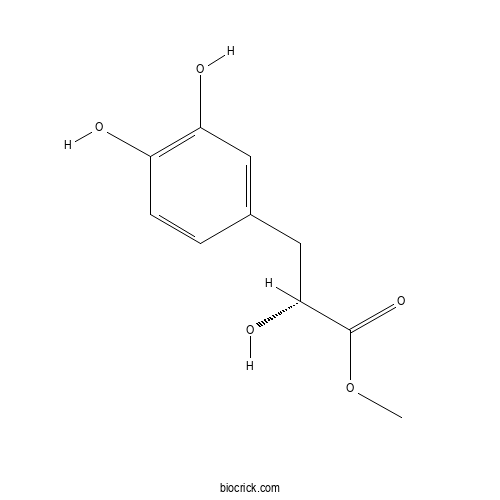
| Cas No. | 136749-45-6 | SDF | File under preparation. |
| PubChem ID | 71480151.0 | Appearance | Oil |
| Formula | C10H12O5 | M.Wt | 212.2 |
| Type of Compound | N/A | Storage | Desiccate at -20°C |
| Solubility | Soluble in Chloroform,Dichloromethane,Ethyl Acetate,DMSO,Acetone,etc. | ||
| Chemical Name | methyl (2R)-3-(3,4-dihydroxyphenyl)-2-hydroxypropanoate | ||
| SMILES | COC(=O)C(CC1=CC(=C(C=C1)O)O)O | ||
| Standard InChIKey | NMAOZVAEJYOPOF-SECBINFHSA-N | ||
| Standard InChI | InChI=1S/C10H12O5/c1-15-10(14)9(13)5-6-2-3-7(11)8(12)4-6/h2-4,9,11-13H,5H2,1H3/t9-/m1/s1 | ||
| General tips | For obtaining a higher solubility , please warm the tube at 37 ℃ and shake it in the ultrasonic bath for a while.Stock solution can be stored below -20℃ for several months. We recommend that you prepare and use the solution on the same day. However, if the test schedule requires, the stock solutions can be prepared in advance, and the stock solution must be sealed and stored below -20℃. In general, the stock solution can be kept for several months. Before use, we recommend that you leave the vial at room temperature for at least an hour before opening it. |
||
| About Packaging | 1. The packaging of the product may be reversed during transportation, cause the high purity compounds to adhere to the neck or cap of the vial.Take the vail out of its packaging and shake gently until the compounds fall to the bottom of the vial. 2. For liquid products, please centrifuge at 500xg to gather the liquid to the bottom of the vial. 3. Try to avoid loss or contamination during the experiment. |
||
| Shipping Condition | Packaging according to customer requirements(5mg, 10mg, 20mg and more). Ship via FedEx, DHL, UPS, EMS or other couriers with RT, or blue ice upon request. | ||
Quality Control & MSDS
3D structure
Package In Stock

Number of papers citing our products


Oresbiusin A Dilution Calculator
Oresbiusin A Molarity Calculator


| 1 mg | 5 mg | 10 mg | 20 mg | 25 mg | |
| 1 mM | 4.7125 mL | 23.5627 mL | 47.1254 mL | 94.2507 mL | 117.8134 mL |
| 5 mM | 0.9425 mL | 4.7125 mL | 9.4251 mL | 18.8501 mL | 23.5627 mL |
| 10 mM | 0.4713 mL | 2.3563 mL | 4.7125 mL | 9.4251 mL | 11.7813 mL |
| 50 mM | 0.0943 mL | 0.4713 mL | 0.9425 mL | 1.885 mL | 2.3563 mL |
| 100 mM | 0.0471 mL | 0.2356 mL | 0.4713 mL | 0.9425 mL | 1.1781 mL |
| * Note: If you are in the process of experiment, it's necessary to make the dilution ratios of the samples. The dilution data above is only for reference. Normally, it's can get a better solubility within lower of Concentrations. | |||||
- Kanjone
Catalog No.:BCX2505
CAS No.:1094-12-8
- Cinnamyl 3,4-dimethoxycinnamate
Catalog No.:BCX2504
CAS No.:391682-57-8
- Maoyecrystal G
Catalog No.:BCX2503
CAS No.:675603-40-4
- Xerophilusin XVI
Catalog No.:BCX2502
CAS No.:1316032-06-0
- Obovatin methyl ether
Catalog No.:BCX2501
CAS No.:69640-78-4
- N-(2-Hydroxy-3-methylbutyl)adenosine
Catalog No.:BCX2500
CAS No.:22662-01-7
- Indole-3-acetic acid N-β-D-xylopyranoside
Catalog No.:BCX2499
CAS No.:2506519-33-9
- Rubescensin J
Catalog No.:BCX2498
CAS No.:760948-09-2
- Cincholic acid 3-O-β-D-quinovopyranoside
Catalog No.:BCX2497
CAS No.:111665-41-9
- Chrysin 5-methyl ether
Catalog No.:BCX2496
CAS No.:33554-47-1
- Hebeirubescensin I
Catalog No.:BCX2495
CAS No.:887333-31-5
- 3-Hydroxy-7,8,9-trimethoxypterocarpan
Catalog No.:BCX2494
CAS No.:2472377-49-2
- Khaephuoside A
Catalog No.:BCX2507
CAS No.:142542-79-8
- Rubescensin O
Catalog No.:BCX2508
CAS No.:602301-96-2
- Phyllostacin D
Catalog No.:BCX2509
CAS No.:960621-59-4
- Scutebata Q
Catalog No.:BCX2510
CAS No.:1616406-84-8
- Ovalifolin
Catalog No.:BCX2511
CAS No.:55303-88-3
- 4-Hydroxy-2,6,6-trimethylcyclohex-1-ene-1-carbaldehyde
Catalog No.:BCX2512
CAS No.:42926-75-0
- Scutebata P
Catalog No.:BCX2513
CAS No.:1616406-83-7
- 6'-O-Xylosyldianthoside
Catalog No.:BCX2514
CAS No.:1566606-35-6
- 1-Pentacosanol
Catalog No.:BCX2515
CAS No.:26040-98-2
- 3-Hydroxy-3-phenyl-1-(4,6,7-trimethoxybenzofuran-5-yl)prop-2-en-1-one
Catalog No.:BCX2516
CAS No.:131694-13-8
- 4-(2-Nitroethyl)phenol
Catalog No.:BCX2517
CAS No.:37567-58-1
- Glucoindol B
Catalog No.:BCX2518
CAS No.:23099-32-3
[One new galloyl derivative from Isodon henryi].[Pubmed:39701800]
Zhongguo Zhong Yao Za Zhi. 2024 Nov;49(21):5909-5913.
Seven compounds(1-7) were isolated from Isodon henryi through silica gel, Sephadex LH-20, ODS, MCI column chromatography and semi-preparative HPLC. Their structures were identified as isogallicacid(1), caffeic acid(2), syringic acid(3), protocatechuic acid(4), Oresbiusin A(5), lophanthoside A(6), and 8-hydroxypinoresinol(7), by spectroscopic techniques including HR-MS, IR, UV, NMR, and ECD. Compound 1 was a new galloyl derivative. Moreover, it demonstrated a significant inhibitory effect on the lipopolysaccharide-induced release of nitric oxide from RAW264.7 cells.
[Chemical constituents from Glechoma longituba].[Pubmed:25204149]
Zhongguo Zhong Yao Za Zhi. 2014 Feb;39(4):695-8.
Fourteen compounds were obtained from Glechoma longituba by the chromatographic methods of silica gel, ODS, Sephadex LH-20 and preparative of HPLC. According to physicochemical properties and spectral data, these compounds were identified as stilbostemin B (1), trilepisiumic acid (2), 3, 4-dihydroxyphenyl ethanol ketone (3), bergeninmonohydrate (4), Oresbiusin A (5), norbergenin (6), stilbostemin D (7), ehretioside B (8), ethyl ferulate (9), E-p-hydroxy-cinnamic acid (10), methyl gallate (11), protocatechuic acid (12), 4'-Hydroxyacetophenone (13), and E-3-2,4-dihydroxyphenyl-2-acrylic acid (14). Among them, compounds 1-10, 13 and 14 were isolated from this plant for the first time.
[Chemical constituents of Salvia chinensis].[Pubmed:23947137]
Zhongguo Zhong Yao Za Zhi. 2013 May;38(10):1556-9.
Chemical constituents were investigated on the ethyl acetate extract of Salvia chinensis. Compounds were separated and purified by various chromatograhic techniques including silica gel, Sephadex LH-20 and reversed-phase HPLC. Their structures were identified by spectroscopic data analysis. Eleven compounds were isolated and purified and their structures were identified as Oresbiusin A(1), ethyl dihydrocaffeate (2), ethyl rosmarinate (3), rosmarinic acid (4), methyl rosmarinate (5), bis (2-ethylhexyl) phthalate (6), salvianol acid C (7), methyl salvianol acid C (8), methyl salvianolate A (9), dimethyl lithospermate B (10), and salvianolic acid A(11). Except for rosmarinic acid, the remaining compounds were isolated from S. chinensis for the first time.
Depsides and other polar constituents from Origanum dictamnus L. and their in vitro antimicrobial activity in clinical strains.[Pubmed:20423097]
J Agric Food Chem. 2010 May 26;58(10):6064-8.
Phytochemical investigation of the polar extracts of the aerial parts of Origanum dictamnus afforded 15 secondary metabolites. One new depside was isolated, to which the trivial name salvianolic acid P (1) was given, in addition to the known depsides rosmarinic acid (2) and rosmarinic acid methyl ester (3), as well as two monoterpenes, thymoquinone (4) and thymoquinol 2-O-beta-glucopyranoside (5); two simple phenolic acids, Oresbiusin A (6) and E-caffeic acid (7); six flavonoids, namely, apigenin (8), kaempferol (9), quercetin (10), eriodictyol (11), taxifolin (12), naringenin (13); and two alicyclic derivatives, that is, 12-hydroxyjasmonic acid (14) and its 12-O-beta-d-glucoside (15). The structures of all isolated compounds were established by spectroscopic methods, mainly 1D and 2D NMR, as well as HPLC-DAD-MS and HR-MS spectrometric analyses. The absolute configuration of compound 1 was determined by CD measurements as 7'R, 7''S, 8''S. Compound 1 is interesting as it contains a benzodioxane ring, which is unusual in natural products. Moreover, it has been proved to be active against the Gram-negative clinical strains Acinetobacter hemolyticus , Empedobacter brevis , Pseudomonas aeruginosa , and Klebsiella pneumoniae .
A New Rosmarinic Acid Derivative from Isodon oresbius.[Pubmed:17260244]
Planta Med. 1999 Feb;65(1):92-3.
Phytochemical reinvestigation of ISODON ORESBIUS afforded, in addition to oleanolic acid, ursolic acid, sodoponin, astragalin, and quercetin-3- O-glucoside, three known (Oresbiusin A, rosmarinic acid and methyl rosmarinate) and a new rosmarinic acid derivative as well as an ENT-kaurene diterpenoid, neo-angustifolin, characterized as a separated component for the first time. By a combination of 1D- and 2D-NMR techniques the structure of the new compound was established as butyl rosmarinate. The IN VITRO antifungal assay showed that neoangustifolin was active against CANDIDA ALBICANS with the MIC being 50 microg/ml.

Calcutta University

University of Minnesota

University of Maryland School of Medicine

University of Illinois at Chicago

The Ohio State University

University of Zurich

Harvard University

Colorado State University

Auburn University

Yale University

Worcester Polytechnic Institute

Washington State University

Stanford University

University of Leipzig

Universidade da Beira Interior

The Institute of Cancer Research

Heidelberg University

University of Amsterdam

University of Auckland

TsingHua University

The University of Michigan

Miami University

DRURY University

Jilin University

Fudan University

Wuhan University

Sun Yat-sen University

Universite de Paris

Deemed University

Auckland University

The University of Tokyo

Korea University



