
KanjoneCAS# 1094-12-8 |
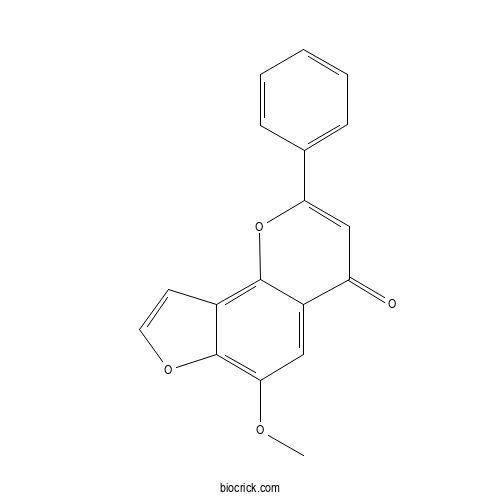
| Cas No. | 1094-12-8 | SDF | File under preparation. |
| PubChem ID | 12305449.0 | Appearance | Powder |
| Formula | C18H12O4 | M.Wt | 292.3 |
| Type of Compound | N/A | Storage | Desiccate at -20°C |
| Solubility | Soluble in Chloroform,Dichloromethane,Ethyl Acetate,DMSO,Acetone,etc. | ||
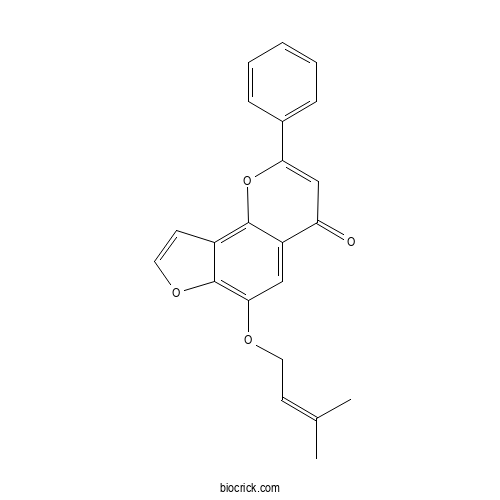
| Chemical Name | 6-methoxy-2-phenylfuro[2,3-h]chromen-4-one | ||
| SMILES | COC1=C2C(=C3C(=C1)C(=O)C=C(O3)C4=CC=CC=C4)C=CO2 | ||
| Standard InChIKey | OVAZJVLXWGEKHQ-UHFFFAOYSA-N | ||
| Standard InChI | InChI=1S/C18H12O4/c1-20-16-9-13-14(19)10-15(11-5-3-2-4-6-11)22-17(13)12-7-8-21-18(12)16/h2-10H,1H3 | ||
| General tips | For obtaining a higher solubility , please warm the tube at 37 ℃ and shake it in the ultrasonic bath for a while.Stock solution can be stored below -20℃ for several months. We recommend that you prepare and use the solution on the same day. However, if the test schedule requires, the stock solutions can be prepared in advance, and the stock solution must be sealed and stored below -20℃. In general, the stock solution can be kept for several months. Before use, we recommend that you leave the vial at room temperature for at least an hour before opening it. |
||
| About Packaging | 1. The packaging of the product may be reversed during transportation, cause the high purity compounds to adhere to the neck or cap of the vial.Take the vail out of its packaging and shake gently until the compounds fall to the bottom of the vial. 2. For liquid products, please centrifuge at 500xg to gather the liquid to the bottom of the vial. 3. Try to avoid loss or contamination during the experiment. |
||
| Shipping Condition | Packaging according to customer requirements(5mg, 10mg, 20mg and more). Ship via FedEx, DHL, UPS, EMS or other couriers with RT, or blue ice upon request. | ||
Quality Control & MSDS
3D structure
Package In Stock

Number of papers citing our products


Kanjone Dilution Calculator
Kanjone Molarity Calculator
| 1 mg | 5 mg | 10 mg | 20 mg | 25 mg | |
| 1 mM | 3.4211 mL | 17.1057 mL | 34.2114 mL | 68.4229 mL | 85.5286 mL |
| 5 mM | 0.6842 mL | 3.4211 mL | 6.8423 mL | 13.6846 mL | 17.1057 mL |
| 10 mM | 0.3421 mL | 1.7106 mL | 3.4211 mL | 6.8423 mL | 8.5529 mL |
| 50 mM | 0.0684 mL | 0.3421 mL | 0.6842 mL | 1.3685 mL | 1.7106 mL |
| 100 mM | 0.0342 mL | 0.1711 mL | 0.3421 mL | 0.6842 mL | 0.8553 mL |
| * Note: If you are in the process of experiment, it's necessary to make the dilution ratios of the samples. The dilution data above is only for reference. Normally, it's can get a better solubility within lower of Concentrations. | |||||
- Cinnamyl 3,4-dimethoxycinnamate
Catalog No.:BCX2504
CAS No.:391682-57-8
- Maoyecrystal G
Catalog No.:BCX2503
CAS No.:675603-40-4
- Xerophilusin XVI
Catalog No.:BCX2502
CAS No.:1316032-06-0
- Obovatin methyl ether
Catalog No.:BCX2501
CAS No.:69640-78-4
- N-(2-Hydroxy-3-methylbutyl)adenosine
Catalog No.:BCX2500
CAS No.:22662-01-7
- Indole-3-acetic acid N-β-D-xylopyranoside
Catalog No.:BCX2499
CAS No.:2506519-33-9
- Rubescensin J
Catalog No.:BCX2498
CAS No.:760948-09-2
- Cincholic acid 3-O-β-D-quinovopyranoside
Catalog No.:BCX2497
CAS No.:111665-41-9
- Chrysin 5-methyl ether
Catalog No.:BCX2496
CAS No.:33554-47-1
- Hebeirubescensin I
Catalog No.:BCX2495
CAS No.:887333-31-5
- 3-Hydroxy-7,8,9-trimethoxypterocarpan
Catalog No.:BCX2494
CAS No.:2472377-49-2
- Uridine 5′-diphosphate arabinoside disodium
Catalog No.:BCX2493
CAS No.:15839-78-8
- Oresbiusin A
Catalog No.:BCX2506
CAS No.:136749-45-6
- Khaephuoside A
Catalog No.:BCX2507
CAS No.:142542-79-8
- Rubescensin O
Catalog No.:BCX2508
CAS No.:602301-96-2
- Phyllostacin D
Catalog No.:BCX2509
CAS No.:960621-59-4
- Scutebata Q
Catalog No.:BCX2510
CAS No.:1616406-84-8
- Ovalifolin
Catalog No.:BCX2511
CAS No.:55303-88-3
- 4-Hydroxy-2,6,6-trimethylcyclohex-1-ene-1-carbaldehyde
Catalog No.:BCX2512
CAS No.:42926-75-0
- Scutebata P
Catalog No.:BCX2513
CAS No.:1616406-83-7
- 6'-O-Xylosyldianthoside
Catalog No.:BCX2514
CAS No.:1566606-35-6
- 1-Pentacosanol
Catalog No.:BCX2515
CAS No.:26040-98-2
- 3-Hydroxy-3-phenyl-1-(4,6,7-trimethoxybenzofuran-5-yl)prop-2-en-1-one
Catalog No.:BCX2516
CAS No.:131694-13-8
- 4-(2-Nitroethyl)phenol
Catalog No.:BCX2517
CAS No.:37567-58-1
Mutational analysis of flavonol synthase of M. pinnata towards enhancement of binding affinity: a computational approach.[Pubmed:37592887]
J Biomol Struct Dyn. 2024 Oct;42(16):8574-8587.
Millettia pinnata is an important medicinal plant that has been used as a treatment of various diseases due to presence of wide range of pharmacological properties. The plant contains quercetin, kaempferol, karanjin, pongaglabrone, Kanjone, kanugin, gammatin, pongaglabol, and other bioflavonoids. Kaempferol is a natural flavonol that shows many pharmacological properties including anti-inflammatory, antioxidant, anticancer, and antidiabetic activities etc. The enzyme flavonol synthase (FLS, EC 1.14.20.6) catalyses the conversion of dihydroflavonols to flavonols, i.e. biosynthesis of kaempferol from dihydrokaempferol. The current work examined the binding affinity-based approach to improve the enzyme catalytic activity using computational methods. Sequential site-directed mutagenesis was used to create four mutants with the goal to increase hydrogen bonds and further improving the ligand (dihydrokaempferol) binding efficiency. Simulations were done to monitor the stability of the mutants followed by molecular docking to confirm interactions with ligand. For structure validation, various dynamic analysis like RMSD, RMSF, ROG, SASA, H-bond, PCA, DCCM, and FEL were performed, which predicts the stability of wild-type (WT) proteins and mutants. The Mutant_2 and Mutant_3 showed maximum H-bonding and better stability than other mutants and WT that proved higher affinity suggesting improved catalysis. Mutant_2 and Mutant_3 exhibited binding affinities of -7.6 and -8.2 kcal/mol, respectively for the ligand. The outcome of present study will provide significant improvement in synthesis of kaempferol and other plant-based flavonoids.Communicated by Ramaswamy H. Sarma.
First total syntheses of kanjone and its natural analogues.[Pubmed:35439092]
J Asian Nat Prod Res. 2022 Apr 19:1-10.
Kanjone (1), a bioactive furanoflavone and a potent biomolecule, was first isolated from Pongamia pinnata (L.). Herein, we have developed two approaches to synthesize Kanjone as well as its natural analogues 6-methoxyisopongaglabol (2) and 6,3'-dimethoxy-[2'',3'':7,8]furanoflavone (3) starting from khellin and 3-hydroxy-4-methoxy-benzaldehyde, respectively.
Flavonoids from twigs of Millettia pubinervis.[Pubmed:25632467]
Nat Prod Commun. 2014 Dec;9(12):1721-2.
A new flavone, 3-methoxy-5-hydroxy-[2",3":7,8] furanoflavone, pubinerone (1), was isolated from the twigs of Millettia pubinervis Kurz, together with ten known flavonoids, karanjin (2), Kanjone (3), 3,6-dimethoxy-[2",3":7,8] furanoflavone (4), pongaglabrone (5), pongapin (6), pongaflavone (7), 3,6-dimethoxy- 6",6"-dimethylchromene-[2",3":7,8] flavone (8), pongachromene (9), 3,6-dimethoxy-3',4'-methylenedioxy-6",6"-dimethylchromene-[2",3":7,8] flavone (10) and demethoxykanugin (11). This is the first phytochemical investigation of this plant. The structure of compound 1 was elucidated on the basis of spectroscopic data interpretation, including 1D and 2D NMR and HREIMS analysis. The cytotoxicity of 1 against five human cancer cell lines; HL-60, SMMC-7721, A-549, MCF-7 and SW480, was evaluated, but it was inactive (IC50 > 40 muM).
Synthesis of novel benzofuran isoxazolines as protein tyrosine phosphatase 1B inhibitors.[Pubmed:16460930]
Bioorg Med Chem Lett. 2006 Apr 15;16(8):2139-43.
PTPases are considered to be involved in the etiology of diabetes mellitus and neural diseases, such as Alzheimer's disease and Parkinson's disease. Therefore, PTPase inhibitors should be useful tools to study the role of PTPases in these diseases and other biological phenomena, and which can be developed into chemotherapeutic agents. In the present study, we have synthesized novel benzofuran isoxazolines 13-21 via 1,3-dipolar cycloaddition reaction using karanjin (1) and Kanjone (2), isolated from Pongamia pinnata fruits. All the synthesized compounds were evaluated against PTPase enzyme. Compounds 19 and 20 displayed significant inhibitory activity with IC50 values 76 and 81 microM, respectively.

Calcutta University

University of Minnesota

University of Maryland School of Medicine

University of Illinois at Chicago

The Ohio State University

University of Zurich

Harvard University

Colorado State University

Auburn University

Yale University

Worcester Polytechnic Institute

Washington State University

Stanford University

University of Leipzig

Universidade da Beira Interior

The Institute of Cancer Research

Heidelberg University

University of Amsterdam

University of Auckland

TsingHua University

The University of Michigan

Miami University

DRURY University

Jilin University

Fudan University

Wuhan University

Sun Yat-sen University

Universite de Paris

Deemed University

Auckland University

The University of Tokyo

Korea University



