
Shizukaol FCAS# 165171-10-8 |
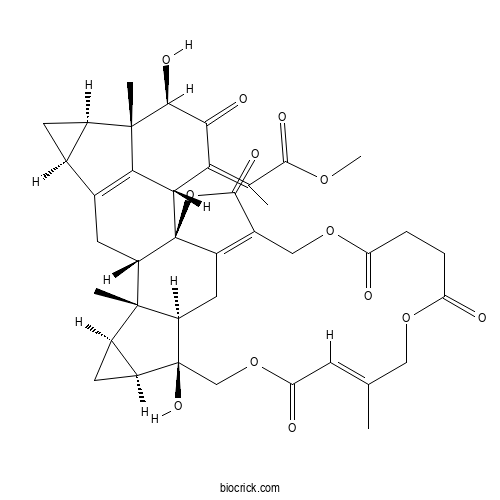
| Cas No. | 165171-10-8 | SDF | File under preparation. |
| PubChem ID | 56681897.0 | Appearance | Powder |
| Formula | C40H44O13 | M.Wt | 732.8 |
| Type of Compound | N/A | Storage | Desiccate at -20°C |
| Solubility | Soluble in Chloroform,Dichloromethane,Ethyl Acetate,DMSO,Acetone,etc. | ||
| Chemical Name | methyl (2Z)-2-[(1S,13E,18S,19S,21R,22S,23S,26S,28R,29S,30R,33R,36R)-18,30-dihydroxy-13,22,29-trimethyl-3,7,10,15,31-pentaoxo-2,6,11,16-tetraoxanonacyclo[16.15.3.125,29.01,23.04,34.019,21.022,36.026,28.033,37]heptatriaconta-4(34),13,25(37)-trien-32-ylidene]propanoate | ||
| SMILES | CC1=CC(=O)OCC2(C3CC3C4(C2CC5=C(COC(=O)CCC(=O)OC1)C(=O)OC56C4CC7=C8C6C(=C(C)C(=O)OC)C(=O)C(C8(C9C7C9)C)O)C)O | ||
| Standard InChIKey | XOCHXEVAPBOSPH-RCNNXFIWSA-N | ||
| Standard InChI | InChI=1S/C40H44O13/c1-16-8-29(43)52-15-39(48)24-11-23(24)37(3)25(39)12-22-20(14-51-28(42)7-6-27(41)50-13-16)36(47)53-40(22)26(37)10-19-18-9-21(18)38(4)31(19)32(40)30(33(44)34(38)45)17(2)35(46)49-5/h8,18,21,23-26,32,34,45,48H,6-7,9-15H2,1-5H3/b16-8+,30-17-/t18-,21-,23-,24+,25-,26+,32+,34+,37+,38+,39+,40+/m1/s1 | ||
| General tips | For obtaining a higher solubility , please warm the tube at 37 ℃ and shake it in the ultrasonic bath for a while.Stock solution can be stored below -20℃ for several months. We recommend that you prepare and use the solution on the same day. However, if the test schedule requires, the stock solutions can be prepared in advance, and the stock solution must be sealed and stored below -20℃. In general, the stock solution can be kept for several months. Before use, we recommend that you leave the vial at room temperature for at least an hour before opening it. |
||
| About Packaging | 1. The packaging of the product may be reversed during transportation, cause the high purity compounds to adhere to the neck or cap of the vial.Take the vail out of its packaging and shake gently until the compounds fall to the bottom of the vial. 2. For liquid products, please centrifuge at 500xg to gather the liquid to the bottom of the vial. 3. Try to avoid loss or contamination during the experiment. |
||
| Shipping Condition | Packaging according to customer requirements(5mg, 10mg, 20mg and more). Ship via FedEx, DHL, UPS, EMS or other couriers with RT, or blue ice upon request. | ||
Quality Control & MSDS
3D structure
Package In Stock

Number of papers citing our products


Shizukaol F Dilution Calculator
Shizukaol F Molarity Calculator


| 1 mg | 5 mg | 10 mg | 20 mg | 25 mg | |
| 1 mM | 1.3646 mL | 6.8231 mL | 13.6463 mL | 27.2926 mL | 34.1157 mL |
| 5 mM | 0.2729 mL | 1.3646 mL | 2.7293 mL | 5.4585 mL | 6.8231 mL |
| 10 mM | 0.1365 mL | 0.6823 mL | 1.3646 mL | 2.7293 mL | 3.4116 mL |
| 50 mM | 0.0273 mL | 0.1365 mL | 0.2729 mL | 0.5459 mL | 0.6823 mL |
| 100 mM | 0.0136 mL | 0.0682 mL | 0.1365 mL | 0.2729 mL | 0.3412 mL |
| * Note: If you are in the process of experiment, it's necessary to make the dilution ratios of the samples. The dilution data above is only for reference. Normally, it's can get a better solubility within lower of Concentrations. | |||||
- 7,10-Dihydroxy-2,6,10-trimethyl-2,5,11-dodecatrien-4-one
Catalog No.:BCX2595
CAS No.:82901-07-3
- Ferulacoumarin B
Catalog No.:BCX2594
CAS No.:263746-20-9
- Ferulacoumarin A
Catalog No.:BCX2593
CAS No.:263746-19-6
- Pinoresinol monomethyl ether
Catalog No.:BCX2592
CAS No.:95404-51-6
- α-Peltatin 5-O-glucoside
Catalog No.:BCX2591
CAS No.:11024-58-1
- 4'-Demethylpodophyllotoxin 7-O-glucoside
Catalog No.:BCX2590
CAS No.:40505-30-4
- 3-Methoxy-N-acetylnornantenine
Catalog No.:BCX2589
CAS No.:53452-28-1
- Gymnetinoside B
Catalog No.:BCX2588
CAS No.:1588477-86-4
- Juglanin B
Catalog No.:BCX2587
CAS No.:958365-42-9
- Methyl 4-acetamidobutanoate
Catalog No.:BCX2586
CAS No.:32039-11-5
- Cassumunene
Catalog No.:BCX2585
CAS No.:73573-81-6
- trans-Cassumunene
Catalog No.:BCX2584
CAS No.:76318-79-1
- 3,4-Bis(3,4-dimethoxyphenyl)cycloocta-1,5-diene
Catalog No.:BCX2597
CAS No.:146564-35-4
- Fukanedone B
Catalog No.:BCX2598
CAS No.:850621-98-6
- 2-epi-Baigene C
Catalog No.:BCX2599
CAS No.:263746-16-3
- Baigene C
Catalog No.:BCX2600
CAS No.:263746-17-4
- 5,7-Dimethoxyphenanthrene-2,6-diol
Catalog No.:BCX2601
CAS No.:72966-94-0
- 13βH-Malabarica-14(27),17,21-trien-3β-ol
Catalog No.:BCX2602
CAS No.:1159402-28-4
- Funingenoside J
Catalog No.:BCX2603
CAS No.:645411-82-1
- Tuliferoline
Catalog No.:BCX2604
CAS No.:60755-82-0
- Dysoslignan XL
Catalog No.:BCX2605
CAS No.:627677-61-5
- Baigene B
Catalog No.:BCX2606
CAS No.:1472648-83-1
- Funingenoside C
Catalog No.:BCX2607
CAS No.:587876-16-2
- Chlorahololide B
Catalog No.:BCX2608
CAS No.:928040-25-9
Antifungal Activities of Dimeric Sesquiterpenes, Shizukaols C and F, Isolated from Chloranthus japonicus Sieb.[Pubmed:28535608]
J Microbiol Biotechnol. 2017 Jul 28;27(7):1272-1275.
Two dimeric sesquiterpenes were separated from Chloranthus japonicus Sieb. and identified as shizukaols C and F. They exhibited potent antifungal activities (MICs = 4-16 mug/ml) in vitro against various plant pathogenic fungi (Pythium ultimum, Phytophthora infestans, Botrytis cinerea, Colletotrichum lagenarium, Alternaria kikuchiana, and Magnaporthe grisea). Shizukaol C showed 88% and 91% protective activities in the greenhouse against Puccinia recondita (wheat leaf rust) and Phytophthora infestans (tomato late blight), respectively, at 100 mug/ml; Shizukaol F exhibited 93% antifungal activity against Puccinia recondita at the same concentration. Therefore, these compounds might serve as interesting candidates for effective antifungal agents.
Modulation of glucose metabolism by a natural compound from Chloranthus japonicus via activation of AMP-activated protein kinase.[Pubmed:28396610]
Sci Rep. 2017 Apr 10;7(1):778.
AMP-activated protein kinase (AMPK) is a key sensor and regulator of glucose metabolism. Here, we demonstrated that Shizukaol F, a natural compound isolated from Chloranthus japonicus, can activate AMPK and modulate glucose metabolism both in vitro and in vivo. Shizukaol F increased glucose uptake in differentiated C2C12 myotubes by stimulating glucose transporter-4 (GLUT-4) membraned translocation. Treatment of primary mouse hepatocytes with Shizukaol F decreased the expression of phosphoenolpyruvate carboxykinase 2 (PEPCK), glucose-6-phosphatase (G6Pase) and suppressed hepatic gluconeogenesis. Meanwhile, a single oral dose of Shizukaol F reduced gluconeogenesis in C57BL/6 J mice. Further studies indicated that Shizukaol F modulates glucose metabolism mainly by AMPKa phosphorylation activity. In addition, we also found that Shizukaol F depolarizes the mitochondrial membrane and inhibits respiratory complex I, which may result in AMPK activation. Our results highlight the potential value of Shizukaol F as a possible treatment of metabolic syndrome.
[Shizukaol F: a new structural type inhibitor of HIV-1 reverse transcriptase RNase H].[Pubmed:23162897]
Yao Xue Xue Bao. 2012 Aug;47(8):1011-6.
This study is to investigate the mechanism of action of lindenane disesquiterpenoid Shizukaol F on HIV-1 replication. Real time quantity PCR, ELISA assay and fluorescence methods were used to test HIV-1 reverse transcription process, RNA-dependent DNA polymerase activity, and RNase H activity, respectively. It showed that Shizukaol F inhibited LTR/Gag production of HIV-1 reverse transcription with an IC50 of 9.11 micromol x L(-1). This result is consistent with its inhibitory effect on HIV-1 replication (IC50 of 6.12 micromol x L(-1)). Mechanism studies showed that compound Shizukaol F inhibited HIV-1 RT-RNase H with IC50 of 26.4 micromol x L(-1), but had no effect on HIV-1 RT RNA-dependent DNA polymerase activity. In conclusion, Shizukaol F is a new structural type HIV-1 RNase H inhibitor. This discovery will provide a clue for new type of reverse transcriptase inhibitors development.
Spicachlorantins G-J, new lindenane sesquiterpenoid dimers from the roots of Chloranthus spicatus.[Pubmed:21963639]
Chem Pharm Bull (Tokyo). 2011;59(10):1281-4.
Four new lindenane sesquiterpenoid dimers, spicachlorantins G-J (1-4), were isolated from the roots of Chloranthus spicatus together with seven known compounds, including chloramultilide A, shizukaol B, shizukaol D, Shizukaol F, shizukaol P, chlorahololide D, and cycloshizukaol A. The planar structures of the new compounds were established by 1D-, 2D-NMR, and MS analyses. The absolute configurations of these compounds were determined by analyzing rotating Overhauser enhancement and exchange spectroscopy (ROESY) and circular dichroism (CD) spectra.
Terpenoids from Chloranthus multistachys.[Pubmed:18855217]
Nat Prod Res. 2008;22(13):1163-8.
Two new diterpenoids, ent-17-hydroxyl-16beta-methoxyl-kauran-3-one (1) and ent-17-acetoxyl-16beta-methoxyl-kauran-3-one (2), along with nine known compounds (3-12), ent-17-hydroxyl-kaur-15-en-3-one (3), ent-3beta-acetoxyl-kaur-15-en-16beta, 17-diol (4), ent-kauran-3beta, 16beta, 17-triol (5), ent-3beta-acetoxyl-kauran-16beta, 17-diol (6), ent-kauran-16beta, 17-diol (7), abbeokutone (8), ent-17alpha-acetyl-16beta-hydroxyl- kauran-3-one (9), Shizukaol F (10), cycloshizukaol A (11) and curcolonol (12), were isolated from Chloranthus multistachys (Chloranthaceae). Their structures were elucidated by spectroscopic spectra.
Dimeric sesquiterpenoids isolated from Chloranthus japonicus inhibited the expression of cell adhesion molecules.[Pubmed:16229979]
J Ethnopharmacol. 2006 Mar 8;104(1-2):270-7.
In the search for cell adhesion inhibitors from natural sources, three active compounds were isolated from Chloranthus japonicus Sieb. (Chloranthaceae) roots. The compounds were identified as dimeric sesquiterpenoids of shizukaol B (1), cycloshizukaol A (2) and Shizukaol F (3). These compounds inhibited PMA-induced homotypic aggregation of HL-60 cells without cytotoxicity with MIC values of 34.1 nM (1), 0.9 microM (2) and 27.3 nM (3), respectively. Although 1-3 did not affect the direct binding of LFA-1 to ICAM-1, these compounds markedly inhibited ICAM-1 expression in HL-60 cells in a dose-dependent fashion. On the other hand, when HUVEC were pretreated with 1-3 and stimulated with TNF-alpha, adhesion of THP-1 cells to HUVEC decreased in dose-dependent manner with IC(50) values of 54.6 nM, 1.2 microM and 34.1 nM, respectively. In fact, 1 inhibited TNF-alpha-induced surface expression of the ICAM-1, VCAM-1 and E-selectin in HUVEC with IC(50) values of 5.4 nM, 13.6 microM and 95.6 nM, respectively. The present findings suggest that 1-3 prevent monocyte adhesion to HUVEC through the inhibition of cell adhesion molecules expression stimulated by TNF-alpha.

Calcutta University

University of Minnesota

University of Maryland School of Medicine

University of Illinois at Chicago

The Ohio State University

University of Zurich

Harvard University

Colorado State University

Auburn University

Yale University

Worcester Polytechnic Institute

Washington State University

Stanford University

University of Leipzig

Universidade da Beira Interior

The Institute of Cancer Research

Heidelberg University

University of Amsterdam

University of Auckland

TsingHua University

The University of Michigan

Miami University

DRURY University

Jilin University

Fudan University

Wuhan University

Sun Yat-sen University

Universite de Paris

Deemed University

Auckland University

The University of Tokyo

Korea University



