Neurotransmission
Neurotransmission, or synaptic transmission, involves the passage of signals by electrical or chemical means from one neuron to another. It allows communication between nerve cells for the propagation of electrical impulses to and from the central nervous system leading to the co-ordination of secretion, muscle contraction and organ function.
Neurotransmission Products Targets
- GABAB Receptor (28)
- Others (20)
- Nucleoside Transporter (5)
- Glycine Transporter (6)
- GABA (10)
- Cannabinoid Transporter (10)
- Acetylcholine Transporter (1)
- D4 Receptor (12)
- 5-HT7 Receptor (11)
- 5-HT6 Receptor (14)
- 5-ht5 Receptor (2)
- 5-HT4 Receptor (17)
- NOP Receptor (21)
- Mu-Opioid Receptors (15)
- Kappa Opioid Receptors (14)
- Glutamate (Metabotropic) Group III Receptor (26)
- Glutamate (Metabotropic) Group II Receptor (33)
- Glutamate (Metabotropic) Group I Receptor (54)
- AMPA Receptor (45)
- GABAA-ρ Receptor (8)
- GABAA Receptor (66)
- GPR55 (8)
- CB2 Receptor (6)
- CB1 Receptor (17)
- Nicotinic (α7) Receptor (25)
- Nicotinic (α4β2) Receptor (14)
- Purinergic (P2Y) Receptors (31)
- Purinergic (P2X) Receptors (32)
- Glycine Receptors (6)
- D3 Receptor (12)
- Vesicular Monoamine Transporter (4)
- NMDA Receptor (87)
- Kainate Receptor (22)
- D2 Receptor (14)
- D1 and D5 Receptor (16)
- Glutamate Transporter (18)
- Dopamine Transporter (20)
- Histamine H4 Receptor (12)
- Histamine H3 Receptor (22)
- Histamine H2 Receptor (10)
- Histamine H1 Receptor (17)
- Adrenergic Transporter (23)
- 5-HT Transporter (30)
- NO donors and precursors (9)
- nNOS (5)
- iNOS (11)
- eNOS (1)
- M5 Receptor (2)
- M4 Receptor (3)
- M3 Receptor (4)
- M2 Receptor (5)
- M1 Receptor (8)
- Delta opioid receptor (16)
- Adrenergic α2 Receptor (33)
- Adrenergic α1 Receptor (22)
- Adrenergic β3 Receptor (12)
- Adrenergic β2 Receptor (6)
- Adrenergic β1 Receptor (7)
Products for Neurotransmission - Page 23
- Cat.No. Product Name Information/Activity
-
BCC7436
ST 91
4749-61-5

-
BCC7991
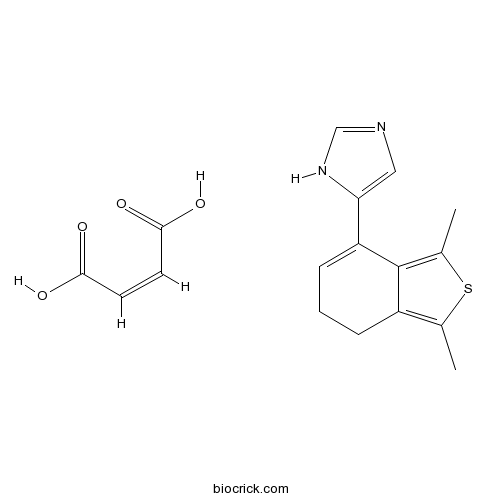
TC-G 1000
245744-18-7
-
BCC4357
Tizanidine HCl
Tizanidine hydrochloride is an α2-adrenergic receptor agonist and inhibits neurotransmitter release from CNS noradrenergic neurons.

-
BCC5226
UK 14,304
Brimonidine (UK 14304) is a full α2-adrenergic receptor (α2-AR) agonist.

-
BCC7336
A 80426 mesylate
152148-64-6

-
BCC6851
ARC 239 dihydrochloride
55974-42-0

-
BCC7521
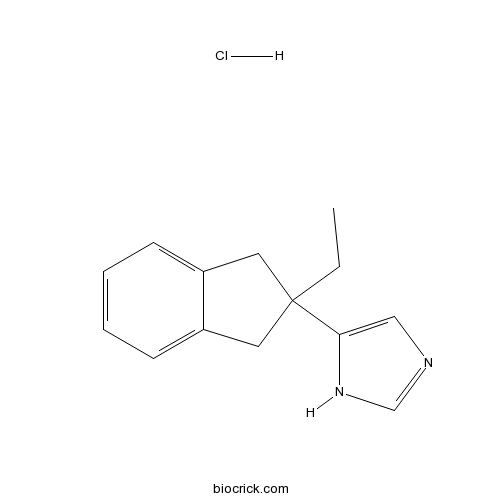
Atipamezole hydrochloride
Atipamezole hydrochloride is a synthetic α2-adrenoceptor antagonist with a Ki of 1.6 nM.
-
BCC6948
BRL 44408 maleate
681806-46-2

-
BCC6797
Efaroxan hydrochloride
89197-00-2

-
BCC6798
Idazoxan hydrochloride
Idazoxan hydrochloride (RX 781094 hydrochloride) is an α2-adrenoceptor antagonist and is also a imidazoline receptors (IRs) antagonist competitively antagonized the centrally induced hypotensive effect of imidazoline-like drugs (IMs). Idazoxan hydrochloride also improves motor symptoms in Parkinson’s disease, L-DOPA-induced dyskinesias, and experimental Parkinsonism.