
Natural Products from Swertia angustifolia
Natural Products Isolated from Swertia angustifolia
BioCrick provides high-purity natural products and bioactive compounds isolated and purified from natural sources for scientific research.
- Natural product compounds selected from diverse chemical and biological sources.
- Broad structural diversity and coverage of biological activities.
- Product activity information can be supported by published literature, patents and research reports.
- Natural products can be selected according to source, target, activity and disease research interests.
- Compounds should be stored according to the product specifications after receipt.
Natural Products from Swertia angustifolia
1 natural product associated with Swertia angustifolia
| Catalog No. | Product Name | CAS Number | COA |
|---|---|---|---|
| BCN5948 |
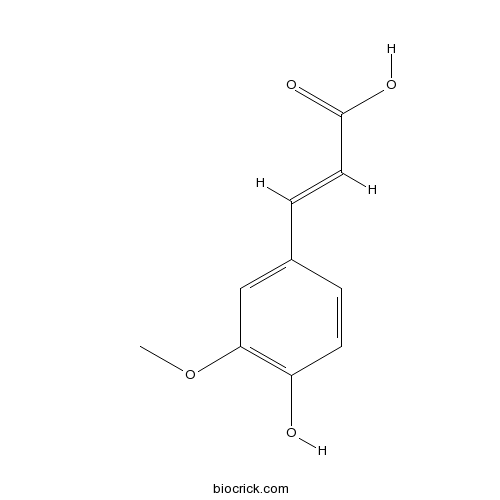
Ferulic acid
|
1135-24-6 | COA |
References
[Chemical constituents of Swertia angustifolia].[Pubmed: 26983208]
This present work is to study the chemical constituents of Swertia angustifolia. The whole plants of air-dried Swertia angustifolia was extracted with 90% EtOH. The water extract was suspended in H2O and extracted with petroleum ether, EtOAc and nBuOH, successively. The compounds were isolated and purified by column chromatography from the EtOAc fraction, and identified based on spectral analyses (MS, 1H-NMR, 13C-NMR). Fourteen compounds were isolated and characterized as 1, 8-dihydroxy-3, 7-dimethoxyxanthone (1), 1, 8-dihydroxy-3, 5, 7-trimethoxyxanthone (2), 7-hydroxy-3, 8-dimethoxyxanthone-1-O-β-D-glucopyranoside (3), 8-0-[β-D-xylopyranosyl-(1-6) -β-D-glucopyranosyl] -1, 7-dihydroxy-3-methoxyxanthone (4), (+) -syringaresinol (5), ferulic acid (6), trans-coniferyl aldehyde (7), sinapaldehyde (8), trans-coniferyl alcohol (9), 3, 4-dihydroxybenzoic acid (10), 2-hydroxybenzoic acid (11), isophthalic acid (12), 2-furoic acid (13), and 2-methyl-4(3H)-quinazolinone(14). Compounds 2-14 were obtained from this plant for the first time.
Gentiocrucines A-E, five unusual lactonic enamino Ketones from Swertia macrosperma and Swertia angustifolia.[Pubmed: 23059634]
Five unusual lactonic enamino ketones, gentiocrucines A-E (1-5), were isolated from Swertia macrosperma and S. angustifolia. Their structures were determined based on extensive spectroscopic analyses (IR, UV, MS, 1D- and 2D-NMR). By anti-HBV assay on the HepG 2.2.15 cell line in vitro, compound 1 inhibited both the secretion of hepatitis B virus surface antigen (HBsAg) and hepatitis B virus e antigen (HBeAg) with IC50 values of 3.14 and 3.35 mM, and compound 5 only inhibited the secretion of HBsAg with an IC50 value of 2.07 mM.
Seven new secoiridoids with anti-hepatitis B virus activity from Swertia angustifolia.[Pubmed: 22441835]
Seven new secoiridoids, swertianglide (1) and swertianosides A-F (2-7), together with fifteen known compounds, were isolated from the whole plants of Swertia angustifolia. Their structures were elucidated on the basis of extensive spectroscopic analyses ([α](D), UV, IR, MS, 1D- and 2D-NMR). Fourteen compounds were evaluated for their anti-hepatitis B virus (HBV) activities on the Hep G 2.2.15 cell line in vitro. Compound 2, an unusual secoiridoid glycoside dimer, showed significant activities inhibiting the secretion of HBsAg (IC₅₀ 0.18 mM, SI 3.11) and HBeAg (IC₅₀ 0.12 mM, SI 4.67).
Two new xanthones from Swertia angustifolia.[Pubmed: 22296155]
Two new xanthones, angustins A and B (1 and 2), were isolated from the aerial parts of Swertia angustifolia together with six known compounds (3-8). The structures of these two xanthones were elucidated by extensive analysis of the spectroscopic data. In addition, compounds 3 and 6-8 were isolated from this plant for the first time.
[Studies on iridoid glycosides from Swertia angustifolia].[Pubmed: 1414367]
Five secoiridoid glycosides were isolated from Swertia angustifolia Buch. -Ham. ex D. Don. The structures of two new compounds, angustiamarin (I) and angustioside (II) with three known compounds sweroside (III), swertiamarin (IV) and epi-eustomoside (V) were elucidated by means of spectroscopic and chemical methods.