Darwin's Orchids
In 1862, three years after the publication of On the Origin of Species, Darwin published a work on orchids. His purpose in studying orchids was to prove that natural selection is the driving force behind biological evolution and to provide supplementary material for On the Origin of Species.
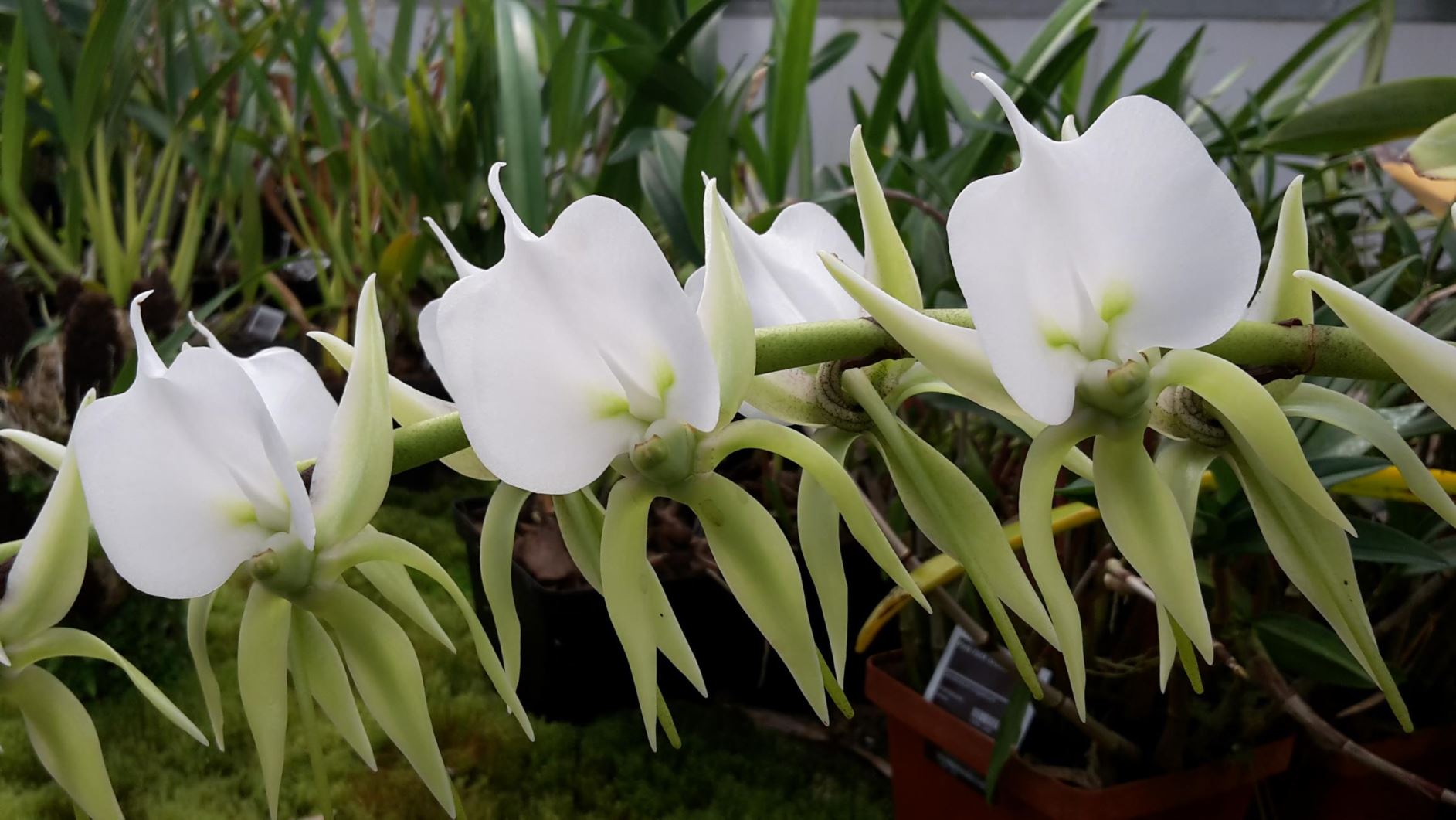
There are over 20,000 species of wild orchids, with flowers of all imaginable shapes, sizes, colors, and scents, but they all serve one purpose: to attract insects (or hummingbirds) to collect nectar. Pollen sticks to the bodies of these pollinators, helping the orchids reproduce. Therefore, orchids cannot reproduce without their pollinators. Regardless of their strange shapes and structures, they are all adapted to their pollinators. In order to collect nectar, pollinators must also adapt to the orchids. Under the influence of natural selection, orchids and their pollinators co-evolve. The central idea of Darwin's book on orchids was that only natural selection could explain the origin of the orchid's structure.
However, one species, the comet orchid native to Madagascar, stumped Darwin. Its Latin name means "one and a half feet," a reference to its "astonishing" (in Darwin's words) flower shape. It has a long, slender nectar spur, a narrow tube that extends 11.5 inches (29.2 cm) from the opening of the flower, with nectar only at the bottom 1.5 inches (3.8 cm). "What kind of insect could possibly reach its nectar?" Darwin boldly predicted: "In Madagascar, there must live a moth with a proboscis that can stretch 10 to 11 inches long!"
But who had ever seen an insect with such a long proboscis? "Absurd!" some entomologists of the time thought. However, Darwin's ally, Alfred Russel Wallace, who had independently proposed the theory of natural selection, stood firmly by Darwin's side. He wrote, "It may be safely predicted that such a moth exists in Madagascar; and naturalists who visit that island should search for it with as much confidence as an astronomer would search for a predicted Neptune; I venture to predict that they will be equally successful!"
In 1873, the renowned naturalist Hermann Müller reported in the journal Nature that his brother had caught a sphinx moth in Brazil with a proboscis 25 cm long, proving that Darwin's prediction was not so absurd. In 1903, the moth was finally found in Madagascar—a large sphinx moth the size of a small bird (with a wingspan of 13-15 cm) and a 25-cm-long proboscis. It was named Xanthopan morganii praedicta, the subspecies name meaning "predicted." This was 41 years after Darwin made his prediction.
The American Museum of Natural History in New York is currently hosting an exhibition titled Darwin: His Life and Times, and the final exhibit features specimens of the comet orchid and the sphinx moth, which successfully proved the predictive power of the theory of natural selection. Although I had long known about this famous prediction of Darwin's, seeing the specimen of the moth with such a slender proboscis still filled me with "astonishment," and I could not help but marvel at the wonder of evolution.

Darwin dared to make this astonishing prediction because he was deeply aware of the power of natural selection. The nectar spur of the orchid should be slightly longer than the pollinator's proboscis. This way, when the pollinator stretches its proboscis to reach the nectar at the bottom of the spur, its body will press against the flower's corolla, and pollen will stick to its body. Therefore, in this situation, the longer the orchid's nectar spur, the more pollen will be forced to adhere to the pollinator, and the more likely the orchid is to leave behind more offspring. Conversely, the longer the pollinator's proboscis, the easier it is to collect nectar, have more abundant nutrition, and thus the more likely it is to leave behind more offspring. The result of such a long-term co-evolutionary race is that the orchid's nectar spur becomes longer and longer, and the moth's proboscis becomes longer and longer.
This phenomenon is not unique. In South Africa, there are more than a dozen species of "long-nosed flies" that also have long, slender proboscises, comparable in length to the "predicted" moth's, but with much smaller bodies. Correspondingly, there are many species of flowers with long nectar spurs there that they pollinate.
In Madagascar, there is another species of orchid in the same genus as the "one and a half feet" comet orchid, but its nectar spur is even longer, reaching 40 cm. In 1991, the American entomologist Gene Kritsky followed Darwin's lead and predicted: there must be an unknown large moth in Madagascar with a proboscis 38 cm long!
This prediction has not yet been confirmed. This species of orchid has become extinct in the wild and survives only through artificial cultivation. Has its pollinator also become extinct? We can only hope that it can survive by collecting nectar from other flowers. Perhaps we won't have to wait another 41 years for a strange moth to once again astonish us.