
2-Deoxokanshone MCAS# 3062873-62-2 |
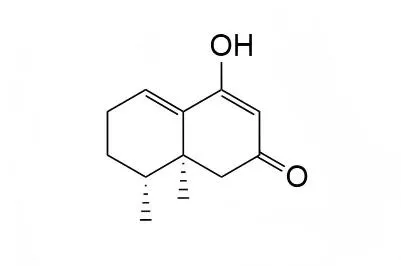
| Cas No. | 3062873-62-2 | SDF | File under preparation. |
| PubChem ID | N/A | Appearance | Powder |
| Formula | C12H16O2 | M.Wt | 192.3 |
| Type of Compound | Sesquiterpenoids | Storage | Desiccate at -20°C |
| Solubility | Soluble in Chloroform,Dichloromethane,Ethyl Acetate,DMSO,Acetone,etc. | ||
| General tips | For obtaining a higher solubility , please warm the tube at 37 ℃ and shake it in the ultrasonic bath for a while.Stock solution can be stored below -20℃ for several months. We recommend that you prepare and use the solution on the same day. However, if the test schedule requires, the stock solutions can be prepared in advance, and the stock solution must be sealed and stored below -20℃. In general, the stock solution can be kept for several months. Before use, we recommend that you leave the vial at room temperature for at least an hour before opening it. |
||
| About Packaging | 1. The packaging of the product may be reversed during transportation, cause the high purity compounds to adhere to the neck or cap of the vial.Take the vail out of its packaging and shake gently until the compounds fall to the bottom of the vial. 2. For liquid products, please centrifuge at 500xg to gather the liquid to the bottom of the vial. 3. Try to avoid loss or contamination during the experiment. |
||
| Shipping Condition | Packaging according to customer requirements(5mg, 10mg, 20mg and more). Ship via FedEx, DHL, UPS, EMS or other couriers with RT, or blue ice upon request. | ||
Quality Control & MSDS
Package In Stock
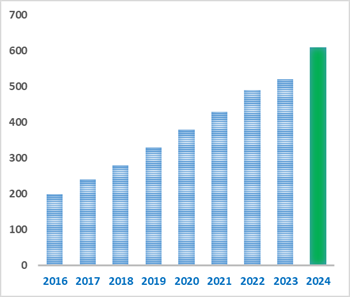
Number of papers citing our products

2-Deoxokanshone M Dilution Calculator
2-Deoxokanshone M Molarity Calculator
| 1 mg | 5 mg | 10 mg | 20 mg | 25 mg | |
| 1 mM | 5.2002 mL | 26.001 mL | 52.0021 mL | 104.0042 mL | 130.0052 mL |
| 5 mM | 1.04 mL | 5.2002 mL | 10.4004 mL | 20.8008 mL | 26.001 mL |
| 10 mM | 0.52 mL | 2.6001 mL | 5.2002 mL | 10.4004 mL | 13.0005 mL |
| 50 mM | 0.104 mL | 0.52 mL | 1.04 mL | 2.0801 mL | 2.6001 mL |
| 100 mM | 0.052 mL | 0.26 mL | 0.52 mL | 1.04 mL | 1.3001 mL |
| * Note: If you are in the process of experiment, it's necessary to make the dilution ratios of the samples. The dilution data above is only for reference. Normally, it's can get a better solubility within lower of Concentrations. | |||||
- Z-isogeranic acid
Catalog No.:BCX2249
CAS No.:85916-85-4
- 6,11,12,16-Tetrahydroxy-5,8,11,13-abitetetraen-7-one
Catalog No.:BCX2248
CAS No.:1295650-67-7
- 3-(2-Hydroxyphenyl)propionic acid
Catalog No.:BCX2247
CAS No.:495-78-3
- Oxypeucedanin hydrate-3-ethyl ether
Catalog No.:BCX2246
CAS No.:90686-46-7
- 4'-Demethyldeoxypodophyllotoxin beta-D-glucopyranoside
Catalog No.:BCX2245
CAS No.:78178-42-4
- Dihydromelilotoside
Catalog No.:BCX2244
CAS No.:24696-05-7
- 7-Feruloylloganic acid
Catalog No.:BCX2243
CAS No.:178666-92-7
- rel-(7S,8S,7''R,8''R)-3,3'',4'',5''-hexamethoxy-7-O-7'',8,8''-lignan
Catalog No.:BCX2242
CAS No.:50394-05-3
- Neoligustilide
Catalog No.:BCX2241
CAS No.:179382-45-7
- threo-1-C-Syringylglycerol 4-O-beta-D-glucopyranoside
Catalog No.:BCX2240
CAS No.:942304-08-7
- Phyllangin
Catalog No.:BCX2239
CAS No.:854044-76-1
- Pubeside D
Catalog No.:BCX2238
CAS No.:335150-90-8
- Glycocholic acid
Catalog No.:BCX2813
CAS No.:475-31-0
- Cadalene
Catalog No.:BCX2814
CAS No.:483-78-3
- Auramine O
Catalog No.:BCX2815
CAS No.:2465-27-2
- 3-Phenylpropyl Acetate
Catalog No.:BCX2816
CAS No.:122-72-5
- Gweicurculactone
Catalog No.:BCX2817
CAS No.:123914-43-2
- Esculentoside L
Catalog No.:BCX2818
CAS No.:130364-33-9
- Rorifamide
Catalog No.:BCX2819
CAS No.:53078-91-4
- Stemoninine
Catalog No.:BCX2820
CAS No.:69772-72-1
- Dracorubin
Catalog No.:BCX2821
CAS No.:6219-63-2
- Astin J
Catalog No.:BCX2822
CAS No.:163136-31-0
- Kalopanaxsaponin G
Catalog No.:BCX2823
CAS No.:57539-70-5
- Kuwanon L
Catalog No.:BCX2824
CAS No.:88524-65-6
Degradation Profiling of Nardosinone at High Temperature and in Simulated Gastric and Intestinal Fluids.[Pubmed:37513256]
Molecules. 2023 Jul 13;28(14):5382.
Nardosinone, a predominant bioactive product from Nardostachys jatamansi DC, is well-known for its promising therapeutic applications, such as being used as a drug on anti-inflammatory, antidepressant, cardioprotective, anti-neuroinflammatory, anti-arrhythmic, anti-periodontitis, etc. However, its stability under varying environmental conditions and its degradation products remain unclear. In this study, four main degradation products, including two previously undescribed compounds [2-Deoxokanshone M (64.23%) and 2-deoxokanshone L (1.10%)] and two known compounds [desoxo-narchinol A (2.17%) and isonardosinone (3.44%)], were firstly afforded from the refluxed products of nardosinone in boiling water; their structures were identified using an analysis of the extensive NMR and X-ray diffraction data and the simulation and comparison of electronic circular dichroism spectra. Compared with nardosinone, 2-Deoxokanshone M exhibited potent vasodilatory activity without any of the significant anti-neuroinflammatory activity that nardosinone contains. Secondly, UPLC-PDA and UHPLC-DAD/Q-TOF MS analyses on the degradation patterns of nardosinone revealed that nardosinone degraded more easily under high temperatures and in simulated gastric fluid compared with the simulated intestinal fluid. A plausible degradation pathway of nardosinone was finally proposed using nardosinonediol as the initial intermediate and involved multiple chemical reactions, including peroxy ring-opening, keto-enol tautomerization, oxidation, isopropyl cleavage, and pinacol rearrangement. Our findings may supply certain guidance and scientific evidence for the quality control and reasonable application of nardosinone-related products.

Calcutta University

University of Minnesota

University of Maryland School of Medicine

University of Illinois at Chicago

The Ohio State University

University of Zurich

Harvard University

Colorado State University

Auburn University

Yale University

Worcester Polytechnic Institute

Washington State University

Stanford University

University of Leipzig

Universidade da Beira Interior

The Institute of Cancer Research

Heidelberg University

University of Amsterdam

University of Auckland

TsingHua University

The University of Michigan

Miami University

DRURY University

Jilin University

Fudan University

Wuhan University

Sun Yat-sen University

Universite de Paris

Deemed University

Auckland University

The University of Tokyo

Korea University