
4-(Methoxymethyl)phenolCAS# 5355-17-9 |
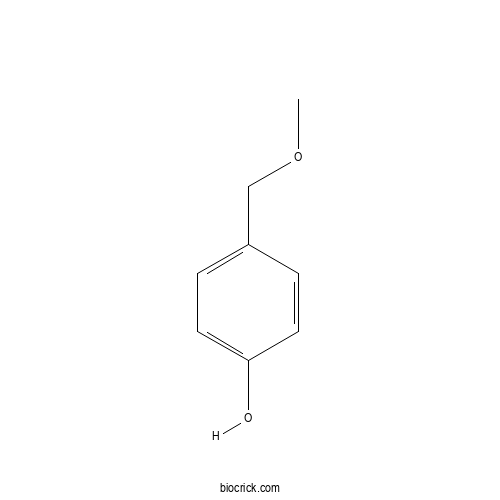
| Cas No. | 5355-17-9 | SDF | File under preparation. |
| PubChem ID | 79310.0 | Appearance | Powder |
| Formula | C8H10O2 | M.Wt | 138.2 |
| Type of Compound | N/A | Storage | Desiccate at -20°C |
| Solubility | Soluble in Chloroform,Dichloromethane,Ethyl Acetate,DMSO,Acetone,etc. | ||
| Chemical Name | 4-(methoxymethyl)phenol | ||
| SMILES | COCC1=CC=C(C=C1)O | ||
| Standard InChIKey | AHXXIALEMINDAW-UHFFFAOYSA-N | ||
| Standard InChI | InChI=1S/C8H10O2/c1-10-6-7-2-4-8(9)5-3-7/h2-5,9H,6H2,1H3 | ||
| General tips | For obtaining a higher solubility , please warm the tube at 37 ℃ and shake it in the ultrasonic bath for a while.Stock solution can be stored below -20℃ for several months. We recommend that you prepare and use the solution on the same day. However, if the test schedule requires, the stock solutions can be prepared in advance, and the stock solution must be sealed and stored below -20℃. In general, the stock solution can be kept for several months. Before use, we recommend that you leave the vial at room temperature for at least an hour before opening it. |
||
| About Packaging | 1. The packaging of the product may be reversed during transportation, cause the high purity compounds to adhere to the neck or cap of the vial.Take the vail out of its packaging and shake gently until the compounds fall to the bottom of the vial. 2. For liquid products, please centrifuge at 500xg to gather the liquid to the bottom of the vial. 3. Try to avoid loss or contamination during the experiment. |
||
| Shipping Condition | Packaging according to customer requirements(5mg, 10mg, 20mg and more). Ship via FedEx, DHL, UPS, EMS or other couriers with RT, or blue ice upon request. | ||
Quality Control & MSDS
3D structure
Package In Stock

Number of papers citing our products


4-(Methoxymethyl)phenol Dilution Calculator
4-(Methoxymethyl)phenol Molarity Calculator
| 1 mg | 5 mg | 10 mg | 20 mg | 25 mg | |
| 1 mM | 7.2359 mL | 36.1795 mL | 72.3589 mL | 144.7178 mL | 180.8973 mL |
| 5 mM | 1.4472 mL | 7.2359 mL | 14.4718 mL | 28.9436 mL | 36.1795 mL |
| 10 mM | 0.7236 mL | 3.6179 mL | 7.2359 mL | 14.4718 mL | 18.0897 mL |
| 50 mM | 0.1447 mL | 0.7236 mL | 1.4472 mL | 2.8944 mL | 3.6179 mL |
| 100 mM | 0.0724 mL | 0.3618 mL | 0.7236 mL | 1.4472 mL | 1.809 mL |
| * Note: If you are in the process of experiment, it's necessary to make the dilution ratios of the samples. The dilution data above is only for reference. Normally, it's can get a better solubility within lower of Concentrations. | |||||
- Fukanedone I
Catalog No.:BCX2614
CAS No.:219595-67-2
- 2-epi-Baigene B
Catalog No.:BCX2613
CAS No.:263746-25-4
- Sinolignan B
Catalog No.:BCX2612
CAS No.:1314092-87-9
- (7R,8S)-Dihydrodehydrodiconiferyl alcohol 9-O-glucoside
Catalog No.:BCX2611
CAS No.:421546-95-4
- Ainsliaside C
Catalog No.:BCX2610
CAS No.:138195-61-6
- 1,5-Dimethoxyphenanthrene-2,7-diol
Catalog No.:BCX2609
CAS No.:86630-47-9
- Chlorahololide B
Catalog No.:BCX2608
CAS No.:928040-25-9
- Funingenoside C
Catalog No.:BCX2607
CAS No.:587876-16-2
- Baigene B
Catalog No.:BCX2606
CAS No.:1472648-83-1
- Dysoslignan XL
Catalog No.:BCX2605
CAS No.:627677-61-5
- Tuliferoline
Catalog No.:BCX2604
CAS No.:60755-82-0
- Funingenoside J
Catalog No.:BCX2603
CAS No.:645411-82-1
- 14-Hydroxy-5-desoxyilludosin
Catalog No.:BCX2616
CAS No.:1243248-95-4
- (20R)-Funingenoside L
Catalog No.:BCX2617
CAS No.:1034171-40-8
- (20S)-Funingenoside L
Catalog No.:BCX2618
CAS No.:1034171-46-4
- Dysoslignan B
Catalog No.:BCX2619
CAS No.:3053227-57-6
- 7-O-Galloylcatechin
Catalog No.:BCX2620
CAS No.:89702-01-2
- Iturin A2
Catalog No.:BCX2621
CAS No.:83785-07-3
- Ammoresinol
Catalog No.:BCX2622
CAS No.:643-57-2
- Cyclosuffrobuxine K
Catalog No.:BCX2623
CAS No.:7671-41-2
- 11-O-(4'-O-Methylgalloyl)bergenin
Catalog No.:BCX2624
CAS No.:866721-61-1
- erythro-Syringylglycerol β-sinapyl ether
Catalog No.:BCX2625
CAS No.:613683-98-0
- erythro-1,2-Bis(4-hydroxy-3-methoxyphenyl)propane-1,3-diol
Catalog No.:BCX2626
CAS No.:69887-41-8
- Chlorajaponilide I
Catalog No.:BCX2627
CAS No.:2260997-81-5
Structural analysis of flavinylation in vanillyl-alcohol oxidase.[Pubmed:10984479]
J Biol Chem. 2000 Dec 8;275(49):38654-8.
Vanillyl-alcohol oxidase (VAO) is member of a newly recognized flavoprotein family of structurally related oxidoreductases. The enzyme contains a covalently linked FAD cofactor. To study the mechanism of flavinylation we have created a design point mutation (His-61 --> Thr). In the mutant enzyme the covalent His-C8alpha-flavin linkage is not formed, while the enzyme is still able to bind FAD and perform catalysis. The H61T mutant displays a similar affinity for FAD and ADP (K(d) = 1.8 and 2.1 microm, respectively) but does not interact with FMN. H61T is about 10-fold less active with 4-(Methoxymethyl)phenol) (k(cat) = 0.24 s(-)(1), K(m) = 40 microm) than the wild-type enzyme. The crystal structures of both the holo and apo form of H61T are highly similar to the structure of wild-type VAO, indicating that binding of FAD to the apoprotein does not require major structural rearrangements. These results show that covalent flavinylation is an autocatalytical process in which His-61 plays a crucial role by activating His-422. Furthermore, our studies clearly demonstrate that in VAO, the FAD binds via a typical lock-and-key approach to a preorganized binding site.
Asp-170 is crucial for the redox properties of vanillyl-alcohol oxidase.[Pubmed:10809721]
J Biol Chem. 2000 May 19;275(20):14799-808.
Vanillyl-alcohol oxidase is a flavoprotein containing a covalent flavin that catalyzes the oxidation of 4-(Methoxymethyl)phenol to 4-hydroxybenzaldehyde. The reaction proceeds through the formation of a p-quinone methide intermediate, after which, water addition takes place. Asp-170, located near the N5-atom of the flavin, has been proposed to act as an active site base. To test this hypothesis, we have addressed the properties of D170E, D170S, D170A, and D170N variants. Spectral and fluorescence analysis, together with the crystal structure of D170S, suggests that the Asp-170 replacements do not induce major structural changes. However, in D170A and D170N, 50 and 100%, respectively, of the flavin is non-covalently bound. Kinetic characterization of the vanillyl-alcohol oxidase variants revealed that Asp-170 is required for catalysis. D170E is 50-fold less active, and the other Asp-170 variants are about 10(3)-fold less active than wild type enzyme. Impaired catalysis of the Asp-170 variants is caused by slow flavin reduction. Furthermore, the mutant proteins have lost the capability of forming a stable complex between reduced enzyme and the p-quinone methide intermediate. The redox midpoint potentials in D170E (+6 mV) and D170S (-91 mV) are considerably decreased compared with wild type vanillyl-alcohol oxidase (+55 mV). This supports the idea that Asp-170 interacts with the protonated N5-atom of the reduced cofactor, thus increasing the FAD redox potential. Taken together, we conclude that Asp-170 is involved in the process of autocatalytic flavinylation and is crucial for efficient redox catalysis.
Subcellular localization of vanillyl-alcohol oxidase in Penicillium simplicissimum.[Pubmed:9475171]
FEBS Lett. 1998 Jan 23;422(1):65-8.
Growth of Penicillium simplicissimum on anisyl alcohol, veratryl alcohol or 4-(Methoxymethyl)phenol, is associated with the synthesis of relatively large amounts of the hydrogen peroxide producing flavoprotein vanillyl-alcohol oxidase (VAO). Immunocytochemistry revealed that the enzyme has a dual location namely in peroxisomes and in the cytosol. The C-terminus of the primary structure of VAO displays a WKL-COOH sequence which might function as a peroxisomal targeting signal type 1 (PTS1). As VAO activity results in production of hydrogen peroxide also the subcellular location of a recently characterized co-inducible catalase-peroxidase was studied. As VAO, this hydroperoxidase is also distributed throughout the cytosol and peroxisomes.
Catalytic mechanism of the oxidative demethylation of 4-(methoxymethyl)phenol by vanillyl-alcohol oxidase. Evidence for formation of a p-quinone methide intermediate.[Pubmed:9218444]
J Biol Chem. 1997 Jul 18;272(29):18111-6.
The catalytic mechanism for the oxidative demethylation of 4-(Methoxymethyl)phenol by the covalent flavoprotein vanillyl-alcohol oxidase was studied. Using H218O, it was found that the carbonylic oxygen atom from the product 4-hydroxybenzaldehyde originates from a water molecule. Oxidation of vanillyl alcohol did not result in any incorporation of 18O. Enzyme-monitored turnover experiments revealed that for both substrates a process involving flavin reduction is rate determining. During anaerobic reduction of vanillyl-alcohol oxidase by 4-(Methoxymethyl)phenol, a relatively stable spectral intermediate is formed. Deconvolution of its spectral characteristics showed a typical pH-independent absorption maximum at 364 nm (epsilon364 nm = 46 mM-1 cm-1). A similar transient species was observed upon anaerobic reduction by vanillyl alcohol. The rate of flavin reduction and synchronous intermediate formation by 4-(Methoxymethyl)phenol is 3.3 s-1 and is fast enough to account for turnover (3.1 s-1). The anaerobic decay of the intermediate was too slow (0.01 s-1) to be of catalytical relevance. The reduced binary complex is rapidly reoxidized (1.5 x 10(5) M-1 s-1) and is accompanied with formation and release of product. Oxidation of free-reduced enzyme is an even faster process (3.1 x 10(5) M-1 s-1). The kinetic data for the oxidative demethylation of 4-(Methoxymethyl)phenol are in accordance with a ternary complex mechanism in which the reduction rate is rate-limiting. It is proposed that, upon reduction, a binary complex is produced composed of the p-quinone methide of 4-(Methoxymethyl)phenol and reduced enzyme.
Enigmatic Gratuitous Induction of the Covalent Flavoprotein Vanillyl-Alcohol Oxidase in Penicillium simplicissimum.[Pubmed:16535508]
Appl Environ Microbiol. 1997 Feb;63(2):435-9.
When Penicillium simplicissimum is grown on veratryl alcohol, anisyl alcohol, or 4-(Methoxymethyl)phenol, an intracellular covalent flavin-containing vanillyl-alcohol oxidase is induced. The induction is highest (up to 5% of total protein) during the growth phase. In addition to vanillyl-alcohol oxidase, an intracellular catalase-peroxidase is induced. Induction of vanillyl-alcohol oxidase in P. simplicissimum is prevented by the addition of isoeugenol to veratryl alcohol-containing media, but growth is unaffected. The inhibitory effect of isoeugenol on induction is not observed when anisyl alcohol or 4-(Methoxymethyl)phenol is used as the growth substrate. Based on the induction experiments and the degradation pathways for veratryl and anisyl alcohol, we propose that induction of vanillyl-alcohol oxidase is superfluous when P. simplicissimum is grown on these aromatic alcohols. However, the enzyme plays an essential role in the degradation of the methyl ether of p-cresol, 4-(Methoxymethyl)phenol.

Calcutta University

University of Minnesota

University of Maryland School of Medicine

University of Illinois at Chicago

The Ohio State University

University of Zurich

Harvard University

Colorado State University

Auburn University

Yale University

Worcester Polytechnic Institute

Washington State University

Stanford University

University of Leipzig

Universidade da Beira Interior

The Institute of Cancer Research

Heidelberg University

University of Amsterdam

University of Auckland

TsingHua University

The University of Michigan

Miami University

DRURY University

Jilin University

Fudan University

Wuhan University

Sun Yat-sen University

Universite de Paris

Deemed University

Auckland University

The University of Tokyo

Korea University



