
Iturin A2CAS# 83785-07-3 |
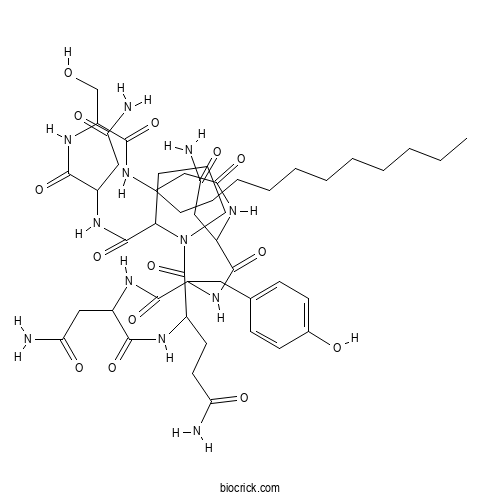
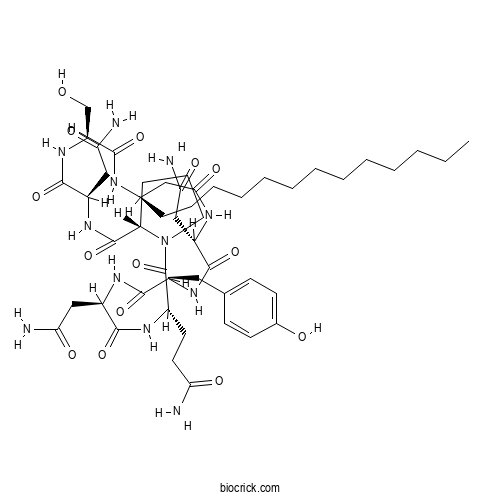
| Cas No. | 83785-07-3 | SDF | File under preparation. |
| PubChem ID | 158570.0 | Appearance | Powder |
| Formula | C48H74N12O14 | M.Wt | 1043.2 |
| Type of Compound | N/A | Storage | Desiccate at -20°C |
| Solubility | Soluble in Chloroform,Dichloromethane,Ethyl Acetate,DMSO,Acetone,etc. | ||
| Chemical Name | 3-[6,12,22-tris(2-amino-2-oxoethyl)-19-(hydroxymethyl)-9-[(4-hydroxyphenyl)methyl]-2,5,8,11,14,18,21,24-octaoxo-16-undecyl-1,4,7,10,13,17,20,23-octazabicyclo[23.3.0]octacosan-3-yl]propanamide | ||
| SMILES | CCCCCCCCCCCC1CC(=O)NC(C(=O)NC(C(=O)NC(C(=O)NC(C(=O)N2CCCC2C(=O)NC(C(=O)NC(C(=O)N1)CO)CC(=O)N)CCC(=O)N)CC(=O)N)CC3=CC=C(C=C3)O)CC(=O)N | ||
| Standard InChIKey | HNAPWDKFUSLFFE-UHFFFAOYSA-N | ||
| Standard InChI | InChI=1S/C48H74N12O14/c1-2-3-4-5-6-7-8-9-10-12-28-22-41(67)54-32(23-38(50)64)43(69)56-31(21-27-14-16-29(62)17-15-27)42(68)57-33(24-39(51)65)44(70)55-30(18-19-37(49)63)48(74)60-20-11-13-36(60)47(73)58-34(25-40(52)66)45(71)59-35(26-61)46(72)53-28/h14-17,28,30-36,61-62H,2-13,18-26H2,1H3,(H2,49,63)(H2,50,64)(H2,51,65)(H2,52,66)(H,53,72)(H,54,67)(H,55,70)(H,56,69)(H,57,68)(H,58,73)(H,59,71) | ||
| General tips | For obtaining a higher solubility , please warm the tube at 37 ℃ and shake it in the ultrasonic bath for a while.Stock solution can be stored below -20℃ for several months. We recommend that you prepare and use the solution on the same day. However, if the test schedule requires, the stock solutions can be prepared in advance, and the stock solution must be sealed and stored below -20℃. In general, the stock solution can be kept for several months. Before use, we recommend that you leave the vial at room temperature for at least an hour before opening it. |
||
| About Packaging | 1. The packaging of the product may be reversed during transportation, cause the high purity compounds to adhere to the neck or cap of the vial.Take the vail out of its packaging and shake gently until the compounds fall to the bottom of the vial. 2. For liquid products, please centrifuge at 500xg to gather the liquid to the bottom of the vial. 3. Try to avoid loss or contamination during the experiment. |
||
| Shipping Condition | Packaging according to customer requirements(5mg, 10mg, 20mg and more). Ship via FedEx, DHL, UPS, EMS or other couriers with RT, or blue ice upon request. | ||
Quality Control & MSDS
3D structure
Package In Stock

Number of papers citing our products


Iturin A2 Dilution Calculator
Iturin A2 Molarity Calculator
| 1 mg | 5 mg | 10 mg | 20 mg | 25 mg | |
| 1 mM | 0.9586 mL | 4.7929 mL | 9.5859 mL | 19.1718 mL | 23.9647 mL |
| 5 mM | 0.1917 mL | 0.9586 mL | 1.9172 mL | 3.8344 mL | 4.7929 mL |
| 10 mM | 0.0959 mL | 0.4793 mL | 0.9586 mL | 1.9172 mL | 2.3965 mL |
| 50 mM | 0.0192 mL | 0.0959 mL | 0.1917 mL | 0.3834 mL | 0.4793 mL |
| 100 mM | 0.0096 mL | 0.0479 mL | 0.0959 mL | 0.1917 mL | 0.2396 mL |
| * Note: If you are in the process of experiment, it's necessary to make the dilution ratios of the samples. The dilution data above is only for reference. Normally, it's can get a better solubility within lower of Concentrations. | |||||
- 7-O-Galloylcatechin
Catalog No.:BCX2620
CAS No.:89702-01-2
- Dysoslignan B
Catalog No.:BCX2619
CAS No.:3053227-57-6
- (20S)-Funingenoside L
Catalog No.:BCX2618
CAS No.:1034171-46-4
- (20R)-Funingenoside L
Catalog No.:BCX2617
CAS No.:1034171-40-8
- 14-Hydroxy-5-desoxyilludosin
Catalog No.:BCX2616
CAS No.:1243248-95-4
- 4-(Methoxymethyl)phenol
Catalog No.:BCX2615
CAS No.:5355-17-9
- Fukanedone I
Catalog No.:BCX2614
CAS No.:219595-67-2
- 2-epi-Baigene B
Catalog No.:BCX2613
CAS No.:263746-25-4
- Sinolignan B
Catalog No.:BCX2612
CAS No.:1314092-87-9
- (7R,8S)-Dihydrodehydrodiconiferyl alcohol 9-O-glucoside
Catalog No.:BCX2611
CAS No.:421546-95-4
- Ainsliaside C
Catalog No.:BCX2610
CAS No.:138195-61-6
- 1,5-Dimethoxyphenanthrene-2,7-diol
Catalog No.:BCX2609
CAS No.:86630-47-9
- Ammoresinol
Catalog No.:BCX2622
CAS No.:643-57-2
- Cyclosuffrobuxine K
Catalog No.:BCX2623
CAS No.:7671-41-2
- 11-O-(4'-O-Methylgalloyl)bergenin
Catalog No.:BCX2624
CAS No.:866721-61-1
- erythro-Syringylglycerol β-sinapyl ether
Catalog No.:BCX2625
CAS No.:613683-98-0
- erythro-1,2-Bis(4-hydroxy-3-methoxyphenyl)propane-1,3-diol
Catalog No.:BCX2626
CAS No.:69887-41-8
- Chlorajaponilide I
Catalog No.:BCX2627
CAS No.:2260997-81-5
- Shizukaol M
Catalog No.:BCX2628
CAS No.:1006590-91-5
- 3-Carene-2,5-dione
Catalog No.:BCX2629
CAS No.:6617-34-1
- Asarinol A
Catalog No.:BCX2630
CAS No.:131896-45-2
- 10-Hydroxy-11-methoxydracaenone
Catalog No.:BCX2631
CAS No.:113459-56-6
- (6R,9S)-3-Oxo-α-ionol
Catalog No.:BCX2632
CAS No.:68759-08-0
- 11-O-p-hydroxybenzoylbergenin
Catalog No.:BCX2633
CAS No.:189691-23-4
Exploring the Phytobeneficial and Biocontrol Capacities of Endophytic Bacteria Isolated from Hybrid Vanilla Pods.[Pubmed:37512926]
Microorganisms. 2023 Jul 5;11(7):1754.
In this study, 58 endophytic bacterial strains were isolated from pods of two hybrid vanilla plants from Madagascar, Manitra ampotony and Tsy taitra. They were genetically characterized and divided into four distinct phylotypes. Three were associated to genus Bacillus species, and the fourth to the genus Curtobacterium. A selection of twelve strains corresponding to the identified genetic diversity were tested in vitro for four phytobeneficial capacities: phosphate solubilisation, free nitrogen fixation, and phytohormone and siderophore production. They were also evaluated in vitro for their ability to biocontrol the growth of the vanilla pathogenic fungi, Fusarium oxysporum f. sp. radicis vanillae and Cholletotrichum orchidophilum. Three bacteria of phylotype 4, m62a, m64 and m65, showed a high nitrogen fixation capacity in vitro, similar to the Pseudomonas florescens F113 bacterium used as a control (phospate solubilizing efficiency respectively 0.50 +/- 0.07, 0.43 +/- 0.07 and 0.40 +/- 0.06 against 0.48 +/- 0.03). Strain t2 related to B. subtilis showed a higher siderophore production than F113 (respectively 1.40 +/- 0.1 AU and 1.2 +/- 0.1 AU). The strain m72, associated with phylotype 2, showed the highest rate of production of Indole-3-acetic acid (IAA) in vitro. Bacteria belonging to the pylotype 4 showed the best capacity to inhibit fungal growth, especially the strains m62b m64 and t24, which also induced a significant zone of inhibition, suggesting that they may be good candidates for controlling fungal diseases of vanilla. This competence was highlighted with spectral imaging showing the production of lipopeptides (Iturin A2 and A3, C(16) and C(15)-Fengycin A and C(14) and C(15)-Surfactin) by the bacterial strains m65 confronted with the pathogenic fungi of vanilla.
Genomic Analysis and Secondary Metabolites Production of the Endophytic Bacillus velezensis Bvel1: A Biocontrol Agent against Botrytis cinerea Causing Bunch Rot in Post-Harvest Table Grapes.[Pubmed:34451760]
Plants (Basel). 2021 Aug 20;10(8):1716.
Botrytis bunch rot caused by Botrytis cinerea is one of the most economically significant post-harvest diseases of grapes. In the present study, we showed that the bacterial strain Bvel1 is phylogenetically affiliated to Bacillus velezensis species. The strain Bvel1 and its secreted metabolites exerted an antifungal activity, under in vitro conditions, against B. cinerea. UHPLC-HRMS chemical analysis revealed that Iturin A2, surfactin-C13 and -C15, oxydifficidin, bacillibactin, L-dihydroanticapsin, and azelaic acid were among the metabolites secreted by Bvel1. Treatment of wounded grape berries with Bacillus sp. Bvel1 cell culture was effective for controlling grey mold ingress and expansion in vivo. The effectiveness of this biological control agent was a function of the cell culture concentration of the antagonist applied, while preventive treatment proved to be more effective compared to curative. The strain Bvel1 exhibited an adequate colonization efficiency in wounded grapes. The whole-genome phylogeny, combined with ANI and dDDH analyses, provided compelling evidence that the strain Bvel1 should be taxonomically classified as Bacillus velezensis. Genome mining approaches showed that the strain Bvel1 harbors 13 antimicrobial biosynthetic gene clusters, including iturin A, fengycin, surfactin, bacilysin, difficidin, bacillaene, and bacillibactin. The results provide new insights into the understanding of the endophytic Bacillus velezensis Bvel1 biocontrol mechanism against post-harvest fungal pathogens, including bunch rot disease in grape berries.
Antifungal activity of endophytic Bacillus safensis B21 and its potential application as a biopesticide to control rice blast.[Pubmed:31836057]
Pestic Biochem Physiol. 2020 Jan;162:69-77.
Endophytic bacteria are potential biocontrol agents for the control of fungal diseases. Here, an endophyte strain, B21, was isolated from Osmanthus fragrans Lour. fruits and identified as Bacillus safensis by analysis of its 16S rDNA gene sequence and its biochemical and physiological characteristics. The culture filtrate showed antifungal activity against Magnaporthe oryzae, which causes rice blast disease, and the IC(50) of the methanol extract was 15.56 mug/mL, which was significantly lower than that of carbendazim (25.16 mug/mL). The antifungal activity of the methanol extract was stable at a wide range of pH values (1-9) and temperatures (40-100 degrees C). Two antifungal compounds were isolated by organic extraction, silica gel column chromatography and high-performance liquid chromatography (HPLC). Based on electrospray ionization mass spectrometry (ESI-MS) and nuclear magnetic resonance spectrometry (NMR) analyses, the structures of the antifungal compounds were identified as Iturin A2 and iturin A6. Additionally, the hyphae treated with iturin (Iturin A2 or iturin A6) could be stained with the fluorescent dye propidium iodide (PI), indicating that these two compounds inhibited the growth of hyphae by changing the hyphal membrane permeability. In field experiments, spray treatment with fermentation broth resulted in a lower disease index than treatment with carbendazim, as did the culture filtrate. The results suggest that strain B21 and its bioactive compounds have the potential to be developed into a biopesticide for the biocontrol of rice blast.
HPLC-HRMS Quantification of the Ichthyotoxin Karmitoxin from Karlodinium armiger.[Pubmed:28858210]
Mar Drugs. 2017 Aug 31;15(9):278.
Being able to quantify ichthyotoxic metabolites from microalgae allows for the determination of ecologically-relevant concentrations that can be simulated in laboratory experiments, as well as to investigate bioaccumulation and degradation. Here, the ichthyotoxin karmitoxin, produced by Karlodinium armiger, was quantified in laboratory-grown cultures using high-performance liquid chromatography (HPLC) coupled to electrospray ionisation high-resolution time-of-flight mass spectrometry (HRMS). Prior to the quantification of karmitoxin, a standard of karmitoxin was purified from K. armiger cultures (80 L). The standard was quantified by fluorescent derivatisation using Waters AccQ-Fluor reagent and derivatised fumonisin B(1) and fumonisin B(2) as standards, as each contain a primary amine. Various sample preparation methods for whole culture samples were assessed, including six different solid phase extraction substrates. During analysis of culture samples, MS source conditions were monitored with chloramphenicol and valinomycin as external standards over prolonged injection sequences (>12 h) and karmitoxin concentrations were determined using the response factor of a closely eluting Iturin A2 internal standard. Using this method the limit of quantification was 0.11 mug.mL(-1), and the limit of detection was found to be 0.03 mug.mL(-1). Matrix effects were determined with the use of K. armiger cultures grown with (13)C-labelled bicarbonate as the primary carbon source.
Production of iturin A homologues under different culture conditions.[Pubmed:25084426]
J Environ Sci (China). 2009;21 Suppl 1:S28-32.
Iturin A is a cyclic lipopeptide antibiotic and eight different kinds of iturin A have been reported based on its alkyl side chains. As iturin A is a promising biocontrol agent, total production of iturin A was tried to enhance and comparative production of its homologues was investigated by using different nitrogen and carbon sources. When Polypepton S and defatted soybean meal were used, total production as well as the ratio of the iturin A homologues were similar. However, production of iturin A was relatively lower and also the ratio of the iturin A homologues was different when Polypepton was used, where A2 was decreased and A4 was increased. Production ratio of the iturin A homologues was similar for the carbon sources like maltose, mannitol, sucrose and starch but relative production of Iturin A2 was much enhanced compared to A3 when lactose or galactose was used. Interestingly production ratio of A4 was increased and A2 and A3 were decreased when no additional carbon source was used, and similar tendency was observed in the homologue ratio with glucose and fructose. Production of iturin A homologue A6 was significantly increased whereas A2 and A3 were decreased when defatted rapeseed cake was used. Utilization of different amino acids did not show significant differences in their production of the iturin A homologues. Oxygen supply found to be the factor affecting the production of iturin A homologues when it was investigated in a varied culture volume size and shaking speed. A2 found to be increased with increased oxygen supply where the production of A3 was affected inversely.
Antimicrobial Activity of Culture Filtrate of Bacillus amyloliquefaciens RC-2 Isolated from Mulberry Leaves.[Pubmed:18944392]
Phytopathology. 2001 Feb;91(2):181-7.
ABSTRACT A potential antagonist, Bacillus amyloliquefaciens strain RC-2, against Colletotrichum dematium, mulberry anthracnose fungus, was obtained from healthy mulberry leaves by in vitro and in vivo screening techniques. Application of culture filtrate of RC-2 inhibited disease on mulberry leaves, indicating that suppression was due to antifungal compounds in the filtrate. Development of mulberry anthracnose on mulberry leaves was inhibited only when the culture filtrate was applied before fungal inoculation, and it was not inhibited by application after inoculation. These results suggest that the antifungal compounds in the filtrate exhibit a preventive effect on the disease. Peptone significantly increased production of the antifungal compounds. The culture filtrate of RC-2 also inhibited the growth of several other phytopathogenic fungi and bacteria, such as Rosellinia necatrix, Pyricularia oryzae, Agrobacterium tumefaciens, and Xanthomonas campestris pv. campestris, in vitro. From the culture filtrate of RC-2, seven kinds of antifungal compounds were isolated by high performance liquid chromatography analysis, and one of the compounds was determined as Iturin A2, a cyclic peptide, by nuclear magnetic resonance and fast atom bombardment mass analysis.
Study of the antifungal activity of Acinetobacter baumannii LCH001 in vitro and identification of its antifungal components.[Pubmed:17534613]
Appl Microbiol Biotechnol. 2007 Aug;76(2):459-66.
An Acinetobacter strain, given the code name LCH001 and having the potential to be an endophytic antagonist, has been isolated from healthy stems of the plant Cinnamomum camphora (L.) Presl, guided by an in vitro screening technique. The bacterium inhibited the growth of several phytopathogenic fungi such as Cryphonectria parasitica, Glomerella glycines, Phytophthora capsici, Fusarium graminearum, Botrytis cinerea, and Rhizoctonia solani. Biochemical, physiological, and 16S rDNA sequence analysis proved that it is Acinetobacter baumannii. When the filtrate from the fermentation broth of strain LCH001 was tested in vitro and in vivo, it showed strong growth inhibition against several phytopathogens including P. capsici, F. graminearum, and R. solani, indicating that suppression of the growth of the fungi was due to the presence of antifungal compounds in the culture broth. Moreover, the antifungal activity of the culture filtrate was significantly correlated with the cell growth of strain LCH001. The active metabolites in the filtrate were relatively thermally stable, but were sensitive to acidic conditions. Three antifungal compounds were isolated from the culture broth by absorption onto macropore resin, ethanol extraction, chromatography on silica gel or LH-20 columns, and crystallization. The structures of the bioactive compounds were identified by spectroscopic methods as isomers of iturin A, namely, Iturin A2, iturin A3, and iturin A6. The characterization of an unusual endophytic bacterial strain LCH001 and its bioactive components may provide an alternative resource for the biocontrol of plant diseases.
Sequence specific stabilization of a linear analog of the antifungal lipopeptide iturin A2 by sodium during low energy electrospray ionization mass spectrometry conditions.[Pubmed:11349948]
J Am Soc Mass Spectrom. 2001 May;12(5):505-16.
The structures and stability of sodiated species of 8-Beta, a linear lipopeptide analog (beta-aminotetradecanoyl-NYNQPNS) of the antifungal peptide Iturin A2, were evaluated by electrospray ionization mass spectrometry (ESI-MS). Association of the lipopeptide, 8-Beta, with sodium afforded protection from fragmentation at high cone voltages and increasing collision energy conditions in the ESI-MS. The order of decreasing stability was found as 8-Beta 1Na > 8-Beta 2Na > 8-Beta 3Na > 8-Beta. Substantial differences were found between fragmentation patterns of the free and sodiated molecular species. Breakage of the N-terminal peptide bond of L-Pro generated the major product ions of the free 8-Beta parent ion. Impaired fragmentation of the sodium adducts of 8-Beta, indicated that this bond is protected by sodium complexation. Fragmentation patterns of the sodiated lipopeptide further revealed two specific binding sites for a nonsolvated sodium ion within the two type II beta-turn sequences (beta-aminotetradecanoyl-NYN and QPNS) of the natural Iturin A2. It is proposed that specific interaction with sodium takes place with most of the peptide bond oxygens in these turns, and with the Gln sidechain. This interaction leads to stabilized structures in which the peptide backbone, specifically the peptide bonds in which L-Pro participates, is protected against low-energy fragmentation during ESI-MS.
The interaction of analogues of the antimicrobial lipopeptide, iturin A2, with alkali metal ions.[Pubmed:11092539]
Bioorg Med Chem. 2000 Nov;8(11):2539-48.
Electrospray mass spectrometry was employed as a tool in this first study on the molecular interaction between the alkali metal ions and antifungal lipopeptide iturin A, and some analogues. Cationisation by sodium and signal intensity of lipopeptide species depended on sodium concentration, but was independent of sample solvent, carrier solvent polarity and sample pH between 4 and 11. 8-Beta, a linear analogue of Iturin A2 (8-Beta; beta-aminotetradecanoyl-NYNQPNS), and its shorter linear lipopeptide analogues, associated either one or two alkali metal cations, while the N-->C cyclic peptides associated with only one cation. The chirality of the beta-NC14 residue had a limited influence on the cationisation. It was observed that 8-Beta contained at least four interaction sites for a cation of which two, the C-terminal carboxylate and the side-chain of tyrosine, can take part in ionic interaction with a cation. It is proposed that the remaining two interaction centres of alkali metal ions are within the two type II beta-turns found in conformation of natural iturin A. This was corroborated by the diminished capacity of the shorter peptides, in which one of the beta-turns was eliminated to bind a second larger cation. All the lipopeptides showed the same order of alkali metal ion selectivity: Na+ > K+ > Rb+. These results indicated a size limitation in the interaction cavity or cavities. The absence of, or observation of only low abundance, di-cationised complexes of cyclic peptides the indicated association of the cation in the interior of the peptide ring. It is thus hypothesised that alkali metal ions can bind in one of the two beta-turns in the natural iturin A molecule.
Effects of the antimycotic molecule Iturin A2, secreted by Bacillus subtilis strain M51, on arbuscular mycorrhizal fungi.[Pubmed:7987612]
Microbiol Res. 1994 Sep;149(3):241-6.
A new system, devised for the study of early stages of arbuscular mycorrhizal infection, was used to test the effect of the biological control agent Iturin A2, secreted by the strain M51 of Bacillus subtilis, on the development of arbuscular mycorrhizal fungi. The saprophytic growth of the fungus Glomus mosseae was inhibited by Iturin A2 concentrations higher than 100 micrograms/g of sand; whereas, in the presence of the tomato host plant, both, pre-infection events and intraradical growth were not negatively influenced by the antifungal compound; furthermore, the development of arbuscular mycorrhizal symbiosis was not impeded by the biocontrol agent in field conditions, while Fusarium oxysporum f. sp. lycopersici infection was hindered.

Calcutta University

University of Minnesota

University of Maryland School of Medicine

University of Illinois at Chicago

The Ohio State University

University of Zurich

Harvard University

Colorado State University

Auburn University

Yale University

Worcester Polytechnic Institute

Washington State University

Stanford University

University of Leipzig

Universidade da Beira Interior

The Institute of Cancer Research

Heidelberg University

University of Amsterdam

University of Auckland

TsingHua University

The University of Michigan

Miami University

DRURY University

Jilin University

Fudan University

Wuhan University

Sun Yat-sen University

Universite de Paris

Deemed University

Auckland University

The University of Tokyo

Korea University



