
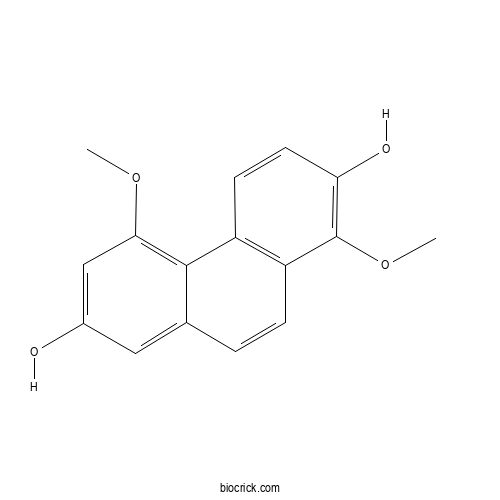
1,5-Dimethoxyphenanthrene-2,7-diolCAS# 86630-47-9 |
| Cas No. | 86630-47-9 | SDF | File under preparation. |
| PubChem ID | 158976.0 | Appearance | Powder |
| Formula | C16H14O4 | M.Wt | 270.3 |
| Type of Compound | N/A | Storage | Desiccate at -20°C |
| Solubility | Soluble in Chloroform,Dichloromethane,Ethyl Acetate,DMSO,Acetone,etc. | ||
| Chemical Name | 1,5-dimethoxyphenanthrene-2,7-diol | ||
| SMILES | COC1=C2C(=CC(=C1)O)C=CC3=C2C=CC(=C3OC)O | ||
| Standard InChIKey | FEKWNIUACHRZJW-UHFFFAOYSA-N | ||
| Standard InChI | InChI=1S/C16H14O4/c1-19-14-8-10(17)7-9-3-4-12-11(15(9)14)5-6-13(18)16(12)20-2/h3-8,17-18H,1-2H3 | ||
| General tips | For obtaining a higher solubility , please warm the tube at 37 ℃ and shake it in the ultrasonic bath for a while.Stock solution can be stored below -20℃ for several months. We recommend that you prepare and use the solution on the same day. However, if the test schedule requires, the stock solutions can be prepared in advance, and the stock solution must be sealed and stored below -20℃. In general, the stock solution can be kept for several months. Before use, we recommend that you leave the vial at room temperature for at least an hour before opening it. |
||
| About Packaging | 1. The packaging of the product may be reversed during transportation, cause the high purity compounds to adhere to the neck or cap of the vial.Take the vail out of its packaging and shake gently until the compounds fall to the bottom of the vial. 2. For liquid products, please centrifuge at 500xg to gather the liquid to the bottom of the vial. 3. Try to avoid loss or contamination during the experiment. |
||
| Shipping Condition | Packaging according to customer requirements(5mg, 10mg, 20mg and more). Ship via FedEx, DHL, UPS, EMS or other couriers with RT, or blue ice upon request. | ||
Quality Control & MSDS
3D structure
Package In Stock

Number of papers citing our products


1,5-Dimethoxyphenanthrene-2,7-diol Dilution Calculator
1,5-Dimethoxyphenanthrene-2,7-diol Molarity Calculator

| 1 mg | 5 mg | 10 mg | 20 mg | 25 mg | |
| 1 mM | 3.6996 mL | 18.498 mL | 36.9959 mL | 73.9919 mL | 92.4898 mL |
| 5 mM | 0.7399 mL | 3.6996 mL | 7.3992 mL | 14.7984 mL | 18.498 mL |
| 10 mM | 0.37 mL | 1.8498 mL | 3.6996 mL | 7.3992 mL | 9.249 mL |
| 50 mM | 0.074 mL | 0.37 mL | 0.7399 mL | 1.4798 mL | 1.8498 mL |
| 100 mM | 0.037 mL | 0.185 mL | 0.37 mL | 0.7399 mL | 0.9249 mL |
| * Note: If you are in the process of experiment, it's necessary to make the dilution ratios of the samples. The dilution data above is only for reference. Normally, it's can get a better solubility within lower of Concentrations. | |||||
- Chlorahololide B
Catalog No.:BCX2608
CAS No.:928040-25-9
- Funingenoside C
Catalog No.:BCX2607
CAS No.:587876-16-2
- Baigene B
Catalog No.:BCX2606
CAS No.:1472648-83-1
- Dysoslignan XL
Catalog No.:BCX2605
CAS No.:627677-61-5
- Tuliferoline
Catalog No.:BCX2604
CAS No.:60755-82-0
- Funingenoside J
Catalog No.:BCX2603
CAS No.:645411-82-1
- 13βH-Malabarica-14(27),17,21-trien-3β-ol
Catalog No.:BCX2602
CAS No.:1159402-28-4
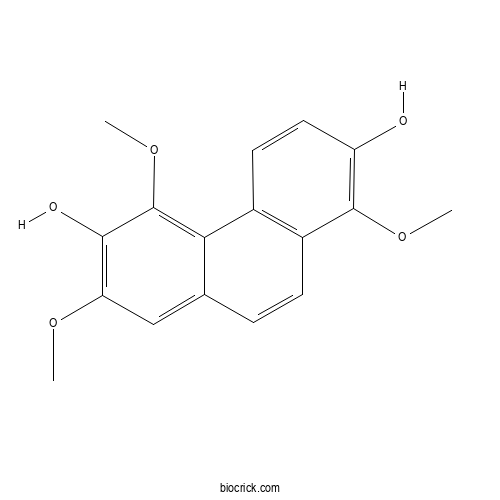
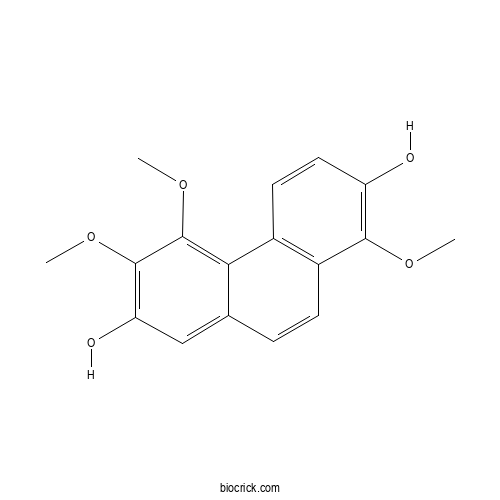
- 5,7-Dimethoxyphenanthrene-2,6-diol
Catalog No.:BCX2601
CAS No.:72966-94-0
- Baigene C
Catalog No.:BCX2600
CAS No.:263746-17-4
- 2-epi-Baigene C
Catalog No.:BCX2599
CAS No.:263746-16-3
- Fukanedone B
Catalog No.:BCX2598
CAS No.:850621-98-6
- 3,4-Bis(3,4-dimethoxyphenyl)cycloocta-1,5-diene
Catalog No.:BCX2597
CAS No.:146564-35-4
- Ainsliaside C
Catalog No.:BCX2610
CAS No.:138195-61-6
- (7R,8S)-Dihydrodehydrodiconiferyl alcohol 9-O-glucoside
Catalog No.:BCX2611
CAS No.:421546-95-4
- Sinolignan B
Catalog No.:BCX2612
CAS No.:1314092-87-9
- 2-epi-Baigene B
Catalog No.:BCX2613
CAS No.:263746-25-4
- Fukanedone I
Catalog No.:BCX2614
CAS No.:219595-67-2
- 4-(Methoxymethyl)phenol
Catalog No.:BCX2615
CAS No.:5355-17-9
- 14-Hydroxy-5-desoxyilludosin
Catalog No.:BCX2616
CAS No.:1243248-95-4
- (20R)-Funingenoside L
Catalog No.:BCX2617
CAS No.:1034171-40-8
- (20S)-Funingenoside L
Catalog No.:BCX2618
CAS No.:1034171-46-4
- Dysoslignan B
Catalog No.:BCX2619
CAS No.:3053227-57-6
- 7-O-Galloylcatechin
Catalog No.:BCX2620
CAS No.:89702-01-2
- Iturin A2
Catalog No.:BCX2621
CAS No.:83785-07-3
(1)H-NMR-Based Metabolomic Profiling and Phylogenetic Analysis of Dendrobium Species Identify Lineage-Correlated Metabolites in the Main Clades.[Pubmed:41565293]
Chem Pharm Bull (Tokyo). 2026;74(1):90-97.
Dendrobium Sw. is one of the largest genera in the Orchidaceae. Most species belong to one of two major clades (the Asian and the Australasian clades) based on morphology and phylogenetic analyses using DNA sequences. Several Dendrobium species in the Asian clade are used in traditional herbal medicine, and many compounds have been isolated from them (e.g., phenanthrene derivatives, bibenzyl derivatives, and polysaccharides). Conversely, there are only a few reports on the compounds contained in the Australasian clade species. Due to its size and diversity, the Australasian clade could be expected to contain compounds of potential medicinal value as well. Previously, we constructed the HPLC profile of 18 Dendrobium species and identified the phenanthrene derivative 1,5-Dimethoxyphenanthrene-2,7-diol (1) as a characteristic compound in certain species of the Australasian clade. In this study, we performed metabolic analyses based on (1)H-NMR to identify lineage-correlated metabolites for the Australasian clade. NMR profiling analysis also showed that 1 is a characteristic compound of the Australasian clade species. Additionally, pinoresinol (2) was predominantly detected in the Australasian clade. While syringaresinol (3) was widely detected in species from both clades, specimens from the Australasian clade tended to have higher concentrations. The simple (1)H-NMR profiling method enables rapid comparison of metabolites across multiple species, providing new insights into metabolic differences associated with evolutionary lineages that were not detectable by the previous HPLC profiling.
Identification of Two Phenanthrene Derivatives from Australasian Allied Species in Genus Dendrobium.[Pubmed:29618669]
Chem Pharm Bull (Tokyo). 2018 Jun 1;66(6):642-650.
Genus Dendrobium (Orchidaceae) contains numerous species. Phylogenetic analyses based on morphological characteristics and DNA sequences indicated that this genus is divided into two major groups: Asian and Australasian clades. On the other hand, little is known about the phytochemical differences and similarities among the species in each clade. In this study, we selected 18 Dendrobium species (11 from the Asian clade and 7 from the Australasian clade) and constructed HPLC profiles, arrays composed of relative intensity of the chromatographic peaks. Next, orthogonal partial least square discriminant analysis (OPLS-DA) was applied to the profile matrix to classify Dendrobium species into the Asian and Australasian clades in order to identify the peaks that significantly contribute to the class separation. In the end, two phenanthrenes, 4,9-dimethoxyphenanthrene-2,5-diol 1 and 1,5-Dimethoxyphenanthrene-2,7-diol 2, which contributed to the class separation, were isolated from the HPLC peaks. The existence of 2 was limited to the genetically related Australasian species.

Calcutta University

University of Minnesota

University of Maryland School of Medicine

University of Illinois at Chicago

The Ohio State University

University of Zurich

Harvard University

Colorado State University

Auburn University

Yale University

Worcester Polytechnic Institute

Washington State University

Stanford University

University of Leipzig

Universidade da Beira Interior

The Institute of Cancer Research

Heidelberg University

University of Amsterdam

University of Auckland

TsingHua University

The University of Michigan

Miami University

DRURY University

Jilin University

Fudan University

Wuhan University

Sun Yat-sen University

Universite de Paris

Deemed University

Auckland University

The University of Tokyo

Korea University



