
PestaloneCAS# 381722-85-6 |
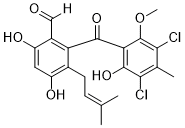
| Cas No. | 381722-85-6 | SDF | File under preparation. |
| PubChem ID | N/A | Appearance | Powder |
| Formula | C21H20Cl2O6 | M.Wt | 439.3 |
| Type of Compound | N/A | Storage | Desiccate at -20°C |
| Solubility | Soluble in Chloroform,Dichloromethane,Ethyl Acetate,DMSO,Acetone,etc. | ||
| General tips | For obtaining a higher solubility , please warm the tube at 37 ℃ and shake it in the ultrasonic bath for a while.Stock solution can be stored below -20℃ for several months. We recommend that you prepare and use the solution on the same day. However, if the test schedule requires, the stock solutions can be prepared in advance, and the stock solution must be sealed and stored below -20℃. In general, the stock solution can be kept for several months. Before use, we recommend that you leave the vial at room temperature for at least an hour before opening it. |
||
| About Packaging | 1. The packaging of the product may be reversed during transportation, cause the high purity compounds to adhere to the neck or cap of the vial.Take the vail out of its packaging and shake gently until the compounds fall to the bottom of the vial. 2. For liquid products, please centrifuge at 500xg to gather the liquid to the bottom of the vial. 3. Try to avoid loss or contamination during the experiment. |
||
| Shipping Condition | Packaging according to customer requirements(5mg, 10mg, 20mg and more). Ship via FedEx, DHL, UPS, EMS or other couriers with RT, or blue ice upon request. | ||
Quality Control & MSDS
Package In Stock

Number of papers citing our products


Pestalone Dilution Calculator
Pestalone Molarity Calculator
| 1 mg | 5 mg | 10 mg | 20 mg | 25 mg | |
| 1 mM | 2.2763 mL | 11.3817 mL | 22.7635 mL | 45.527 mL | 56.9087 mL |
| 5 mM | 0.4553 mL | 2.2763 mL | 4.5527 mL | 9.1054 mL | 11.3817 mL |
| 10 mM | 0.2276 mL | 1.1382 mL | 2.2763 mL | 4.5527 mL | 5.6909 mL |
| 50 mM | 0.0455 mL | 0.2276 mL | 0.4553 mL | 0.9105 mL | 1.1382 mL |
| 100 mM | 0.0228 mL | 0.1138 mL | 0.2276 mL | 0.4553 mL | 0.5691 mL |
| * Note: If you are in the process of experiment, it's necessary to make the dilution ratios of the samples. The dilution data above is only for reference. Normally, it's can get a better solubility within lower of Concentrations. | |||||
- Dihydrophaseic acid β-D-glucopyranosyl ester
Catalog No.:BCX2702
CAS No.:114906-04-6
- Staunoside C
Catalog No.:BCX2701
CAS No.:153980-86-0
- 3-O-[β-D-xylopyranosyl-(1→3)-a-L-rhamnopyranosyl-(1→2)-a-L-arabinopyranosyl]oleanolic acid 28-O-β-D-glucopyranosyl ester
Catalog No.:BCX2700
CAS No.:688797-26-4
- 8,14-Epoxy-4-acetoxycardanolide 3-O-α-L-cymaropyranoside
Catalog No.:BCX2699
CAS No.:1034171-38-4
- Ferulin D
Catalog No.:BCX2698
CAS No.:1440795-35-6
- Bleformin G
Catalog No.:BCX2697
CAS No.:1980064-41-2
- (2S*,3R*)-3-((E)-4,8-dimethylnona-3,7-dien-1-yl)-7-methoxy-2,3-dimethyl-2H-furo[3,2-c]chromen-4(3H)-one
Catalog No.:BCX2696
CAS No.:263746-15-2
- Sitoindoside II
Catalog No.:BCX2695
CAS No.:53657-29-7
- Medioresinol
Catalog No.:BCX2694
CAS No.:125638-34-8
- 3β-Hydroxy-12,13E-biformen
Catalog No.:BCX2693
CAS No.:71052-17-0
- 4-epi-trans-Communol
Catalog No.:BCX2692
CAS No.:203319-77-1
- threo-Guaiacylglycerol-β-coniferylaldehyde ether
Catalog No.:BCX2691
CAS No.:74474-54-7
- Caffeyl alcohol 4-O-β-glucopyranoside
Catalog No.:BCX2704
CAS No.:183859-30-5
- Caffeyl alcohol 3-O-β-glucopyranoside
Catalog No.:BCX2705
CAS No.:1303610-03-8
- Ferulin B
Catalog No.:BCX2706
CAS No.:1440795-29-8
- Idescarparide
Catalog No.:BCX2707
CAS No.:1627833-27-5
- Bleformin D
Catalog No.:BCX2708
CAS No.:1980064-38-7
- Aketrilignoside B
Catalog No.:BCX2709
CAS No.:1020108-72-8
- 1-(4-Hydroxybenzyl)-4,8-dimethoxy-2,7-phenanthrenediol
Catalog No.:BCX2710
CAS No.:124901-90-2
- Meliasendanin C
Catalog No.:BCX2711
CAS No.:1820034-04-5
- Meliasendanin B
Catalog No.:BCX2712
CAS No.:1820034-03-4
- (2R*,3S*)-7-hydroxy-2,3-dimethyl-2-((E)-4-methyl-5-(4-methylfuran-2-yl)pent-3-en-1-yl)-2H-furo[2,3-b]chromen-4(3H)-one
Catalog No.:BCX2713
CAS No.:263746-26-5
- Baigene A
Catalog No.:BCX2714
CAS No.:380913-60-0
- 7,4'-Dihydroxy-5-methoxy-8-methylflavan
Catalog No.:BCX2715
CAS No.:1993394-52-7
Studies toward Pestalachloride B: Synthesis of the 6/7/6 Tricyclic Scaffold.[Pubmed:41709707]
Org Lett. 2026 Mar 6;28(9):2831-2835.
Antibiotic therapy is a critical part of modern healthcare, and the discovery of antibiotics with novel mechanisms of action is needed to combat the rise of antimicrobial resistance. Pestalachloride B, isolated from Pestalotiopsis adusta, is a compound belonging to the Pestalone family of natural products which demonstrates potent and selective antimicrobial activity against clinically relevant, antimicrobial-resistant Gram-positive bacteria. Here, we report the first synthetic studies focused specifically on pestalachloride B. Two key disconnections were evaluated for the construction of the rare 6/7/6 tricyclic scaffold, and a key intramolecular Parham-type cyclization was found to afford the desired scaffold in 74% yield, enabling us to obtain a late-stage intermediate bearing the complete pestalachloride B framework in 8% overall yield over 11 steps.
Synergistic effect of secondary metabolites isolated from Pestalotiopsis sp. FKR-0115 in overcoming beta-lactam resistance in MRSA.[Pubmed:37302827]
J Gen Appl Microbiol. 2024 Feb 2;69(4):234-238.
Six aromatic secondary metabolites, Pestalone (1), emodin (2), phomopsilactone (3), pestalachlorides B (4), C (5), and D (6), were isolated from Pestalotiopsis sp. FKR-0115, a filamentous fungus collected from white moulds growing on dead branches in Minami Daito Island. The efficacy of these secondary metabolites against methicillin-resistant Staphylococcus aureus (MRSA) with and without meropenem (beta-lactam antibiotic) was evaluated using the paper disc method and broth microdilution method. The chemical structures of the isolated compounds (1-6) were characterised using spectroscopic methods, including nuclear magnetic resonance and mass spectrometry. All six isolated compounds exhibited synergistic activity with meropenem against MRSA. Among the six secondary metabolites, Pestalone (1) overcame bacterial resistance in MRSA to the greatest extent.
Pestalotinones A-D, new benzophenone antibiotics from endophytic fungus Pestalotiopsis trachicarpicola SC-J551.[Pubmed:35115699]
J Antibiot (Tokyo). 2022 Apr;75(4):207-212.
Four new Pestalone-type benzophenones, pestalotinones A-D (1-4), along with six known congeners, Pestalone, Pestalone E-F, SB87-Cl, SB87-H, and pestalachloride B, were isolated from the endophytic fungus Pestalotiopsis trachicarpicola SC-J551 cultivated on rice grains. Their structures were established by extensive spectroscopic analysis. Compounds 1-3 exhibited potent activity against Staphylococcus aureus and MRSA (MIC: 1.25-2.5 mug ml(-1)) while no cytotoxicity against Vero cells (IC(50) > 50 muM). The activity profile of this group of compounds suggested that replacement of the C-14 aldehyde with an oxymethyl greatly increases their activity and selectivity towards the bacteria and chlorine substitutions result in the increase of antibacterial activity and slight decrease of cytotoxicity against the mammalian cells.
On the antibiotic and antifungal activity of pestalone, pestalachloride A, and structurally related compounds.[Pubmed:23905700]
J Nat Prod. 2013 Aug 23;76(8):1519-22.
Pestalone (1) is a prominent marine natural product first isolated by M. Cueto et al. in 2001 from a co-fermentation of a marine fungus with a marine bacterium. For more than 10 years, 1 had been considered as a promising new antibiotic compound, the reported MIC against methicillin-resistant Staphylococcus aureus (MRSA) being 37 ng/mL. After overcoming the limited availability of 1 by total synthesis (N. Slavov et al., 2010) we performed new biological tests, which did not confirm the expected degree of antibiotic activity. The observed activity of Pestalone against different MRSA strains was 3-10 mug/mL, as determined independently in two laboratories. A number of synthetic derivatives of 1 including pestalachloride A and other isoindolinones (formed from 1 by reaction with amines) did not exhibit higher activities as compared to 1 against MRSA and a series of plant pathogens.
Nucleophile- or light-induced synthesis of 3-substituted phthalides from 2-formylarylketones.[Pubmed:22519905]
Org Lett. 2012 May 4;14(9):2338-41.
The surprisingly facile conversion (isomerization) of 2-formyl-arylketones into 3-substituted phthalides, as observed for the marine natural product Pestalone and its per-O-methylated derivative, was investigated using a series of simple 2-acylbenzaldehydes as substrates. The transformation generally proceeds smoothly in DMSO, either in a Cannizarro-Tishchenko-type reaction under nucleophile catalysis (NaCN) or under photochemical conditions (DMSO, 350 nm).
N-Capping of primary amines with 2-acyl-benzaldehydes to give isoindolinones.[Pubmed:21902238]
Org Lett. 2011 Oct 7;13(19):5374-7.
A unique reactivity pattern, first observed in the conversion of the marine natural product Pestalone into pestalachloride A, was investigated. It was shown that 2-formyl-arylketones smoothly react with ammonia and primary amines, respectively, under mild conditions to afford 3-substituted isoindolinones in high yield. The reaction represents a new option for the derivatization (N-capping) of primary amines. As the substrates are readily accessible the methodology opens a short and modular access to pharmaceutically relevant substituted isoindolinones.
Small-molecule elicitation of microbial secondary metabolites.[Pubmed:21375710]
Microb Biotechnol. 2011 Jul;4(4):471-8.
Microbial natural products continue to be an unparalleled resource for pharmaceutical lead discovery, but the rediscovery rate is high. Bacterial and fungal sequencing studies indicate that the biosynthetic potential of many strains is much greater than that observed by fermentation. Prodding the expression of such silent (cryptic) pathways will allow us to maximize the chemical diversity available from microorganisms. Cryptic metabolic pathways can be accessed in the laboratory using molecular or cultivation-based approaches. A targeted approach related to cultivation-based methods is the application of small-molecule elicitors to specifically affect transcription of secondary metabolite gene clusters. With the isolation of the novel secondary metabolites lunalides A and B, oxylipins, cladochromes F and G, nygerone A, chaetoglobosin-542, -540 and -510, sphaerolone, dihydrosphaerolone, mutolide and Pestalone, and the enhanced production of known secondary metabolites like penicillin and bacitracin, chemical elicitation is proving to be an effective way to augment natural product libraries.
Pestalone, a new antibiotic produced by a marine fungus in response to bacterial challenge.[Pubmed:11720529]
J Nat Prod. 2001 Nov;64(11):1444-6.
The isolation and structure determination of a new chlorinated benzophenone antibiotic, Pestalone (1), is described. The new compound was produced by a cultured marine fungus only when a unicellular marine bacterium, strain CNJ-328, was co-cultured in the fungal fermentation. The fungus, isolated from the surface of the brown alga Rosenvingea sp. collected in the Bahamas Islands, was identified as an undescribed member of the genus Pestalotia. The structure of 1, initially assigned with only modest confidence by combined spectral and chemical data, was confirmed by single-crystal X-ray analysis. Pestalone (1) exhibits moderate in vitro cytotoxicity in the National Cancer Institute's 60 human tumor cell line screen (mean GI(50) = 6.0 microM). More importantly, Pestalone shows potent antibiotic activity against methicillin-resistant Staphylococcus aureus (MIC = 37 ng/mL) and vancomycin-resistant Enterococcus faecium (MIC = 78 ng/mL), indicating that Pestalone should be evaluated in advanced models of infectious disease.

Calcutta University

University of Minnesota

University of Maryland School of Medicine

University of Illinois at Chicago

The Ohio State University

University of Zurich

Harvard University

Colorado State University

Auburn University

Yale University

Worcester Polytechnic Institute

Washington State University

Stanford University

University of Leipzig

Universidade da Beira Interior

The Institute of Cancer Research

Heidelberg University

University of Amsterdam

University of Auckland

TsingHua University

The University of Michigan

Miami University

DRURY University

Jilin University

Fudan University

Wuhan University

Sun Yat-sen University

Universite de Paris

Deemed University

Auckland University

The University of Tokyo

Korea University



