
Sitoindoside IICAS# 53657-29-7 |
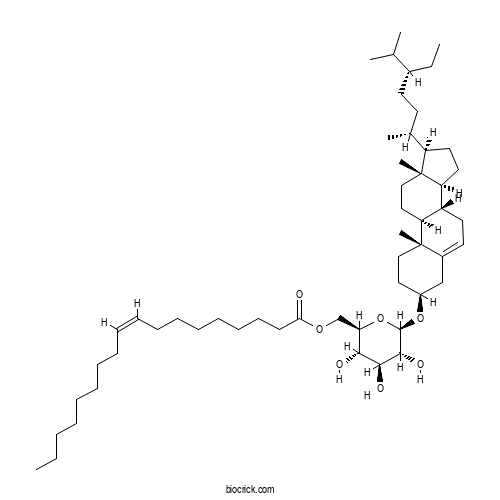
| Cas No. | 53657-29-7 | SDF | File under preparation. |
| PubChem ID | 16058264.0 | Appearance | Powder |
| Formula | C53H92O7 | M.Wt | 841.3 |
| Type of Compound | N/A | Storage | Desiccate at -20°C |
| Solubility | Soluble in Chloroform,Dichloromethane,Ethyl Acetate,DMSO,Acetone,etc. | ||
| Chemical Name | [(2R,3S,4S,5R,6R)-6-[[(3S,8S,9S,10R,13R,14S,17R)-17-[(2R,5R)-5-ethyl-6-methylheptan-2-yl]-10,13-dimethyl-2,3,4,7,8,9,11,12,14,15,16,17-dodecahydro-1H-cyclopenta[a]phenanthren-3-yl]oxy]-3,4,5-trihydroxyoxan-2-yl]methyl (Z)-octadec-9-enoate | ||
| SMILES | CCCCCCCCC=CCCCCCCCC(=O)OCC1C(C(C(C(O1)OC2CCC3(C4CCC5(C(C4CC=C3C2)CCC5C(C)CCC(CC)C(C)C)C)C)O)O)O | ||
| Standard InChIKey | MEEONOMPSMYAQO-MBEOCFQISA-N | ||
| Standard InChI | InChI=1S/C53H92O7/c1-8-10-11-12-13-14-15-16-17-18-19-20-21-22-23-24-47(54)58-36-46-48(55)49(56)50(57)51(60-46)59-41-31-33-52(6)40(35-41)27-28-42-44-30-29-43(53(44,7)34-32-45(42)52)38(5)25-26-39(9-2)37(3)4/h16-17,27,37-39,41-46,48-51,55-57H,8-15,18-26,28-36H2,1-7H3/b17-16-/t38-,39-,41+,42+,43-,44+,45+,46-,48-,49+,50-,51-,52+,53-/m1/s1 | ||
| General tips | For obtaining a higher solubility , please warm the tube at 37 ℃ and shake it in the ultrasonic bath for a while.Stock solution can be stored below -20℃ for several months. We recommend that you prepare and use the solution on the same day. However, if the test schedule requires, the stock solutions can be prepared in advance, and the stock solution must be sealed and stored below -20℃. In general, the stock solution can be kept for several months. Before use, we recommend that you leave the vial at room temperature for at least an hour before opening it. |
||
| About Packaging | 1. The packaging of the product may be reversed during transportation, cause the high purity compounds to adhere to the neck or cap of the vial.Take the vail out of its packaging and shake gently until the compounds fall to the bottom of the vial. 2. For liquid products, please centrifuge at 500xg to gather the liquid to the bottom of the vial. 3. Try to avoid loss or contamination during the experiment. |
||
| Shipping Condition | Packaging according to customer requirements(5mg, 10mg, 20mg and more). Ship via FedEx, DHL, UPS, EMS or other couriers with RT, or blue ice upon request. | ||
Quality Control & MSDS
3D structure
Package In Stock

Number of papers citing our products


Sitoindoside II Dilution Calculator
Sitoindoside II Molarity Calculator

| 1 mg | 5 mg | 10 mg | 20 mg | 25 mg | |
| 1 mM | 1.1886 mL | 5.9432 mL | 11.8864 mL | 23.7727 mL | 29.7159 mL |
| 5 mM | 0.2377 mL | 1.1886 mL | 2.3773 mL | 4.7545 mL | 5.9432 mL |
| 10 mM | 0.1189 mL | 0.5943 mL | 1.1886 mL | 2.3773 mL | 2.9716 mL |
| 50 mM | 0.0238 mL | 0.1189 mL | 0.2377 mL | 0.4755 mL | 0.5943 mL |
| 100 mM | 0.0119 mL | 0.0594 mL | 0.1189 mL | 0.2377 mL | 0.2972 mL |
| * Note: If you are in the process of experiment, it's necessary to make the dilution ratios of the samples. The dilution data above is only for reference. Normally, it's can get a better solubility within lower of Concentrations. | |||||
- Medioresinol
Catalog No.:BCX2694
CAS No.:125638-34-8
- 3β-Hydroxy-12,13E-biformen
Catalog No.:BCX2693
CAS No.:71052-17-0
- 4-epi-trans-Communol
Catalog No.:BCX2692
CAS No.:203319-77-1
- threo-Guaiacylglycerol-β-coniferylaldehyde ether
Catalog No.:BCX2691
CAS No.:74474-54-7
- (2S*,3S*)-3-((E)-4,8-dimethylnona-3,7-dien-1-yl)-7-methoxy-2,3-dimethyl-2H-furo[3,2-c]chromen-4(3H)-one
Catalog No.:BCX2690
CAS No.:1714988-35-8
- 4,6-Di-O-galloylarbutin
Catalog No.:BCX2689
CAS No.:108027-05-0
- (3-Hydroxy-9-(4′-hydroxy-3′-methoxyphenyl)-11-methoxy-5,6,9,10-tetrahydrophenanthro[2,3-b]furan-10-yl)methyl acetate
Catalog No.:BCX2688
CAS No.:1009566-73-7
- Neridienone A
Catalog No.:BCX2687
CAS No.:53823-05-5
- Scabiostellatoside A
Catalog No.:BCX2686
CAS No.:2229823-05-4
- Thaliatrioside A
Catalog No.:BCX2685
CAS No.:3078805-86-1
- Pestalotiopsin H
Catalog No.:BCX2684
CAS No.:2270234-26-7
- Arundinan
Catalog No.:BCX2683
CAS No.:767291-22-5
- (2S*,3R*)-3-((E)-4,8-dimethylnona-3,7-dien-1-yl)-7-methoxy-2,3-dimethyl-2H-furo[3,2-c]chromen-4(3H)-one
Catalog No.:BCX2696
CAS No.:263746-15-2
- Bleformin G
Catalog No.:BCX2697
CAS No.:1980064-41-2
- Ferulin D
Catalog No.:BCX2698
CAS No.:1440795-35-6
- 8,14-Epoxy-4-acetoxycardanolide 3-O-α-L-cymaropyranoside
Catalog No.:BCX2699
CAS No.:1034171-38-4
- 3-O-[β-D-xylopyranosyl-(1→3)-a-L-rhamnopyranosyl-(1→2)-a-L-arabinopyranosyl]oleanolic acid 28-O-β-D-glucopyranosyl ester
Catalog No.:BCX2700
CAS No.:688797-26-4
- Staunoside C
Catalog No.:BCX2701
CAS No.:153980-86-0
- Dihydrophaseic acid β-D-glucopyranosyl ester
Catalog No.:BCX2702
CAS No.:114906-04-6
- Pestalone
Catalog No.:BCX2703
CAS No.:381722-85-6
- Caffeyl alcohol 4-O-β-glucopyranoside
Catalog No.:BCX2704
CAS No.:183859-30-5
- Caffeyl alcohol 3-O-β-glucopyranoside
Catalog No.:BCX2705
CAS No.:1303610-03-8
- Ferulin B
Catalog No.:BCX2706
CAS No.:1440795-29-8
- Idescarparide
Catalog No.:BCX2707
CAS No.:1627833-27-5
Non-targeted metabolomics of cooked cowpea (Vigna unguiculata) and pigeon pea (Cajanus cajan) from Ghana using two distinct and complementary analytical platforms.[Pubmed:35415674]
Food Chem (Oxf). 2022 Feb 14;4:100087.
Legumes are global staple foods with multiple human health properties that merit detailed composition analysis in cooked forms. This study analyzed cowpea [Vigna unguiculata] (three varieties: Dagbantuya, Sangyi, and Tukara), pigeon pea [Cajanus cajan], and common bean [Phaseolus vulgaris] using two distinct ultra-performance liquid chromatography mass spectrometry (UPLC-MS) platforms and analytical workflows. Comparisons between cowpea and pigeon pea consumed in Ghana, and common bean (navy bean) from USA, revealed 75 metabolites that differentiated cowpeas. Metabolite fold-change comparisons resulted in 142 metabolites with significantly higher abundance in cowpea, and 154 higher in abundance from pigeon pea. 3-(all-trans-nonaprenyl)benzene-1,2-diol, N-tetracosanoylphytosphingosine, and Sitoindoside II are novel identifications in cowpea, with notably higher abundance than other legumes tested. Cowpea variety specific markers were tonkinelin (Dagbantuya), pheophytin A (Sangyi), and linoleoyl ethanolamide (Tukara). This study identified novel cowpea and pigeon pea food metabolites that warrant continued investigation as bioactive food components following consumption in people.
Chemical and biological studies on Cichorium intybus L.[Pubmed:28629227]
Nat Prod Res. 2018 Jun;32(11):1343-1347.
Cichorium intybus L. (Asteraceae family) is a world-wide grown plant known as chicory. In traditional medicine, this plant is used as diuretic, anti-inflammatory, digestive, cardiotonic and liver tonic. Chromatographic purification of the supercritical fluid extract of aerial parts of C. intybus on silica gel column led to isolation of three compounds: new compound, 28beta-hydroxytaraxasterol (I), and two known compounds usnic acid (II) and beta-sitosterol (III). Purification of the ethanolic extract of aerial parts of this plant on silica gel column chromatography yielded four compounds: 1,3-dioleylglycerate (IV), Sitoindoside II (V), 11beta-13-dihydrolactucin (VI) and beta-sitosterol-3-O-glucoside (VII). The structures of the isolated compounds were determined by their 1D, 2D NMR and MS spectral data. All the fractions and isolated compounds were tested for cannabinoid and opioid receptor binding, as well as antibacterial, antifungal and antimalarial activities. Compound I showed moderate activity (60.5% displacement) towards CB1 receptor.
Discovery of natural product chemopreventive agents utilizing HL-60 cell differentiation as a model.[Pubmed:7762989]
Anticancer Res. 1995 Mar-Apr;15(2):233-9.
Terminal differentiation of human promyelocytic leukemia (HL-60) cells can be induced by a variety of chemical agents and this process can be monitored readily by the generation of morphologically, histochemically, and functionally mature granulocytes and monocytes/macrophages. The availability of this model has heightened interest in the possible therapeutic role of inducers of myeloid differentiation for the treatment of leukemia and other neoplasms. In addition, however, potent cancer chemopreventive agents induce HL-60 cell differentiation at very low dose levels. Thus, as part of our search for natural product chemopreventive agents, extracts derived from nearly 400 plants were tested for their potential to induce HL-60 cell differentiation. As a result, 17 plant extracts were judged to be active (ED50 values < or = 4 micrograms/ml). One of most potent leads was an extract derived from Dirca occidentalis Gray (Thymelaeaceae) (ED50, 0.14 micrograms/ml), and bioassay-guided fractionation led to the identification of genkwanin (I), (+/-)-lariciresinol (II) and Sitoindoside II (IV) as active principles, with ED50 values of 18.3, 1.1 and 0.069 microM, respectively. Based on these data, we conclude that the HL-60 cell differentiation system is a valid and useful model for the discovery of natural product cancer chemopreventive or chemotherapeutic agents.

Calcutta University

University of Minnesota

University of Maryland School of Medicine

University of Illinois at Chicago

The Ohio State University

University of Zurich

Harvard University

Colorado State University

Auburn University

Yale University

Worcester Polytechnic Institute

Washington State University

Stanford University

University of Leipzig

Universidade da Beira Interior

The Institute of Cancer Research

Heidelberg University

University of Amsterdam

University of Auckland

TsingHua University

The University of Michigan

Miami University

DRURY University

Jilin University

Fudan University

Wuhan University

Sun Yat-sen University

Universite de Paris

Deemed University

Auckland University

The University of Tokyo

Korea University



