
Rosthorin ACAS# 93772-27-1 |
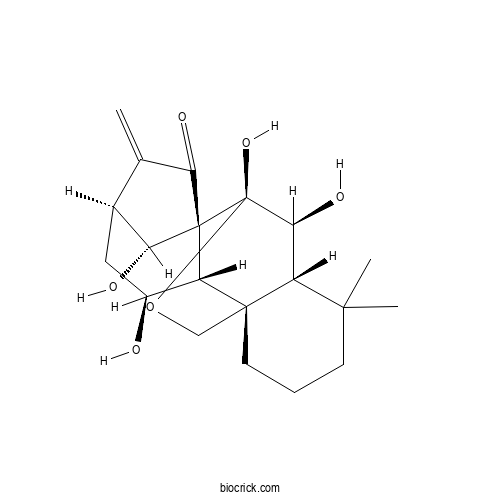
| Cas No. | 93772-27-1 | SDF | File under preparation. |
| PubChem ID | 44445757.0 | Appearance | Powder |
| Formula | C20H28O6 | M.Wt | 364.4 |
| Type of Compound | N/A | Storage | Desiccate at -20°C |
| Solubility | Soluble in Chloroform,Dichloromethane,Ethyl Acetate,DMSO,Acetone,etc. | ||
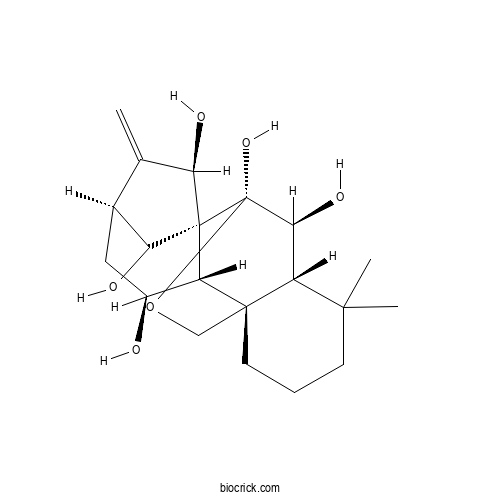
| Chemical Name | (1R,2S,3S,5S,8R,9R,10S,11R,18R)-3,9,10,18-tetrahydroxy-12,12-dimethyl-6-methylidene-17-oxapentacyclo[7.6.2.15,8.01,11.02,8]octadecan-7-one | ||
| SMILES | CC1(CCCC23C1C(C(C45C2C(CC(C4O)C(=C)C5=O)O)(OC3)O)O)C | ||
| Standard InChIKey | AOUAZUQTHDBROH-BAFGBBEMSA-N | ||
| Standard InChI | InChI=1S/C20H28O6/c1-9-10-7-11(21)12-18-6-4-5-17(2,3)13(18)16(24)20(25,26-8-18)19(12,14(9)22)15(10)23/h10-13,15-16,21,23-25H,1,4-8H2,2-3H3/t10-,11-,12-,13+,15+,16-,18+,19-,20-/m0/s1 | ||
| General tips | For obtaining a higher solubility , please warm the tube at 37 ℃ and shake it in the ultrasonic bath for a while.Stock solution can be stored below -20℃ for several months. We recommend that you prepare and use the solution on the same day. However, if the test schedule requires, the stock solutions can be prepared in advance, and the stock solution must be sealed and stored below -20℃. In general, the stock solution can be kept for several months. Before use, we recommend that you leave the vial at room temperature for at least an hour before opening it. |
||
| About Packaging | 1. The packaging of the product may be reversed during transportation, cause the high purity compounds to adhere to the neck or cap of the vial.Take the vail out of its packaging and shake gently until the compounds fall to the bottom of the vial. 2. For liquid products, please centrifuge at 500xg to gather the liquid to the bottom of the vial. 3. Try to avoid loss or contamination during the experiment. |
||
| Shipping Condition | Packaging according to customer requirements(5mg, 10mg, 20mg and more). Ship via FedEx, DHL, UPS, EMS or other couriers with RT, or blue ice upon request. | ||
Quality Control & MSDS
3D structure
Package In Stock

Number of papers citing our products


Rosthorin A Dilution Calculator
Rosthorin A Molarity Calculator
| 1 mg | 5 mg | 10 mg | 20 mg | 25 mg | |
| 1 mM | 2.7442 mL | 13.7212 mL | 27.4424 mL | 54.8847 mL | 68.6059 mL |
| 5 mM | 0.5488 mL | 2.7442 mL | 5.4885 mL | 10.9769 mL | 13.7212 mL |
| 10 mM | 0.2744 mL | 1.3721 mL | 2.7442 mL | 5.4885 mL | 6.8606 mL |
| 50 mM | 0.0549 mL | 0.2744 mL | 0.5488 mL | 1.0977 mL | 1.3721 mL |
| 100 mM | 0.0274 mL | 0.1372 mL | 0.2744 mL | 0.5488 mL | 0.6861 mL |
| * Note: If you are in the process of experiment, it's necessary to make the dilution ratios of the samples. The dilution data above is only for reference. Normally, it's can get a better solubility within lower of Concentrations. | |||||
- Chantriolide A
Catalog No.:BCX2278
CAS No.:558470-59-0
- Chantriolide B
Catalog No.:BCX2277
CAS No.:558470-60-3
- Saxifragin
Catalog No.:BCX2276
CAS No.:34199-21-8
- Taccafurostanoside B
Catalog No.:BCX2275
CAS No.:98569-68-7
- Taccafurostanoside A
Catalog No.:BCX2274
CAS No.:290809-76-6
- 1,2-Di-O-linolenoylglycerol 3-O-β-D-galactopyranoside
Catalog No.:BCX2273
CAS No.:111187-16-7
- 1β,4β-Dihydroxy-11,12,13-trinoreudesm-5-en-7-one
Catalog No.:BCX2272
CAS No.:2170107-68-1
- (2E,6Z)-8,9-Dihydroxy-N-isobutyldeca-2,6-dienamide
Catalog No.:BCX2271
CAS No.:1492015-25-4
- (2E,7E)-6,9-Dihydroxy-N-isobutyldeca-2,7-dienamide
Catalog No.:BCX2270
CAS No.:1383715-05-6
- (2E,7E)-6,9-Dihydroxy-N-isobutyldeca-2,7-dienamide
Catalog No.:BCX2269
CAS No.:1492015-24-3
- 7-O-Galloyltricetiflavan
Catalog No.:BCX2268
CAS No.:889447-89-6
- Taccalonolide Q
Catalog No.:BCX2267
CAS No.:488791-19-1
- 30-Hydroxyquinoa-saponin 1
Catalog No.:BCX2280
CAS No.:898565-67-8
- (3R,5R)-1,7-Bis(3,4-dihydroxyphenyl)heptane-3,5-diol 3-O-glucoside
Catalog No.:BCX2281
CAS No.:408324-05-0
- Zizyvoside I
Catalog No.:BCX2282
CAS No.:81425-28-7
- Anol glucoside
Catalog No.:BCX2283
CAS No.:120396-85-2
- Rubescensin D
Catalog No.:BCX2284
CAS No.:88907-93-1
- Rabdoternin D
Catalog No.:BCX2285
CAS No.:155969-81-6
- 7-O-Ethylepirosmanol
Catalog No.:BCX2286
CAS No.:1394242-96-6
- 4'-O-Methylthujaplicatin
Catalog No.:BCX2287
CAS No.:1613381-17-1
- Plasiaticine B
Catalog No.:BCX2288
CAS No.:1528768-32-2
- Micrometam A
Catalog No.:BCX2289
CAS No.:1622947-22-1
- 1-Hydroxyrutaecarpine 1-O-glucoside
Catalog No.:BCX2290
CAS No.:1884364-62-8
- (4aR,10R)-9,10-Dihydroxy-2-methyl-4a,10-dihydroanthracen-1(4H)-one
Catalog No.:BCX2291
CAS No.:2305966-67-8
Integrated miRNAome, transcriptome, and degradome analyses reveal the role of miRNA-mRNA modules in the biosynthesis of oridonin in Isodon rubescens.[Pubmed:40606481]
Front Plant Sci. 2025 Jun 18;16:1566354.
INTRODUCTION: Isodon rubescens contains many bioactive diterpenoids, especially oridonin, which are used both as medicines and drinks. However, the structure and content of the diterpenoids in I. rubescens vary greatly in response to different ecological environments. MicroRNAs (miRNAs) play a pivotal role in the biosynthesis of secondary metabolites; but their roles in I. rubescens are obscure. METHODS: This research involved conducting miRNAome, transcriptome, and degradome sequencing analysis of three ecotypes of I. rubescens. Furthermore, the regulation of two candidate miRNA-mRNA modules was validated through a dual-luciferase reporter system. RESULTS: In this study, a total of 1634 miRNAs were identified from 9 miRNAome libraries of three I. rubescens ecotypes, which contained various contents of oridonin, lasiodonin, and Rosthorin A. Furthermore, 99 DEMs and 8180 DEGs were obtained across three I. rubescens ecotypes, and the expressions of selected DEMs and DEGs were verified via reverse transcription quantitative PCR (RT-qPCR). A total of 8928 miRNA-mRNAs networks were identified by degradome analysis, and 23 miRNA-mRNA modules were enriched in the terpenoid biosynthesis pathway. Additionally, 92 negatively correlated DEM‒DEG modules were identified through integrated miRNAome, transcriptome, and degradome analyses, ath-miR858b_1ss21GA‒MYB and ath-miR408-3p_L-1R+1‒CYP72A219 modules were likely involved in oridonin biosynthesis in I. rubescens. Furthermore, the negative regulation of ath-miR858b_1ss21GA targeted MYB was validated through a dual-luciferase reporter system. DISCUSSION: This study revealed that Ath-miR858b_1ss21GA could repress MYB transcription, potentially downregulating the specific genes involved in the biosynthesis of oridonin and reducing oridonin accumulation in I. rubescens.
Rosthorin A inhibits non-small cell lung cancer cell growth and metastasis through repressing epithelial-mesenchymal transition via downregulating Slug.[Pubmed:33065690]
Anticancer Drugs. 2020 Nov;31(10):997-1003.
Lung cancer always ranks first in the number of cancer deaths every year, accounting for 18.4% of total cancer deaths in 2018. Metastasis is the main cause of death in lung cancer patients. The identification of bioactive components of traditional Chinese medicine is very important for the development of novel reagents against non-small cell lung cancer (NSCLC). Rosthorin A has originated from Rabdosia rosthornii (Diels) Hara which excerpts from 'Chinese materia medica', and is known to have 'clear heat phlegm' properties in the folk. Little is known about the biological functions and mechanisms of Rosthorin A in cancer cells at present. The role of EMT in metastasis of a tumor cell is self-evident. Slug is an important EMT inducer, which is related to the development of lung cancer. Cell growth, clone assay, cell migration, cell invasion, and protein expression, and NSCLC transplanted tumor growth were performed in A549, H1299, and H1975 cells. Rosthorin A significantly inhibited the growth of NSCLC cells, it could prolong the survival of nude mice. Rosthorin A inhibited the migration and invasion of A549, H1299, and H1975 cells. Rosthorin A up-regulated E-cadherin expression level and down-regulated the expression of beta-catenin, N-cadherin, vimentin, Slug, and Twist. Rosthorin A could promote the expression of E-cadherin and inhibit the development of EMT by downregulating Slug, to inhibit the development and metastasis of NSCLC cells. In summary, Rosthorin A could be used as a promising candidate for the treatment of NSCLC patients with recurrence and metastasis.
Antiproliferative ent-Kauranoids from Isodon parvifolius.[Pubmed:16732517]
Planta Med. 2006 Jun;72(8):740-5.
Nine new 7alpha,20-epoxy- ENT-kaurane diterpenoids, parvifolines O - W (1 - 9), together with five known analogues, lasiocarpanin (10), Rosthorin A (11), longikaurin E (12), adenolin D (13) and longikaurin B (14), were isolated from the leaves of Isodon parvifolius. Their structures were determined by means of spectroscopic analysis. Selected diterpenoids (1 - 10) were tested for their antiproliferative activity against A549, HT-29 and K562 cells. Compounds 3, 7, 8 and 10 showed moderate inhibitory activity against all three cell lines.
Cytotoxic ent-kauranoids from Isodon leucophyllus.[Pubmed:15008461]
J Asian Nat Prod Res. 2004 Jun;6(2):145-50.
Two new compounds, baiyecrystals D and E (1, 2), together with eight known analogues, xerophilusin B (4), macrocalin B (5), oridonin (6), Rosthorin A (7), lasiocarpanin (8), rabdoternin A (9) and phyllostachysin A (10) and B (11), were isolated from the aerial parts of Isodon leucophyllus. The structures of 1 and 2 and 4-11 were elucidated on the basis of spectroscopic methods, especially the 2D NMR spectral analysis. Compounds 2, 6-8 and 10 were evaluated for their antineoplastic activities in vitro. Among them, lasiocarpanin (8) showed significant inhibitory activities against K562 and Bcap37 cells, with the IC50 values of 0.13 and 1.26 microg mL(-1), respectively, which were lower than those of the positive control.
Cytotoxic 7,20-epoxy ent-kauranoids from Isodon xerophilus.[Pubmed:11524129]
Phytochemistry. 2001 Sep;58(1):179-83.
Four 7,20-epoxy ent-kaurane diterpenoids, xerophilusins G (1) and I-K (2-4), were isolated from the leaves of Isodon xerophilus, along with four known ones, enanderianin C (5), Rosthorin A (6), longikaurin B (7), and rabdoternin D (8). Their structures were determined primarily using NMR spectroscopic techniques. The structure and stereochemistry of 3 were confirmed by X-ray crystallography. Compounds 4 and 7 exhibited broad cytotoxicity against four kinds of human tumor cells (K562, HL-60, HCT, and MKN-28 cells) in the range of 2.23-15.35 and 0.30-8.61 microg/ml, respectively.

Calcutta University

University of Minnesota

University of Maryland School of Medicine

University of Illinois at Chicago

The Ohio State University

University of Zurich

Harvard University

Colorado State University

Auburn University

Yale University

Worcester Polytechnic Institute

Washington State University

Stanford University

University of Leipzig

Universidade da Beira Interior

The Institute of Cancer Research

Heidelberg University

University of Amsterdam

University of Auckland

TsingHua University

The University of Michigan

Miami University

DRURY University

Jilin University

Fudan University

Wuhan University

Sun Yat-sen University

Universite de Paris

Deemed University

Auckland University

The University of Tokyo

Korea University



