
7-O-GalloyltricetiflavanCAS# 889447-89-6 |
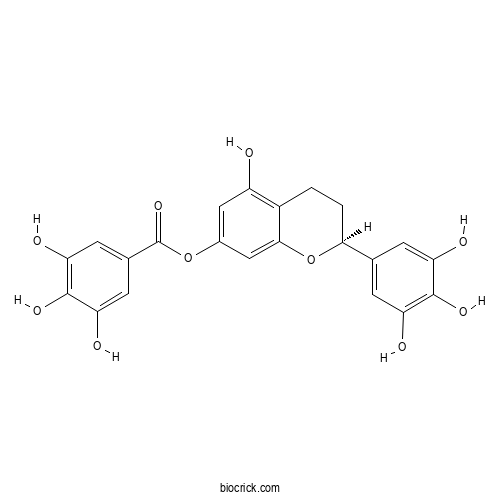
| Cas No. | 889447-89-6 | SDF | File under preparation. |
| PubChem ID | 23726067.0 | Appearance | Brown powder |
| Formula | C22H18O10 | M.Wt | 442.4 |
| Type of Compound | N/A | Storage | Desiccate at -20°C |
| Solubility | Soluble in Chloroform,Dichloromethane,Ethyl Acetate,DMSO,Acetone,etc. | ||
| Chemical Name | [(2S)-5-hydroxy-2-(3,4,5-trihydroxyphenyl)-3,4-dihydro-2H-chromen-7-yl] 3,4,5-trihydroxybenzoate | ||
| SMILES | C1CC2=C(C=C(C=C2OC1C3=CC(=C(C(=C3)O)O)O)OC(=O)C4=CC(=C(C(=C4)O)O)O)O | ||
| Standard InChIKey | XQLJWQWRTLHKGO-SFHVURJKSA-N | ||
| Standard InChI | InChI=1S/C22H18O10/c23-13-7-11(31-22(30)10-5-16(26)21(29)17(27)6-10)8-19-12(13)1-2-18(32-19)9-3-14(24)20(28)15(25)4-9/h3-8,18,23-29H,1-2H2/t18-/m0/s1 | ||
| General tips | For obtaining a higher solubility , please warm the tube at 37 ℃ and shake it in the ultrasonic bath for a while.Stock solution can be stored below -20℃ for several months. We recommend that you prepare and use the solution on the same day. However, if the test schedule requires, the stock solutions can be prepared in advance, and the stock solution must be sealed and stored below -20℃. In general, the stock solution can be kept for several months. Before use, we recommend that you leave the vial at room temperature for at least an hour before opening it. |
||
| About Packaging | 1. The packaging of the product may be reversed during transportation, cause the high purity compounds to adhere to the neck or cap of the vial.Take the vail out of its packaging and shake gently until the compounds fall to the bottom of the vial. 2. For liquid products, please centrifuge at 500xg to gather the liquid to the bottom of the vial. 3. Try to avoid loss or contamination during the experiment. |
||
| Shipping Condition | Packaging according to customer requirements(5mg, 10mg, 20mg and more). Ship via FedEx, DHL, UPS, EMS or other couriers with RT, or blue ice upon request. | ||
Quality Control & MSDS
3D structure
Package In Stock

Number of papers citing our products


7-O-Galloyltricetiflavan Dilution Calculator
7-O-Galloyltricetiflavan Molarity Calculator
| 1 mg | 5 mg | 10 mg | 20 mg | 25 mg | |
| 1 mM | 2.2604 mL | 11.302 mL | 22.604 mL | 45.208 mL | 56.5099 mL |
| 5 mM | 0.4521 mL | 2.2604 mL | 4.5208 mL | 9.0416 mL | 11.302 mL |
| 10 mM | 0.226 mL | 1.1302 mL | 2.2604 mL | 4.5208 mL | 5.651 mL |
| 50 mM | 0.0452 mL | 0.226 mL | 0.4521 mL | 0.9042 mL | 1.1302 mL |
| 100 mM | 0.0226 mL | 0.113 mL | 0.226 mL | 0.4521 mL | 0.5651 mL |
| * Note: If you are in the process of experiment, it's necessary to make the dilution ratios of the samples. The dilution data above is only for reference. Normally, it's can get a better solubility within lower of Concentrations. | |||||
- Taccalonolide Q
Catalog No.:BCX2267
CAS No.:488791-19-1
- Isosyringinoside
Catalog No.:BCX2266
CAS No.:152686-85-6
- 7-epi-Teucrenone
Catalog No.:BCX2265
CAS No.:165898-48-6
- Valerianol
Catalog No.:BCX2264
CAS No.:20489-45-6
- α-Santalene
Catalog No.:BCX2263
CAS No.:512-61-8
- Picropodophyllin
Catalog No.:BCX2262
CAS No.:477-47-4
- Malic acid
Catalog No.:BCX2261
CAS No.:636-61-3
- 4,5-Di-O-caffeoylquinic acid
Catalog No.:BCX2260
CAS No.:89886-30-6
- 4-(2-(Carboxymethyl)-3,5-dihydroxyphenoxy)benzoic acid
Catalog No.:BCX2259
CAS No.:2193189-82-9
- Lobetyolin
Catalog No.:BCX2258
CAS No.:129277-38-9
- Benzil
Catalog No.:BCX2257
CAS No.:134-81-6
- Tryptamine
Catalog No.:BCX2256
CAS No.:61-54-1
- (2E,7E)-6,9-Dihydroxy-N-isobutyldeca-2,7-dienamide
Catalog No.:BCX2269
CAS No.:1492015-24-3
- (2E,7E)-6,9-Dihydroxy-N-isobutyldeca-2,7-dienamide
Catalog No.:BCX2270
CAS No.:1383715-05-6
- (2E,6Z)-8,9-Dihydroxy-N-isobutyldeca-2,6-dienamide
Catalog No.:BCX2271
CAS No.:1492015-25-4
- 1β,4β-Dihydroxy-11,12,13-trinoreudesm-5-en-7-one
Catalog No.:BCX2272
CAS No.:2170107-68-1
- 1,2-Di-O-linolenoylglycerol 3-O-β-D-galactopyranoside
Catalog No.:BCX2273
CAS No.:111187-16-7
- Taccafurostanoside A
Catalog No.:BCX2274
CAS No.:290809-76-6
- Taccafurostanoside B
Catalog No.:BCX2275
CAS No.:98569-68-7
- Saxifragin
Catalog No.:BCX2276
CAS No.:34199-21-8
- Chantriolide B
Catalog No.:BCX2277
CAS No.:558470-60-3
- Chantriolide A
Catalog No.:BCX2278
CAS No.:558470-59-0
- Rosthorin A
Catalog No.:BCX2279
CAS No.:93772-27-1
- 30-Hydroxyquinoa-saponin 1
Catalog No.:BCX2280
CAS No.:898565-67-8
7-GTDF from Archidendron clypearia extract inhibits PRRSV entry and interacts with the CD163 receptor.[Pubmed:42067782]
BMC Vet Res. 2026 May 1;22(1):379.
BACKGROUND: Porcine reproductive and respiratory syndrome virus (PRRSV) poses a major threat to global swine production, with no clinically approved specific therapeutics. Archidendron clypearia (AC), a medicinal plant traditionally used for human upper respiratory infections, exhibits broad-spectrum antiviral activity. This study systematically evaluated the antiviral efficacy of AC against PRRSV, elucidated its pharmacodynamic material basis through comprehensive chemical profiling, and explored the targeted molecular mechanisms of its core active component, 7-GTDF. RESULTS: Screening of 30 herbal ethanol extracts based on a PRRSV-EGFP fluorescence phenotype identified AC as possessing significant anti-PRRSV activity. In Marc-145 cells and porcine alveolar macrophages (PAMs), AC inhibited the replication of PRRSV-Li11 and PRRSV-CHR6 at both the mRNA and protein levels. Time-of-addition assays indicated that AC acts by inactivating the virus and interfering with early infection stages. Phytochemical analysis identified 40 constituents in AC, with 7-O-Galloyltricetiflavan (7-GTDF) quantified via high-performance liquid chromatography (HPLC) as the predominant compound, accounting for 37.59% of the total peak area. Network pharmacology combined with experimental validation demonstrated that AC suppresses the PRRSV-induced overexpression of TNF-alpha, IL-1beta, and IL-6 in PAMs by modulating the TLR4/NF-kappaB signaling pathway. Subsequent screening of the primary compounds in AC revealed that 7-GTDF exhibits significant anti-PRRSV activity. Molecular docking and molecular dynamics simulations indicated a stable interaction between 7-GTDF and the host CD163 receptor. Finally, cellular thermal shift assay (CETSA) confirmed this target engagement, demonstrating that 7-GTDF binds to the CD163 receptor and reduces its thermal stability. CONCLUSIONS: These data indicate that AC and its constituent 7-GTDF inhibit PRRSV infection through mechanisms involving CD163 targeting and inflammatory pathway modulation. These findings provide a pharmacological basis for evaluating AC as a potential antiviral candidate in swine health management.
Discovery, Validation, and Target Prediction of Antibacterial and Antidiabetic Components of Archidendron clypearia Based on a Combination of Multiple Analytical Methods.[Pubmed:36770996]
Molecules. 2023 Jan 30;28(3):1329.
Archidendron clypearia (A. clypearia), a Fabaceae family member, is widely used as an anti-inflammatory herbal medicine; however, its antibacterial and antidiabetic properties have not been extensively investigated. This study aimed to systematically analyze the antibacterial and antidiabetic components of A. clypearia by utilizing a combination of analytical methods. First, ten different polarity extracts were analyzed through ultra-performance liquid chromatography (UPLC), and their antibacterial and antidiabetic activities were evaluated. Then the spectrum-effect relationship between the biological activity and UPLC chromatograms was analyzed by partial least squares regression and gray relational analysis, followed by corresponding validation using isolated components. Finally, network pharmacology and molecular docking were implemented to predict the main antibacterial target components of A. clypearia and the enzyme inhibition active sites of alpha-amylase and alpha-glucosidase. P15, P16, and P20 were found to be the antibacterial and antidiabetic active components. The inhibitory effect of 7-O-Galloyltricetiflavan (P15) on six bacterial species may be mediated through the lipid and atherosclerosis pathway, prostate cancer, adherens junctions, and targets such as SRC, MAPK1, and AKT1. The molecular docking results revealed that 7-O-Galloyltricetiflavan and 7,4'-di-O-galloyltricetiflavan (P16/P20) can bind to alpha-amylase and alpha-glucosidase pockets with binding energies lower than -6 kcal/mol. Our study provides guidance for the development of antibacterial and antidiabetic products based on A. clypearia and can be used as a reference for the evaluation of bioactivity of other herbs.
Pithecellobium clypearia: Amelioration Effect on Imiquimod-Induced Psoriasis in Mice Based on a Tissue Metabonomic Analysis.[Pubmed:34603060]
Front Pharmacol. 2021 Sep 17;12:748772.
Pithecellobium clypearia Benth. (accepted name: Archidendron clypearia (Jack) I.C.Nielsen; Mimosaceae), a popular traditional Chinese medicine, has a significant anti-inflammatory effect. The crude water extract of the aerial part of P. clypearia has been clinically applied to treat upper respiratory tract infections, acute gastroenteritis, laryngitis, and pharyngitis. However, the therapeutic mechanism of ethanol fraction of water extract (ESW) of P. clypearia to treat psoriasis should be complemented. The aim of our research was to clarify the protective effects of ESW from P. clypearia against psoriasis-like skin inflammation induced by imiquimod (IMQ) in mice with efficacy indexes and target tissue (spleen and serum) metabolomics. The ingredient of ESW was analyzed by ultrahigh-performance liquid chromatography combined with tandem mass spectrometry (UHPLC-MS/MS) method. The imiquimod-induced psoriatic mouse model was employed to investigate the effect of ESW against psoriasis, where the treatment method was implemented for 6 days both topically (Gel at 5%) and orally (at 2.4 g/kg p.o.). Traditional pharmacodynamic indicators (phenotypic characteristics, psoriasis area and severity index (PASI) score, H&E staining, immunohistochemical staining, the thickness of epidermis, body weight change, and spleen index) were conducted to appraise the efficacy of ESW. Furthermore, a gas chromatography-mass spectrometer (GC-MS) coupled with multivariate analysis was integrated and applied to obtain serum and spleen metabolic profiles for clarifying metabolic regulatory mechanisms of ESW. The current study illustrated that ESW is composed mainly of gallic acid, ethyl gallate, quercitin, 7-O-Galloyltricetiflavan, quercetin, and myricetin by UHPLC-MS/MS analysis. ESW could distinctly improve IMQ-induced psoriasis in mouse through reducing PASI score, alleviating tissue damage, restoring spleen index, and inhibiting proliferating cell nuclear antigen (PCNA) expression in psoriasis-like skin tissue. From the metabolomics study, 23 markers with significant changes are involved in eight main pathways in spleen and serum samples, including linoleic acid metabolism and glycine, serine, and threonine metabolism. The current study showed that ESW had obvious antipsoriasis effects on IMQ-induced psoriasis in mice, which might be attributed to regulating the dysfunction of differential biomarkers and related pathways. In summary, ESW of P. clypearia showed a favourable therapeutic effect on IMQ-induced psoriasis, and metabolomics provided insights into the mechanisms of ESW to the treatment of psoriasis.
Natural products for treatment of Plasmodium falciparum malaria: An integrated computational approach.[Pubmed:33910128]
Comput Biol Med. 2021 Jul;134:104415.
Malaria is a life-threatening infectious disease with an estimated 229 million cases in the year 2019 worldwide. Plasmodium falciparum 1-deoxy-d-xylulose-5-phosphate reductoisomerase (PfDXR) is one of the key enzymes in the biosynthetic pathway of isoprenoid, (required for parasite growth and survival) and considered as an attractive target for designing anti-malarial drugs. Fosmidomycin is an effective DXR inhibitor and has been proven effective and safe against P. falciparum in clinical trials. However, due to low bioavailability and inappropriate drug attributes, it is not a preferred option. The present study was performed to identify PfDXR inhibitors with improved pharmacology/safety. For this purpose, an integrated computational framework, comprising of pharmacophore modeling, virtual screening, molecular docking, molecular dynamics (MD) simulation and MM/PBSA, was used. The binding free energy analysis was performed using a focused library of phytochemicals established from medicinal plants. The study identified four bioactive compounds namely, Myricetin 3-rhamnoside, 7-O-Galloyltricetiflavan, (25S)-5-beta-spirostan-3-beta-ol 3-O-beta-d-glucopyranosyl-(1->2)-beta-d-glucopyranoside, and Oleanolic acid 28-O-beta-d-glucopyranoside as potential inhibitors of PfDXR. The selection of these four compounds was based on pharmacophore mapping, docking score, binding stability, molecular interactions with the residues of PfDXR active site, binding stability and free energy estimation. In conclusion, medicinal plant-based scaffolds were predicted with enhanced efficacy and adequate physiochemical/pharmacokinetic profile that might be helpful in controlling malaria.
Semi-synthesis and biological evaluation of flavone hybrids as multifunctional agents for the potential treatment of Alzheimer's disease.[Pubmed:32442817]
Bioorg Chem. 2020 Jul;100:103917.
7-O-Galloyltricetiflavan (GTF), a natural flavonoid, is known to exert anti-oxidation and neuroprotective activity, which are related to the prevention of Alzheimer's disease (AD). In this study, three series of GTF hybrids have been designed, synthesized and evaluated as multifunctional agents for treatment AD. The biological assays indicated that most of them showed strong inhibitory effect on self-induced beta-amyloid (Abeta) aggregation, and a significant ability to inhibit ChEs. Among them, compound A15 exhibited best inhibition of Abeta aggregation (78.81% at 20 muM), potent AChE inhibitory potencies (IC(50), 0.56 muM), and compound C4 presented the highest ability to inhibit BuChE (IC(50), 5.77 muM). Furthermore, kinetic, molecular modeling and molecular dynamics studies revealed that A15 and C4 could interact with the catalytic active site of AChE and BuChE, respectively. In addition, compounds A15 and C4 could cross the blood-brain barrier in vitro. More importantly, A15 and C4 also showed excellent neuroprotective activities against H(2)O(2)-induced human neuroblastoma SH-SY5Y cells damage and nearly no toxicity on SH-SY5Y cells. All of these outstanding in vitro results indicated A15 and C4 as the leading structure worthy of further investigation.
A concise synthesis of (+/-)-7-O-galloyltricetiflavan.[Pubmed:35540744]
RSC Adv. 2018 Apr 18;8(26):14389-14392.
(+/-)-7-O-Galloyltricetiflavan (1a) was synthesized successfully in five steps from the commercially available trihydroxyacetophenone (2) and trimethoxybenzoyl chloride (3). The flavone 4a was prepared in a one-pot reaction and it gave hex-O-methylflavan 6 followed by acylation and reduction. However, the demethylation of flavan 6, 5-O-acetylflavan 10 and 5-O-phenylacetylflavan 11 by BBr(3) gave all the hydrolyzed fragments 7 and 8 as the major products. By contrast, in the same condition, hept-O-methylflavan 9 could provide the desired product (+/-)-7-O-Galloyltricetiflavan (1a) in 91% yield. The additional 5-O-B-Br(2) complex may stabilize the ester bond during the demethylation process.
Xanthine oxidase inhibitors from Archidendron clypearia (Jack.) I.C. Nielsen: Results from systematic screening of Vietnamese medicinal plants.[Pubmed:28756918]
Asian Pac J Trop Med. 2017 Jun;10(6):549-556.
OBJECTIVE: To screen Vietnamese medicinal plants for xanthine oxidase (XO) inhibitory activity and to isolate XO inhibitor(s) from the most active plant. METHODS: The plants materials were extracted by methanol. The active plant materials were fractionated using different organic solvents, including n-hexane, ethyl acetate, and n-butanol. Bioassay-guided fractionation and column chromatography were used to isolate compounds. The compounds structures were elucidated by analysis of spectroscopic data, including IR, MS, and NMR. RESULTS: Three hundreds and eleven methanol extracts (CME) belonging to 301 Vietnamese herbs were screened for XO inhibitory activity. Among these plants, 57 extracts displayed XO inhibitory activity at 100 mug/mL with inhibition rates of over 50%. The extracts of Archidendron clypearia (A. clypearia), Smilax poilanei, Linociera ramiflora and Passiflora foetida exhibited the greatest potency with IC(50) values below 30 mug/mL. Chemical study performed on the extract of A. clypearia resulted in the isolation of six compounds, including 1-octacosanol, docosenoic acid, daucosterol, methyl gallate, quercitrin and (-)-7-O-Galloyltricetiflavan. The compound (-)-7-O-Galloyltricetiflavan showed the most potent XO inhibitory activity with an IC(50) value of 25.5 mumol/L. CONCLUSIONS: From this investigation, four Vietnamese medicinal plants were identified to have XO inhibitory effects with IC(50) values of the methanol extracts below 30 mug/mL. Compound (-)-7-O- galloyltricetiflavan was identified as an XO inhibitor from A. clypearia with IC(50) value of 25.5 mumol/L.

Calcutta University

University of Minnesota

University of Maryland School of Medicine

University of Illinois at Chicago

The Ohio State University

University of Zurich

Harvard University

Colorado State University

Auburn University

Yale University

Worcester Polytechnic Institute

Washington State University

Stanford University

University of Leipzig

Universidade da Beira Interior

The Institute of Cancer Research

Heidelberg University

University of Amsterdam

University of Auckland

TsingHua University

The University of Michigan

Miami University

DRURY University

Jilin University

Fudan University

Wuhan University

Sun Yat-sen University

Universite de Paris

Deemed University

Auckland University

The University of Tokyo

Korea University



