
7-epi-TeucrenoneCAS# 165898-48-6 |
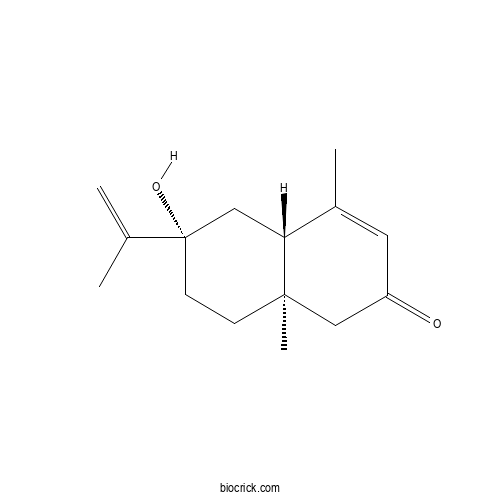
| Cas No. | 165898-48-6 | SDF | File under preparation. |
| PubChem ID | 57393409.0 | Appearance | Oil |
| Formula | C15H22O2 | M.Wt | 234.3 |
| Type of Compound | N/A | Storage | Desiccate at -20°C |
| Solubility | Soluble in Chloroform,Dichloromethane,Ethyl Acetate,DMSO,Acetone,etc. | ||
| Chemical Name | (4aS,6S,8aR)-6-hydroxy-4,8a-dimethyl-6-prop-1-en-2-yl-4a,5,7,8-tetrahydro-1H-naphthalen-2-one | ||
| SMILES | CC1=CC(=O)CC2(C1CC(CC2)(C(=C)C)O)C | ||
| Standard InChIKey | SAJFRLDIWQUNCQ-KFWWJZLASA-N | ||
| Standard InChI | InChI=1S/C15H22O2/c1-10(2)15(17)6-5-14(4)8-12(16)7-11(3)13(14)9-15/h7,13,17H,1,5-6,8-9H2,2-4H3/t13-,14-,15+/m1/s1 | ||
| General tips | For obtaining a higher solubility , please warm the tube at 37 ℃ and shake it in the ultrasonic bath for a while.Stock solution can be stored below -20℃ for several months. We recommend that you prepare and use the solution on the same day. However, if the test schedule requires, the stock solutions can be prepared in advance, and the stock solution must be sealed and stored below -20℃. In general, the stock solution can be kept for several months. Before use, we recommend that you leave the vial at room temperature for at least an hour before opening it. |
||
| About Packaging | 1. The packaging of the product may be reversed during transportation, cause the high purity compounds to adhere to the neck or cap of the vial.Take the vail out of its packaging and shake gently until the compounds fall to the bottom of the vial. 2. For liquid products, please centrifuge at 500xg to gather the liquid to the bottom of the vial. 3. Try to avoid loss or contamination during the experiment. |
||
| Shipping Condition | Packaging according to customer requirements(5mg, 10mg, 20mg and more). Ship via FedEx, DHL, UPS, EMS or other couriers with RT, or blue ice upon request. | ||
Quality Control & MSDS
3D structure
Package In Stock

Number of papers citing our products


7-epi-Teucrenone Dilution Calculator
7-epi-Teucrenone Molarity Calculator
| 1 mg | 5 mg | 10 mg | 20 mg | 25 mg | |
| 1 mM | 4.268 mL | 21.3402 mL | 42.6803 mL | 85.3606 mL | 106.7008 mL |
| 5 mM | 0.8536 mL | 4.268 mL | 8.5361 mL | 17.0721 mL | 21.3402 mL |
| 10 mM | 0.4268 mL | 2.134 mL | 4.268 mL | 8.5361 mL | 10.6701 mL |
| 50 mM | 0.0854 mL | 0.4268 mL | 0.8536 mL | 1.7072 mL | 2.134 mL |
| 100 mM | 0.0427 mL | 0.2134 mL | 0.4268 mL | 0.8536 mL | 1.067 mL |
| * Note: If you are in the process of experiment, it's necessary to make the dilution ratios of the samples. The dilution data above is only for reference. Normally, it's can get a better solubility within lower of Concentrations. | |||||
- Valerianol
Catalog No.:BCX2264
CAS No.:20489-45-6
- α-Santalene
Catalog No.:BCX2263
CAS No.:512-61-8
- Picropodophyllin
Catalog No.:BCX2262
CAS No.:477-47-4
- Malic acid
Catalog No.:BCX2261
CAS No.:636-61-3
- 4,5-Di-O-caffeoylquinic acid
Catalog No.:BCX2260
CAS No.:89886-30-6
- 4-(2-(Carboxymethyl)-3,5-dihydroxyphenoxy)benzoic acid
Catalog No.:BCX2259
CAS No.:2193189-82-9
- Lobetyolin
Catalog No.:BCX2258
CAS No.:129277-38-9
- Benzil
Catalog No.:BCX2257
CAS No.:134-81-6
- Tryptamine
Catalog No.:BCX2256
CAS No.:61-54-1
- Coniferyl acetate
Catalog No.:BCX2255
CAS No.:94930-81-1
- Scinamine C
Catalog No.:BCX2254
CAS No.:2184979-75-5
- 3''-Hydroxypyrrolezanthine
Catalog No.:BCX2253
CAS No.:2647391-04-4
- Isosyringinoside
Catalog No.:BCX2266
CAS No.:152686-85-6
- Taccalonolide Q
Catalog No.:BCX2267
CAS No.:488791-19-1
- 7-O-Galloyltricetiflavan
Catalog No.:BCX2268
CAS No.:889447-89-6
- (2E,7E)-6,9-Dihydroxy-N-isobutyldeca-2,7-dienamide
Catalog No.:BCX2269
CAS No.:1492015-24-3
- (2E,7E)-6,9-Dihydroxy-N-isobutyldeca-2,7-dienamide
Catalog No.:BCX2270
CAS No.:1383715-05-6
- (2E,6Z)-8,9-Dihydroxy-N-isobutyldeca-2,6-dienamide
Catalog No.:BCX2271
CAS No.:1492015-25-4
- 1β,4β-Dihydroxy-11,12,13-trinoreudesm-5-en-7-one
Catalog No.:BCX2272
CAS No.:2170107-68-1
- 1,2-Di-O-linolenoylglycerol 3-O-β-D-galactopyranoside
Catalog No.:BCX2273
CAS No.:111187-16-7
- Taccafurostanoside A
Catalog No.:BCX2274
CAS No.:290809-76-6
- Taccafurostanoside B
Catalog No.:BCX2275
CAS No.:98569-68-7
- Saxifragin
Catalog No.:BCX2276
CAS No.:34199-21-8
- Chantriolide B
Catalog No.:BCX2277
CAS No.:558470-60-3
Integrated UPLC-MS/MS and UHPLC-Q-orbitrap HRMS Analysis to Reveal Pharmacokinetics and Metabolism of Five Terpenoids from Alpiniae oxyphyllae Fructus in Rats.[Pubmed:33334283]
Curr Drug Metab. 2021;22(1):70-82.
BACKGROUND: Alpiniae oxyphyllae Fructus (AOF), a traditional Chinese medicine (TCM), is widely used in the treatment of urinary, gastrointestinal and neurologic diseases in China. Although terpenoids are the main active ingredients of AOF, there are few researches on their pharmacokinetics and metabolism. METHODS: In this study, a sensitive, rapid, accurate and novel ultra high performance liquid chromatography tandem mass spectrometry (UPLC-MS/MS) method was established to evaluate the pharmacokinetic behavior of five terpenoids (oxyphyllenodiol B, (4S*,5E,10R*)-7-oxo-tri-nor-eudesm-5-en-4beta-ol, 7-epi-Teucrenone, (+)- (4R,5S,7R)-13-hydroxynootkatone, (E)-labda-12,14-dien-15(16)-olide-17-oic acid) in rats after oral administration of AOF extracts. 27 metabolic metabolites of the five terpenoids were identified by ultra high performance liquid chromatography -Q Exactive hybrid quadrupole-orbitrap high-resolution accurate mass spectrometry (UHPLC-Q-Orbitrap HRMS) based on precise mass and fragment ions. RESULTS: The established pharmacokinetic analysis method showed good linearity over a wide concentration range, and the lower quantitative limit (LLOQ) ranged from 0.97 to 4.25 ng/mL. Other validation parameters were within the acceptable range. In addition, 27 metabolites were identified in plasma, urine and feces samples, and the metabolic pathways of five terpenoids were mainly focused on glucoside conjugation, dehydration, desaturation and glycine conjugation. CONCLUSION: This is the first study on the pharmacokinetics and metabolism of five terpenoids in AOF, illuminating the disposal process of terpenoids in vivo. It was expected that the results of this study would provide some references for the apprehension of the action mechanism and the further pharmacological study of five terpenoids in AOF.

Calcutta University

University of Minnesota

University of Maryland School of Medicine

University of Illinois at Chicago

The Ohio State University

University of Zurich

Harvard University

Colorado State University

Auburn University

Yale University

Worcester Polytechnic Institute

Washington State University

Stanford University

University of Leipzig

Universidade da Beira Interior

The Institute of Cancer Research

Heidelberg University

University of Amsterdam

University of Auckland

TsingHua University

The University of Michigan

Miami University

DRURY University

Jilin University

Fudan University

Wuhan University

Sun Yat-sen University

Universite de Paris

Deemed University

Auckland University

The University of Tokyo

Korea University



