
LobetyolinCAS# 129277-38-9 |
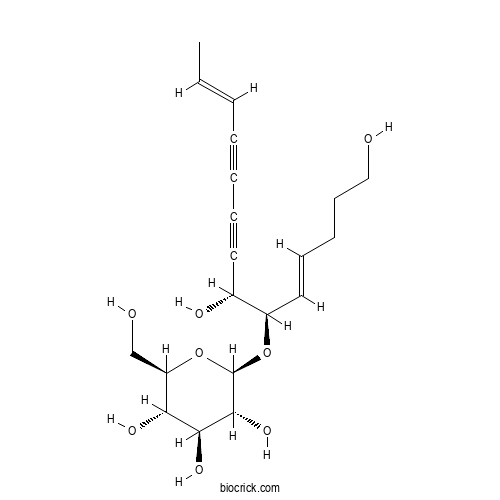
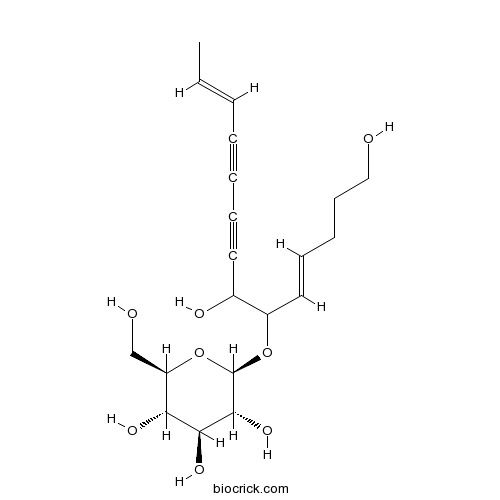
| Cas No. | 129277-38-9 | SDF | File under preparation. |
| PubChem ID | 14655097.0 | Appearance | Powder |
| Formula | C20H28O8 | M.Wt | 396.4 |
| Type of Compound | N/A | Storage | Desiccate at -20°C |
| Solubility | Soluble in Chloroform,Dichloromethane,Ethyl Acetate,DMSO,Acetone,etc. | ||
| Chemical Name | (2R,3R,4S,5S,6R)-2-[(4E,6R,7R,12E)-1,7-dihydroxytetradeca-4,12-dien-8,10-diyn-6-yl]oxy-6-(hydroxymethyl)oxane-3,4,5-triol | ||
| SMILES | CC=CC#CC#CC(C(C=CCCCO)OC1C(C(C(C(O1)CO)O)O)O)O | ||
| Standard InChIKey | MMMUDYVKKPDZHS-MXFZCOKBSA-N | ||
| Standard InChI | InChI=1S/C20H28O8/c1-2-3-4-5-7-10-14(23)15(11-8-6-9-12-21)27-20-19(26)18(25)17(24)16(13-22)28-20/h2-3,8,11,14-26H,6,9,12-13H2,1H3/b3-2+,11-8+/t14-,15-,16-,17-,18+,19-,20-/m1/s1 | ||
| General tips | For obtaining a higher solubility , please warm the tube at 37 ℃ and shake it in the ultrasonic bath for a while.Stock solution can be stored below -20℃ for several months. We recommend that you prepare and use the solution on the same day. However, if the test schedule requires, the stock solutions can be prepared in advance, and the stock solution must be sealed and stored below -20℃. In general, the stock solution can be kept for several months. Before use, we recommend that you leave the vial at room temperature for at least an hour before opening it. |
||
| About Packaging | 1. The packaging of the product may be reversed during transportation, cause the high purity compounds to adhere to the neck or cap of the vial.Take the vail out of its packaging and shake gently until the compounds fall to the bottom of the vial. 2. For liquid products, please centrifuge at 500xg to gather the liquid to the bottom of the vial. 3. Try to avoid loss or contamination during the experiment. |
||
| Shipping Condition | Packaging according to customer requirements(5mg, 10mg, 20mg and more). Ship via FedEx, DHL, UPS, EMS or other couriers with RT, or blue ice upon request. | ||
Quality Control & MSDS
3D structure
Package In Stock

Number of papers citing our products


Lobetyolin Dilution Calculator
Lobetyolin Molarity Calculator

| 1 mg | 5 mg | 10 mg | 20 mg | 25 mg | |
| 1 mM | 2.5227 mL | 12.6135 mL | 25.227 mL | 50.4541 mL | 63.0676 mL |
| 5 mM | 0.5045 mL | 2.5227 mL | 5.0454 mL | 10.0908 mL | 12.6135 mL |
| 10 mM | 0.2523 mL | 1.2614 mL | 2.5227 mL | 5.0454 mL | 6.3068 mL |
| 50 mM | 0.0505 mL | 0.2523 mL | 0.5045 mL | 1.0091 mL | 1.2614 mL |
| 100 mM | 0.0252 mL | 0.1261 mL | 0.2523 mL | 0.5045 mL | 0.6307 mL |
| * Note: If you are in the process of experiment, it's necessary to make the dilution ratios of the samples. The dilution data above is only for reference. Normally, it's can get a better solubility within lower of Concentrations. | |||||
- Benzil
Catalog No.:BCX2257
CAS No.:134-81-6
- Tryptamine
Catalog No.:BCX2256
CAS No.:61-54-1
- Coniferyl acetate
Catalog No.:BCX2255
CAS No.:94930-81-1
- Scinamine C
Catalog No.:BCX2254
CAS No.:2184979-75-5
- 3''-Hydroxypyrrolezanthine
Catalog No.:BCX2253
CAS No.:2647391-04-4
- Lyxose
Catalog No.:BCX2252
CAS No.:65-42-9
- 3'-O-Methylhesperidin
Catalog No.:BCX2251
CAS No.:28034-80-2
- Benzoic acid,2-[(5,10-dihydro-3,7,8-trihydroxy-5,10-dioxo...
Catalog No.:BCX2910
CAS No.:60202-70-2
- Osmanthuside B
Catalog No.:BCX2909
CAS No.:94492-23-6
- Podoverine A
Catalog No.:BCX2908
CAS No.:107882-43-9
- Benzoic acid,2-(5,10-dihydro-2,3,7,8-tetrahydroxy...
Catalog No.:BCX2907
CAS No.:103744-88-3
- Bacogenin A4 (Ebelinlacton)
Catalog No.:BCX2906
CAS No.:3649-76-1
- 4-(2-(Carboxymethyl)-3,5-dihydroxyphenoxy)benzoic acid
Catalog No.:BCX2259
CAS No.:2193189-82-9
- 4,5-Di-O-caffeoylquinic acid
Catalog No.:BCX2260
CAS No.:89886-30-6
- Malic acid
Catalog No.:BCX2261
CAS No.:636-61-3
- Picropodophyllin
Catalog No.:BCX2262
CAS No.:477-47-4
- α-Santalene
Catalog No.:BCX2263
CAS No.:512-61-8
- Valerianol
Catalog No.:BCX2264
CAS No.:20489-45-6
- 7-epi-Teucrenone
Catalog No.:BCX2265
CAS No.:165898-48-6
- Isosyringinoside
Catalog No.:BCX2266
CAS No.:152686-85-6
- Taccalonolide Q
Catalog No.:BCX2267
CAS No.:488791-19-1
- 7-O-Galloyltricetiflavan
Catalog No.:BCX2268
CAS No.:889447-89-6
- (2E,7E)-6,9-Dihydroxy-N-isobutyldeca-2,7-dienamide
Catalog No.:BCX2269
CAS No.:1492015-24-3
- (2E,7E)-6,9-Dihydroxy-N-isobutyldeca-2,7-dienamide
Catalog No.:BCX2270
CAS No.:1383715-05-6
Ludangshen oral liquid ameliorates cyclophosphamide-induced immunosuppression in mice: Insights from metabolomic, gut microbiota, and multi-omics correlation analyses.[Pubmed:42425203]
Microb Pathog. 2026 Sep;218:108691.
Immune dysfunction elevates susceptibility to infections, diseases, and tumors. While conventional immunomodulators often cause adverse effects, plant-derived therapies offer superior stability and hold considerable research promise. Codonopsis pilosula (Franch.) Nannf., a traditional medicinal herb, replenishes blood, promotes fluid production, and tonifies qi. Ludangshen Oral Liquid (LDSOL), a preparation derived from C. pilosula, contains multiple bioactive constituents, including Lobetyolin; however, its immunomodulatory effects and their associations with host metabolism and gut microbiota remain unclear. In this study, we investigated the effects of LDSOL in cyclophosphamide-induced immunosuppressed mice using pharmacodynamic evaluation, metabolomics, 16S rRNA sequencing, and multi-omics correlation analysis. Our results demonstrated that LDSOL alleviated hepatosplenomegaly and thymic atrophy, regulated blood cell counts, and elevated levels of IL-2, IL-6, TNF-alpha, IFN-gamma, and IgG. It also restored the balance between Th17/Treg and Th1/Th2 subsets, suggesting improved immune responses. Metabolomic and 16S rRNA analyses revealed that LDSOL modulated endogenous metabolites (e.g., L-phenylalanine, serotonin) and gut bacterial communities (e.g., Lactobacillus, Ruminococcus). Integrated correlation analysis further identified potential associations among altered gut microbial taxa, LDSOL-responsive metabolites, and immune-related parameters. Collectively, these findings indicate that LDSOL ameliorates cyclophosphamide-induced immunosuppression in mice and suggest that metabolic remodeling and gut microbiota alterations may be associated with its immunomodulatory effects.
[Lobetyolin inhibits T-BHP-induced ferroptosis in human nucleus pulposus cells by regulating PI3K/AKT pathway].[Pubmed:42392778]
Zhongguo Zhong Yao Za Zhi. 2026 Apr;51(7):1971-1978.
This study aimed to investigate the effect of Lobetyolin(LOB) on tert-butyl hydroperoxide(T-BHP)-induced ferroptosis in human nucleus pulposus cells(NPCs) based on the phosphoinositide 3-kinase(PI3K)/protein kinase B(AKT) pathway, thereby providing a theoretical basis for the treatment of intervertebral disc degeneration(IDD). Human NPCs were cultured in vitro. The cell counting kit-8(CCK-8) assay was used to screen the optimal concentration for T-BHP induction and the optimal intervention concentration of LOB. Cells in the logarithmic growth phase were randomly divided into a blank control group, a model group, a Ferrostatin-1(Fer-1) control group, a model + Fer-1 group, a LOB group, and a PI3K/AKT agonist 740Y-P group. Cell viability was assessed using the CCK-8 assay. Intracellular ferrous ion(Fe~(2+)), malondialdehyde(MDA), and glutathione(GSH) levels were measured using colorimetric assays. Mitochondrial ultrastructure was observed using transmission electron microscopy(TEM). The protein expression levels of solute carrier family 7 member 11(SLC7A11), glutathione peroxidase 4(GPX4), collagen type Ⅱ(collagen Ⅱ), matrix metallopeptidase-13(MMP-13), phosphorylated phosphatidylinositol 3-kinase(p-PI3K), and phosphorylated protein kinase B(p-AKT) were determined by Western blot. Additionally, the expression levels of p-PI3K and p-AKT were detected by immunofluorescence. Compared with that in the blank control group, the viability of human NPCs in the model group decreased significantly. Intracellular Fe~(2+) and lipid peroxidation product MDA levels increased significantly, while the antioxidant indicator GSH level decreased significantly in the model group. Protein analysis showed that the expression of SLC7A11, GPX4, and collagen Ⅱ was significantly downregulated, while MMP-13 expression was upregulated. The expression levels of p-PI3K and p-AKT were inhibited. Typical morphological changes of ferroptosis, such as mitochondrial shrinkage and reduction of cristae, were observed under a transmission electron microscope. Compared with the model group, the LOB group, model + Fer-1 group, and 740Y-P group showed significantly reduced levels of Fe~(2+) and MDA, increased GSH levels, upregulated protein expression of SLC7A11, GPX4, and collagen Ⅱ, and downregulated MMP-13 expression. Furthermore, LOB intervention significantly upregulated the expression levels of p-PI3K and p-AKT in human NPCs, and the improvement trend of related indicators was consistent with that of the 740Y-P group. LOB effectively alleviates T-BHP-induced ferroptosis in human NPCs and reduces extracellular matrix degradation. Its protective mechanism may be achieved by regulating the PI3K/AKT signaling pathway.
Ethnopharmacological potential and mechanistic study of Platycodon grandiflorum stems and leaves and Lonicera japonica stems and leaves against acute lung injury.[Pubmed:42379536]
J Ethnopharmacol. 2026 Dec 6;371:122148.
ETHNOPHARMACOLOGICAL RELEVANCE: Platycodon grandiflorum and Lonicera japonica are two plants that have been widely used in traditional ethnic medicine for both medicinal and edible purposes. They are commonly applied in the prevention and treatment of lung-heat-related and inflammatory diseases. However, the stems and leaves of these plants have historically been regarded as by-products, and their therapeutic potential has not been thoroughly explored. Recent studies have shown that the Platycodon grandiflorum stems and leaves, and Lonicera japonica stems and leaves are rich in bioactive compounds, including flavonoids, saponins and phenolic compounds and exhibit notable anti-inflammatory and antioxidant activities. In this study, we investigate the protective mechanism of Platycodon grandiflorum stems and leaves and Lonicera japonica stems and leaves (PLSL) against lipopolysaccharide (LPS)-induced acute lung injury (ALI) in mice. This work aims to provide a theoretical basis for resource development and the sustainable, high-value utilization of non-medicinal parts of traditional Chinese medicinal plants. METHODS: In this study, an LPS-induced inflammatory model using RAW264.7 cells was employed to screen the optimal compatible ratio of PLSL. High-performance liquid chromatography (HPLC) was used to analyze its chemical composition and identify the main active components. In the animal experiment, a mouse model of ALI was established by intranasal instillation of LPS. The severity of lung injury was comprehensively evaluated based on the lung index, lung wet-to-dry (W/D) weight ratio, hematoxylin and eosin staining and Masson's staining. Levels of inflammatory cytokines, including interleukin-6 (IL-6), tumor necrosis factor-alpha (TNF-alpha) and interleukin-1beta (IL-1beta) were measured using ELISA. The transcriptional levels of genes related to the Keap1/Nrf2 pathway were detected by quantitative real-time polymerase chain reaction (qRT-PCR), and the expression and nuclear translocation of Nrf2 and p65 proteins were assessed by immunofluorescence. Meanwhile, 16S rRNA high-throughput sequencing was applied to analyze the cecal microbiota composition in mice, and gas chromatography was used to determine short-chain fatty acid (SCFA) concentrations. Spearman correlation analysis was performed to explore correlations among inflammatory mediators, antioxidant markers and gut microbiota at the genus level. RESULTS: The in vitro results demonstrated that the 4:1 combination of PLSL promoted the migration and proliferation of RAW264.7 cells in a dose-dependent manner and effectively inhibited the overexpression of pro-inflammatory mediators, including cyclooxygenase-2 (COX-2) and inducible nitric oxide synthase (iNOS), as well as inflammatory cytokines such as TNF-alpha, IL-6 and IL-1beta. Meanwhile, PLSL exhibited strong scavenging activity against 2,2-diphenyl-1-picrylhydrazyl (DPPH) radicals, 2,2'-azinobis-3-ethylbenzothiazoline-6-sulfonic acid (ABTS) cation radicals and hydroxyl radicals (.OH). HPLC analysis revealed that PLSL contained key active components, including platycodin D, Lobetyolin, loganin and chlorogenic acid. In vivo experiments confirmed that PLSL significantly alleviated LPS-induced ALI in mice by regulating the NF-kappaB and Keap1/Nrf2 signaling pathways, reducing malondialdehyde (MDA) and nitric oxide (NO) levels, increasing glutathione (GSH) levels, suppressing the expression of COX-2, iNOS, TNF-alpha, IL-6 and IL-1beta and modulating the mRNA expression of Keap1, Nrf2, heme oxygenase-1(HO-1) and NAD(P)H quinone oxidoreductase 1 (NQO1). Furthermore, PLSL effectively improved intestinal microbial diversity, increased the relative abundance of beneficial bacteria, including Lachnospiraceae and Alistipes, and significantly elevated cecal short-chain fatty acids (SCFAs), such as acetic acid, propionic acid and butyric acid. CONCLUSIONS: This study preliminarily elucidates the multi-target synergistic anti-inflammatory effects of PLSL from the perspectives of inflammatory signaling pathways and gut microbiota. It provides experimental evidence for the whole-plant development and utilization of Platycodon grandiflorum and Lonicera japonica as ethnomedicines.
Mechanisms involved in lobetyolin attenuation of cisplatin-induced gastrocnemius muscle atrophy in the mouse.[Pubmed:42366958]
J Toxicol Environ Health A. 2026 Jun 29:1-12.
The chemotherapeutic agent cisplatin for solid tumors frequently induces cancer-associated cachexia characterized by weight loss and decreased skeletal muscle mass. These adverse cisplatin-related symptoms are dose‑limiting, and the ability to counteract drug-initiated muscle atrophy in cancer-associated cachexia remains a pharmacological challenge. The aim of this study was to determine the protective efficacy of Lobetyolin, a natural compound derived from Codonopsis pilosula, known to exert antioxidant, anti‑inflammatory, and anti‑apoptotic activities, against cisplatin-induced skeletal muscle wasting and subsequently elucidate a potential underlying molecular mechanism of action using a mouse model. Mice were injected with cisplatin (4 mg/kg, i.p. every other day, 4 doses in total) with concurrent oral Lobetyolin (20 or 40 mg/kg daily) for 8 days. Lobetyolin inhibited cisplatin-induced reductions in body weight and grip strength, ameliorated gastrocnemius muscle atrophy, and preserved myofiber cross‑sectional area. Mechanistically, Lobetyolin restored superoxide dismutase (SOD) activity and glutathione (GSH) levels while diminishing malondialdehyde (MDA) content in gastrocnemius muscle. Lobetyolin was found to activate the AKT signaling axis as evidenced by enhanced phosphorylation of AKT (Ser473) and FoxO3alpha (Thr32), which suppressed FoxO3alpha nuclear translocation and downregulated the E3 ubiquitin ligase Fbx32, thereby diminishing proteasomal protein degradation. Concurrently, Lobetyolin normalized the Bax/Bcl‑2 ratio to inhibit myocyte apoptosis. These findings demonstrated that Lobetyolin may be considered as a multi‑targeted therapeutic candidate to counteract oxidative injury, protein catabolism, and myocyte apoptosis initiated by cisplatin. Data suggest that Lobetyolin's potential as a safe adjunctive agent against chemotherapy‑induced muscle wasting might involve AKT/FoxO3alpha pathway.
Lobetyolin reinforces endothelial cytoskeletal integrity to alleviate Pseudomonas aeruginosa-induced acute lung injury via targeting ACTN1.[Pubmed:42202915]
J Ethnopharmacol. 2026 Oct 28;369:121916.
ETHNOPHARMACOLOGICAL RELEVANCE: Codonopsis Radix (CR), known as Dangshen in traditional Chinese medicine,is frequently used to tonify Qi and strengthen the spleen and lung. Clinically, "Lung-Qi deficiency" manifests as respiratory weakness and susceptibility to infection. The traditional action of "consolidating Qi to protect the exterior" parallels the physiological preservation of the pulmonary endothelial barrier. However, the bioactive basis linking this traditional efficacy to barrier reinforcement remains unclear. AIM OF THE STUDY: This study evaluates the protective effects of CR against Pseudomonas aeruginosa-induced acute lung injury (ALI), identifies the primary bioactive component responsible for barrier protection, and elucidates its molecular mechanism involving cytoskeletal stabilization. MATERIALS AND METHODS: A P. aeruginosa-induced ALI mouse model was established to assess the efficacy of CR extract (CRE) and its polyacetylene glycoside, Lobetyolin (LBT). Lung injury severity, inflammatory responses, and endothelial barrier function were systematically evaluated. Bioactivity-guided fractionation screened for active constituents. The mechanism was investigated using integrated transcriptomics, chemical proteomics, and molecular docking, validated by in vitro and in vivo experiments. RESULTS: Both CRE and LBT significantly attenuated lung histopathology, diminished pulmonary edema, and suppressed leukocyte infiltration and pro-inflammatory cytokine production. LBT was identified as the key bioactive constituent restoring endothelial barrier integrity, evidenced by upregulated expression and junctional localization of VE-Cadherin, ZO-1, and Claudin-5. Mechanistically, LBT directly targets alpha-actinin-1 (ACTN1). Functioning as a "molecular stabilizer", LBT enhances ACTN1-F-actin affinity, promoting cortical actin organization and stabilizing intercellular junctions under inflammatory stress. CONCLUSIONS: This study identifies LBT as a novel structural consolidator of the vascular endothelial barrier. By demonstrating that LBT reinforces endothelial cytoskeletal organization via ACTN1, our findings offer a compelling modern scientific interpretation of the traditional efficacy of CR in "tonifying Lung-Qi": physically strengthening the biological barrier. Furthermore, targeting ACTN1-mediated cytoskeleton modulation presents a promising strategy for treating ALI and vascular leakage disorders.
Lobetyolin reshapes gut microbiota and bile acid metabolism to improve androgen-driven PCOS phenotypes in mice.[Pubmed:42146061]
Front Microbiol. 2026 May 1;17:1810261.
AIM: To clarify the molecular mechanisms through which Lobetyolin (LT) modifies the gut microbiota-bile acid axis to multitarget the regulation of hyperandrogenism, insulin resistance, chronic low-grade inflammation, and endometrial dysfunction, consequently breaking the vicious cycle and improving the pathological phenotype of polycystic ovary syndrome (PCOS), thereby establishing a theoretical basis and experimental validation for the advancement of LT as a systemic therapeutic agent for PCOS. METHODS: A DHEA-induced PCOS murine model was administered LT (i.p. for 28 days). We monitored hormone levels in the serum, glucose tolerance, and estrus cycle. Ovarian steroidogenic enzyme expression (CYP11A1, CYP17A1, and CYP19A1) was assessed by qPCR, while inflammatory markers (IL-6, TNF-alpha, TLR4, and NF-kappaB) were quantified by ELISA.16S rRNA sequencing was performed for gut microbiota and focused bile acid metabolomics. Uterine molecular markers were evaluated through vascular endothelial growth factor A (VEGFA)/vascular endothelial growth factor receptor (VEGFR2), tissue inhibitor of metalloproteinases 1(TIMP1/2), and matrix metalloproteinase 2/9 (MMP2/9). MAIN RESULTS: LT restored estrous cyclicity, lowered the LH/FSH ratio and serum testosterone levels, and improved insulin sensitivity. Androgen Network Modulation: LT decreased CYP11A1/CYP17A1 and elevated CYP19A1, showing "upstream inhibition-downstream activation." LT also boosted alpha-diversity, adjusted the F/B ratio, enriched Dubosiella/Muribaculum, and inhibited Lachnospiraceae and Alistipes. Higher HCA and TCDCA levels are associated with improved metabolism. LT alleviated pathological vascular remodeling in the uterus by downregulating VEGFA/VEGFR2 and MMP2/9, and by overexpressing TIMP1/2. CONCLUSION: LT modulates the microbiota-bile acid axis to coordinately ameliorate hyperandrogenism, insulin resistance, chronic inflammation, and uterine dysfunction. This intervention blocks the pathological cascade of PCOS. The findings provide a subsequent mechanistic studies on PCOS prevention.
A comprehensive quality assessment strategy integrating multidimensional fingerprints with antioxidant activity analysis: A case study of Codonopsis pilosula.[Pubmed:42119488]
J Chromatogr B Analyt Technol Biomed Life Sci. 2026 Jul 1;1279:125110.
Codonopsis pilosula (CP), a typical medicine-food homology tonic herb in traditional Chinese medicine (TCM), is often referred to as "Little Ginseng". Current studies on CP are largely confined to its chemical constituents, and systematic approaches for evaluating its overall quality remain lacking. In this study, an integrated analytical framework was developed for the quality assessment of CP by combining chromatographic, electrochemical, thermal fingerprints, the 2,2'-azino-bis (3-ethylbenzothiazoline-6-sulfonic acid) (ABTS) assay and chemometric analysis. First, a three-wavelength fused chromatographic fingerprint (TWFF) based on high-performance liquid chromatography (HPLC) was established using two quantitative markers, Lobetyolin (LBT) and chlorogenic acid (CGA), enabling improved detection of weak-response constituents and enhanced coverage of chromatographic information. In parallel, an electrochemical fingerprint (ECFP) based on the Belousov-Zhabotinsky oscillation system and a differential scanning calorimetry quantum fingerprint (DSC-QFP) were constructed to provide complementary information on electrochemical activity and thermal behavior. All fingerprints were assessed using a dual-parameter evaluation method (DPEM) based on macroscopic qualitative similarity (S(m)) and macroscopic quantitative similarity (P(m)), enabling qualitative and quantitative evaluation. The three analytical dimensions were further integrated using the coefficient of variation weighting method (CVWM), thereby improving the objectivity and robustness of quality evaluation. Partial least squares (PLS) modeling combined with Pearson correlation analysis using TWFF, ECFP and ABTS assay data revealed the relationship between chemical fingerprints and antioxidant-related activity, and enabled the screening of potential antioxidant-related constituents. Overall, this study proposes an innovative multidimensional analytical strategy, providing a new reference for the comprehensive characterization and quality evaluation of CP and other complex traditional herbal medicines.
Nitrogen-modulated intercropping boosts yield and quality in Codonopsis pilosula.[Pubmed:42050437]
BMC Plant Biol. 2026 Apr 28;26(1):1019.
Intensive monoculture of Codonopsis pilosula (C. pilosula) reliant on high nitrogen (N) inputs often compromises root quality and long-term sustainability. Here we show that intercropping with faba bean under optimized N application resolves this trade-off by enhancing root yield and the accumulation of active ingredients. To test this, we established a two-factor factorial design with monoculture vs. intercropping across three N rates (0, 60, 120 kg N ha(-)1). Root yield, concentrations of three key active ingredients (Lobetyolin, atractylenolide III, and syringin), leaf traits, photosynthetic parameters, and the activities of key carbon and nitrogen metabolic enzyme were measured. Intercropping increased root yield by 3.2%-18.7%, active ingredient concentrations by 5.5%-56.9%, and active ingredients yield by 29.7%-47.1%. Mechanistically, these improvements were associated with key physiological changes: 1) enhanced photosynthetic capacity (larger leaves with higher photosynthetic rate) increasing total carbon assimilation; 2) upregulated C/N metabolism strengthening utilization and storage capacity of photosynthetic assimilates in root. These benefits were achieved despite a decrease in instantaneous water use efficiency, a pattern consistent with a "water-for-carbon" strategy at the leaf level. The intercropping advantage for C. pilosula was maximized at 60 kg N ha-1, while excessive N application (120 kg N ha-1) diminished these benefits and reduced active ingredient concentrations. Our findings demonstrate that faba bean intercropping under moderate N promotes both productivity and medicinal quality of C. pilosula by co-optimizing leaf physiology and C/N metabolism, providing a potential strategy for more sustainable cultivation under the conditions tested.
Dangshen formula Shengmai-Yin suppresses atherosclerosis through restoring the gut microbiota and homeostatic efferocytosis.[Pubmed:42030803]
Phytomedicine. 2026 Jul;156:158210.
BACKGROUND & AIMS: Atherosclerosis (AS) is a chronic progressive vascular disease characterized by lipid deposition and aortic inflammation. On the basis of traditional Chinese medicine (TCM) theory, the Dangshen Formula Shengmai-Yin (DS-SMY) has demonstrated unique advantages in treating AS. However, the mechanism by which DS-SMY affects AS has not been revealed. METHODS: In this study, high-fat diet-induced apolipoprotein E knockout (ApoE(-/-)) mice were used to construct AS models. The effects of DS-SMY on aortic collagen deposition and inflammatory infiltration were investigated, and atorvastatin (Ato) was used as a positive control. The composition of the gut microbiota was assessed using high-throughput sequencing of the 16S rRNA gene. Colon morphology was observed via TEM, and apoptosis was assessed with TUNEL staining. The main component of DS-SMY in drug-containing serum was determined by HPLC. The effects of DS-SMY components (Lobetyolin and schisandrin) were evaluated in PA-induced RAW 264.7 cells using WB, ELISA, and RT-qPCR. RESULTS: Compared with Ato, DS-SMY also had a therapeutic effect on ApoE(-/-) mice. In addition, DS-SMY inhibited M1 polarization of macrophages in ApoE(-/-) mice. Additionally, the results demonstrated that DS-SMY alleviated intestinal inflammation and promoted the formation of colon tight junctions. Furthermore, changes in the gut microbiota composition in ApoE(-/-) mice after DS-SMY treatment were sufficient to induce changes in colon inflammation. Mechanistically, the results revealed that DS-SMY components suppressed proinflammatory cytokine expression and enhanced macrophage efferocytosis. Furthermore, supplementation with butyric acid (a gut microbiota-derived metabolite) enhanced the effect of DS-SMY, which demonstrated that the effect of DS-SMY involved microbiota-dependent mechanisms. CONCLUSION: In summary, DS-SMY can alleviate atherogenic dyslipidemia and pathological inflammation in AS by targeting the gut microbiota and homeostatic efferocytosis and is accordingly a potential therapeutic agent for AS.
[Evaluation of genetic diversity and screening of high-quality germplasms in Codonopsis based on phenotypic traits and whole-genome resequencing].[Pubmed:42011578]
Zhongguo Zhong Yao Za Zhi. 2026 Mar;51(5):1312-1322.
Using phenotyping and whole-genome resequencing, this study analyzed the genetic diversity of Codonopsis and screened high-quality core germplasms, thereby providing support for germplasm innovation, variety improvement, and industrial standardization. Twenty-seven Codonopsis germplasms were collected from Gansu, Shanxi, Guizhou, and other provinces. After planting in a unified environment, 21 agronomic traits and 6 quality traits were determined. Comprehensive evaluation was conducted using methods such as correlation analysis, cluster analysis, and principal component analysis(PCA) to screen out excellent Codonopsis germplasms. Total DNA was extracted from young leaves by the magnetic bead method, and whole-genome resequencing was performed on the MGIDL-T7 platform. After quality control with FASTP, the sequences were aligned to the reference genome to detect single nucleotide polymorphism(SNP). Subsequently, linkage disequilibrium analysis was carried out using the sliding window method, and population structure was analyzed with the Admixture software to clarify the population genetic characteristics and germplasm genetic background. The 27 Codonopsis germplasms exhibited rich phenotypic and genetic diversity, with the coefficient of variation of the 27 traits ranging from 5.1% to 130.6%. Among them, yield(130.6%), root branch number(87.4%), and atractylenolide Ⅲ content(68.2%) showed significant variation, while traits such as seed germination rate(5.1%) and corolla tube diameter(6.0%) had relatively small variation. Correlation analysis revealed that yield was significantly positively correlated with the number of fruits per plant and the number of primary branches; root weight per plant was significantly positively correlated with root diameter; Lobetyolin content was significantly positively correlated with Lobetyolinin content; tangshenoside Ⅰ content was significantly positively correlated with polysaccharide content. PCA extracted 8 principal components(with a cumulative contribution rate of 82%), and 5 high-quality germplasms were screened out through comprehensive evaluation. Cluster analysis divided the germplasms into 6 groups, and the group characteristics were related to geographical origin and original plants. Whole-genome resequencing yielded 334.49 Gb of clean data(average Q30=95.70%), and 32 429 491 SNP loci were detected. Population structure analysis could clearly distinguish 3 original plants, PC1 significantly differentiated Codonopsis pilosula from C. tangshen, and when K=3, C. pilosula var. modesta showed an independent genetic component. In conclusion, the tested Codonopsis germplasms have rich phenotypic and genetic diversity, and whole-genome SNP markers can clearly resolve their genetic structure. The screened high-quality core germplasms possess both excellent agronomic and quality traits, which can provide a material basis and technical support for Codonopsis variety breeding and high-quality industrial development.
Beneficial Herb-Drug Interaction of Shenqi Oral Liquid on Atorvastatin: A Pharmacokinetic and Pharmacodynamic Investigation in Rats with Hyperlipidemia.[Pubmed:41989500]
Chin J Integr Med. 2026 Apr 16.
OBJECTIVE: To investigate the pharmacodynamic and pharmacokinetic interactions between Shenqi Oral Liquid (SQ) and atorvastatin (ATV) in hyperlipidemic rats, explore the impact of SQ on ATV-related transporters and metabolic enzymes, the potential implications for the safety and rationality of their combined administration based on pharmacodynamic, pharmacokinetic, transporter, and metabolic enzyme data. METHODS: Hyperlipidemic rats were induced using a high-fat diet and randomized according to serum total cholesterol levels using a randomized block design into model, ATV (10 mg/kg), SQ (0.68, 1.68, 3.38 g/kg), and combination groups, and treated for 4 weeks. Serum lipid profiles, liver histopathological changes, pharmacokinetic parameters of ATV, mRNA expression levels of transporters (including Bcrp, Mrp2, etc.) and metabolic enzymes (CYP2C11, CYP3A2), enzyme activities, as well as the effects of SQ's active ingredients were assessed using quantitative PCR, cocktail probe assays, and primary hepatocyte studies. RESULTS: The combination therapy significantly reduced serum lipid levels and improved liver histology, as evidenced by a more organized cellular structure and reduced accumulation of lipid droplets. SQ significantly increased systemic exposure of ATV metabolites, elevating the maximum plasma concentration (C(max)) and area under the curve from time 0 to time t (AUC(0-t)) of o-ATV by 97.02% and 119.01%, and of p-ATV by 73.22% and 63.39%, respectively (all P<0.05). SQ downregulated the expressions of Bcrp and Mrp2 in the jejunum and Oatp2b1, Bcrp, and Mrp2 in the ileum, while upregulating Oatp1b2 and CYP3A2 in the liver (all P<0.05). Additionally, it enhanced the enzymatic activities of CYP2C11 and CYP3A2, as shown by significantly reduced AUC(0-infinity) of omeprazole (P<0.01) and AUC(0-t) of midazolam (P<0.05). Notably, tangshenoside I, Lobetyolin, and ononin were found to promote CYP3A2 mRNA expression (P<0.05). CONCLUSIONS: SQ synergizes with ATV in lipid regulation and hepatoprotection through modulation of drug transporters and metabolic enzymes. These findings suggest that dose adjustment of ATV may be necessary during combination therapy, thereby providing a scientific basis for the rational co-administration of these agents.
Simultaneous quantification of active ingredients after the combination of Shenqi Fuzheng injection and docetaxel in vitro and in rabbits.[Pubmed:41864104]
J Pharm Biomed Anal. 2026 Aug 1;275:117467.
Shenqi Fuzheng injection (SFI), known for its ability to replenish Qi and strengthen vital energy, is frequently combined with docetaxel, a first-line chemotherapeutic agent, for the treatment of breast cancer in clinical practice. Although the combined regimen (SFI-docetaxel) demonstrated proven efficacy against breast cancer, no reports have addressed the alterations in the active concentrations of components in or pharmacokinetic behavior of SFI-docetaxel. Thus, a ultra performance liquid chromatography (UPLC) method was used to investigate alterations in the active components of SFI-docetaxel, and liquid chromatography-tandem mass spectrometry (LCMS/MS) analysis was used to characterize the pharmacokinetic behavior of both the active components of SFI and docetaxel in rabbits. After combination treatment with docetaxel, the concentrations of Lobetyolin significantly decreased, whereas the concentrations of quercetin, formononetin, and astragaloside IV significantly increased (p < 0.05). Pharmacokinetics revealed that docetaxel had the longest half-life (T(1/2)) of 12.159 h, followed by that of astragaloside IV (T(1/2) = 10.139 h), whereas all the other active components had T(1/2) values less than 9 h. All the components reached the peak concentration time (T(max)) at 0.033 h, which is consistent with intravenous administration characteristics, indicating immediate drug action without an absorption phase. This work not only elucidated changes in the concentrations of active components in SFI-docetaxel but also revealed the pharmacokinetic characteristics of both the effective components and docetaxel, thereby providing significant implications for advancing integrated Chinese-Western medicine in cancer treatment and facilitating clinical applications of traditional Chinese medicine formulae.
Comprehensive Genome-Wide Analysis of the AP2/ERF Transcription Factor Family and Examination of Potential Regulators CpERF140 and CpERF138 in the Biosynthesis of Lobetyolin in Codonopsis pilosula.[Pubmed:41754237]
Plants (Basel). 2026 Feb 8;15(4):530.
Lobetyolin is a key bioactive compound in Codonopsis pilosula, but the existing literature has not well explored the regulatory mechanisms governing its biosynthesis. This study performed a genome-wide identification of 175 AP2/ERF transcription factors (TFs), categorizing them into the AP2, ERF, and RAV subfamilies. Promoter analysis revealed numerous hormone- and stress-responsive cis-elements, with a notable prevalence of methyl jasmonate (MeJA)-related motifs. In MeJA-treated hairy root cultures, we observed a significant increase in Lobetyolin accumulation. Integrated transcriptomic and metabolomic analyses demonstrated the activation of jasmonate signaling and secondary metabolism pathways. Two MeJA-induced TFs, CpERF140 and CpERF138, were identified as key regulatory candidates. Subsequent experiments confirmed their nuclear localization and specific binding affinity for GCC-box motifs. This study constitutes the inaugural genome-wide characterization of the AP2/ERF family in C. pilosula, employing hairy root culture as an effective platform for functional investigation. Our findings offer novel perspectives on the transcriptional regulation of Lobetyolin biosynthesis, providing a foundation for the future metabolic engineering of this medicinal plant.
Pharmacological basis of Codonopsis Radix in COPD: Lobetyolin modulates Nrf2/NF-kappaB-mediated inflammation and oxidative stress.[Pubmed:41698557]
J Ethnopharmacol. 2026 May 23;363:121383.
ETHNOPHARMACOLOGICAL RELEVANCE: Codonopsis Radix (CR), a traditional Chinese medicinal herb, tonifies the lung and promotes fluid production. It serves as an effective and commonly used remedy for pulmonary diseases. Chronic obstructive pulmonary disease (COPD) is a common respiratory disease in which inflammation and oxidative stress are central to disease pathogenesis. Lobetyolin (LBT), a bioactive constituent of CR, exhibits anti-inflammatory and antioxidant activities; however, its efficacy and underlying mechanisms in COPD remain unclear. AIM OF THE STUDY: This study aims to identify the active components of Wen Codonopsis Radix (WCR) for the treatment of COPD, and to elucidate the mechanism by which LBT alleviates COPD by regulating the Nrf2/NF-kappaB signaling pathway. MATERIALS AND METHODS: Male SPF-grade C57BL/6J mice were used to establish a CSE/LPS-induced COPD model. The active fraction of WCR was screened by pharmacodynamic evaluation. Potential active components and signaling pathways within the most effective fraction were predicted using UHPLC-QE-MS combined with network pharmacology. Candidate bioactive constituents were further quantified by HPLC to substantiate their chemical relevance. In a CSE/LPS-induced BEAS-2B cell injury model, the mechanism of LBT was investigated with a focus on the Nuclear factor erythroid 2-related factor 2 (Nrf2)/Nuclear factor kappa-light-chain-enhancer of activated B cells (NF-kappaB) signaling pathway. RESULTS: The ethyl acetate fraction of WCR alleviated CSE/LPS-induced lung injury in COPD mice, and LBT emerged as a potential active component for COPD treatment. In CSE/LPS-induced BEAS-2B cells, LBT significantly reduced inflammation and oxidative stress, modulated the Nrf2/NF-kappaB pathway, upregulated SOD expression, and decreased IL-8, TNF-alpha, and MDA levels. Collectively, these effects attenuated COPD development and progression. CONCLUSION: LBT alleviates inflammation and oxidative stress, delays COPD progression, and ameliorates lung injury by activating Nrf2, inhibiting NF-kappaB signaling, and restoring Nrf2/NF-kappaB homeostasis. This study provides a theoretical basis for elucidating the "quality-effect" relationship of WCR and supports its product development.
Codonopsis pilosula (Dangshen) Alleviates Ulcerative Colitis Through Activation of the Aromatic Hydrocarbon Receptor Signaling Pathway by the Gut Bacterium Alistipes onderdonkii and Its Metabolite, 5-HIAA.[Pubmed:41692705]
Am J Chin Med. 2026;54(2):627-659.
Ulcerative colitis (UC) is a growing global health concern, but there remains a lack of natural food sources and multi-targeted drugs to effectively it. Codonopsis pilosula (dangshen, DS), a medicinal food used in traditional Chinese medicine, offers more comprehensive benefits than conventional drugs due to the numerous active compounds, such as Lobetyolin, tangshenoside I, codonopsine, succinic acid, and raffinose, it contains. DS can be safely incorporated into diets to enhance UC treatment compliance and continuous management. This study explored the therapeutic effects and mechanisms of DS using microbial sequencing, metabolomics, and experimental validation. DS alleviated UC symptoms in mice to ultimately achieve reduced weight loss, colon shortening, disease activity, and histopathology scores. It lowered pro-inflammatory cytokine levels (IL-6, IL-1beta, TNF-[Formula: see text], balanced Th17 and Treg cells, and enhanced the intestinal barrier integrity by upregulating tight junction proteins (ZO-1, occludin, E-cadherin). In addition, DS significantly reduced the abundance of pathogenic Escherichia-Shigella by modulating the composition of the intestinal flora and increasing the production of tryptophan metabolites (5-hydroxyindole-3-acetic acid (5-HIAA) and kynurenic acid (KYNA)) through probiotic bacteria, like Alistipes and Lactobacillus, which act as aromatic hydrocarbon receptor (AhR) ligands. We found that Alistipes onderdonkii cultured in vitro produced 5-HIAA, and that DS could further increase 5-HIAA levels. In addition, both 5-HIAA and DS activated AhR in turn. The diminished efficacy of DS in UC after colony clearance was accompanied by a decrease in the level of AhR, which suggests the importance of bacterial-derived metabolites as mediators of the efficacy of DS. The metabolomics results showed that DS mainly exerted its regulatory effects by modulating arachidonic acid metabolism and tryptophan metabolism. Based on our data, which elucidated the relationship between AhR and anti-inflammatory effects, we identified the AhR/NF-kappaBp65 signaling pathway as a potential pharmacological mechanism by which DS is associated with UC amelioration.

Calcutta University

University of Minnesota

University of Maryland School of Medicine

University of Illinois at Chicago

The Ohio State University

University of Zurich

Harvard University

Colorado State University

Auburn University

Yale University

Worcester Polytechnic Institute

Washington State University

Stanford University

University of Leipzig

Universidade da Beira Interior

The Institute of Cancer Research

Heidelberg University

University of Amsterdam

University of Auckland

TsingHua University

The University of Michigan

Miami University

DRURY University

Jilin University

Fudan University

Wuhan University

Sun Yat-sen University

Universite de Paris

Deemed University

Auckland University

The University of Tokyo

Korea University



