
Malic acidCAS# 636-61-3 |
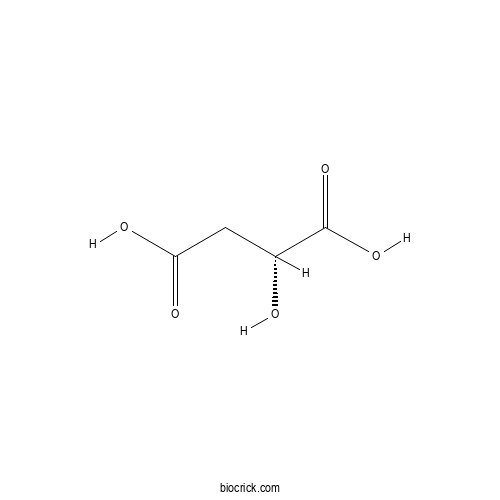
| Cas No. | 636-61-3 | SDF | File under preparation. |
| PubChem ID | 92824.0 | Appearance | Powder |
| Formula | C4H6O5 | M.Wt | 134.1 |
| Type of Compound | N/A | Storage | Desiccate at -20°C |
| Solubility | Soluble in Chloroform,Dichloromethane,Ethyl Acetate,DMSO,Acetone,etc. | ||
| Chemical Name | (2R)-2-hydroxybutanedioic acid | ||
| SMILES | C(C(C(=O)O)O)C(=O)O | ||
| Standard InChIKey | BJEPYKJPYRNKOW-UWTATZPHSA-N | ||
| Standard InChI | InChI=1S/C4H6O5/c5-2(4(8)9)1-3(6)7/h2,5H,1H2,(H,6,7)(H,8,9)/t2-/m1/s1 | ||
| General tips | For obtaining a higher solubility , please warm the tube at 37 ℃ and shake it in the ultrasonic bath for a while.Stock solution can be stored below -20℃ for several months. We recommend that you prepare and use the solution on the same day. However, if the test schedule requires, the stock solutions can be prepared in advance, and the stock solution must be sealed and stored below -20℃. In general, the stock solution can be kept for several months. Before use, we recommend that you leave the vial at room temperature for at least an hour before opening it. |
||
| About Packaging | 1. The packaging of the product may be reversed during transportation, cause the high purity compounds to adhere to the neck or cap of the vial.Take the vail out of its packaging and shake gently until the compounds fall to the bottom of the vial. 2. For liquid products, please centrifuge at 500xg to gather the liquid to the bottom of the vial. 3. Try to avoid loss or contamination during the experiment. |
||
| Shipping Condition | Packaging according to customer requirements(5mg, 10mg, 20mg and more). Ship via FedEx, DHL, UPS, EMS or other couriers with RT, or blue ice upon request. | ||
Quality Control & MSDS
3D structure
Package In Stock

Number of papers citing our products


Malic acid Dilution Calculator
Malic acid Molarity Calculator


| 1 mg | 5 mg | 10 mg | 20 mg | 25 mg | |
| 1 mM | 7.4571 mL | 37.2856 mL | 74.5712 mL | 149.1424 mL | 186.428 mL |
| 5 mM | 1.4914 mL | 7.4571 mL | 14.9142 mL | 29.8285 mL | 37.2856 mL |
| 10 mM | 0.7457 mL | 3.7286 mL | 7.4571 mL | 14.9142 mL | 18.6428 mL |
| 50 mM | 0.1491 mL | 0.7457 mL | 1.4914 mL | 2.9828 mL | 3.7286 mL |
| 100 mM | 0.0746 mL | 0.3729 mL | 0.7457 mL | 1.4914 mL | 1.8643 mL |
| * Note: If you are in the process of experiment, it's necessary to make the dilution ratios of the samples. The dilution data above is only for reference. Normally, it's can get a better solubility within lower of Concentrations. | |||||
- 4,5-Di-O-caffeoylquinic acid
Catalog No.:BCX2260
CAS No.:89886-30-6
- 4-(2-(Carboxymethyl)-3,5-dihydroxyphenoxy)benzoic acid
Catalog No.:BCX2259
CAS No.:2193189-82-9
- Lobetyolin
Catalog No.:BCX2258
CAS No.:129277-38-9
- Benzil
Catalog No.:BCX2257
CAS No.:134-81-6
- Tryptamine
Catalog No.:BCX2256
CAS No.:61-54-1
- Coniferyl acetate
Catalog No.:BCX2255
CAS No.:94930-81-1
- Scinamine C
Catalog No.:BCX2254
CAS No.:2184979-75-5
- 3''-Hydroxypyrrolezanthine
Catalog No.:BCX2253
CAS No.:2647391-04-4
- Lyxose
Catalog No.:BCX2252
CAS No.:65-42-9
- 3'-O-Methylhesperidin
Catalog No.:BCX2251
CAS No.:28034-80-2
- Benzoic acid,2-[(5,10-dihydro-3,7,8-trihydroxy-5,10-dioxo...
Catalog No.:BCX2910
CAS No.:60202-70-2
- Osmanthuside B
Catalog No.:BCX2909
CAS No.:94492-23-6
- Picropodophyllin
Catalog No.:BCX2262
CAS No.:477-47-4
- α-Santalene
Catalog No.:BCX2263
CAS No.:512-61-8
- Valerianol
Catalog No.:BCX2264
CAS No.:20489-45-6
- 7-epi-Teucrenone
Catalog No.:BCX2265
CAS No.:165898-48-6
- Isosyringinoside
Catalog No.:BCX2266
CAS No.:152686-85-6
- Taccalonolide Q
Catalog No.:BCX2267
CAS No.:488791-19-1
- 7-O-Galloyltricetiflavan
Catalog No.:BCX2268
CAS No.:889447-89-6
- (2E,7E)-6,9-Dihydroxy-N-isobutyldeca-2,7-dienamide
Catalog No.:BCX2269
CAS No.:1492015-24-3
- (2E,7E)-6,9-Dihydroxy-N-isobutyldeca-2,7-dienamide
Catalog No.:BCX2270
CAS No.:1383715-05-6
- (2E,6Z)-8,9-Dihydroxy-N-isobutyldeca-2,6-dienamide
Catalog No.:BCX2271
CAS No.:1492015-25-4
- 1β,4β-Dihydroxy-11,12,13-trinoreudesm-5-en-7-one
Catalog No.:BCX2272
CAS No.:2170107-68-1
- 1,2-Di-O-linolenoylglycerol 3-O-β-D-galactopyranoside
Catalog No.:BCX2273
CAS No.:111187-16-7
The effect of water regulation on organic acids and rhizosphere microorganisms in the root system of drought-tolerant rice under Cd stress.[Pubmed:42824867]
Front Plant Sci. 2026 Sep 17;17:1943785.
Rice (Oryza sativa L.) is the primary food crop in southern China, where the southwestern region is characterized by freshwater shortages and frequent seasonal droughts. Dryland rice cultivation serves as an important approach to addressing the conflict between rice production and water utilization. However, farmland cadmium (Cd) pollution in this area is significant, and dryland cultivation may alter the soil ecological environment, thereby affecting Cd uptake by rice and threatening safe rice production. Pot experiments on water regulation (long-term flooding and dryland treatment) of two dryland rice varieties "Yunjing 37" (YJ37) and "Luyin 46" (LY46) analyzed the effects of water regulation on the growth of roots and Cd accumulation under Cd stress; studying the correlation between root organic acids and rhizosphere microbial communities, the rhizosphere mechanism by which dryland rice varieties reduce Cd accumulation risk was revealed. The results showed that under dryland conditions, soil Eh increased significantly, and Cd content in roots increased significantly. Water regulation significantly affected the organic acids and microbial community structure of the two dryland rice varieties. Aerobic conditions significantly increased soil Eh and root Cd accumulation compared to continuous flooding. Furthermore, aerobic treatment reduced the root contents of tartaric, acetic, and Malic acids by an average of 65.93%, 75.33%, and 31.85%, respectively, while decreasing rhizosphere microbial diversity (Chao1 and Shannon indices fell by 10.54% and 4.94%). Under dryland conditions, the dominant bacterial genera in the rice rhizosphere were Sphingomonas and Gaiella, which were significantly and positively correlated with the contents of Malic acid, tartaric acid, and succinic acid in the roots. Under flooding conditions, the dominant bacterial genera in the roots of dryland rice were Anaeromyxobacter, Pedosphaera, etc. These dominant microorganisms help inhibit the activation of soil Cd and reduce the accumulation of Cd in rice. Water regulation affects the soil Cd form by changing low-molecular-weight organic acids, soil Eh, and microbial community structure, thereby affecting the absorption of Cd by dryland rice. Under cadmium contamination, water management for rice, combined with the cultivation of drought-resistant and low-Cd-accumulating varieties capable of directionally recruiting beneficial Cd-immobilizing bacteria, can provide a theoretical basis for the safe production of rice.
Tailoring the electronic structure of iron by molybdenum doping to enhance peroxidase-like activity for colorimetric analysis of natural organic acids.[Pubmed:42822297]
Talanta. 2026 Sep 29;313(Pt C):130682.
Accurate quantification of added organic acids with antioxidant activity in food is critical for food safety and human health. Herein, newly-designed Mo-doped Fe(3)C (denoted as Mo-Fe(3)C) as nanozyme is prepared via a stepwise self-assembly strategy. Notably, the introduction of Mo not only facilitates efficient charge transfer but also creates additional active sites. More importantly, the Mo doping can also modulate the electronic structure of Fe site in Fe(3)C, thereby downshifting its d-band center. This modification endows Mo-Fe(3)C with moderate adsorption capacity toward H(2)O(2), which prevents the over-activation of H(2)O(2). As a result, the Mo-Fe(3)C exhibits significantly enhanced peroxidase-like activity. Taking advantage of the robust peroxidase-like activity of Mo-Fe(3)C, a highly effective colorimetric sensing array is developed using 3,3',5,5'-tetramethyl benzidine (TMB) as colorimetric substrate. Owing to the distinctive "molecular fingerprint" characteristic of electrophilic reactions between *OH and natural organic acids, proposed sensing array is capable of achieving colorimetric detection of four organic acids, including tannic acid (TA), phytic acid (PA), Malic acid (MA), and ascorbic acid (AA). The limit of detection (LOD) values of TA, PA, MA and AA are calculated to be 0.63, 0.82, 2.40 and 2.88 muM, respectively. Even in mixed-component systems or real samples, the colorimetric sensing array still maintains high accuracy in discriminating and quantifying various organic acids. In short, the present work can provide novel insights into future research on nanozyme-based colorimetric sensing analysis.
Metabolomic signatures of early pathway disruptions and clinical outcomes in community-acquired pneumonia: a prospective case-control study.[Pubmed:42811330]
BMC Pulm Med. 2026 Jul 23;26(1):440.
BACKGROUND: The disruption of metabolic pathways in patients with community-acquired pneumonia (CAP) may provide insights into disease progression. We aim to identify early disruption in the serum metabolome of CAP patients using untargeted metabolic approaches. METHODS: We conducted a single-centre, prospective case-control study involving 105 participants (70 with CAP and 35 healthy controls), between January 2025 and November 2025. We also performed a subgroup exploratory metabolomic analysis among the 70 CAP patients, comparing 60 patients with severe CAP requiring ICU admission with the 10 non-severe CAP patients who did not require ICU admission. Untargeted serum metabolomics was performed using gas chromatography-mass spectrometry (GC-MS) to investigate metabolic dysregulation in patients with CAP. The analysis of the clinical data was performed using SPSS version 25.0. The data of metabolomics was analyzed using MetaboAnalyst version 6.0. After the preprocessing, log(10) transformation, normalization and scaling, 93 GC-MS metabolites were retained from the initial 300 metabolites. Principal component analysis was done for unsupervised clustering, which was then followed by OPLS-DA for supervised group discrimination. Model performance was assessed using R(2)Y and cross-validation-derived Q(2) values, and model robustness and overfitting exclusion was further evaluated using permutation testing. Discriminatory metabolites were identified using VIP scores, fold change, log(2) fold change and univariate testing with false discovery rate correction where applicable. ROC analysis, heatmap-based clustering and pathway enrichment analysis were performed. RESULTS: The variable importance in projection (VIP) scores showed that out of 93 untargeted metabolites studied using GC-MS, the greatest differences between the CAP patients and healthy controls were about Malic acid (VIP:3.374, fold change 2.591), 4-hydroxybenzeneacetic acid (VIP:2.459, fold change 27.97), 2-hydroxybutyric acid (VIP:2.059, fold change 4.779), and 4-hydroxyphenyllactic acid (VIP:1.882, fold change 20.67). Key disrupted pathways in CAP patients included propanoate, glyoxylate, and dicarboxylate; tricarboxylic acid cycle; nitrogen; tyrosine, cysteine, and methionine; and amino acid pathways. Comparison between the severe CAP patients (ICU admission required) and non-severe CAP patients (no-ICU admission), VIP analysis identified boric acid, ethylene glycol, ethanimidic acid, linoleic acid, oleic acid, cholesterol, 3-hydroxybutyrate, and alpha-tocopherol as the principal discriminating metabolites, while pathway analysis revealed perturbations in glutathione metabolism, amino acid metabolism, the tricarboxylic acid cycle, pyruvate metabolism, and arachidonic acid metabolism. CONCLUSIONS: CAP patients demonstrated early disruptions of key metabolic pathways compared with healthy controls, spanning energy metabolism, amino acid pathways, redox balance, lipid inflammatory signalling, and gut-host metabolic axes. These findings highlight the potential utility of metabolomic profiling as an adjunctive clinical tool for early risk stratification and biochemical phenotyping in CAP. TRIAL REGISTRATION: Clinical trials Registry of India (CTRI 2024/12/078631) registration was done 27.12.2024.
In Situ Imaging for Monitoring Biomass Content and Pellet Size in Submerged Filamentous Stirred-Tank Cultivation.[Pubmed:42806695]
Biotechnol J. 2026 Oct;21(10):e70314.
Filamentous microorganisms play a central role in industrial biotechnology, where pellet morphology affects mass transfer, rheology, and process performance. However, time-resolved monitoring of filamentous biomass and pellet size dynamics in stirred-tank reactors remains challenging due to offline sampling limitations. We present a noninvasive in situ imaging approach to observe biomass-related light scattering and projected pellet size. A custom-built camera and ring-light setup with MATLAB-based image acquisition and processing was used to quantify image luminosity as a proxy for biomass content and to determine projected object area (POA) and the number of detected objects per image above a POA threshold of 0.5 mm(2). To characterize systematic biases, polyoxymethylene spheres of 1-4 mm diameter served as a model system. Luminosity scaled with object concentration, whereas object detection and apparent size estimation were increasingly affected by object size and concentration. In a bench-scale cultivation of Malic acid-producing Aspergillus oryzae, image luminosity followed biomass content, while in situ POA analysis revealed increasing projected pellet size coinciding with Zn(2+) limitation. These observations differed from ex situ sampling, indicating that image-based in situ monitoring provides time-resolved information on biomass formation and pellet size dynamics that may not be captured by offline sampling alone.
Metabolic Reprogramming in Cucumis metuliferus Roots and Rhizosphere Identifies Candidate Metabolites That Reduce Meloidogyne incognita Infection.[Pubmed:42806667]
Physiol Plant. 2026 Sep-Oct;178(5):e71135.
Root-knot nematode causes severe yield losses in cucumber and other cucurbits. The wild relative Cucumis metuliferus exhibits strong resistance, but the metabolic basis of this resistance and the potential of resistance-associated metabolites to protect susceptible crops remains poorly understood. Here, we compared host status, phenolic content, and untargeted metabolomes of roots and rhizosphere soils of C. metuliferus and C. sativus upon Meloidogyne incognita infection. C. metuliferus showed delayed nematode development, fewer galls, and a lower reproduction factor compared with C. sativus, accompanied by higher constitutive phenolic levels in mock-inoculated plants and phenolic levels at 7, 14, 21, and 28 days after inoculation. Untargeted metabolomics revealed that C. metuliferus underwent more extensive metabolic reprogramming than C. sativus, with 72 root-specific and 45 rhizosphere-specific differential metabolites enriched mainly in linolenic acid metabolism and dominated by lipids and organic acids. Six C. metuliferus-specific up-regulated metabolites (arginine, phenylacetic acid, proline, hydroxyproline, Malic acid, maleic acid) were selected for functional validation. When exogenously applied to C. sativus seedlings under nematode stress, these metabolites were associated with enhanced shoot growth and biomass accumulation. Among them, arginine, hydroxyproline, and maleic acid were consistently associated with reduced root gall formation. Our findings demonstrate that C. metuliferus mounts a resistance phenotype through extensive root and rhizosphere metabolic reprogramming, and that specific up-regulated metabolites from this resistant species can both promote cucumber growth and reduce M. incognita infection. These metabolites represent promising candidates but require further field validation and formulation studies before being developed into sustainable nematode management strategies.
Aleurone layer multi-omics reveals constitutive enzyme-inhibitor imbalance in LMA-contrasting wheat cultivars.[Pubmed:42805001]
Plant Physiol Biochem. 2026 Sep 18;239:111757.
Late maturity amylase (LMA) is a genetic defect in wheat causing premature accumulation of high-pI alpha-amylase isoforms in the aleurone during grain development, which reduces falling number, resulting in flour downgrading and price penalties. Yet, the aleurone layer proteome and metabolome remain poorly characterised across LMA-contrasting cultivars. We measured the proteome and central carbon metabolome of aleurone from three wheat cultivars differing in LMA-phenotype: Seri (susceptible), Kennedy (intermediate), and Hartog (resistant) - under abscisic acid (ABA), abscisic acid plus gibberellic acid (GA), or untreated conditions. Cultivar identity explained 65.7% of proteome variance, exceeding hormone treatment effects (13.1%), with no significant cultivar x treatment interaction. In Seri, increased numbers and abundance of alpha-amylase isoforms, glyoxylate cycle enzymes, arabinofuranosidase, Malic acid, and sucrose indicate constitutive reserve mobilisation in the absence of hormone induction. The inhibitor-to-amylase ratio was higher in Hartog than Seri, suggesting LMA susceptibility reflects a broader imbalance between degradative enzymes and their regulators rather than elevated amylase production alone. The cultivar Hartog showed higher abundance of dehydrins, invertase/PME inhibitors, and sucrose-phosphate synthase, consistent with storage maintenance and cellular protection. Multi-omics integration and proteomics-phenotype integration independently converged on the same cultivar axis, with glyoxylate cycle enzymes and arabinofuranosidase consistently associated with Seri. These findings provide a molecular framework for dissecting mechanisms of LMA susceptibility and resistance.
Experimental Design-Driven Optimization of Choline-Based Natural Deep Eutectic Solvents for the Extraction of Bioactive Compounds from Bellevalia dubia.[Pubmed:42796554]
Molecules. 2026 Sep 15;31(18):3267.
The development of sustainable and efficient sample-preparation strategies remains a key challenge in analytical workflows for plant-derived bioactive compounds. In this study, choline chloride (ChCl)-based natural deep eutectic solvents (NADES) were systematically investigated as green extraction media and combined with chemical and enzyme assays to identify the bioactive effect of phenolic compounds from Bellevalia dubia, an understudied Mediterranean plant. A design of experiments approach was applied to evaluate the influence of hydrogen bond donors (lactic, malic, and citric acid) and their molar ratios on extraction performance. Among the tested systems, the ChCl-Malic acid (MA) mixture at a molar ratio of 1:2.5 (precisely 1:2.47) was identified as the best overall solution according to the desirability approach, which integrated both phytochemical and enzyme-inhibitory responses. This system also showed strong enzyme-inhibitory effects compared to conventional extractants (water and 80% methanol). To identify the extract composition, a suspect screening workflow was applied based on ultra-high-performance liquid chromatography hybrid quadrupole Orbitrap mass spectrometry (UHPLC-q-Orbitrap-MS). Twenty-one compounds were detected and annotated, mainly belonging to the flavonoid class. Principal component analysis (PCA) showed that ChCl-MA extracts were discriminated, particularly at molar ratio 1:2.5, from the rest, indicating a distinct chemical and bioactivity profile. PCA further suggested a possible association of the ChCl-MA 1:2.5 system with vitexin and AChE inhibition, which requires further investigation. Overall, the proposed NADES-based approach offers a tunable, promising, and potentially more sustainable alternative for the extraction of bioactive compounds from plant-based sources.
Integrated Sugar-Acid-Phenolic Profiling Identifies Distinct Chemical Types Associated with Antioxidant Capacity in Apple Pulp Samples.[Pubmed:42794138]
Foods. 2026 Sep 21;15(18):3353.
This study characterized the sugar, organic acid, and phenolic profiles of 25 apple pulp samples from 12 cultivars to investigate their associations with antioxidant potential. Fructose and Malic acid were the predominant free sugar and organic acid, respectively. Hierarchical clustering based on seven non-redundant chemical traits classified the samples into four distinct chemical types: acid-rich, sugar-enriched/low-phenolic, intermediate/low-accumulation, and phenolic-rich types. Phenolic-related traits showed stronger associations with in vitro antioxidant capacity than sugar- and acid-related traits. For cellular validation, polyphenol extracts from five representative samples were tested at 5 mug/mL, a concentration selected based on cell viability results under the tested conditions. The extracts significantly reduced H(2)O(2)- and t-BHP-induced intracellular ROS accumulation in HepG2 cells, with the TPGSH sample exhibiting the strongest cellular protection. These findings establish an integrated chemical-antioxidant framework for characterizing apple pulp samples and identifying compositional patterns associated with antioxidant activity.
Effects of Colchicine Treatment on Bioactive Compounds and Structural Characteristics of the Epidermis and Cortex of Edible Cactus [Opuntia ficus-indica (L.) Mill.] Cladodes at Different Maturity Stages.[Pubmed:42794094]
Foods. 2026 Sep 18;15(18):3310.
This study investigated the effects of colchicine treatment on phenolic and flavonoid profiles, organic acids, antioxidant activities, and structural characteristics of the epidermis and cortex of edible cactus [Opuntia ficus-indica (L.) Mill.] cladodes at different maturity stages (1, 3, and 6 months). Cladodes were treated with 0, 0.5, and 1.0% colchicine for 24 h prior to cultivation. Colchicine significantly influenced metabolite accumulation, with responses varying across tissues and maturity stages. In the epidermis, total phenolic content (TPC) ranged from 942.67 to 1292.72 mg GAE/100 g DW, while total flavonoid content (TFC) ranged from 509.42 to 1322.55 mg QE/100 g DW. HPLC analysis further revealed marked increases in chlorogenic acid (6.25-fold), gentisic acid (3.47-fold), and gallic acid (63.9%), while rutin and apigenin were the predominant flavonoids. In contrast, the cortex accumulated higher levels of organic acids, particularly Malic acid. FTIR and XRD analyses indicated that colchicine treatment did not substantially alter the major functional groups or crystalline characteristics of the cladodes. Pearson's correlation and heatmap analyses further revealed positive associations among phenolic compounds, flavonoids, and antioxidant activities. These findings indicate that colchicine concentration and maturity stage were associated with distinct patterns of metabolite accumulation and antioxidant activity in edible cactus cladodes, supporting their potential application as functional food ingredients.
Unravelling deregulated metabolites in seminal plasma of infertile men: a systematic review and bioinformatic analysis.[Pubmed:42789063]
J Mol Med (Berl). 2026 Sep 25;104(1):112.
Male infertility is a multifactorial condition accounting for 50% of infertility cases. Although conventional semen analysis remains the standard method for male infertility diagnosis, it fails to explain 30% of the cases and their underlying molecular causes. Metabolomics offers valuable insights into sperm metabolic dysfunction, enabling the identification of deregulated pathways involved in male infertility. Here, a systematic review including metabolomic studies that compare the seminal plasma metabolome of healthy and infertile men was conducted. A literature search was conducted in PubMed, Scopus, and Web of Science databases following PRISMA guidelines. Twenty metabolomic studies published until December 2025 were included and categorized into four groups: asthenozoospermia, oligozoospermia, obesity, and overall male infertility. A total of 284 metabolites were retrieved, of which eleven (down: L-tyrosine, D-fructose, L-valine, phenylalanine, proline, D-glucose, L-alanine, leucine, sorbitol, L-aspartic acid; up: uridine), six (down: D-fructose, glycine, maleic acid, L-valine, proline, and lysine), and ten (down: L-carnitine, L-tyrosine, L-valine, L-alanine, phenylalanine, proline, D-glucose, leucine, Malic acid, and citraconic acid) were altered in asthenozoospermia, obesity, and overall infertility groups, respectively. These metabolites were associated with phenylalanine/tyrosine metabolism, fructose and mannose degradation, and beta-oxidation of long-chain fatty acids. A bioinformatic analysis of the enzymes possibly involved in these pathways revealed associations with male infertility phenotypes and key sperm functions, including motility, vitality, and energy metabolism. This study provides a list of metabolites altered in the seminal fluid of infertile men, highlighting their potential as biomarkers of male infertility, and gives insights into the metabolic pathways affected in these conditions.
Sustainable synthesis of cellulose malate ester to prepare nanocellulose paired with zwitterionic amino acid counterion.[Pubmed:42785831]
Carbohydr Polym. 2026 Nov 1;391:125857.
State of the art chemistry for preparation of cellulose nanofibrils (CNF) has mainly been TEMPO-mediated oxidation or carboxymethylation. In this study, CNF of high aspect ratio at high yield is prepared through synthesis of cellulose ester by using Malic acid coupled with mechanical processing, yielding transparent gels and films. Ester formation is performed in an oven-based process and catalyzed by basic salts which allows for easy synthesis, without organic solvents or toxic chemicals, while on average reaching a maximum degree of substitution of 0.3 and a total charge of 1.5 mmol/g. Hydrolysis of the cellulose is limited, retaining a high molecular weight. The results indicate that crosslinking of the cellulose does not occur, even at elevated temperatures of 130 degrees C. A novel concept to utilize unconventional weak bases such as the amino acid lysine as counterion to the carboxylic acid in the nanocellulose is also presented, thereby introducing zwitterionic counterions. It is also shown that other organic acids such as e.g. tartaric- and glutaric acid may also be used through the same process as Malic acid, opening up for a library of organic cellulose esters.
Exercise Metabolomics Reveals Intensity-Dependent Metabolic Responses Associated with Cardiorespiratory Fitness in Adults with Type 1 Diabetes.[Pubmed:42783812]
Metabolites. 2026 Sep 18;16(9):687.
Purpose: To characterize plasma metabolomic responses to maximal exercise and their associations with cardiorespiratory fitness (CRF) in adults with type 1 diabetes. Methods: In this exploratory pooled secondary analysis, 21 adults (67% female; age, 51.6 +/- 13.2 years; HbA1c, 67.5 +/- 7.0 mmol/mol) completed a cycle-ergometer test to exhaustion; metabolomic data were available for 20. Plasma collected at rest, anaerobic threshold (AT), peak exercise, and recovery underwent targeted and untargeted gas chromatography-mass spectrometry profiling. Peak oxygen uptake (V̇O(2)peak) quantified CRF. Linear mixed-effects models adjusted for age, sex, HbA1c, and diabetes duration. Results: At the AT, L-(+)-lactic acid and 2-hydroxyisobutyric acid increased relative to rest (both q Malic acid at peak exercise (beta = 0.063, q = 0.010) and recovery (beta = 0.061, q = 0.015). Conclusions: These preliminary findings suggest the presence of intensity-dependent and fitness-associated metabolic responses to exercise in adults with type 1 diabetes. Given the small sample size, particularly for interaction analyses, these findings require confirmation in larger independent cohorts.
Isolation of a malic acid-overproducing sake yeast that does not possess the known mutations causing high-malic acid-production.[Pubmed:42765938]
Biosci Biotechnol Biochem. 2026 Sep 21:zbag142.
Malic acid is an organic acid that contributes to the refreshing taste of sake. Sake yeast strains with high-Malic acid-productivity have been bred, and numerous mutations causing high-Malic acid-production have been identified. Here, we spontaneously isolated a high-Malic acid-producing mutant among the selected 2-deoxyglucose resistants, that does not possess the known mutations causing high-Malic acid-production from the original sake yeast.
Fermentation dynamics of yerba-mate and coffee-husk kombuchas: bioactive compounds, organic acids, volatile metabolites, and microbial succession.[Pubmed:42757189]
Front Nutr. 2026 Sep 3;13:1935769.
INTRODUCTION: Although yerba-mate and coffee-husk have individually been explored as alternative kombucha substrates, it remains unclear how these chemically distinct matrices differentially shape metabolite evolution and microbial succession when fermented under equivalent conditions. This study directly compared yerba-mate kombucha (YMK) and coffee-husk kombucha (CHK) to investigate substrate-dependent chemical and microbial fermentation trajectories. METHODS: YMK and CHK were produced using the same parental SCOBY and fermentation protocol. Infusions containing 10 g/L substrate and 60 g/L sucrose were fermented statically at 30 degrees C for 9 days and subsequently stored at 4 degrees C for 4 days. Phenolic and flavonoid contents, antioxidant responses, organic-acid profiles, volatile compounds, and bacterial and fungal community succession were evaluated. RESULTS: The two matrices generated distinct fermentation trajectories. YMK maintained consistently higher phenolic content and antioxidant-related responses, reaching 467.97 +/- 43.09 mug GAE/mL at the end of refrigerated storage, and exhibited a broader and more persistent distribution of volatile chemical classes. CHK showed lower but comparatively stable antioxidant-related measurements and a more restricted volatile profile. Organic acids varied non-monotonically in both formulations, although YMK showed a higher final Malic acid concentration. Komagataeibacter remained dominant throughout YMK fermentation, whereas CHK underwent a stronger temporal shift toward Acetobacter. Fungal communities were comparatively stable in both substrates and were dominated by Starmerella and Dekkera. DISCUSSION: These findings demonstrate that substrate composition influenced both beverage chemistry and the temporal organization of the kombucha microbiota. By directly comparing a phytochemical-rich botanical infusion and an agro-industrial coffee by-product under standardized fermentation conditions, this study extends previous single-substrate investigations and highlights the potential of coffee-husk as a plant-derived ingredient for sustainable fermented beverage development.

Calcutta University

University of Minnesota

University of Maryland School of Medicine

University of Illinois at Chicago

The Ohio State University

University of Zurich

Harvard University

Colorado State University

Auburn University

Yale University

Worcester Polytechnic Institute

Washington State University

Stanford University

University of Leipzig

Universidade da Beira Interior

The Institute of Cancer Research

Heidelberg University

University of Amsterdam

University of Auckland

TsingHua University

The University of Michigan

Miami University

DRURY University

Jilin University

Fudan University

Wuhan University

Sun Yat-sen University

Universite de Paris

Deemed University

Auckland University

The University of Tokyo

Korea University



