
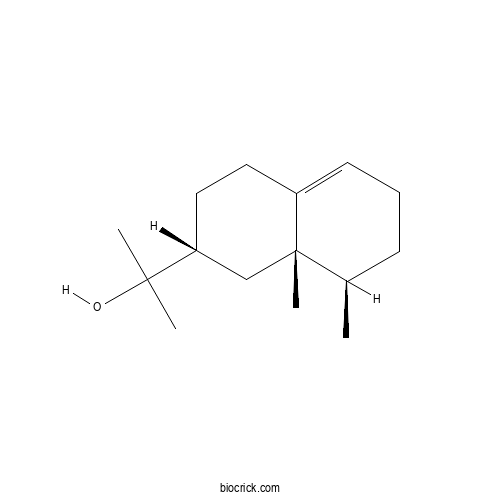
ValerianolCAS# 20489-45-6 |
| Cas No. | 20489-45-6 | SDF | File under preparation. |
| PubChem ID | 9859337.0 | Appearance | Oil |
| Formula | C15H26O | M.Wt | 222.4 |
| Type of Compound | N/A | Storage | Desiccate at -20°C |
| Solubility | Soluble in Chloroform,Dichloromethane,Ethyl Acetate,DMSO,Acetone,etc. | ||
| Chemical Name | 2-[(2R,8R,8aS)-8,8a-dimethyl-2,3,4,6,7,8-hexahydro-1H-naphthalen-2-yl]propan-2-ol | ||
| SMILES | CC1CCC=C2C1(CC(CC2)C(C)(C)O)C | ||
| Standard InChIKey | MQWIFDHBNGIVPO-KYOSRNDESA-N | ||
| Standard InChI | InChI=1S/C15H26O/c1-11-6-5-7-12-8-9-13(14(2,3)16)10-15(11,12)4/h7,11,13,16H,5-6,8-10H2,1-4H3/t11-,13-,15+/m1/s1 | ||
| General tips | For obtaining a higher solubility , please warm the tube at 37 ℃ and shake it in the ultrasonic bath for a while.Stock solution can be stored below -20℃ for several months. We recommend that you prepare and use the solution on the same day. However, if the test schedule requires, the stock solutions can be prepared in advance, and the stock solution must be sealed and stored below -20℃. In general, the stock solution can be kept for several months. Before use, we recommend that you leave the vial at room temperature for at least an hour before opening it. |
||
| About Packaging | 1. The packaging of the product may be reversed during transportation, cause the high purity compounds to adhere to the neck or cap of the vial.Take the vail out of its packaging and shake gently until the compounds fall to the bottom of the vial. 2. For liquid products, please centrifuge at 500xg to gather the liquid to the bottom of the vial. 3. Try to avoid loss or contamination during the experiment. |
||
| Shipping Condition | Packaging according to customer requirements(5mg, 10mg, 20mg and more). Ship via FedEx, DHL, UPS, EMS or other couriers with RT, or blue ice upon request. | ||
Quality Control & MSDS
3D structure
Package In Stock

Number of papers citing our products


Valerianol Dilution Calculator
Valerianol Molarity Calculator
| 1 mg | 5 mg | 10 mg | 20 mg | 25 mg | |
| 1 mM | 4.4964 mL | 22.482 mL | 44.964 mL | 89.9281 mL | 112.4101 mL |
| 5 mM | 0.8993 mL | 4.4964 mL | 8.9928 mL | 17.9856 mL | 22.482 mL |
| 10 mM | 0.4496 mL | 2.2482 mL | 4.4964 mL | 8.9928 mL | 11.241 mL |
| 50 mM | 0.0899 mL | 0.4496 mL | 0.8993 mL | 1.7986 mL | 2.2482 mL |
| 100 mM | 0.045 mL | 0.2248 mL | 0.4496 mL | 0.8993 mL | 1.1241 mL |
| * Note: If you are in the process of experiment, it's necessary to make the dilution ratios of the samples. The dilution data above is only for reference. Normally, it's can get a better solubility within lower of Concentrations. | |||||
- α-Santalene
Catalog No.:BCX2263
CAS No.:512-61-8
- Picropodophyllin
Catalog No.:BCX2262
CAS No.:477-47-4
- Malic acid
Catalog No.:BCX2261
CAS No.:636-61-3
- 4,5-Di-O-caffeoylquinic acid
Catalog No.:BCX2260
CAS No.:89886-30-6
- 4-(2-(Carboxymethyl)-3,5-dihydroxyphenoxy)benzoic acid
Catalog No.:BCX2259
CAS No.:2193189-82-9
- Lobetyolin
Catalog No.:BCX2258
CAS No.:129277-38-9
- Benzil
Catalog No.:BCX2257
CAS No.:134-81-6
- Tryptamine
Catalog No.:BCX2256
CAS No.:61-54-1
- Coniferyl acetate
Catalog No.:BCX2255
CAS No.:94930-81-1
- Scinamine C
Catalog No.:BCX2254
CAS No.:2184979-75-5
- 3''-Hydroxypyrrolezanthine
Catalog No.:BCX2253
CAS No.:2647391-04-4
- Lyxose
Catalog No.:BCX2252
CAS No.:65-42-9
- 7-epi-Teucrenone
Catalog No.:BCX2265
CAS No.:165898-48-6
- Isosyringinoside
Catalog No.:BCX2266
CAS No.:152686-85-6
- Taccalonolide Q
Catalog No.:BCX2267
CAS No.:488791-19-1
- 7-O-Galloyltricetiflavan
Catalog No.:BCX2268
CAS No.:889447-89-6
- (2E,7E)-6,9-Dihydroxy-N-isobutyldeca-2,7-dienamide
Catalog No.:BCX2269
CAS No.:1492015-24-3
- (2E,7E)-6,9-Dihydroxy-N-isobutyldeca-2,7-dienamide
Catalog No.:BCX2270
CAS No.:1383715-05-6
- (2E,6Z)-8,9-Dihydroxy-N-isobutyldeca-2,6-dienamide
Catalog No.:BCX2271
CAS No.:1492015-25-4
- 1β,4β-Dihydroxy-11,12,13-trinoreudesm-5-en-7-one
Catalog No.:BCX2272
CAS No.:2170107-68-1
- 1,2-Di-O-linolenoylglycerol 3-O-β-D-galactopyranoside
Catalog No.:BCX2273
CAS No.:111187-16-7
- Taccafurostanoside A
Catalog No.:BCX2274
CAS No.:290809-76-6
- Taccafurostanoside B
Catalog No.:BCX2275
CAS No.:98569-68-7
- Saxifragin
Catalog No.:BCX2276
CAS No.:34199-21-8
Phytochemical Analysis, In Vitro Anti-Inflammatory Activity, and In Silico Molecular Docking of the Essential Oil from Munronia lancifolia.[Pubmed:41765390]
J Oleo Sci. 2026;75(3):271-280.
This investigation represents the first assessment of the phytochemical profile and biological properties of Munronia lancifolia essential oil. Extracted through hydro-distillation with a yield of 0.1%, the oil made up 57 identified constituents. The primary classes were oxygenated monoterpenes (0.67%), sesquiterpene hydrocarbons (9.41%), oxygenated sesquiterpenes (85.34%), and non-terpenic compounds (3.76%). Key components included 23 (1,5-epoxysalvial-4(14)-ene), 24 (spathulenol), 25 (caryophyllene oxide), 35 (isospathulenol), and 40 (Valerianol) with high concentrations. The oil exhibited significant anti-inflammatory potential, as evidenced by nitric oxide suppression (IC(50) approximately 53.0 +/- 2.62 microg/mL), reduced TNF-alpha levels measured by ELISA, without inducing cytotoxic effect at 100 microg/mL, and bovine serum albumin denaturation-related protein damage (IC(50) approximately 58.08 +/- 2.45 microg/mL). The docking simulations were performed to assess the affinity of major compounds with the TNF-alpha binding site (PDB ID: 2AZ5), offering molecular insights into their prospective anti-inflammatory properties. Overall, these findings suggest this plant as a promising natural source for the inflammatory response.
Chitosan based encapsulation of Valeriana officinalis essential oil as edible coating for inhibition of fungi and aflatoxin B(1) contamination, nutritional quality improvement, and shelf life extension of Citrus sinensis fruits.[Pubmed:36740131]
Int J Biol Macromol. 2023 Apr 1;233:123565.
In this study, a novel chitosan nanoemulsion coating embedded with Valeriana officinalis essential oil (Ne-VOEO) was synthesized in order to improve the postharvest quality of Citrus sinensis fruits against infesting fungi, and aflatoxin B(1) (AFB(1)) mediated nutritional deterioration. The developed nanoemulsion was characterized through SEM, FTIR, XRD, and DLS analyses. The nanoemulsion showed controlled delivery of VOEO responsible for effective inhibition of Aspergillus flavus, A. niger, A. versicolor, Penicillium italicum, and Fusarium oxysporum growth at 6.5, 5.0, 4.0, 5.5, and 3.5 muL/mL, respectively and AFB(1) production at 5.0 muL/mL. The biochemical and molecular mechanism of aflatoxigenic A. flavus inhibition, and AFB(1) diminution was associated with impairment in ergosterol biosynthesis, methylglyoxal production, and stereo-spatial binding of Valerianol in the cavity of Ver-1 protein. During in vivo investigation, Ne-VOEO coating potentially restrained the weight loss, and respiratory rate of C. sinensis fruits with delayed degradation of soluble solids, titrable acidity, pH, and phenolic contents along with maintenance of SOD, CAT, APX activities (p < 0.05) and sensory attributes under specific storage conditions. Based on overall findings, Ne-VOEO nanoemulsion could be recommended as green, and smart antifungal coating agent in prolonging the shelf-life of stored fruits with enhanced AFB(1) mitigation.
A Comparison of the Composition of Selected Commercial Sandalwood Oils with the International Standard.[Pubmed:33924603]
Molecules. 2021 Apr 13;26(8):2249.
Sandalwood oils are highly desired but expensive, and hence many counterfeit oils are sold in high street shops. The study aimed to determine the content of oils sold under the name sandalwood oil and then compare their chromatographic profile and alpha- and beta santalol content with the requirements of ISO 3518:2002. Gas chromatography with mass spectrometry analysis found that none of the six tested "sandalwood" oils met the ISO standard, especially in terms of alpha-santalol content. Only one sample was found to contain both alpha- and beta-santalol, characteristic of Santalum album. In three samples, Valerianol, elemol, eudesmol isomers, and caryophyllene dominated, indicating the presence of Amyris balsamifera oil. Another two oil samples were found to be synthetic mixtures: benzyl benzoate predominating in one, and synthetic alcohols, such as javanol, polysantol and ebanol, in the other. The product label only gave correct information in three cases: one sample containing Santalum album oil and two samples containing Amyris balsamifera oil. The synthetic samples described as 100% natural essential oil from sandalwood are particularly dangerous and misleading to the consumer. Moreover, the toxicological properties of javanol, polysantol and ebanol, for example, are unknown.
Probing Enzymatic Structure and Function in the Dihydroxylating Sesquiterpene Synthase ZmEDS.[Pubmed:32558549]
Biochemistry. 2020 Jul 21;59(28):2660-2666.
Terpene synthases (TPSs) play a vital role in forming the complex hydrocarbon backbones that underlie terpenoid diversity. Notably, some TPSs can add water prior to terminating the catalyzed reaction, leading to hydroxyl groups, which are critical for biological activity. A particularly intriguing example of this is the maize (Zea mays) sesquiterpene TPS whose major product is eudesmanediol, ZmEDS. This production of dual hydroxyl groups is presumably enabled by protonation of the singly hydroxylated transient stable intermediate hedycaryol. To probe the enzymatic structure-function relationships underlying this unusual reaction, protein modeling and docking were used to direct mutagenesis of ZmEDS. Previously, an F303A mutant was shown to produce only hedycaryol, suggesting a role in protonation. Here this is shown to be dependent on the steric bulk positioning of hedycaryol, including a supporting role played by the nearby F299, rather than pi-cation interaction. Among the additional residues investigated here, G411 at the conserved kink in helix G is of particular interest, as substitution of this leads to predominant production of the distinct (-)-Valerianol, while substitution for the aliphatic I279 and V306 can lead to significant production of the alternative eudesmane-type diols 2,3-epi-cryptomeridiol and 3-epi-cryptomeridol, respectively. Altogether, nine residues that are important for this unusual reaction were investigated here, with the results not only emphasizing the importance of reactant positioning suggested by the stereospecificity observed among the various product types but also highlighting the potential role of the Mg(2+)-diphosphate complex as the general acid for the protonation-initiated (bi)cyclization of hedycaryol.
Essential Oils of Lemongrass (Cymbopogon citratus Stapf) Induces Apoptosis and Cell Cycle Arrest in A549 Lung Cancer Cells.[Pubmed:32420353]
Biomed Res Int. 2020 Jan 11;2020:5924856.
Essential oils were extracted from the culm and leaf of Cymbopogon citratus collected from different regions of Vietnam and analyzed using GC/MS. The results showed that citral is the major component accounting for 61.20%-76.46% of the essential oils. The citral content was higher in the essential oil obtained from the leaf than in that from the culm of lemongrass in all regions. In particular, camphene, Valerianol, and epi-alpha-muurolol can be used to differentiate essential oils originating from leaves versus culms. The cytotoxic effects of the essential oils on various lung cancer cell lines were evaluated in the present study. All essential oils exhibited cytotoxicity in the tested cells. The Ha Loc leaf essential oil (HLL) exhibited the most potent effects on A549 and H1975 cells, with IC(50) values of 1.73 +/- 0.37 and 4.01 +/- 0.30 mug/mL, respectively. The Hy Cuong leaf essential oil (HCL) showed the strongest effect on H1299 cells, with an IC(50) value of 2.45 +/- 0.21 mug/mL. The Kim Duc culm (KDC) essential oil exerted the strongest cytotoxic effects against H1650 cells, with an IC(50) value of 4.86 +/- 0.29 mug/mL. The HLL induced apoptosis and cycle arrest in A549 cells according to flow cytometric analysis and fluorescent nuclear staining assays. The western blot analysis indicated that HLL induced the apoptotic effect by altering the regulating proteins of the apoptosis process such as caspase-3, Bcl-2, and Bax. The data strongly suggested that the intrinsic pathway may play an important role in the apoptotic effects of HLL.
Chemical composition of the leaf oils from two morphotypes of Psidium cattleyanum at four phenological stages.[Pubmed:32028801]
Nat Prod Res. 2021 Nov;35(21):4094-4097.
The chemical composition of volatile oil extracted from leaves of two morphotypes of Psidium cattleyanum Sabine from southern Brazil was evaluated at four phenological stages. In addition, plant material was evaluated at four different locations of the Planalto Serrano Region of Santa Catarina state, Brazil. Major components found were: 1,8-cineole, alpha-pinene, alpha-eudesmol, (E)-caryophyllene and p-cymene in red morphotype whereas 1,8-cineole, alpha-pinene, myrcene, (E)-caryophyllene and Valerianol were found in the yellow morphotype. The differences observed in the chemical composition in red and yellow morphotypes may help in the differentiation between the two morphotypes in the absence of fruits. Also, important differences were observed mainly for 1,8-cineole and alpha-pinene percentage at different phenological stages.
[Analysis of volatile ingredients of selected essential oils listing relaxing action].[Pubmed:30912530]
Med Pr. 2019 Apr 19;70(2):229-247.
BACKGROUND: Stress is a result of disturbed homeostasis and can contribute to the development of many diseases. One of the methods of combating stress is aromatherapy, which uses essential oils with a calming and relaxing effect. The aim of the work was to perform a qualitative analysis of selected essential oils with a relaxing effect. MATERIAL AND METHODS: The research concerned 6 preparations available on the Polish market, which are attributed with anti-stress activity. The qualitative analysis was carried out by gas chromatography with mass spectrometry, which allows the determination of both main and trace substances in the tested oils. The components of individual samples were compared with data from the literature. RESULTS: In the samples tested 9-36 substances were identified. The following substances had the largest share in the composition of the studied samples: limonene (0.5-91%), linalool acetate (16.8-39.2%), citronellal (0.1-28.7%), linalool (0.8-46.5%), Valerianol (17.6%), geraniol (16.4%), and citronellol (14%). CONCLUSIONS: According to literature data, the main components of the studied essential oils have low acute toxicity. They can be safely used as intended and in the quantities recommended by the manufacturer. However, one should remember the potential synergistic effect (as a result of exposure to the abovementioned substances from various sources, such as: food, cosmetics, cleaning agents, etc.), as well as sensitizing effects of some compounds contained in oils. Despite the different chemical structure of active substances contained in the tested oils, it is suggested that the mechanism of the relaxing effect is identical and is associated with the inhibition of glutamatergic neurotransmission, similar to the action of benzodiazepines. Med Pr. 2019;70(2):229-47.
Identification of novel sesquiterpene synthase genes that mediate the biosynthesis of valerianol, which was an unknown ingredient of tea.[Pubmed:30127518]
Sci Rep. 2018 Aug 20;8(1):12474.
Seven cDNA clones encoding terpene synthases (TPSs), their structures closely related to each other, were isolated from the flower of Camellia hiemalis ('Kantsubaki'). Their putative TPS proteins were phylogenetically positioned in a sole clade with the TPSs of other Camellia species. The obtained Tps genes, one of which was designated ChTps1 (ChTps1a), were introduced into mevalonate-pathway-engineered Escherichia coli, which carried the genes for utilizing acetoacetate as a substrate, and cultured in a medium including lithium acetoacetate. Volatile products generated in the E. coli cells transformed with ChTps1 were purified from the cell suspension culture, and analyzed by NMR. Consequently, the predominant product with ChTPS1 was identified as Valerianol, indicating that the ChTps1 gene codes for Valerianol synthase. This is the first report on a gene that can mediate the synthesis of Valerianol. We next synthesized a Tps ortholog encoding ChTPS1variant R477H (named CsiTPS8), whose sequence had been isolated from a tea tree (Camellia sinensis), carried out similar culture experiment with the E. coli transformant including CsiTps8, and consequently found Valerianol production equally. Furthermore, GC-MS analysis of several teas revealed that Valerianol had been an unknown ingredient in green tea and black tea.
Phytochemical Study of the Ecuadorian Species Lepechinia mutica (Benth.) Epling and High Antifungal Activity of Carnosol against Pyricularia oryzae.[Pubmed:29671794]
Pharmaceuticals (Basel). 2018 Apr 19;11(2):33.
The plant Lepechinia mutica (Benth.) Epling (family Lamiaceae) is endemic to Ecuador. In the present study, we report some major non-volatile secondary metabolites from the leaves and the chemistry of the essential oil distilled from the flowers. The main identified compounds were carnosol, viridiflorol, ursolic acid, oleanolic acid, chrysothol, and 5-hydroxy-4′,7-dimethoxy flavone. Their structures were determined by X-ray diffraction and NMR and MS techniques. The essential oil showed a chemical composition similar to that distilled from the leaves, but with some qualitative and quantitative differences regarding several minor compounds. The main constituents (>4%) were: δ-3-carene (24.23%), eudesm-7(11)-en-4-ol (13.02%), thujopsan-2-α-ol (11.90%), β-pinene (7.96%), Valerianol (5.19%), and co-eluting limonene and β-phellandrene (4.47%). The volatile fraction was also submitted to enantioselective analysis on a β-cyclodextrin column, obtaining the separation and identification of the enantiomers for α-thujene, β-pinene, sabinene, α-phellandrene, limonene and β-phellandrene. Furthermore, the anti-fungal activity of non-volatile secondary metabolites was tested in vitro, with carnosol resulting in being very active against the “blast disease” caused by the fungus Pyricularia oryzae.
Sulphur-containing compounds in the essential oil of Ferula alliacea roots and their mass spectral fragmentation patterns.[Pubmed:26963574]
Pharm Biol. 2016 Oct;54(10):2264-8.
Context GC-MS analysis is the best way to characterize volatile sulphur-containing compounds. Ferula (Apiaceae) is a genus of perennial herbs. Due to the occurrence of essential oils or oleoresins in the Ferula species, these plants usually possess strong aromatic scent. Terpenoid compounds were the most abundant constituents of Ferula oils, however, in some of Ferula species, the essential oils were dominated by volatile sulphur-containing compounds. Objectives Ferula alliacea Boiss. is considered one of the sources of the oleo-gum-resin asafoetida. In this study, we analyzed the hydrodistilled essential oil from its dried roots and provide new data about retention indices and mass fragmentation patterns of some volatile sulphur-containing compounds that are useful for future studies on this class of compounds. Materials and methods The roots of F. alliacea were collected during the flowering stage of plant, from Bezgh, Kashmar to Neishabour road, Khorasan-Razavi province, Iran, in June 2012. The oil was obtained by hydrodistillation using a Clevenger apparatus and analyzed by GC-MS. Results This is the first report on phytochemical analysis of F. alliacea roots. Seventy-six components, representing 99.5% of the oil, were characterized. The major components were 10-epi-gamma-eudesmol (22.3%), Valerianol (12.5%), hinesol (8.3%), guaiol (7.3%) and Z-propenyl-sec-butyl trisulphide (6.5%). Predominant mass fragment ions of the identified sulphur-containing compounds are explained in this paper. Conclusion The volatile oil of F. alliacea mostly contains oxygenated sesquiterpenes, however, its odour was dominated by sulphur-containing compounds. The most abundant sulphur-containing compound includes Z-propenyl-sec-butyl trisulphide (6.5%).
Biotransformation of terpenoids by mammals, microorganisms, and plant-cultured cells.[Pubmed:17192005]
Chem Biodivers. 2005 May;2(5):569-90.
This review article summarizes our knowledge of the metabolism of mono- and sesquiterpenoids in mammals, microorganisms, cloned-insect enzymes, and plant-cultured cells. A number of unusual enzymatic reactions and products are reported such as the stereoselective formation of primary alcohols from sterically congested Me2C groups. Such enzymatic processes, including unknown chemical transformations under abiotic conditions, could lead to the discovery of new chemical reactions and might be helpful in the design of new drugs. The transformations of the following mono- and sesquiterpenoids (in alphabetical order) are discussed: (+)-(1R)-aromadendrene (61), (-)-allo-aromadendrene (62), (+/-)-camphene (21), (-)-cis-carane (20), (+)-3-carene (17), (+/-)-carvone (27), (-)-beta-caryophyllene (43), (+)-cedrol (35), cuminaldehyde (25), (+)-curdione (69), (-)-cyclocolorenone (60), (-)-elemol (51), (2E,6E)-farnesol (31), germacrone (67), ginsenol (40), (-)-globulol (63), isoprobotryan-9alpha-ol (82a), juvenile hormone III (33), (+)-ledol (65), (+)-longifolene (46), myrcene (3), (-)-myrtenal (23), (+)-nootkatone (48), patchouli alcohol (37), (-)-perillaldehyde (24), (-)-alpha- and beta-pinene (8 and 9), alpha-santalol (28), (-)-6beta-santonin (83a), 6beta-tetrahydrosantonin (83b), beta-selinene (57), alpha-thujone (26a), beta-thujone (26b), T-2 toxin (87), and Valerianol (53).

Calcutta University

University of Minnesota

University of Maryland School of Medicine

University of Illinois at Chicago

The Ohio State University

University of Zurich

Harvard University

Colorado State University

Auburn University

Yale University

Worcester Polytechnic Institute

Washington State University

Stanford University

University of Leipzig

Universidade da Beira Interior

The Institute of Cancer Research

Heidelberg University

University of Amsterdam

University of Auckland

TsingHua University

The University of Michigan

Miami University

DRURY University

Jilin University

Fudan University

Wuhan University

Sun Yat-sen University

Universite de Paris

Deemed University

Auckland University

The University of Tokyo

Korea University



