
Osmanthuside BCAS# 94492-23-6 |
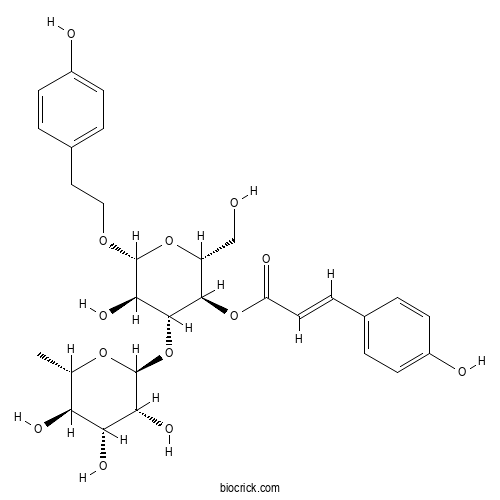
| Cas No. | 94492-23-6 | SDF | File under preparation. |
| PubChem ID | 10438425.0 | Appearance | Powder |
| Formula | C29H36O13 | M.Wt | 592.6 |
| Type of Compound | N/A | Storage | Desiccate at -20°C |
| Solubility | Soluble in Chloroform,Dichloromethane,Ethyl Acetate,DMSO,Acetone,etc. | ||
| Chemical Name | [(2R,3R,4R,5R,6R)-5-hydroxy-2-(hydroxymethyl)-6-[2-(4-hydroxyphenyl)ethoxy]-4-[(2S,3R,4R,5R,6S)-3,4,5-trihydroxy-6-methyloxan-2-yl]oxyoxan-3-yl] (E)-3-(4-hydroxyphenyl)prop-2-enoate | ||
| SMILES | CC1C(C(C(C(O1)OC2C(C(OC(C2OC(=O)C=CC3=CC=C(C=C3)O)CO)OCCC4=CC=C(C=C4)O)O)O)O)O | ||
| Standard InChIKey | PRTREKIVGSNQRM-DQHNYDBYSA-N | ||
| Standard InChI | InChI=1S/C29H36O13/c1-15-22(34)23(35)24(36)29(39-15)42-27-25(37)28(38-13-12-17-4-9-19(32)10-5-17)40-20(14-30)26(27)41-21(33)11-6-16-2-7-18(31)8-3-16/h2-11,15,20,22-32,34-37H,12-14H2,1H3/b11-6+/t15-,20+,22-,23+,24+,25+,26+,27+,28+,29-/m0/s1 | ||
| General tips | For obtaining a higher solubility , please warm the tube at 37 ℃ and shake it in the ultrasonic bath for a while.Stock solution can be stored below -20℃ for several months. We recommend that you prepare and use the solution on the same day. However, if the test schedule requires, the stock solutions can be prepared in advance, and the stock solution must be sealed and stored below -20℃. In general, the stock solution can be kept for several months. Before use, we recommend that you leave the vial at room temperature for at least an hour before opening it. |
||
| About Packaging | 1. The packaging of the product may be reversed during transportation, cause the high purity compounds to adhere to the neck or cap of the vial.Take the vail out of its packaging and shake gently until the compounds fall to the bottom of the vial. 2. For liquid products, please centrifuge at 500xg to gather the liquid to the bottom of the vial. 3. Try to avoid loss or contamination during the experiment. |
||
| Shipping Condition | Packaging according to customer requirements(5mg, 10mg, 20mg and more). Ship via FedEx, DHL, UPS, EMS or other couriers with RT, or blue ice upon request. | ||
Quality Control & MSDS
3D structure
Package In Stock

Number of papers citing our products


Osmanthuside B Dilution Calculator
Osmanthuside B Molarity Calculator
-
 Ligupurpuroside BCatalog No.: BCC8199CAS No.: 147396-02-9
-
 Cis-Ligupurpuroside BCatalog No.: BCX0764CAS No.: 350588-96-4
-
 Ligurobustoside NCatalog No.: BCN0965CAS No.: 583058-07-5
-
 ActeosideCatalog No.: BCN4136CAS No.: 61276-17-3
-
 Jionoside CCatalog No.: BCN0927CAS No.: 120406-33-9
-
 Ligupurpuroside ACatalog No.: BCC8198CAS No.: 147396-01-8
-
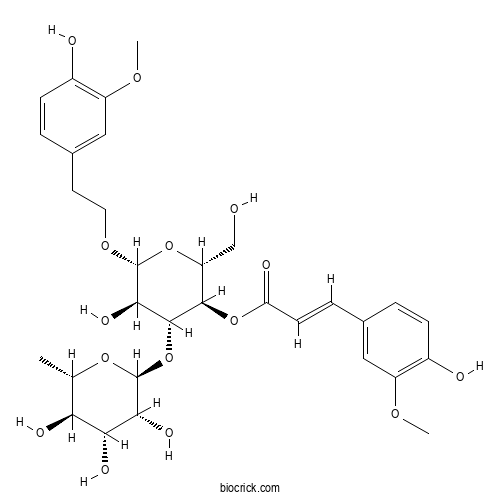 Cistanoside DCatalog No.: BCX2904CAS No.: 94492-21-4
-
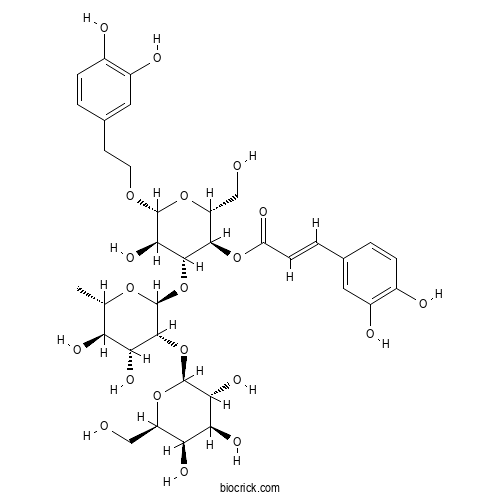 TeupoliosideCatalog No.: BCN9833CAS No.: 143617-02-1
-
 Leucosceptoside ACatalog No.: BCN7457CAS No.: 83529-62-8
-
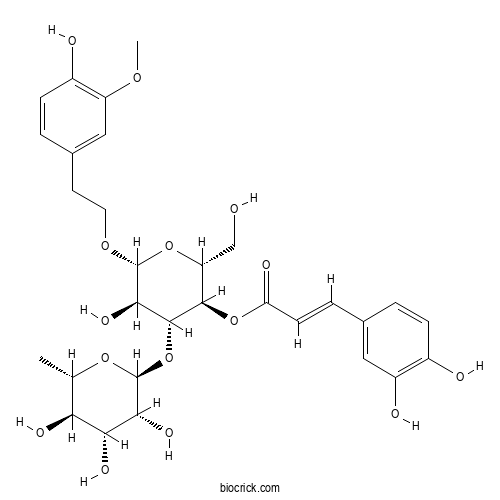 Cistanoside CCatalog No.: BCX2837CAS No.: 94492-22-5
-
 BrachynosideCatalog No.: BCN3749CAS No.: 145898-87-9
-
 MartynosideCatalog No.: BCN4236CAS No.: 67884-12-2
-
 Jionoside DCatalog No.: BCN8575CAS No.: 120406-34-0
-
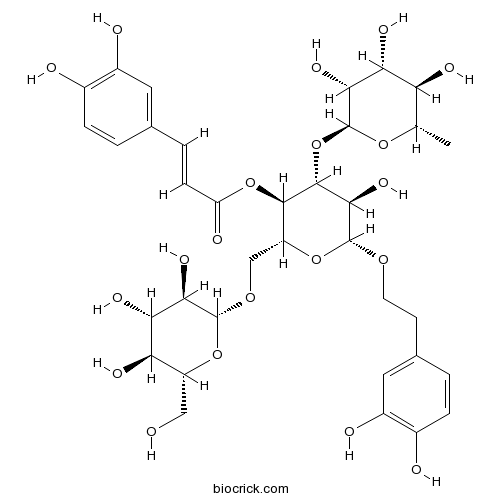 EchinacosideCatalog No.: BCN4953CAS No.: 82854-37-3
-
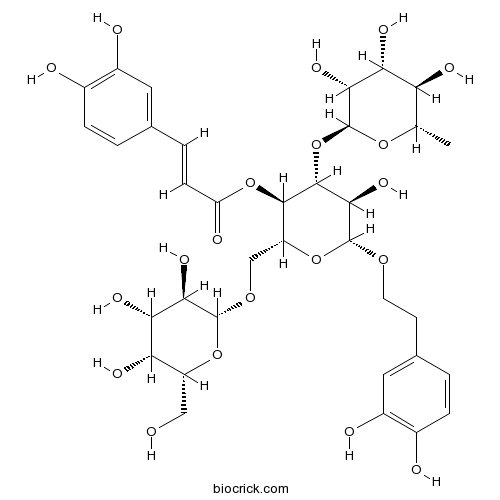 Purpureaside CCatalog No.: BCN3865CAS No.: 108648-07-3
-
 Purpureaside BCatalog No.: BCN0926CAS No.: 104777-69-7
-
 Ligupurpuroside CCatalog No.: BCN8583CAS No.: 1194056-33-1
-
 PoliumosideCatalog No.: BCN1204CAS No.: 94079-81-9
| 1 mg | 5 mg | 10 mg | 20 mg | 25 mg | |
| 1 mM | 1.6875 mL | 8.4374 mL | 16.8748 mL | 33.7496 mL | 42.187 mL |
| 5 mM | 0.3375 mL | 1.6875 mL | 3.375 mL | 6.7499 mL | 8.4374 mL |
| 10 mM | 0.1687 mL | 0.8437 mL | 1.6875 mL | 3.375 mL | 4.2187 mL |
| 50 mM | 0.0337 mL | 0.1687 mL | 0.3375 mL | 0.675 mL | 0.8437 mL |
| 100 mM | 0.0169 mL | 0.0844 mL | 0.1687 mL | 0.3375 mL | 0.4219 mL |
| * Note: If you are in the process of experiment, it's necessary to make the dilution ratios of the samples. The dilution data above is only for reference. Normally, it's can get a better solubility within lower of Concentrations. | |||||
- Podoverine A
Catalog No.:BCX2908
CAS No.:107882-43-9
- Benzoic acid,2-(5,10-dihydro-2,3,7,8-tetrahydroxy...
Catalog No.:BCX2907
CAS No.:103744-88-3
- Bacogenin A4 (Ebelinlacton)
Catalog No.:BCX2906
CAS No.:3649-76-1
- Feruloylputrescine
Catalog No.:BCX2905
CAS No.:501-13-3
- Cistanoside D
Catalog No.:BCX2904
CAS No.:94492-21-4
- 4-Hepten-3-one, 1,7-diphenyl-, (4E)-
Catalog No.:BCX2903
CAS No.:170033-27-9
- 4-Hepten-3-one, 7-(4-hydroxy-3-methoxyphenyl)-1-phenyl-, (4E)
Catalog No.:BCX2902
CAS No.:478314-07-7
- 5-hydroxy-1,7-diphenyl-3-heptanone
Catalog No.:BCX2901
CAS No.:55836-43-6
- Cimiciphenone
Catalog No.:BCX2900
CAS No.:863604-14-2
- Castacrenin C
Catalog No.:BCX2899
CAS No.:173450-72-1
- Castacrenin B
Catalog No.:BCX2898
CAS No.:173429-80-6
- Castacrenin A
Catalog No.:BCX2897
CAS No.:173429-79-3
- Benzoic acid,2-[(5,10-dihydro-3,7,8-trihydroxy-5,10-dioxo...
Catalog No.:BCX2910
CAS No.:60202-70-2
- 3'-O-Methylhesperidin
Catalog No.:BCX2251
CAS No.:28034-80-2
- Lyxose
Catalog No.:BCX2252
CAS No.:65-42-9
- 3''-Hydroxypyrrolezanthine
Catalog No.:BCX2253
CAS No.:2647391-04-4
- Scinamine C
Catalog No.:BCX2254
CAS No.:2184979-75-5
- Coniferyl acetate
Catalog No.:BCX2255
CAS No.:94930-81-1
- Tryptamine
Catalog No.:BCX2256
CAS No.:61-54-1
- Benzil
Catalog No.:BCX2257
CAS No.:134-81-6
- Lobetyolin
Catalog No.:BCX2258
CAS No.:129277-38-9
- 4-(2-(Carboxymethyl)-3,5-dihydroxyphenoxy)benzoic acid
Catalog No.:BCX2259
CAS No.:2193189-82-9
- 4,5-Di-O-caffeoylquinic acid
Catalog No.:BCX2260
CAS No.:89886-30-6
- Malic acid
Catalog No.:BCX2261
CAS No.:636-61-3
[Chemical constituents of leaves of Diospyros kaki (Ⅲ)].[Pubmed:41814695]
Zhongguo Zhong Yao Za Zhi. 2025 Dec;50(24):6868-6875.
Diospyros kaki leaves were separated and purified using various chromatographic methods, including polyamide chromatography, microporous resin(MCI) chromatography, C_(18) reversed-phase chromatography, and silica gel column chromatography. The isolated compounds were identified through spectral data analysis and comparison with literature. Ten monomeric compounds were obtained from D. kaki leaves:(Z)-hex-3-en-1-ol-(alpha-L-rhamnopyranosyl)-(1-->3)-(4-O-trans-p-coumaroyl)-beta-D-glucopyranoside(1), benzyl 2-O-beta-glucopyranosyl-2,6-dihydroxybenzoate(2), ligurobustoside C(3), eugenol-O-beta-glucopyranoside(4), Osmanthuside B_6(5), beta-(p-hydroxyphenyl)ethyl-O-alpha-L-rhamnopyranosyl-(1-->3)-6-O-cis-p-coumaroyl-beta-D-glucopyranpside(6), eugenol-beta-rutinoside(7), amarusine A(8), osmanthuside D(9), and Osmanthuside B(10). Among them, compound 1 is a new compound, while compounds 2-10 were isolated from this plant for the first time. The antioxidant activities of the compounds were evaluated by DPPH and ABTS radical scavenging assays, with water-soluble vitamin E as the positive control. The IC_(50) values of compounds 2, 3, and 5 for ABTS radical scavenging were 8.2, 5.7, and 9.9 mug.mL~(-1), respectively, which were comparable to that of the positive control(5.9 mug.mL~(-1)), indicating that compounds 2, 3, and 5 possess strong antioxidant activity.
Structural insights into the catalytic mechanism of the phenylethanoid glycoside rhamnosyltransferase UGT79G15 from Rehmannia glutinosa.[Pubmed:41013894]
Plant Commun. 2025 Dec 8;6(12):101539.
Phenylethanoid glycosides (PhGs) are a group of important natural products widely distributed in medicinal plants and known for their remarkable pharmacological properties. Uridine diphosphate (UDP) glycosyltransferase 79G15 (UGT79G15) from Rehmannia glutinosa catalyzes the conversion of osmanthuside A to Osmanthuside B, a key intermediate in the PhG biosynthetic pathway, through the formation of a (1-->3) glycosidic bond. In this study, we present the crystal structures of UGT79G15 in its apo form, UDP-bound form, and, notably, its ternary complex containing UDP and a mimic acceptor, forsythiaside A, within its active site. Structural and comparative analyses revealed that UGT79G15 possesses a distinctive funnel-shaped acceptor-binding pocket with a small auxiliary cavity capable of accommodating the 4'-hydroxycinnamoyl group of PhGs, explaining the enzyme's regiospecificity toward the 3'-OH of the acceptor. Additional structural examination and site-directed mutagenesis identified key residues that recognize and stabilize UDP-rhamnose and the sugar acceptor. Among the variants generated, I204W exhibits enhanced catalytic efficiency for osmanthuside A conversion, reaching up to 2.2-fold higher activity than the wild type. This study provides mechanistic insight into the donor specificity and acceptor regioselectivity of PhG 1,3-rhamnosyltransferase and expands the structural understanding of plant UGTs.
High-level sustainable production of complex phenylethanoid glycosides from glucose through engineered yeast cell factories.[Pubmed:39603334]
Metab Eng. 2025 Jan;87:95-108.
Complex phenylethanoid glycosides (PhGs), such as verbascoside and echinacoside, comprise a vital family of natural products with renowned nutraceutical and pharmaceutical signi fi cance. Despite the high demand for these compounds across various industries, traditional plant extraction methods yield insufficient quantities, highlighting the need for alternative production methods. Therefore, this paper reports the successful engineering of Saccharomyces cerevisiae cell factories for the ef fi cient production of complex PhGs from glucose. First, key pathway enzymes with enhanced catalytic activities in yeast were primarily screened from various verbascoside-producing plants. Second, intermediate Osmanthuside B was produced with a titer of 21.5 +/- 1.5 mg/L from glucose by overexpressing several enzymes, including glucosyltransferase RrUGT33 from Rhdiola rosea, acyltransferase SiAT, and 1,3-rhamnosyltransferase SiRT from Sesamum indicum, UDP-L-rhamnose synthase AtRHM2, and 4-coumarate: coenzyme A ligase At4CL1 from Arabidopsis thaliana in a p-coumaric acid-overproducing S. cerevisiae strain. Third, the production of Osmanthuside B was further enhanced by increasing the copy number of SiAT and AtRHM2 in genome and diverting L-tyrosine into tyrosol biosynthesis by introducing an aromatic aldehyde synthase PcAAS from Petroselinum crispum with a titer of 320.6 +/- 59.3 mg/L. Fourth, the biosynthesis of verbascoside was accomplished by integrating genes CYP98A20 and AtCPR1 into the chromosomes of the Osmanthuside B-producing strain, the titer reached 184.7 +/- 5.7 mg/L. Furthermore, the overexpression of the glucose-6-phosphate dehydrogenase (ZWF1) led to significantly enhanced verbascoside production to 230.6 +/- 11.8 mg/L. The strains were further engineered to produce echinacoside with a titer of 184.2 +/- 11.2 mg/L. Finally, the fed-batch fermentation in a 5-L bioreactor yielded 4497.9 +/- 285.2 mg/L of verbascoside or 3617.4 +/- 117.4 mg/L of echinacoside. This work provides a crucial foundation for the green, industrial, and sustainable production of verbascoside and echinacoside and sets an initial point for the microbial production of other complex PhG derivatives.
Functional characterization of polyphenol oxidase OfPPO2 supports its involvement in parallel biosynthetic pathways of acteoside.[Pubmed:38872484]
Plant J. 2024 Jul;119(2):927-941.
Acteoside is a bioactive phenylethanoid glycoside widely distributed throughout the plant kingdom. Because of its two catechol moieties, acteoside displays a variety of beneficial activities. The biosynthetic pathway of acteoside has been largely elucidated, but the assembly logic of two catechol moieties in acteoside remains unclear. Here, we identified a novel polyphenol oxidase OfPPO2 from Osmanthus fragrans, which could hydroxylate various monophenolic substrates, including tyrosine, tyrosol, tyramine, 4-hydroxyphenylacetaldehyde, salidroside, and osmanthuside A, leading to the formation of corresponding catechol-containing intermediates for acteoside biosynthesis. OfPPO2 could also convert Osmanthuside B into acteoside, creating catechol moieties directly via post-modification of the acteoside skeleton. The reverse transcription-quantitative polymerase chain reaction (RT-qPCR) analysis and subcellular localization assay further support the involvement of OfPPO2 in acteoside biosynthesis in planta. These findings suggest that the biosynthesis of acteoside in O. fragrans may follow "parallel routes" rather than the conventionally considered linear route. In support of this hypothesis, the glycosyltransferase OfUGT and the acyltransferase OfAT could direct the flux of diphenolic intermediates generated by OfPPO2 into acteoside. Significantly, OfPPO2 and its orthologs constitute a functionally conserved enzyme family that evolved independently from other known biosynthetic enzymes of acteoside, implying that the substrate promiscuity of this PPO family may offer acteoside-producing plants alternative ways to synthesize acteoside. Overall, this work expands our understanding of parallel pathways plants may employ to efficiently synthesize acteoside, a strategy that may contribute to plants' adaptation to environmental challenges.
Complete biosynthesis of the phenylethanoid glycoside verbascoside.[Pubmed:36935606]
Plant Commun. 2023 Jul 10;4(4):100592.
Verbascoside, which was first discovered in 1963, is a well-known phenylethanoid glycoside (PhG) that exhibits antioxidant, anti-inflammatory, antimicrobial, and neuroprotective activities and contributes to the therapeutic effects of many medicinal plants. However, the biosynthetic pathway of verbascoside remains to be fully elucidated. Here, we report the identification of two missing enzymes in the verbascoside biosynthesis pathway by transcriptome mining and in vitro enzymatic assays. Specifically, a BAHD acyltransferase (hydroxycinnamoyl-CoA:salidroside hydroxycinnamoyltransferase [SHCT]) was shown to catalyze the regioselective acylation of salidroside to form osmanthuside A, and a CYP98 hydroxylase (Osmanthuside B 3,3'-hydroxylase [OBH]) was shown to catalyze meta-hydroxylations of the p-coumaroyl and tyrosol moieties of Osmanthuside B to complete the biosynthesis of verbascoside. Because SHCTs and OBHs are found in many Lamiales species that produce verbascoside, this pathway may be general. The findings from the study provide novel insights into the formation of caffeoyl and hydroxytyrosol moieties in natural product biosynthetic pathways. In addition, with the newly acquired enzymes, we achieved heterologous production of Osmanthuside B, verbascoside, and ligupurpuroside B in Escherichia coli; this work lays a foundation for sustainable production of verbascoside and other PhGs in micro-organisms.
Phenylethanoid and Phenylmethanoid Glycosides from the Leaves of Ligustrum robustum and Their Bioactivities.[Pubmed:36364215]
Molecules. 2022 Oct 31;27(21):7390.
The phytochemical study on the leaves of Ligustrum robustum, which have been used as Ku-Ding-Cha, led to the isolation and identification of three new phenylethanoid glycosides and three new phenylmethanoid glycosides, named ligurobustosides R(1) (1b), R(2-3) (2), R(4) (3), S(1) (4b), S(2) (5), and S(3) (6), and five reported phenylethanoid glycosides (7-11). In the bioactivity test, (Z)-Osmanthuside B(6) (11) displayed strong fatty acid synthase (FAS) inhibitory activity (IC(50): 4.55 +/- 0.35 muM) as the positive control orlistat (IC(50): 4.46 +/- 0.13 muM), while ligurobustosides R(4) (3) and S(2) (5), ligupurpuroside B (7), cis-ligupurpuroside B (8), ligurobustoside N (9), osmanthuside D (10), and (Z)-Osmanthuside B(6) (11) showed stronger ABTS radical scavenging activity (IC(50): 2.68 +/- 0.05~4.86 +/- 0.06 muM) than the positive control L-(+)-ascorbic acid (IC(50): 10.06 +/- 0.19 muM). This research provided a theoretical basis for the leaves of L. robustum as a tea with function in treating obesity and diabetes.
Discovery of Glycosyltransferases Involved in the Biosynthesis of Ligupurpuroside B.[Pubmed:34609151]
Org Lett. 2021 Oct 15;23(20):7851-7854.
In this study, we report the characterization of three glycosyltransferases involved in the biosynthesis of ligupurpuroside B, a complex acylated phenolic glycoside in Ligustrum robustum. UGT85AF8 catalyzed the formation of salidroside from tyrosol. UGT79G7, an osmanthuside A 1,3-rhamnosyltransferase, and UGT79A19, an Osmanthuside B 1,4-rhamnosyltransferase, sequentially converted osmanthuside A into ligupurpuroside B. Orthologs of UGT79G7 were also discovered from other plants producing verbascoside. These rhamnosyltransferases expand the toolbox for the biosynthesis of natural products with various sugar chains.
The Difference of Chemical Components and Biological Activities of the Raw Products slices and the Wine Steam-Processed Product from Cistanche deserticola.[Pubmed:31007699]
Evid Based Complement Alternat Med. 2019 Mar 17;2019:2167947.
As a well-known Chinese herb medicine, the Cistanche deserticola has been used for the treatment of kidney deficiency syndrome in China for thousands of years. Both the raw product of Cistanche deserticola slices (RCD) and its Wine Steam-Processed Product (WSCD) are used clinically for different effects. In this study, the influences of steaming process with wine (SPW) from Cistanche deserticola on chemical compositions and biological effects were investigated. The principal component analysis (PCA) and quantitative analysis were used to study the differences of the chemical compositions. The effects of nourishing kidney were also investigated to compare the differences between the RCD and the WSCD. The PCA results indicated that the obvious separation was achieved in the RCD and WSCD. The results of quantitative analysis showed that the WSCD has higher amounts of total polysaccharides, total PhGs, isoacteoside, and Osmanthuside B than RCD, while the content of 2'-acetylacteoside and acteoside decreased after the SPW. The comparison of RCD and WSCD on biological activities showed that both could restore the level of sex hormone in the model of kidney-yang deficiency and improve the antioxidant effect. The WSCD were much better in increasing the viscera weight of kidney and seminal vesicle. The results indicated that SPW changed its chemical components and enhanced its biological activities.
Characterization of binding interactions between selected phenylpropanoid glycosides and trypsin.[Pubmed:29146317]
Food Chem. 2018 Mar 15;243:118-124.
Phenylpropanoid glycosides (PPGs) are important bioactive polyphenolic compounds that are widely distributed in plants. In this paper, the inhibitory effects of four selected PPGs against trypsin were investigated. The interactions between these PPGs and trypsin were further investigated by multiple spectroscopic methods and molecular docking studies. The results showed that the binding of each of these PPGs to trypsin induced changes in the natural conformation of trypsin, which inhibited the enzyme in the following order: acteoside>syringalide A 3'-alpha-l-rhamnopyranoside>lipedoside A-I>Osmanthuside B. The binding constant (K(a)) values followed the same trend. The hydrogen bond force played an important role in the interaction between each PPG and trypsin. Interestingly, the binding affinity and inhibitory effect increased as the number of phenolic hydroxyl groups increased. In addition, the effect of the phenolic hydroxyl group on the A ring had a greater effect than one on the B ring.

Calcutta University

University of Minnesota

University of Maryland School of Medicine

University of Illinois at Chicago

The Ohio State University

University of Zurich

Harvard University

Colorado State University

Auburn University

Yale University

Worcester Polytechnic Institute

Washington State University

Stanford University

University of Leipzig

Universidade da Beira Interior

The Institute of Cancer Research

Heidelberg University

University of Amsterdam

University of Auckland

TsingHua University

The University of Michigan

Miami University

DRURY University

Jilin University

Fudan University

Wuhan University

Sun Yat-sen University

Universite de Paris

Deemed University

Auckland University

The University of Tokyo

Korea University



