
Cistanoside CCAS# 94492-22-5 |
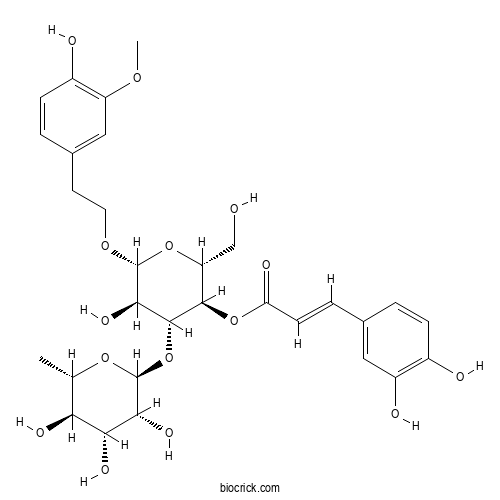
| Cas No. | 94492-22-5 | SDF | File under preparation. |
| PubChem ID | 5315929.0 | Appearance | Powder |
| Formula | C30H38O15 | M.Wt | 638.6 |
| Type of Compound | Simple Phenolic Compounds | Storage | Desiccate at -20°C |
| Solubility | Soluble in Chloroform,Dichloromethane,Ethyl Acetate,DMSO,Acetone,etc. | ||
| Chemical Name | [(2R,3R,4R,5R,6R)-5-hydroxy-6-[2-(4-hydroxy-3-methoxyphenyl)ethoxy]-2-(hydroxymethyl)-4-[(2S,3R,4R,5R,6S)-3,4,5-trihydroxy-6-methyloxan-2-yl]oxyoxan-3-yl] (E)-3-(3,4-dihydroxyphenyl)prop-2-enoate | ||
| SMILES | CC1C(C(C(C(O1)OC2C(C(OC(C2OC(=O)C=CC3=CC(=C(C=C3)O)O)CO)OCCC4=CC(=C(C=C4)O)OC)O)O)O)O | ||
| Standard InChIKey | SUNMCVVGOLDIKD-CPPDSBOHSA-N | ||
| Standard InChI | InChI=1S/C30H38O15/c1-14-23(36)24(37)25(38)30(42-14)45-28-26(39)29(41-10-9-16-4-7-18(33)20(12-16)40-2)43-21(13-31)27(28)44-22(35)8-5-15-3-6-17(32)19(34)11-15/h3-8,11-12,14,21,23-34,36-39H,9-10,13H2,1-2H3/b8-5+/t14-,21+,23-,24+,25+,26+,27+,28+,29+,30-/m0/s1 | ||
| General tips | For obtaining a higher solubility , please warm the tube at 37 ℃ and shake it in the ultrasonic bath for a while.Stock solution can be stored below -20℃ for several months. We recommend that you prepare and use the solution on the same day. However, if the test schedule requires, the stock solutions can be prepared in advance, and the stock solution must be sealed and stored below -20℃. In general, the stock solution can be kept for several months. Before use, we recommend that you leave the vial at room temperature for at least an hour before opening it. |
||
| About Packaging | 1. The packaging of the product may be reversed during transportation, cause the high purity compounds to adhere to the neck or cap of the vial.Take the vail out of its packaging and shake gently until the compounds fall to the bottom of the vial. 2. For liquid products, please centrifuge at 500xg to gather the liquid to the bottom of the vial. 3. Try to avoid loss or contamination during the experiment. |
||
| Shipping Condition | Packaging according to customer requirements(5mg, 10mg, 20mg and more). Ship via FedEx, DHL, UPS, EMS or other couriers with RT, or blue ice upon request. | ||
Quality Control & MSDS
3D structure
Package In Stock

Number of papers citing our products


Cistanoside C Dilution Calculator
Cistanoside C Molarity Calculator
| 1 mg | 5 mg | 10 mg | 20 mg | 25 mg | |
| 1 mM | 1.5659 mL | 7.8296 mL | 15.6593 mL | 31.3185 mL | 39.1481 mL |
| 5 mM | 0.3132 mL | 1.5659 mL | 3.1319 mL | 6.2637 mL | 7.8296 mL |
| 10 mM | 0.1566 mL | 0.783 mL | 1.5659 mL | 3.1319 mL | 3.9148 mL |
| 50 mM | 0.0313 mL | 0.1566 mL | 0.3132 mL | 0.6264 mL | 0.783 mL |
| 100 mM | 0.0157 mL | 0.0783 mL | 0.1566 mL | 0.3132 mL | 0.3915 mL |
| * Note: If you are in the process of experiment, it's necessary to make the dilution ratios of the samples. The dilution data above is only for reference. Normally, it's can get a better solubility within lower of Concentrations. | |||||
- (7S)-Hellicoside
Catalog No.:BCX2836
CAS No.:132278-04-7
- 3-Butylidene-7-hydroxyphthalide
Catalog No.:BCX2835
CAS No.:93236-67-0
- Molephantinin
Catalog No.:BCX2834
CAS No.:56221-98-8
- Molephantin
Catalog No.:BCX2833
CAS No.:50656-66-1
- Trans-resveratrol-3-O-β-D-glucuronide
Catalog No.:BCX2832
CAS No.:387372-17-0
- Esculentoside F
Catalog No.:BCX2831
CAS No.:95263-31-3
- Rorifone
Catalog No.:BCX2830
CAS No.:53078-90-3
- (+)-(R)-Ribalinine
Catalog No.:BCX2829
CAS No.:62928-56-7
- Parthenin
Catalog No.:BCX2828
CAS No.:508-59-8
- Protodioscin
Catalog No.:BCX2827
CAS No.:60478-69-5
- Dihydrochelirubine
Catalog No.:BCX2826
CAS No.:28342-26-9
- Evodiamide
Catalog No.:BCX2825
CAS No.:116965-70-9
- β-Curcumene
Catalog No.:BCX2838
CAS No.:451-56-9
- (E)-Ligustilide
Catalog No.:BCX2839
CAS No.:81944-08-3
- Apigenin-7-O-(6′′-E-p-coumaroyl-β-D-glucopyranoside)
Catalog No.:BCX2840
CAS No.:105815-90-5
- Xanthalin
Catalog No.:BCX2841
CAS No.:21800-48-6
- Benzyl β-gentiobioside
Catalog No.:BCX2842
CAS No.:56775-64-5
- Amygdalinic acid
Catalog No.:BCX2843
CAS No.:66427-92-7
- 1,2-Dilinoleoyl-3-palmitin
Catalog No.:BCX2844
CAS No.:2190-15-0
- Acanthoic acid
Catalog No.:BCX2845
CAS No.:119290-87-8
- Penicillide
Catalog No.:BCX2846
CAS No.:55303-92-9
- Gingerglycolipid B
Catalog No.:BCX2847
CAS No.:88168-90-5
- Atractylodinol
Catalog No.:BCX2848
CAS No.:61642-89-5
- Dendronobiloside A
Catalog No.:BCX2849
CAS No.:370557-49-6
Chemical profiles and metabolite study of raw and processed Cistanche deserticola in rats by UPLC-Q-TOF-MS(E).[Pubmed:34583715]
Chin Med. 2021 Sep 28;16(1):95.
BACKGROUND: Chinese materia medica processing is a distinguished and unique pharmaceutical technique in Traditional Chinese Medicine (TCM) used for reducing side effects, and increasing or even changing therapeutic efficacy of the raw herbs.Changes in the essential components induced by an optimized processing procedure are primarily responsible for the increased efficacy of medicinal plants.The kidney-yang invigorating effect of rice wine-steamed Cistancha deserticola (C. deserticola) was stronger than raw C. deserticola (CD). METHODS: A comparison analysis was carried out using the UPLC-Q-TOF-MS(E) with the UNIFI informatics platform to determine the influence of processing. In vitro studies were performed for the characterization of constituents as well as metabolites in vivo. The chemical components were determined in CD and its processed products. The multivariate statistical analyses were conducted to evaluate variations between them while OPLS-DA was used for pairwise comparison. RESULTS: The results of this study revealed considerable variations in phenylethanoid glycosides (PhGs) and iridoids after processing. A total of 97 compounds were detected in the extracts of CD and its processed product. PhGs having 4'-O-caffeoyl group in the 8-O-beta-D-glucopyranosyl part, like acteoside, Cistanoside C, campneoside II, osmanthuside decreased after being processed, while PhGs with 6'-O-caffeoyl group in the 8-O-beta-D-glucopyranosyl part, such as isoacetoside, isoCistanoside C, isocampneoside I, isomartynoside increased, especially in the CD-NP group. The intensity of echinacoside and cistanoside B whose structure possess 6'-O-beta-D-glucopyranosyl moiety also increased. In in vivo study, 10 prototype components and 44 metabolites were detected in rat plasma, feces, and urine. The obtained results revealed that processing leads to the considerable variation in the chemical constituents of CD and affected the disposition of the compounds in vivo, and phase II metabolic processes are the key cascades of each compound and most of the metabolites are associated with echinacoside or acteoside. CONCLUSIONS: This is the first global comparison research of raw and processed CD. These findings add to our understanding of the impact of CD processing and give important data for future efficacy investigations.
Localization of constituents for determining the age and parts of ginseng through ultraperfomance liquid chromatography quadrupole/time of flight-mass spectrometry combined with desorption electrospray ionization mass spectrometry imaging.[Pubmed:33171337]
J Pharm Biomed Anal. 2021 Jan 30;193:113722.
Ginseng has been used for prevention and treatment of disease for thousands of years in China and many other Asian countries. Phytochemical studies have indicated that ginsenosides, polysaccharides, alkaloids, and phenolic acids are the active constituents of ginseng. Main and branch roots of ginseng exhibit distinct bioactive behavior. Furthermore, the bioactive behavior of ginseng depends on its age. Traditional analysis is complex preparation and provides inadequate of chemical information of the original distribution of analytes. Therefore, in this study, ultraperformance liquid chromatography quadrupole/time of flight-mass spectrometry (UPLC-QTOF MS) and desorption electrospray ionization mass spectrometry imaging (DESI-MSI) combined with orthogonal partial least squares discriminant analysis were used to discriminate ginseng in different age and parts of ginseng, and profiled distribution of selected markers. The results indicated that UPLC-QTOF-MS and DESI-MSI could be used to determine the parts and age of ginseng. Fifteen variables including five of protopanaxatriol (PPT), four of protopanaxadiol (PPD), and six of other types were assumed as markers for different parts of ginseng. Moreover, four variables of PPT, four of PPD, and ten of other types were used to determine the age of ginseng samples. An analysis of localization of markers indicated that malonyl ginsenoside, including malonyl-ginsenoside Rb(1), Rb(2), Rc, and Rd was mainly distributed in the corks. Neutral ginsenoside Rg(1), yesanchinoisde D, and chikusetsusaponin Iva were mainly distributed in the cork and phloem. Non-ginsenoside castanoside H, 20(S)-protopanaxatriol, unknown 2, saponin III and Cistanoside C were distributed in all tissues. Ethyloleate, unknown 1 and monolinolein were distributed in the cork.
[Identification of Chinese Traditional Medicine Cistanches Herba from Different Places by HPLC-ESI-MS and FTIR Methods].[Pubmed:26197602]
Guang Pu Xue Yu Guang Pu Fen Xi. 2015 Apr;35(4):1056-61.
Five samples of Cistanches Herba from different places were analyzed by HPLC-ESI-MS and FTIR methods. The effective compositions in Cistanches Herba including cistanoside A, echinacoside, acteoside , isoacteoside, 2'-actylacteoside, Cistanoside C and tubluoside B were determined by HPLC-MS. The common peak ratio and variant peak ratio were calculated by FTIR spectroscopy of the five samples and the dual index sequence of common peak ratio and variant peak ratio were established. The results showed that the evaluation results of the samples by the two methods were the same. The general fake plant Cynomorii Herba could be identified by FTIR. HPLC-ESI-MS, which has high sensitivity and rapid determination procedure, can be used to evaluate quality of Cistanches Herba by quantitative analysis of the primary compositions. FTIR is a non-destructive analysis method. without complicated extraction and separation procedures to the samples. The absorption strength and the absorption shape were the synergistic effect of the functional groups and the nestification of the components in Cistanches Herba. The provided method has some advantages such as rapid analysis process, good reproducibility, non-destructive, small quantity of sample, simple treatment, good specificity, low-cost and environment-friendly. The method meets the trend of complex analysis and whole analysis for the Chinese medicines. Combination of FTIR and HPLC-ESI-MS was a good method for identification and evaluation of quality of Chinese medicines.
Chemical and genetic discrimination of Cistanches Herba based on UPLC-QTOF/MS and DNA barcoding.[Pubmed:24854031]
PLoS One. 2014 May 22;9(5):e98061.
Cistanches Herba (Rou Cong Rong), known as "Ginseng of the desert", has a striking curative effect on strength and nourishment, especially in kidney reinforcement to strengthen yang. However, the two plant origins of Cistanches Herba, Cistanche deserticola and Cistanche tubulosa, vary in terms of pharmacological action and chemical components. To discriminate the plant origin of Cistanches Herba, a combined method system of chemical and genetic--UPLC-QTOF/MS technology and DNA barcoding--were firstly employed in this study. The results indicated that three potential marker compounds (isomer of campneoside II, Cistanoside C, and cistanoside A) were obtained to discriminate the two origins by PCA and OPLS-DA analyses. DNA barcoding enabled to differentiate two origins accurately. NJ tree showed that two origins clustered into two clades. Our findings demonstrate that the two origins of Cistanches Herba possess different chemical compositions and genetic variation. This is the first reported evaluation of two origins of Cistanches Herba, and the finding will facilitate quality control and its clinical application.
Reaction of hydroxyl radical with phenylpropanoid glycoside and its derivatives by pulse radiolysis.[Pubmed:18763133]
Sci China C Life Sci. 1999 Aug;42(4):420-6.
The reaction of hydroxyl radical with 1 phenylpropanoid glycoside (PPG), Cistanoside C, and its 3 derivatives: 1-0-beta-D-2-(p-hydroxyphenyl)-ethanyl-glucose, 6-O-(E)-femloyl-glucose and 6-O-(E)-p-hydroxy-cinnarnoylglucose isolated from folk medicinal herbs was investigated by pulse radiolysis technique respectively. The reaction rate constants were determined by analysis of built-up trace of absorption at lambda(max) of specific transient absorption spectra of PPG and its derivatives upon attacking . OH. All four compounds react with . OH at close to diffusion controlled rate (1. 03 x 10(9)-19.139 x 10(9) L . mol(-1) . s(-1)), suggesting that they are effective . OH scavengers. The results demonstrated that the numbers of phenolic hydroxyl groups of PPG and its derivatives are directly related to their scavenging activities. By comparing the reaction rates of . OH with 1-O-beta-D-2-(p-hydroxyphenyl)-ethanyl-glucose, 6-O-(E)-feruloyl-glucose or 6-O-(E)-p-hydroxy-cinnomoyl-glucose, it is evident that the phenylethyl group is more impofiant than phenylacryloyl group for scavenging . OH.
[Isolation and characterization of phenylethanoid glycosides from Clerodendron bungei].[Pubmed:16268507]
Yao Xue Xue Bao. 2005 Aug;40(8):722-7.
AIM: To study the chemical constituents from Clerodendron bungei Steud. METHODS: The compounds were isolated and purified by various chromatographic techniques and identified by their physicochemical properties and spectral data. RESULTS: Ten phenylethanoid glycosides were isolated and identified as clerodendronoside (1), acteoside (2), isoacteoside (3), Cistanoside C (4), jionoside C (5), leucosceptoside A (6), cistanoside D (7), campneoside I (8), campneoside II (9), cistanoside F (10). CONCLUSION: Compound 1 is a new phenylethanoid glycoside, while compounds 4-10 are obtained from this plant for the first time.
Fast repair of the poly G hydroxyl radical adduct by two phenylpropanoid glycosides.[Pubmed:14531467]
Pharmazie. 2003 Sep;58(9):664-7.
The repair activities and the reaction mechanisms of two phenylpropanoid glycosides (PPGs), isolated from a herb used in Chinese folk medicine, towards the oxidizing hydroxyl radical adduct of poly G were studied with a pulse radiolytic technique. On pulse irradiation of a nitrous oxide saturated 4 mM aqueous solution of poly G containing one of the tested compounds, the transient absorption spectrum of the hydroxyl radical adduct of poly G decays with the formation of that of the phenoxyl radical of the tested compound within several tens microseconds after the electron pulse irradiation. The results indicated that there was a repair reaction between the hydroxyl radical adduct of poly G and the compounds tested. The rate constants for the repair reactions of poly G hydroxyl radical adducts by verbasicoside and Cistanoside C were determined to be 1.4 and 1.0 x 10(9) M(-1) x s(-1), respectively.
Docking study of cistanoside C to telomeric DNA fragment.[Pubmed:12570045]
SAR QSAR Environ Res. 2002 Dec;13(7-8):675-88.
Experiments show that the natural products phenyl propanoid glycosides (PPGs) extracted from the plant Pedicularis spicata are capable of repairing DNA damaged by oxygen radicals. Based on kinetic measurements and experiments on tumor cells, a theoretical study of the interaction between PPG molecule Cistanoside C and telomeric DNA fragment has been carried out. The docking calculations performed using JUMNA software showed that the Cistanoside C could be docked into the minor groove of telomeric DNA and form complexes with the geometry suitable for an electron transfer between guanine radical and the ligand. Such complexes can be formed without major distortions of DNA structure and are further stabilized by the interaction with the saccharide side-groups.
Theoretical study of fast repair of DNA damage by cistanoside C and analogs: mechanism and docking.[Pubmed:12071653]
SAR QSAR Environ Res. 2002 Mar;13(2):243-60.
Experiments show that the natural substances phenylpropanoid glycosides (PPGs) extracted from pelicularis spicata are capable of repairing DNA damaged by oxygen radicals. Based on kinetic measurements and experiments on tumor cells, a theoretical study of the interaction between PPG molecules and isolated DNA bases, as well as a DNA fragment has been performed. An interaction mechanism reported early has been refined. The docking calculations performed using junction minimization of nucleic acids (JUMNA) software showed that the PPG molecules can be docked into the minor groove of DNA and form complexes with the geometry suitable for an electron transfer between guanine radical and the ligand. Such complexes can be formed without major distortions of DNA structure and are further stabilized by the interaction with the rhamnosyl side-groups.
Phenylpropanoid and iridoid glycosides from Pedicularis lasiophrys.[Pubmed:1367881]
Phytochemistry. 1992 Jan;31(1):263-6.
Two new compounds, pedicularioside E and F, were isolated from whole plants of Pedicularis lasiophrys, along with the four known compounds, verbascoside, Cistanoside C, cistanoside D and 8-epiloganin. On the basis of spectral and chemical evidence, pedicularioside E and F were identified to be 1'-O-beta-D-(3-methoxy-4-hydroxy-beta-phenyl)-ethyl-6'-O-feruloyl- alpha-L-(2-acetyl)-rhamnosyl-(1----3')-4'-acetylglucopyranoside and shanzhisin methyl ester cellobioside, respectively.

Calcutta University

University of Minnesota

University of Maryland School of Medicine

University of Illinois at Chicago

The Ohio State University

University of Zurich

Harvard University

Colorado State University

Auburn University

Yale University

Worcester Polytechnic Institute

Washington State University

Stanford University

University of Leipzig

Universidade da Beira Interior

The Institute of Cancer Research

Heidelberg University

University of Amsterdam

University of Auckland

TsingHua University

The University of Michigan

Miami University

DRURY University

Jilin University

Fudan University

Wuhan University

Sun Yat-sen University

Universite de Paris

Deemed University

Auckland University

The University of Tokyo

Korea University



