
Dendronobiloside ACAS# 370557-49-6 |
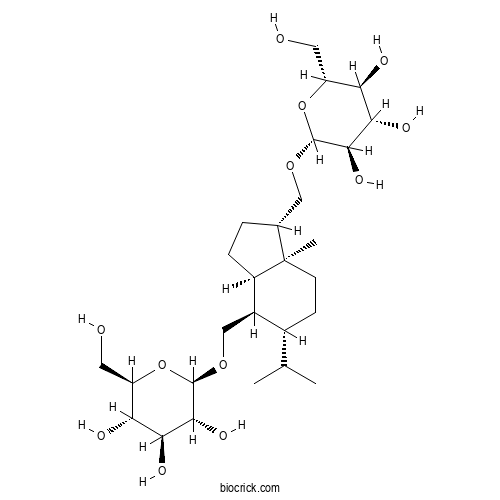
| Cas No. | 370557-49-6 | SDF | File under preparation. |
| PubChem ID | 10030799.0 | Appearance | Powder |
| Formula | C27H48O12 | M.Wt | 564.7 |
| Type of Compound | Sesquiterpenoids | Storage | Desiccate at -20°C |
| Solubility | Soluble in Chloroform,Dichloromethane,Ethyl Acetate,DMSO,Acetone,etc. | ||
| Chemical Name | (2R,3R,4S,5S,6R)-2-[[(1S,3aR,4R,5R,7aS)-7a-methyl-5-propan-2-yl-4-[[(2R,3R,4S,5S,6R)-3,4,5-trihydroxy-6-(hydroxymethyl)oxan-2-yl]oxymethyl]-1,2,3,3a,4,5,6,7-octahydroinden-1-yl]methoxy]-6-(hydroxymethyl)oxane-3,4,5-triol | ||
| SMILES | CC(C)C1CCC2(C(CCC2C1COC3C(C(C(C(O3)CO)O)O)O)COC4C(C(C(C(O4)CO)O)O)O)C | ||
| Standard InChIKey | BZZQPBIRQSCVAL-QSTLOTDISA-N | ||
| Standard InChI | InChI=1S/C27H48O12/c1-12(2)14-6-7-27(3)13(10-36-25-23(34)21(32)19(30)17(8-28)38-25)4-5-16(27)15(14)11-37-26-24(35)22(33)20(31)18(9-29)39-26/h12-26,28-35H,4-11H2,1-3H3/t13-,14-,15-,16-,17-,18-,19-,20-,21+,22+,23-,24-,25-,26-,27-/m1/s1 | ||
| General tips | For obtaining a higher solubility , please warm the tube at 37 ℃ and shake it in the ultrasonic bath for a while.Stock solution can be stored below -20℃ for several months. We recommend that you prepare and use the solution on the same day. However, if the test schedule requires, the stock solutions can be prepared in advance, and the stock solution must be sealed and stored below -20℃. In general, the stock solution can be kept for several months. Before use, we recommend that you leave the vial at room temperature for at least an hour before opening it. |
||
| About Packaging | 1. The packaging of the product may be reversed during transportation, cause the high purity compounds to adhere to the neck or cap of the vial.Take the vail out of its packaging and shake gently until the compounds fall to the bottom of the vial. 2. For liquid products, please centrifuge at 500xg to gather the liquid to the bottom of the vial. 3. Try to avoid loss or contamination during the experiment. |
||
| Shipping Condition | Packaging according to customer requirements(5mg, 10mg, 20mg and more). Ship via FedEx, DHL, UPS, EMS or other couriers with RT, or blue ice upon request. | ||
Quality Control & MSDS
3D structure
Package In Stock

Number of papers citing our products


Dendronobiloside A Dilution Calculator
Dendronobiloside A Molarity Calculator
| 1 mg | 5 mg | 10 mg | 20 mg | 25 mg | |
| 1 mM | 1.7709 mL | 8.8543 mL | 17.7085 mL | 35.417 mL | 44.2713 mL |
| 5 mM | 0.3542 mL | 1.7709 mL | 3.5417 mL | 7.0834 mL | 8.8543 mL |
| 10 mM | 0.1771 mL | 0.8854 mL | 1.7709 mL | 3.5417 mL | 4.4271 mL |
| 50 mM | 0.0354 mL | 0.1771 mL | 0.3542 mL | 0.7083 mL | 0.8854 mL |
| 100 mM | 0.0177 mL | 0.0885 mL | 0.1771 mL | 0.3542 mL | 0.4427 mL |
| * Note: If you are in the process of experiment, it's necessary to make the dilution ratios of the samples. The dilution data above is only for reference. Normally, it's can get a better solubility within lower of Concentrations. | |||||
- Atractylodinol
Catalog No.:BCX2848
CAS No.:61642-89-5
- Gingerglycolipid B
Catalog No.:BCX2847
CAS No.:88168-90-5
- Penicillide
Catalog No.:BCX2846
CAS No.:55303-92-9
- Acanthoic acid
Catalog No.:BCX2845
CAS No.:119290-87-8
- 1,2-Dilinoleoyl-3-palmitin
Catalog No.:BCX2844
CAS No.:2190-15-0
- Amygdalinic acid
Catalog No.:BCX2843
CAS No.:66427-92-7
- Benzyl β-gentiobioside
Catalog No.:BCX2842
CAS No.:56775-64-5
- Xanthalin
Catalog No.:BCX2841
CAS No.:21800-48-6
- Apigenin-7-O-(6′′-E-p-coumaroyl-β-D-glucopyranoside)
Catalog No.:BCX2840
CAS No.:105815-90-5
- (E)-Ligustilide
Catalog No.:BCX2839
CAS No.:81944-08-3
- β-Curcumene
Catalog No.:BCX2838
CAS No.:451-56-9
- Cistanoside C
Catalog No.:BCX2837
CAS No.:94492-22-5
- N-Methylhernovine
Catalog No.:BCX2850
CAS No.:5550-65-2
- Hosenkoside L
Catalog No.:BCX2851
CAS No.:161016-50-8
- 1,3-Dioleoyl-2-linoleoylglycerol
Catalog No.:BCX2852
CAS No.:2190-19-4
- (-)-3-O -Acetylcatechin
Catalog No.:BCX2853
CAS No.:116935-88-7
- 4-Hydroxy-3-butylphthalide
Catalog No.:BCX2854
CAS No.:74459-23-7
- (Z)-α-Santalol
Catalog No.:BCX2855
CAS No.:115-71-9
- Tenuifoliose Q
Catalog No.:BCX2856
CAS No.:662166-93-0
- (-)-Epigallocatechin 3'-O-methylether gallate
Catalog No.:BCX2857
CAS No.:298700-56-8
- α-Calacorene
Catalog No.:BCX2858
CAS No.:21391-99-1
- (-)-δ-Cadinene
Catalog No.:BCX2859
CAS No.:13061-82-0
- β-Sesquiphellandrene
Catalog No.:BCX2860
CAS No.:20307-83-9
- Azukisaponin VI
Catalog No.:BCX2861
CAS No.:82801-39-6
Dendrobium officinale Kimura et Migo regulates the proliferation and migration of colon adenocarcinoma via LGALS4.[Pubmed:40911261]
Mol Divers. 2026 Jun;30(3):3919-3933.
Dendrobium officinale Kimura et Migo (DO) has demonstrated potential anti-colon adenocarcinoma (COAD) effects; however, its underlying mechanisms of action require further elucidation. In this study, DO (work concentrations of 0, 0.1, and 0.01 mug/mL) was administered to HCT116 and Caco-2 cells to evaluated cell viability and migration. Herb databases were utilized to identify potential DO targets. Differential gene screening and weighted gene co-expression network analysis were conducted on the GSE35782 dataset, followed by enrichment analysis and immune infiltration analysis. Key genes were validated using The Cancer Genome Atlas (TCGA), molecular docking, and real-time polymerase chain reaction. The study found that DO significantly inhibited the viability and migration of HCT116 or Caco-2 cells (P < 0.05). A total of 26 key genes were identified, among which galectin-4 (LGALS4) was significantly downregulated in TCGA-COAD (P < 0.05) and was correlated with prognosis (P < 0.05). Molecular docking revealed that the binding energy between LGALS4 and lactose, Dendronobiloside A, and dendronobiloside B was-7.22,-9.05, and-8.05 kcal/mol, respectively, forming 5, 11, and 8 hydrogen bonds. Overall, DO effectively suppresses the viability and migration of COAD HCT116 or Caco-2 cells, with LGALS4 potentially serving as a key target.
Pharmacokinetics and tissue distribution of key sesquiterpene glycosides in Dendrobium nobile analyzed by UHPLC-Q-Trap-MS/MS.[Pubmed:39603010]
J Chromatogr B Analyt Technol Biomed Life Sci. 2025 Jan 1;1250:124386.
Dendrobium nobile (D. nobile), a traditional herb known for its immunomodulatory and neuroprotective properties, contains characteristic alkaloids and sesquiterpene glycosides. While alkaloids have been extensively studied, research on sesquiterpene glycosides remains limited. This study established and validated a UHPLC-Q-Trap-MS/MS method for detecting six sesquiterpene glycosides in D. nobile, applying it to pharmacokinetic and tissue distribution studies in rats following oral administration of the D. nobile aqueous extract. Plasma and tissue samples were prepared using methanol for protein precipitation and separated on a Waters Acquity UPLC BEH C18 column. Quantification was performed using multiple reaction monitoring (MRM) in negative electrospray ionization (ESI) mode. Method validation demonstrated specificity, selectivity, precision, accuracy, stability, matrix effects, and recovery rates meeting the criteria for in vivo drug analysis. Pharmacokinetic results indicated that Dendronobiloside A, dendronobiloside C, and dendronobiloside D were rapidly absorbed with low plasma concentrations and quick elimination. In contrast, dendronobiloside E, dendroside G, and dendromoniliside D were rapidly absorbed with higher plasma concentrations but also eliminated quickly. Tissue distribution studies revealed that Dendronobiloside A, C, and D were detectable in the heart, liver, spleen, lungs, kidneys, stomach, large intestine, small intestine, thymus, and pancreas, but almost undetectable in the brain. And dendronobiloside E, dendroside G, and dendromoniliside D were detectable in all tissues. Overall, the six sesquiterpene glycosides reached various tissues within 2 h of administration, with distribution levels ranked as follows: small intestine > stomach > large intestine > pancreas > lungs > kidneys > liver > heart > thymus > spleen > brain. These findings provide insights into the immunomodulatory mechanisms of D. nobile sesquiterpene glycosides and inform clinical dosing considerations.
Two new sesquiterpene glycosides from Dendrobium findleyanum.[Pubmed:38329059]
Nat Prod Res. 2025 Jul;39(13):3751-3759.
One new ylangene-type sesquiterpene glycoside, findlayanoside C (1), and one new picrotoxane-type sesquiterpene glycoside, findlayanoside D (3), together with five known sesquiterpene glycosides, dendrofindlayanoside C (2), dendronobiloside B (4), Dendronobiloside A (5), dendroside F (6) and dendromoniliside D (7), have been isolated from the stems of Dendrobium findleyanum. The structures of compounds 1 and 3 were elucidated by means of extensive spectroscopic analyses, and their absolute configuration were confirmed by electronic circular dichroism (ECD) calculations. Cytotoxic activity assays against SMMC-7721, A-549 and MCF-7 human cancer cell lines revealed IC(50) values of 10.12, 12.32 and 14.13 muM for compound 1, and of 9.25, 13.16 and 16.26 muM for compound 2. This study enriches the anti-tumour sesquiterpenoids composition of D. findleyanum.
A highly convergent cascade cyclization to cis-hydrindanes with all-carbon quaternary centers and its application in the synthesis of the aglycon of dendronobiloside A.[Pubmed:21218775]
Org Lett. 2011 Feb 18;13(4):588-91.
An efficient and versatile ZnBr(2)-catalyzed Diels-Alder/carbocyclization cascade reaction has been developed for construction of highly functionalized cis-hydrindanes (70-96% yields with high diastereoselectivity), and it has been successfully utilized in the synthesis of the aglycon of Dendronobiloside A.

Calcutta University

University of Minnesota

University of Maryland School of Medicine

University of Illinois at Chicago

The Ohio State University

University of Zurich

Harvard University

Colorado State University

Auburn University

Yale University

Worcester Polytechnic Institute

Washington State University

Stanford University

University of Leipzig

Universidade da Beira Interior

The Institute of Cancer Research

Heidelberg University

University of Amsterdam

University of Auckland

TsingHua University

The University of Michigan

Miami University

DRURY University

Jilin University

Fudan University

Wuhan University

Sun Yat-sen University

Universite de Paris

Deemed University

Auckland University

The University of Tokyo

Korea University



