
PenicillideCAS# 55303-92-9 |
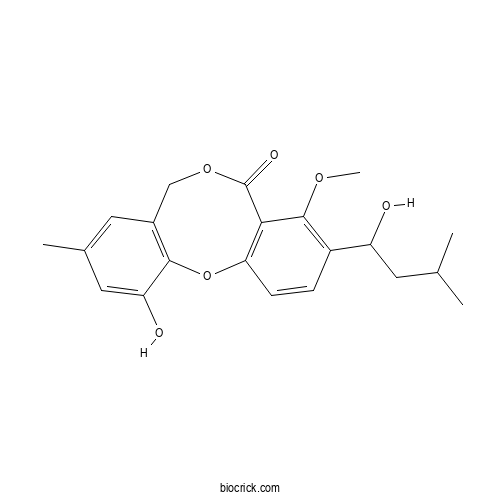
| Cas No. | 55303-92-9 | SDF | File under preparation. |
| PubChem ID | 9842429.0 | Appearance | Powder |
| Formula | C21H24O6 | M.Wt | 372.4 |
| Type of Compound | Lignanoids | Storage | Desiccate at -20°C |
| Solubility | Soluble in Chloroform,Dichloromethane,Ethyl Acetate,DMSO,Acetone,etc. | ||
| Chemical Name | 6-hydroxy-2-(1-hydroxy-3-methylbutyl)-1-methoxy-8-methyl-10H-benzo[b][1,5]benzodioxocin-12-one | ||
| SMILES | CC1=CC2=C(C(=C1)O)OC3=C(C(=C(C=C3)C(CC(C)C)O)OC)C(=O)OC2 | ||
| Standard InChIKey | UOWGLBYIKHMCIS-UHFFFAOYSA-N | ||
| Standard InChI | InChI=1S/C21H24O6/c1-11(2)7-15(22)14-5-6-17-18(20(14)25-4)21(24)26-10-13-8-12(3)9-16(23)19(13)27-17/h5-6,8-9,11,15,22-23H,7,10H2,1-4H3 | ||
| General tips | For obtaining a higher solubility , please warm the tube at 37 ℃ and shake it in the ultrasonic bath for a while.Stock solution can be stored below -20℃ for several months. We recommend that you prepare and use the solution on the same day. However, if the test schedule requires, the stock solutions can be prepared in advance, and the stock solution must be sealed and stored below -20℃. In general, the stock solution can be kept for several months. Before use, we recommend that you leave the vial at room temperature for at least an hour before opening it. |
||
| About Packaging | 1. The packaging of the product may be reversed during transportation, cause the high purity compounds to adhere to the neck or cap of the vial.Take the vail out of its packaging and shake gently until the compounds fall to the bottom of the vial. 2. For liquid products, please centrifuge at 500xg to gather the liquid to the bottom of the vial. 3. Try to avoid loss or contamination during the experiment. |
||
| Shipping Condition | Packaging according to customer requirements(5mg, 10mg, 20mg and more). Ship via FedEx, DHL, UPS, EMS or other couriers with RT, or blue ice upon request. | ||
Quality Control & MSDS
3D structure
Package In Stock

Number of papers citing our products


Penicillide Dilution Calculator
Penicillide Molarity Calculator
| 1 mg | 5 mg | 10 mg | 20 mg | 25 mg | |
| 1 mM | 2.6853 mL | 13.4264 mL | 26.8528 mL | 53.7057 mL | 67.1321 mL |
| 5 mM | 0.5371 mL | 2.6853 mL | 5.3706 mL | 10.7411 mL | 13.4264 mL |
| 10 mM | 0.2685 mL | 1.3426 mL | 2.6853 mL | 5.3706 mL | 6.7132 mL |
| 50 mM | 0.0537 mL | 0.2685 mL | 0.5371 mL | 1.0741 mL | 1.3426 mL |
| 100 mM | 0.0269 mL | 0.1343 mL | 0.2685 mL | 0.5371 mL | 0.6713 mL |
| * Note: If you are in the process of experiment, it's necessary to make the dilution ratios of the samples. The dilution data above is only for reference. Normally, it's can get a better solubility within lower of Concentrations. | |||||
- Acanthoic acid
Catalog No.:BCX2845
CAS No.:119290-87-8
- 1,2-Dilinoleoyl-3-palmitin
Catalog No.:BCX2844
CAS No.:2190-15-0
- Amygdalinic acid
Catalog No.:BCX2843
CAS No.:66427-92-7
- Benzyl β-gentiobioside
Catalog No.:BCX2842
CAS No.:56775-64-5
- Xanthalin
Catalog No.:BCX2841
CAS No.:21800-48-6
- Apigenin-7-O-(6′′-E-p-coumaroyl-β-D-glucopyranoside)
Catalog No.:BCX2840
CAS No.:105815-90-5
- (E)-Ligustilide
Catalog No.:BCX2839
CAS No.:81944-08-3
- β-Curcumene
Catalog No.:BCX2838
CAS No.:451-56-9
- Cistanoside C
Catalog No.:BCX2837
CAS No.:94492-22-5
- (7S)-Hellicoside
Catalog No.:BCX2836
CAS No.:132278-04-7
- 3-Butylidene-7-hydroxyphthalide
Catalog No.:BCX2835
CAS No.:93236-67-0
- Molephantinin
Catalog No.:BCX2834
CAS No.:56221-98-8
- Gingerglycolipid B
Catalog No.:BCX2847
CAS No.:88168-90-5
- Atractylodinol
Catalog No.:BCX2848
CAS No.:61642-89-5
- Dendronobiloside A
Catalog No.:BCX2849
CAS No.:370557-49-6
- N-Methylhernovine
Catalog No.:BCX2850
CAS No.:5550-65-2
- Hosenkoside L
Catalog No.:BCX2851
CAS No.:161016-50-8
- 1,3-Dioleoyl-2-linoleoylglycerol
Catalog No.:BCX2852
CAS No.:2190-19-4
- (-)-3-O -Acetylcatechin
Catalog No.:BCX2853
CAS No.:116935-88-7
- 4-Hydroxy-3-butylphthalide
Catalog No.:BCX2854
CAS No.:74459-23-7
- (Z)-α-Santalol
Catalog No.:BCX2855
CAS No.:115-71-9
- Tenuifoliose Q
Catalog No.:BCX2856
CAS No.:662166-93-0
- (-)-Epigallocatechin 3'-O-methylether gallate
Catalog No.:BCX2857
CAS No.:298700-56-8
- α-Calacorene
Catalog No.:BCX2858
CAS No.:21391-99-1
Study on the Antifungal Activity and Molecular Docking of Polyester Metabolites from Talaromyces striatoconidius.[Pubmed:42345776]
Biology (Basel). 2026 Jun 12;15(12):920.
Plant pathogenic fungi seriously threaten global crop production, and endophytic fungi are promising reservoirs of bioactive antifungal metabolites. Three undescribed polyester derivatives, talapolyesters I-K (1-3), along with thirteen known compounds including 15G256omega (4), 15G256iota (5), 15G256alpha (6), talapolyester E (7), 15G256alpha-1 (8), 15G256alpha-2 (9), 15G256alpha-2-me (10), 15G256nu (11), ES-242-3 (12), dongtinganthracene A (13), Penicillide (14), 3-methyl-6-hydroxy-8-methoxy-3,4-dihydroisocoumarin (15), and (R)-6-hydroxymellein (16), were isolated from the endophytic fungus Talaromyces striatoconidius WI-F2. Their chemical structures were elucidated comprehensively using NMR and MS spectroscopic analyses, combined with alkaline hydrolysis. Compounds 4-8 exhibited in vitro promising antifungal activity against Fusarium oxysporum f. sp. cubense, with half-maximal inhibitory concentration (IC(50)) values of 9.72, 21.07, 7.89, 8.91 and 9.65 mug/mL respectively, all markedly lower than that of ketoconazole (46.23 mug/mL). Molecular docking simulations further validated the observed antifungal activity, with binding energies ranging from -9.01 to -12.25 kcal/mol, indicative of stronger binding affinity compared with benzamidine (-6.80 kcal/mol). This study offers new clues for research on antifungal agents.
Penicillide Triggers Immunogenic Pyroptosis in Tumor Cells via Oxidative Stress/NF-kappaB/GSDMD Signaling Axis.[Pubmed:41842655]
FASEB J. 2026 Mar 31;40(6):e71636.
Immunogenic cell death (ICD) converts dying tumor cells into an endogenous vaccine, but clinically applicable pyroptosis-inducing agents remain scarce. Penicillide (PEN), a fungal metabolite, has not previously been examined for anticancer activity. PEN elicits potent, concentration-dependent cytotoxicity across six human cancer cell lines by triggering pyroptosis rather than apoptosis, necroptosis, ferroptosis, or autophagy. Electron microscopy observations showed that PEN causes noticeable damage to the cell membrane. PEN activates the canonical NLRP3/caspase-1/GSDMD axis, as evidenced by marked up-regulation of NLRP3, CASP1, and GSDMD transcripts, accumulation of cleaved GSDMD, and rescue of viability by their specific inhibitor and GSDMD siRNA. Mechanistically, PEN induces mitochondrial hyperpolarization followed by depolarization, depletes reduced glutathione, elevates malondialdehyde and reactive oxygen species, and activates NF-kappaB signaling via IkappaBalpha degradation and p65 nuclear translocation; all cytotoxic effects are reversed by the ROS scavenger N-acetylcysteine or the thiol-reducing agent dithiothreitol. PEN-treated cells exhibit hallmark features of immunogenic cell death-surface calreticulin exposure, nucleocytoplasmic HMGB1 translocation, and extracellular ATP release-and function as an effective prophylactic vaccine in Balb/c mice, delaying tumor outgrowth and augmenting intratumoral CD8(+) cytotoxic T lymphocyte and CD11c(+) cell infiltration. These findings establish PEN as a novel pyroptosis-inducing agent that couples oxidative stress and NF-kappaB signaling to elicit robust antitumor immunity, offering translational potential for ICD-based cancer immunotherapy.
Identification of EEF1A1 as a therapeutic target in TNBC: Anticancer action of a novel Penicillide-derived inhibitor through ribosomal protein regulation.[Pubmed:41666627]
Bioorg Chem. 2026 May;172:109602.
Triple-negative breast cancer (TNBC) is one of the most prevalent and aggressive subtypes of breast cancer worldwide, contributing significantly to cancer-related mortality in women. Due to the absence of effective targeted therapies, there is an urgent need to identify novel molecular targets and bioactive compounds for TNBC treatment. Eukaryotic elongation factor 1A1 (EEF1A1), a key regulator of protein synthesis through its role in peptide chain elongation, has emerged as a potential therapeutic candidate; however, its functional role in TNBC remains poorly understood. In this study, we isolated a series of Penicillide-like compounds from the mycelium of Penicillium sp. NBU2256, designated as compounds 1-5. Using CCK-8 cytotoxicity assays, compound 2 was identified as the most potent inhibitor of TNBC cell viability. Subsequent mechanistic investigations revealed that compound 2 induced apoptosis, triggered cell cycle arrest, and modulated cancer stem cell properties. To elucidate its molecular target, we employed drug affinity responsive target stability (DARTS) and cellular thermal shift assay (CETSA), which identified EEF1A1 as a direct binding partner of compound 2. Network pharmacology analysis further predicted RPL27A and RPLP0 as downstream effectors of EEF1A1 signaling. Functional validation using actinomycin D and cycloheximide treatments demonstrated that compound 2 suppresses RPL27A and RPLP0 expression at the translational level, thereby inhibiting tumor cell invasion and migration and exerting robust antitumor effects. Collectively, these findings provide novel insights into the anticancer mechanisms of EEF1A1-targeting agents and highlight EEF1A1 as a promising therapeutic target for the treatment of TNBC.
[Secondary metabolites of endophytic fungus Talaromyces malicola hosted in Armadillidium vulgare].[Pubmed:39307783]
Zhongguo Zhong Yao Za Zhi. 2024 Aug;49(16):4470-4476.
The secondary metabolites of the endophytic fungus Talaromyces malicola hosted in the arthropod Armadillidium vulgare were separated by silica gel column chromatography, gel column chromatography, and semi-preparative high-performance liquid chromatography. Eleven compounds(1-11) were obtained from the ethyl acetate fraction of the fermentation broth of T. malicola, and their structures were identified by NMR, HR-ESI-MS, UV, IR, and ECD. The 11 compounds were talarosesquiterpene A(1),(3beta,5alpha,6alpha,15alpha,22E)-5,6-epoxyergosta-8(14),22-diene-3,7,15-triol(2), vermistatin(3), hydroxyvermistatin(4), bercheminol A(5), Penicillide(6), lunatinin(7), penipurdin A(8), emodin(9), BE-25327(10), and(-)-regiolone(11). Compound 1 was a new diaporol-type sesquiterpene. Compounds 2, 4-5, and 7-11 were isolated from Talaromyces for the first time.
Penicillides from Penicillium and Talaromyces: Chemical Structures, Occurrence and Bioactivities.[Pubmed:39202967]
Molecules. 2024 Aug 16;29(16):3888.
Penicillide is the founder product of a class of natural products of fungal origin. Although this compound and its analogues have been identified from taxonomically heterogeneous fungi, they are most frequently and typically reported from the species of Talaromyces and Penicillium. The producing strains have been isolated in various ecological contexts, with a notable proportion of endophytes. The occurrence of Penicillides in these plant associates may be indicative of a possible role in defensive mutualism based on their bioactive properties, which are also reviewed in this paper. The interesting finding of Penicillides in fruits and seeds of Phyllanthus emblica is introductory to a new ground of investigation in view of assessing whether they are produced by the plant directly or as a result of the biosynthetic capacities of some endophytic associates.
Talarostatin, a vermistatin derivative from the soil-derived fungus Talaromyces thailandensis PSU-SPSF059.[Pubmed:36919631]
Nat Prod Res. 2024 Aug;38(15):2535-2542.
The soil-derived fungus Talaromyces thailandensis PSU-SPSF059 produced one new vermistatin derivative, talarostatin, and seven known compounds including two vermistatins, two chrodrimanins, two diphenyl ethers and one Penicillide derivative. Extensive spectroscopic analysis was performed to identify their structures. The absolute configuration of talarostatin was determined by comparing the experimental and calculated electronic circular dichroism data. The antimicrobial and cytotoxic activities of the isolated secondary metabolites were also evaluated.
New Antibacterial Secondary Metabolites from a Marine-Derived Talaromyces sp. Strain BTBU20213036.[Pubmed:35203824]
Antibiotics (Basel). 2022 Feb 10;11(2):222.
New polyketide-derived oligophenalenone dimers, bacillisporins K and L (1 and 2) and xanthoradone dimer rugulosin D (3), together with four known compounds, bacillisporin B (4), macrosporusone D (5), rugulosin A and Penicillide (6 and 7), were isolated from the marine-derived fungus Talaromyces sp. BTBU20213036. Their structures were determined by detailed analysis of HRESIMS, 1D and 2D NMR data, and the absolute configurations were determined on the basis of calculated and experimental electronic circular dichroism (ECD). The antibacterial and antifungal activities of these compounds were tested against Gram-positive-Staphylococcus aureus, Gram-negative-Escherichia coli, and fungal strain-Candida albicans. These compounds showed potential inhibitory effects against S. aureus with minimum inhibitory concentrations ranging from 0.195 to 100 microg/mL.
Five Tetramic Acid Derivatives Isolated from the Iranian Fungus Colpoma quercinum CCTU A372.[Pubmed:34067463]
Biomolecules. 2021 May 22;11(6):783.
Submerged mycelial cultures of the ascomycete Colpoma quercinum CCTU A372 were found to produce five previously undescribed tetramic acids, for which we propose the trivial names colposetins A-C (1-3) and colpomenoic acids A and B (4 and 5), along with the known compounds Penicillide (6) and monodictyphenone (7). The planar structures of 1-5 were determined by high-resolution electrospray ionization mass spectrometry (HR-ESIMS) and extensive 1D and 2D nuclear magnetic resonance (NMR) spectroscopy. Their absolute configurations were determined by the combination of electronic circular dischroism (ECD) analysis, J-based configurational analysis, and a rotating-frame Overhauser effect spectroscopy (ROESY) experiment. Colposetin B displayed weak antimicrobial activity against Bacillus subtilis and Mucor hiemalis (MIC 67 microg/mL).
Antibacterial Secondary Metabolites from Marine-Derived Fungus Aspergillus sp. IMCASMF180035.[Pubmed:33916658]
Antibiotics (Basel). 2021 Apr 3;10(4):377.
Four new secondary metabolites, including one spiro[anthracenone-xanthene] derivative aspergiloxathene A (1), one Penicillide analogue, Delta(2')-1'-dehydroPenicillide (2), and two new phthalide derivatives, 5-methyl-3-methoxyepicoccone (3) and 7-carboxy-4-hydroxy-6-methoxy-5-methylphthalide (4), together with four known compounds, yicathin C (5), dehydroPenicillide (6), 3-methoxyepicoccone (7), 4-hydroxy-6-methoxy-5-methylphthalide (8), were identified from the marine-derived fungus Aspergillus sp. IMCASMF180035. Their structures were determined by spectroscopic data, including high-resolution electrospray ionization mass spectrometry (HRESIMS), 1D and 2D nuclear magnetic resonance (NMR) techniques. Compound 1 was identified as the first jointed molecule by xanthene and anthracenone moieties possessing an unprecedented carbon skeleton with spiro-ring system. All compounds were evaluated activities against Staphylococcus aureus, methicillin resistant S. aureus (MRSA), Escherichia coli, Escherichia faecium, Pseudomonas aeruginosa, and Helicobacter pylori. Compound 1 showed significant inhibitory effects against S. aureus and MRSA, with minimum inhibitory concentration (MIC) values of 5.60 and 22.40 microM. Compounds 2 and 6 exhibited potent antibacterial activities against H. pylori, with MIC values of 21.73 and 21.61 microM, respectively.
Two marine natural products, penicillide and verrucarin J, are identified from a chemical genetic screen for neutral lipid accumulation effectors in Phaeodactylum tricornutum.[Pubmed:32002603]
Appl Microbiol Biotechnol. 2020 Mar;104(6):2731-2743.
There are a large number of valuable substances in diatoms, such as neutral lipid and pigments. However, due to the lack of clear metabolic pathways, their applications are still limited. Recently, chemical modulators are found to be powerful tools to investigate the metabolic pathways of neutral lipids. Thus, in this study, to identify new neutral lipid accumulation effectors, we screened the natural products that we separated before in the model diatom Phaeodactylum tricornutum (P. tricornutum) by using Nile-red staining method. Two compounds, Penicillide and verrucarin J which were isolated from two marine fungal strains, were identified to promote neutral lipid accumulation. However, Penicillide and verrucarin J were also found to significantly inhibit the growth of P. tricornutum through specifically inhibiting the photosynthesis of P. tricornutum. Quantitative analysis results showed that Penicillide and verrucarin J significantly increased total lipid and triacylglycerol (TAG) contents, which are consistent with previous Nile-red staining results. The expression of key genes such as DGAT2D, GPAT2, LPAT2, and PAP involved in TAG synthesis and unsaturated fatty acids also increased after Penicillide and verrucarin J treatments. Besides, many TAG-rich plastoglobuli formed in plastids shown by increased lipid droplets in the cytosol. Finally, Penicillide and verrucarin J were found to reduce the expression of synthetic genes of fucoxanthin, and consequently reduced the content of fucoxanthin, indicating that there might be crosstalk between lipid metabolism and fucoxanthin metabolism. Thus, our work exhibits two useful compounds that could be used to further study the metabolic pathways of neutral lipid and fucoxanthin, which will fulfill the promise of diatoms as low cost, high value, sustainable feedstock for high-value products such as neutral lipid and pigments.
Clinical characteristics of AChRAb and MuSKAb double seropositive myasthenia gravis patients.[Pubmed:29986198]
Clin Neurol Neurosurg. 2018 Sep;172:69-73.
OBJECTIVES: To explore the characteristics of double seropositive myasthenia gravis (DSP-MG). PATIENTS AND METHODS: A literature review of twenty-four cases of DSP-MG including 2 novel cases presented in the current study, was performed. RESULTS: Among 24 reported patients, 7 were male (29.17%) and 17 were female (70.83%). Among 20 patients with known age, the mean age of onset was 37.30 +/- 19.50 years, among which the average onset age of the 6 male patients was 53.17 +/- 8.98 years, while the average onset age of the remaining 14 female patients was 30.50 +/- 18.94 years. Three patients had simple ocular muscle-type MG (14.28%), while 18 (85.71%) had non-ocular muscle-type MG. After administration of Penicillide, 1 patient developed DSP-MG. In 9 cases, patients developed DSP-MG after thymectomy, while 5 patients naturally developed DSP-MG. CONCLUSION: Women more frequently developed DSP-MG than men and men were diagnosed at an older age. MG is typically found in the ocular muscles, bulbar and limb muscles.
Secondary Metabolites Produced by an Endophytic Fungus Pestalotiopsis sydowiana and Their 20S Proteasome Inhibitory Activities.[Pubmed:27447600]
Molecules. 2016 Jul 20;21(7):944.
Fungal endophytes have attracted attention due to their functional diversity. Secondary metabolites produced by Pestalotiopsis sydowiana from a halophyte, Phragmites communis Trinus, were investigated. Eleven compounds, including four Penicillide derivatives (1-4) and seven alpha-pyrone analogues (5-10) were isolated from cultures of P. sydowiana. The compounds were identified based on spectroscopic data. The inhibitory activities against the 20S proteasome were evaluated. Compounds 1-3, 5, and 9-10 showed modest proteasome inhibition activities, while compound 8 showed strong activity with an IC50 of 1.2 +/- 0.3 muM. This is the first study on the secondary metabolites produced by P. sydowiana and their proteasome inhibitory activities. The endophytic fungus P. sydowiana might be a good resource for proteasome inhibitors.
A Putative Histone Deacetylase Modulates the Biosynthesis of Pestalotiollide B and Conidiation in Pestalotiopsis microspora.[Pubmed:25394605]
J Microbiol Biotechnol. 2015 May;25(5):579-88.
Fungi of the genus Pestalotiopsis have drawn attention for their capability to produce an array of bioactive secondary metabolites that have potential for drug development. Here, we report the determination of a polyketide derivative compound, pestalotiollide B, in the culture of the saprophytic fungus Pestalotiopsis microspora NK17. Structural information acquired by analyses with a set of spectroscopic and chromatographic techniques suggests that pestalotiollide B has the same skeleton as the Penicillide derivatives, dibenzodioxocinones, which are inhibitors of cholesterol ester transfer protein (CETP), and as purpactins A and C', inhibitors of acyl-CoA:cholesterol acyltransferase (ACAT). Strain NK17 can make a fairly high yield of pestalotiollide B (i.e., up to 7.22 mg/l) in a constitutive manner in liquid culture. Moreover, we found that a putative histone deacetylase gene, designated as hid1, played a role in the biosynthesis of pestalotiollide B. In the hid1 null mutant, the yield of pestalotiollide B increased approximately 2-fold to 15.90 mg/l. In contrast, deletion of gene hid1 led to a dramatic decrease of conidia production of the fungus. These results suggest that hid1 is a modulator, concerting secondary metabolism and development such as conidiation in P. microspora. Our work may help with the investigation into the biosynthesis of pestalotiollide B and the development for new CETP and ACAT inhibitors.
Enhancement of metabolites productivity of Penicillium pinophilum FKI-5653, by co-culture with Trichoderma harzianum FKI-5655.[Pubmed:22008698]
J Antibiot (Tokyo). 2011 Dec;64(12):769-74.
In the course of discovering new metabolites from co-culture of Penicillium pinophilum FKI-5653 and Trichoderma harzianum FKI-5655, a new compound, designated secoPenicillide C, and four known compounds, Penicillide, MC-141, pestalasin A and stromemycin were isolated. The production of these compounds, except pestalasin A, was enhanced in co-culture to be two to six times higher than in pure culture of Penicillium pinophilum FKI-5653, which was the producer of these compounds.
1H and 13C NMR assignments for 6-demethylvermistatin and two penicillide derivatives from the mangrove fungus Guignardia sp. (No. 4382) from the South China Sea.[Pubmed:18338749]
Magn Reson Chem. 2008 Jul;46(7):693-6.
One new compound 6-demethylvermistatin (1), together with two known compounds, the Penicillide derivatives (2) and (3) were isolated from the mangrove fungus Guignardia sp. No. 4382 obtained from the South China Sea. Their structures were assigned using high-resolution electron ionization mass spectrometry(HREIMS), (1)H and (13)C NMR spectra, DEPT, and by 2D COSY, HMQC, and HMBC experiments. The absolute configuration of 1 was established by comparison of its CD with that of vermistatin.

Calcutta University

University of Minnesota

University of Maryland School of Medicine

University of Illinois at Chicago

The Ohio State University

University of Zurich

Harvard University

Colorado State University

Auburn University

Yale University

Worcester Polytechnic Institute

Washington State University

Stanford University

University of Leipzig

Universidade da Beira Interior

The Institute of Cancer Research

Heidelberg University

University of Amsterdam

University of Auckland

TsingHua University

The University of Michigan

Miami University

DRURY University

Jilin University

Fudan University

Wuhan University

Sun Yat-sen University

Universite de Paris

Deemed University

Auckland University

The University of Tokyo

Korea University



