
3-Butylidene-7-hydroxyphthalideCAS# 93236-67-0 |
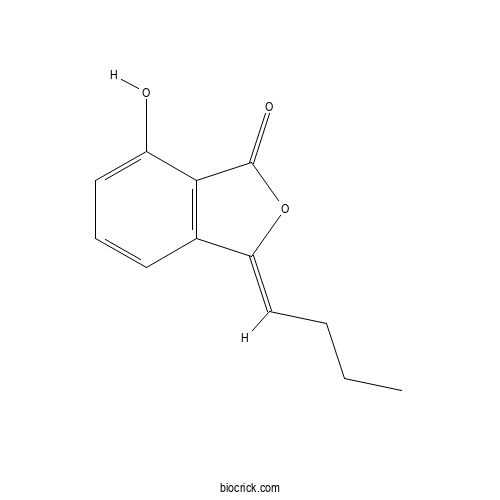
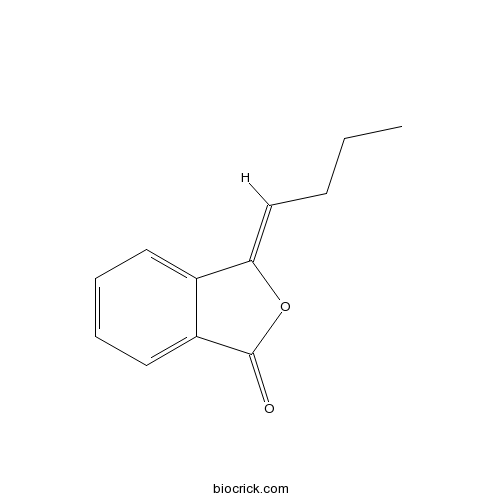
| Cas No. | 93236-67-0 | SDF | File under preparation. |
| PubChem ID | 5281559.0 | Appearance | Powder |
| Formula | C12H12O3 | M.Wt | 204.2 |
| Type of Compound | Aurones | Storage | Desiccate at -20°C |
| Solubility | Soluble in Chloroform,Dichloromethane,Ethyl Acetate,DMSO,Acetone,etc. | ||
| Chemical Name | (3Z)-3-butylidene-7-hydroxy-2-benzofuran-1-one | ||
| SMILES | CCCC=C1C2=C(C(=CC=C2)O)C(=O)O1 | ||
| Standard InChIKey | XLFDJKJEYMKLJX-YFHOEESVSA-N | ||
| Standard InChI | InChI=1S/C12H12O3/c1-2-3-7-10-8-5-4-6-9(13)11(8)12(14)15-10/h4-7,13H,2-3H2,1H3/b10-7- | ||
| General tips | For obtaining a higher solubility , please warm the tube at 37 ℃ and shake it in the ultrasonic bath for a while.Stock solution can be stored below -20℃ for several months. We recommend that you prepare and use the solution on the same day. However, if the test schedule requires, the stock solutions can be prepared in advance, and the stock solution must be sealed and stored below -20℃. In general, the stock solution can be kept for several months. Before use, we recommend that you leave the vial at room temperature for at least an hour before opening it. |
||
| About Packaging | 1. The packaging of the product may be reversed during transportation, cause the high purity compounds to adhere to the neck or cap of the vial.Take the vail out of its packaging and shake gently until the compounds fall to the bottom of the vial. 2. For liquid products, please centrifuge at 500xg to gather the liquid to the bottom of the vial. 3. Try to avoid loss or contamination during the experiment. |
||
| Shipping Condition | Packaging according to customer requirements(5mg, 10mg, 20mg and more). Ship via FedEx, DHL, UPS, EMS or other couriers with RT, or blue ice upon request. | ||
Quality Control & MSDS
3D structure
Package In Stock

Number of papers citing our products


3-Butylidene-7-hydroxyphthalide Dilution Calculator
3-Butylidene-7-hydroxyphthalide Molarity Calculator

| 1 mg | 5 mg | 10 mg | 20 mg | 25 mg | |
| 1 mM | 4.8972 mL | 24.4858 mL | 48.9716 mL | 97.9432 mL | 122.429 mL |
| 5 mM | 0.9794 mL | 4.8972 mL | 9.7943 mL | 19.5886 mL | 24.4858 mL |
| 10 mM | 0.4897 mL | 2.4486 mL | 4.8972 mL | 9.7943 mL | 12.2429 mL |
| 50 mM | 0.0979 mL | 0.4897 mL | 0.9794 mL | 1.9589 mL | 2.4486 mL |
| 100 mM | 0.049 mL | 0.2449 mL | 0.4897 mL | 0.9794 mL | 1.2243 mL |
| * Note: If you are in the process of experiment, it's necessary to make the dilution ratios of the samples. The dilution data above is only for reference. Normally, it's can get a better solubility within lower of Concentrations. | |||||
- Molephantinin
Catalog No.:BCX2834
CAS No.:56221-98-8
- Molephantin
Catalog No.:BCX2833
CAS No.:50656-66-1
- Trans-resveratrol-3-O-β-D-glucuronide
Catalog No.:BCX2832
CAS No.:387372-17-0
- Esculentoside F
Catalog No.:BCX2831
CAS No.:95263-31-3
- Rorifone
Catalog No.:BCX2830
CAS No.:53078-90-3
- (+)-(R)-Ribalinine
Catalog No.:BCX2829
CAS No.:62928-56-7
- Parthenin
Catalog No.:BCX2828
CAS No.:508-59-8
- Protodioscin
Catalog No.:BCX2827
CAS No.:60478-69-5
- Dihydrochelirubine
Catalog No.:BCX2826
CAS No.:28342-26-9
- Evodiamide
Catalog No.:BCX2825
CAS No.:116965-70-9
- Kuwanon L
Catalog No.:BCX2824
CAS No.:88524-65-6
- Kalopanaxsaponin G
Catalog No.:BCX2823
CAS No.:57539-70-5
- (7S)-Hellicoside
Catalog No.:BCX2836
CAS No.:132278-04-7
- Cistanoside C
Catalog No.:BCX2837
CAS No.:94492-22-5
- β-Curcumene
Catalog No.:BCX2838
CAS No.:451-56-9
- (E)-Ligustilide
Catalog No.:BCX2839
CAS No.:81944-08-3
- Apigenin-7-O-(6′′-E-p-coumaroyl-β-D-glucopyranoside)
Catalog No.:BCX2840
CAS No.:105815-90-5
- Xanthalin
Catalog No.:BCX2841
CAS No.:21800-48-6
- Benzyl β-gentiobioside
Catalog No.:BCX2842
CAS No.:56775-64-5
- Amygdalinic acid
Catalog No.:BCX2843
CAS No.:66427-92-7
- 1,2-Dilinoleoyl-3-palmitin
Catalog No.:BCX2844
CAS No.:2190-15-0
- Acanthoic acid
Catalog No.:BCX2845
CAS No.:119290-87-8
- Penicillide
Catalog No.:BCX2846
CAS No.:55303-92-9
- Gingerglycolipid B
Catalog No.:BCX2847
CAS No.:88168-90-5
Comparative analysis of antimicrobial compounds from endophytic Buergenerula spartinae from orchid.[Pubmed:37597137]
Antonie Van Leeuwenhoek. 2023 Oct;116(10):1057-1072.
A rare fungal endophyte, identified as Buergenerula spartinae (C28), was isolated from the roots of Cymbidium orchids and was characterised and evaluated for its antimicrobial activities. Bio-guided fractionation revealed 4 fractions from B. spartinae (C28) having antibacterial activities against at least one bacterial pathogen tested (Bacillus cereus and Staphylococcus aureus). However, inhibitory activities were absent against pathogenic fungi (Ganoderma boninense, Pythium ultimum and Fusarium solani). Fraction 2 and fraction 4 of B. spartinae (C28) exhibited potent antibacterial activities against S. aureus (MIC: 0.078 mg/mL) and B. cereus (MIC: 0.313 mg/mL), respectively. LCMS analysis revealed the presence of antibacterial agents and antibiotics in fraction 2 (benoxinate, pyropheophorbide A, (-)-ormosanine and N-undecylbenzenesulfonic acid) and fraction 4 (kaempferol 3-p-coumarate, 6-methoxy naphthalene acetic acid, levofuraltadone, hinokitiol glucoside, 3-alpha(S)-strictosidine, pyropheophorbide A, 5'-hydroxystreptomycin, kanzonol N and 3-Butylidene-7-hydroxyphthalide), which may be responsible for the antibacterial activities observed. Most of the bioactive compounds profiled from the antibacterial fractions were discovered for the first time from endophytic isolates (i.e. from B. spartinae (C28)). Buergenerula spartinae (C28) from Cymbidium sp. is therefore, an untapped resource of bioactive compounds for potential applications in healthcare and commercial industries.
Endophytic bacteria from strawberry plants control gray mold in fruits via production of antifungal compounds against Botrytis cinerea L.[Pubmed:34325193]
Microbiol Res. 2021 Oct;251:126793.
Botrytis cinerea causes the gray mold disease in a wide range of plant hosts, especially in post-harvest periods. The control of this phytopathogen has been accomplished through the application of fungicides. However, this practice can cause environmental problems and increase fruit production costs. In addition, this fungus species has developed resistance to conventional synthetic fungicides. In this context, plant growth-promoting bacteria have shown potential for application in agricultural production because they are able to stimulate plant growth through different mechanisms, including the biological control of phytopathogens (indirect growth promotion mechanism). The aim of this work was to evaluate in vitro and in fruits the potential for indirect plant growth-promotion of bacteria isolated from strawberry leaves and roots. Dual plate method and inverted plate method were used to verify the ability of controlling in vitro the growth of Botrytis cinerea via the production of diffusible and volatile antifungal compounds, respectively. The effect of six bacterial isolates that showed greater potential for biological control in vitro was evaluated by scanning electron microscopy. Antifungal compounds produced by these bacterial isolates were identified by liquid chromatography coupled with mass spectrometry. Six bacterial strains were tested on strawberry pseudofruits. Five selected strains belong to the genus Bacillus and one to the genus Pantoea sp. Selected strains were able to inhibit more than 80 % of the mycelial growth of B. cinerea by the production of diffusible compounds and 90 % by volatile antifungal compounds production. Scanning electron microscopy showed the intense degradation of fungal hyphae caused by the presence of all bacterial strains. Bioactive compounds (salycilamide, maculosin, herniarin, lauroyl diethanolamide, baptifoline, undecanedioic acid, botrydial, 8 3-Butylidene-7-hydroxyphthalide and N-(3-oxo-henoyl)-homoserine lactone) were obtained from liquid culture of these strains and extraction with ethyl acetate. All six isolates tested in vivo reduced the incidence of gray mold in strawberry pseudofruits in postharvest. It is concluded that isolates 26, 29, 65, 69, 132 (Bacillus sp.) and MQT16M1 (Pantoea sp.) have potential application for the biological control of Botrytis cinerea in strawberry via the production of diffusible and volatile antifungal compounds.
Gut bacteria of Varanus salvator possess potential antitumour molecules.[Pubmed:32737845]
Int Microbiol. 2021 Jan;24(1):47-56.
Pollution, unhygienic conditions and organic waste are detrimental to human health. On the contrary, animals living in polluted environments, feeding on organic waste and exposed to noxious agents such as heavy metals must possess remarkable properties against contracting diseases. Species such as cockroaches and water monitor lizards thrive in unhygienic conditions and feed on decaying matter. Here, we investigated the antitumour properties of metabolites produced by gut bacteria isolated from Varanus salvator (Asian water monitor lizard). An adult water monitor lizard and a juvenile water monitor lizard were acquired, and dissected. Their aerobic gut bacteria were isolated and identificated through 16S rDNA sequencing. Next, bacterial conditioned media (CM) were prepared and utilised for subsequent assays. Growth inhibition, MTT 3-(4,5-dimethylthiazol-2-yl)-2,5-diphenyltetrazolium bromide cell viability assay, cytotoxicity and cell survival assays were accomplished against a panel of cancer cells as well as a normal cell line. Furthermore, liquid chromatography-mass spectrometry (LC-MS) was employed to identify potential antitumour molecules. A plethora of bacteria were isolated from the gut of juvenile and adult V. salvator respectively. Moreover, CM prepared from selected bacteria exhibited antitumour activity. Of note, LC-MS results indicated the presence of several molecules with reported antitumour activity, namely, 3-Butylidene-7-hydroxyphthalide, C75, enigmol, estrone 16-oxime, proglumide and S-allyl-L-cysteine. Furthermore, 356 potentially novel molecules from juvenile V. salvator and 184 from adult V. salvator were depicted. Thus, the gut microbiota of V. salvator might be considered as a great niche of antitumour molecules; however, further in vitro and in vivo studies are needed to assess the antitumour properties of these molecules.
Biologically active metabolite(s) from haemolymph of red-headed centipede Scolopendra subspinipes possess broad spectrum antibacterial activity.[Pubmed:31254123]
AMB Express. 2019 Jun 28;9(1):95.
The discovery of novel antimicrobials from animal species under pollution is an area untapped. Chinese red-headed centipede is one of the hardiest arthropod species commonly known for its therapeutic value in traditional Chinese medicine. Here we determined the antibacterial activity of haemolymph and tissue extracts of red-headed centipede, Scolopendra subspinipes against a panel of Gram-positive and Gram-negative bacteria. Lysates exhibited potent antibacterial activities against a broad range of bacteria tested. Chemical characterization of biologically active molecules was determined via liquid chromatography mass spectrometric analysis. From crude haemolymph extract, 12 compounds were identified including: (1) L-Homotyrosine, (2) 8-Acetoxy-4-acoren-3-one, (3) N-Undecylbenzenesulfonic acid, (4) 2-Dodecylbenzenesulfonic acid, (5) 3H-1,2-Dithiole-3-thione, (6) Acetylenedicarboxylate, (7) Albuterol, (8) Tetradecylamine, (9) Curcumenol, (10) 3-Butylidene-7-hydroxyphthalide, (11) Oleoyl Ethanolamide and (12) Docosanedioic acid. Antimicrobial activities of the identified compounds were reported against Gram-positive and Gram-negative bacteria, fungi, viruses and parasites, that possibly explain centipede's survival in harsh and polluted environments. Further research in characterization, molecular mechanism of action and in vivo testing of active molecules is needed for the development of novel antibacterials.
LC-DAD-APCI-MS-based screening and analysis of the absorption and metabolite components in plasma from a rabbit administered an oral solution of danggui.[Pubmed:16132135]
Anal Bioanal Chem. 2005 Sep;383(2):247-54.
A valid chromatographic fingerprint method using liquid chromatography-diode array detection-atmospheric pressure chemical ionization mass spectrometry in negative mode (LC-DAD-APCI-MS) is proposed for studying the absorption and metabolites of a traditional Chinese medicine (TCM) Angelica sinensis (danggui) in rabbit plasma, after the rabbit is administered with danggui oral solution (DOS). More than thirty-two common components were detected in both DOS and rabbit plasma, which shows that the components in the DOS were absorbed into the body of the rabbit. Of these, senkyunolide I, senkyunolide H, Z-6,7-epoxyligustilide, 3-Butylidene-7-hydroxyphthalide, Z-ligustilide, Z-butylidenephthalide, Diels-Alder dimers of ligustilide, linolenic acid, linoleic acid and falcarindiol were tentatively identified from their MS, UV spectra and retention behavior by comparing the results with the published literature. At least ten components were found in rabbit plasma but not in DOS, indicating that these components must be metabolites of some of the components in the original extract. The results prove that the proposed method can be used to rapidly analyze multiple constituents in TCMs, and to screen for bioactive compounds by comparing and contrasting the chromatographic fingerprints of DOS and plasma samples.

Calcutta University

University of Minnesota

University of Maryland School of Medicine

University of Illinois at Chicago

The Ohio State University

University of Zurich

Harvard University

Colorado State University

Auburn University

Yale University

Worcester Polytechnic Institute

Washington State University

Stanford University

University of Leipzig

Universidade da Beira Interior

The Institute of Cancer Research

Heidelberg University

University of Amsterdam

University of Auckland

TsingHua University

The University of Michigan

Miami University

DRURY University

Jilin University

Fudan University

Wuhan University

Sun Yat-sen University

Universite de Paris

Deemed University

Auckland University

The University of Tokyo

Korea University



