
PartheninCAS# 508-59-8 |
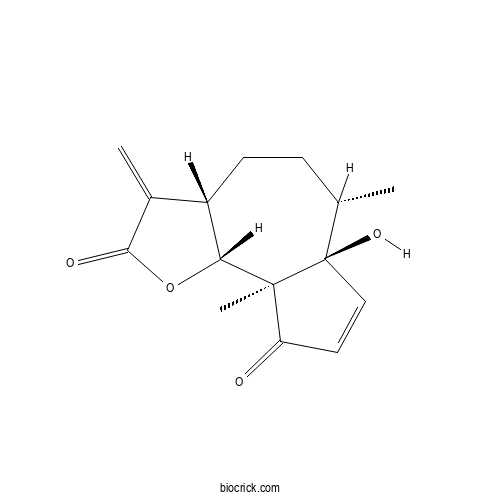
| Cas No. | 508-59-8 | SDF | File under preparation. |
| PubChem ID | 442288.0 | Appearance | Powder |
| Formula | C15H18O4 | M.Wt | 262.3 |
| Type of Compound | Sesquiterpenoids | Storage | Desiccate at -20°C |
| Solubility | Soluble in Chloroform,Dichloromethane,Ethyl Acetate,DMSO,Acetone,etc. | ||
| Chemical Name | (3aS,6S,6aS,9aS,9bR)-6a-hydroxy-6,9a-dimethyl-3-methylidene-4,5,6,9b-tetrahydro-3aH-azuleno[8,7-b]furan-2,9-dione | ||
| SMILES | CC1CCC2C(C3(C1(C=CC3=O)O)C)OC(=O)C2=C | ||
| Standard InChIKey | LLQCRTZROWMVOL-JISBIHODSA-N | ||
| Standard InChI | InChI=1S/C15H18O4/c1-8-4-5-10-9(2)13(17)19-12(10)14(3)11(16)6-7-15(8,14)18/h6-8,10,12,18H,2,4-5H2,1,3H3/t8-,10-,12+,14-,15+/m0/s1 | ||
| General tips | For obtaining a higher solubility , please warm the tube at 37 ℃ and shake it in the ultrasonic bath for a while.Stock solution can be stored below -20℃ for several months. We recommend that you prepare and use the solution on the same day. However, if the test schedule requires, the stock solutions can be prepared in advance, and the stock solution must be sealed and stored below -20℃. In general, the stock solution can be kept for several months. Before use, we recommend that you leave the vial at room temperature for at least an hour before opening it. |
||
| About Packaging | 1. The packaging of the product may be reversed during transportation, cause the high purity compounds to adhere to the neck or cap of the vial.Take the vail out of its packaging and shake gently until the compounds fall to the bottom of the vial. 2. For liquid products, please centrifuge at 500xg to gather the liquid to the bottom of the vial. 3. Try to avoid loss or contamination during the experiment. |
||
| Shipping Condition | Packaging according to customer requirements(5mg, 10mg, 20mg and more). Ship via FedEx, DHL, UPS, EMS or other couriers with RT, or blue ice upon request. | ||
Quality Control & MSDS
3D structure
Package In Stock

Number of papers citing our products


Parthenin Dilution Calculator
Parthenin Molarity Calculator
| 1 mg | 5 mg | 10 mg | 20 mg | 25 mg | |
| 1 mM | 3.8124 mL | 19.0621 mL | 38.1243 mL | 76.2486 mL | 95.3107 mL |
| 5 mM | 0.7625 mL | 3.8124 mL | 7.6249 mL | 15.2497 mL | 19.0621 mL |
| 10 mM | 0.3812 mL | 1.9062 mL | 3.8124 mL | 7.6249 mL | 9.5311 mL |
| 50 mM | 0.0762 mL | 0.3812 mL | 0.7625 mL | 1.525 mL | 1.9062 mL |
| 100 mM | 0.0381 mL | 0.1906 mL | 0.3812 mL | 0.7625 mL | 0.9531 mL |
| * Note: If you are in the process of experiment, it's necessary to make the dilution ratios of the samples. The dilution data above is only for reference. Normally, it's can get a better solubility within lower of Concentrations. | |||||
- Protodioscin
Catalog No.:BCX2827
CAS No.:60478-69-5
- Dihydrochelirubine
Catalog No.:BCX2826
CAS No.:28342-26-9
- Evodiamide
Catalog No.:BCX2825
CAS No.:116965-70-9
- Kuwanon L
Catalog No.:BCX2824
CAS No.:88524-65-6
- Kalopanaxsaponin G
Catalog No.:BCX2823
CAS No.:57539-70-5
- Astin J
Catalog No.:BCX2822
CAS No.:163136-31-0
- Dracorubin
Catalog No.:BCX2821
CAS No.:6219-63-2
- Stemoninine
Catalog No.:BCX2820
CAS No.:69772-72-1
- Rorifamide
Catalog No.:BCX2819
CAS No.:53078-91-4
- Esculentoside L
Catalog No.:BCX2818
CAS No.:130364-33-9
- Gweicurculactone
Catalog No.:BCX2817
CAS No.:123914-43-2
- 3-Phenylpropyl Acetate
Catalog No.:BCX2816
CAS No.:122-72-5
- (+)-(R)-Ribalinine
Catalog No.:BCX2829
CAS No.:62928-56-7
- Rorifone
Catalog No.:BCX2830
CAS No.:53078-90-3
- Esculentoside F
Catalog No.:BCX2831
CAS No.:95263-31-3
- Trans-resveratrol-3-O-β-D-glucuronide
Catalog No.:BCX2832
CAS No.:387372-17-0
- Molephantin
Catalog No.:BCX2833
CAS No.:50656-66-1
- Molephantinin
Catalog No.:BCX2834
CAS No.:56221-98-8
- 3-Butylidene-7-hydroxyphthalide
Catalog No.:BCX2835
CAS No.:93236-67-0
- (7S)-Hellicoside
Catalog No.:BCX2836
CAS No.:132278-04-7
- Cistanoside C
Catalog No.:BCX2837
CAS No.:94492-22-5
- β-Curcumene
Catalog No.:BCX2838
CAS No.:451-56-9
- (E)-Ligustilide
Catalog No.:BCX2839
CAS No.:81944-08-3
- Apigenin-7-O-(6′′-E-p-coumaroyl-β-D-glucopyranoside)
Catalog No.:BCX2840
CAS No.:105815-90-5
Stereodivergent double Thia-Michael diversification of parthenin enables reduced cytotoxicity with retained anti-inflammatory activity.[Pubmed:42259143]
Bioorg Chem. 2026 Sep 15;180:110078.
Parthenin, a sesquiterpene lactone bearing dual Michael acceptor motifs, was employed as a reactive natural product scaffold for stereodivergent diversification via a mild base-promoted, one-pot double Thia-Michael addition strategy, representing the first systematic report of dual thiol functionalization on this scaffold. Reactions with aliphatic and aromatic thiols afforded fifteen sulfur-functionalized derivatives under mild, room-temperature conditions with distinct substrate-dependent stereochemical outcomes. Aliphatic thiols consistently produced single diastereomers, whereas aromatic thiols yielded separable alpha/beta mixtures arising from stereochemical divergence at C-3. In all cases, the C-7 thiol substituent and adjacent C-6a hydroxyl group adopt a conserved syn orientation (alpha-face), as confirmed by detailed 1D/2D NMR analysis and single-crystal X-ray diffraction. Biological evaluation in LPS-stimulated RAW 264.7 macrophages revealed that thiol modification significantly reduces the intrinsic cytotoxicity of Parthenin under the tested cellular conditions while retaining anti-inflammatory activity. Among the derivatives, compound 2a showed high cell viability (92 +/- 5.42% at 10 muM), potent nitric oxide inhibition (63 +/- 4.57%, EC(5)(0) = 7.35 muM), and low cytotoxicity in RAW 264.7 macrophages (IC(5)(0) = 35.36 muM), along with concentration-dependent suppression of IL-6 and TNF-alpha. Molecular docking suggested favorable binding compatibility of 2a within the iNOS active site, with additional interactions predicted for IKK2. ADMET analysis indicated favorable drug-like properties and elimination of predicted mutagenicity relative to Parthenin. Overall, this strategy enables controlled modulation of electrophilicity to generate potentially safer anti-inflammatory analogues.
Parthenin: targeted isolation, characterisation and its application as a fluorescent probe for ammonia sensing.[Pubmed:41678421]
Nat Prod Res. 2026 Feb 12:1-10.
Natural products representing an important class of organic compounds exhibiting immense potential applications. Keeping in view of diverse applications of natural products we have isolated Parthenin compound from Parthenium hysterophorosus using column chromatography. The extracted compounds were subjected to initial screening through FT-IR spectroscopy depicting the presence of different functionalities in the compound. The compound have been screened for optical studies in solid phase depicting the presence of transitions (pi-pi and n-pi) with characteristics optical band gap of 2.3 eV. The thermal studies indicate that the compound is anhydrous and stable upto 300 degrees C beyond which degradation starts. The compound being soluble in various polar and non-polar solvents were investigated for solvatochromism and it has been observed that polar solvents enhances the absorption behaviour compared to non-polar solvents which include water, MeOH, DMF, the lambda(max) corresponding to water, MeOH and DMF are depicted as 290, 230 and 270 nm, respectively. The compound were explored for the sensing of NH(3) molecule for which the limit of detection was 1.2 x 10(-3) M. The isolated compound were characterised by (1)H and (13)C-NMR spectroscopy.
Anti-inflammatory and anti-oxidant potential of dispiro-indanedione hybrid of parthenin via regulating Nrf2 and NF-kappaB/MAPK pathways.[Pubmed:40154568]
Eur J Pharmacol. 2025 Jun 5;996:177547.
Steroidal and non-steroidal anti-inflammatory drugs are widely used for treating a spectrum of inflammatory conditions; however, their systemic adverse effects hinder their usage. Therefore, alternate therapeutic strategies are required to treat inflammatory disorders. Parthenin, a lactone derived from Parthenium hysterophorus, has demonstrated anti-inflammatory activity; however, its toxic nature limits its application. We proposed modifications of Parthenin to enhance its efficacy while reducing toxicity. In this context, we screened Parthenin derivatives for anti-inflammatory efficacy and identified dispiro-indanedione hybrid of Parthenin (DIHP) as a potent anti-inflammatory agent. Macrophages were pre-treated with DIHP followed by LPS stimulation to evaluate the in-vitro anti-inflammatory and anti-oxidant activity. We assessed in-vivo anti-inflammatory effect of DIHP in carrageenan-induced paw edema and LPS-induced sepsis model. Our findings showed that DIHP exerts negligible effect on cell viability, effectively attenuates the production of inflammatory markers (NO, TNF-alpha, IL-6 &IL-1beta) and down-regulates NF-kappaB, MAPK pathways in in-vitro and in-vivo system. Additionally, DIHP inhibited LPS-induced generation of prostaglandin E2, leukotriene B4, ROS and upregulated the expression of superoxide dismutase, catalase, nuclear factor-E2-related factor 2 and peroxisome proliferator-activated receptor gamma. Furthermore, DIHP effectively reduced carrageenan-induced paw edema and curtailed the levels of liver, and kidney damage markers (AST, ALT, CRE, and BUN), protected the lung, liver and kidney against pathological damage and enhanced the survival rate in LPS-challenged mice. DIHP demonstrated comparable efficacy to dexamethasone in reducing inflammatory markers. In conclusion, our study strongly suggests that DIHP curtailed inflammation and oxidative stress by down regulating NF-kappaB and MAPK pathways and enhanced anti-oxidant response.
Antiparasitic Activity of Isolated Fractions from Parthenium incanum Kunth against the Hemoflagellate Protozoan Trypanosoma cruzi.[Pubmed:39061304]
Antibiotics (Basel). 2024 Jul 4;13(7):622.
This study focused on isolating, identifying, and evaluating the trypanocidal potential against the hemoflagellate protozoan Trypanosoma cruzi of compounds from Parthenium incanum (Mariola), a plant used in traditional Mexican medicine to treat stomach and liver disorders. P. incanum has a wide distribution in Mexico. This study found that methanolic extracts of P. incanum, obtained by static maceration and successive reflux, had promising results. The fractions were compared using thin-layer chromatography (TLC) and those that showed similarities were mixed. A bioguided assay was performed with Staphylococcus aureus ATCC 25923, using agar diffusion and bioautography techniques to determine the preliminary biological activity. The fractions with antimicrobial activity were purified using a preparative thin-layer chromatography (PTLC) plate, obtaining the bioactive bandages that were subjected to a trypanocidal evaluation against the Ninoa strain of T. cruzi in its epimastigote stage. This revealed an IC(50) of up to 45 +/- 2.5 microg/mL, in contrast to the values obtained from the crude extracts of less than 100 microg/mL. The TLC, Fourier-transform infrared spectroscopy (FT-IR), and high-performance liquid chromatography coupled with mass spectrometry (HPLC-MS) techniques were used to identify the compounds, demonstrating the presence of sesquiterpene lactones, Parthenin, and coronopolin. We concluded that these compounds have the potential to inhibit T. cruzi growth.
P19 a Parthenin Analog Induces Cell Lineage Dependent Apoptotic and Immunomodulatory Signaling in Acute Lymphoid Leukemia Cells.[Pubmed:37942260]
Int J Mol Cell Med. 2023;12(1):1-17.
Leukemia is a type of cancer that affects the blood and bone marrow. Acute lymphoid leukaemia, also known as ALL, is regarded as one of the deadliest forms of cancer. Due to the rapid increase in various cancer cases and the development of resistance in cancer cells, it is necessary to identify novel lead molecules with more potent anticancer properties. There is a growing interest in using herbal products/analogs as multi-component agents (as anticancer agents and immunomodulators) for cancer treatment. In the present investigation, an attempt has been made to explore the anticancer and immunomodulatory activity of P19, an analog of Parthenin in ALL. P19 was reported to exhibit anticancer efficacy by triggering apoptotic signaling events in human leukaemia HL-60 cells by significant NO production. In contrast to this finding, ROS and NO were not required for P19-mediated apoptosis in Raji cells. The mechanism of action of P19 was observed to be cancer cell lineage dependent. P19 demonstrated very effective anticancer properties against ALL (IC(50) 3microM). Molecular investigations revealed that P19 induced mitochondrion mediated apoptosis by Bax localization to mitochondria and enhanced cytosolic calcium in the cytoplasm. Further activation of the caspase 3, caspase 8 and PARP cleavage suggested the involvement of the caspase-mediated apoptosis. Anti-proliferative activity revealed the telomerase inhibition and cell cycle arrest in G0/G1 phase after P19 treatment. Immunomodulatory effects of the P19 revealed the enhanced INFɣ and NO production in Jurkat and THP cells. Owing to its antiproliferative and immunomodulatory potential against leukemia cells P19 can further be explored as effective therapeutics against leukemia.
Semisynthesis of Novel Dispiro-pyrrolizidino/thiopyrrolizidino-oxindolo/indanedione Natural Product Hybrids of Parthenin Followed by Their Cytotoxicity Evaluation.[Pubmed:37779957]
ACS Omega. 2023 Sep 14;8(38):35283-35294.
Natural products possess unique and broader intricacies in the chemical space and have been essential for drug discovery. The crucial factor for drug discovery success is not the size of the library but rather its structural diversity. Although reports on the number of new structurally diverse natural products (NPs) have declined recently, researchers follow the next logical step: synthesizing natural product hybrids and their analogues using the most potent tool, diversity-oriented synthesis (DOS). Here, we use weed Parthenium hysterophorus as a source of Parthenin for synthesis of novel dispiro-pyrrolizidino/thiopyrrolizidino-oxindolo/indanedione natural product hybrids of Parthenin via chemo-, regio-, and stereoselective azomethine ylide cycloaddition. All synthesized compounds were characterized through a detailed analysis of one-dimensional (1D) and two-dimensional (2D) NMR and HRMS data, and the stereochemistries of the compounds were confirmed by X-ray diffraction analysis. All compounds were evaluated for their cytotoxicity against four cell lines (HCT-116, A549, Mia-Paca-2, and MCF-7), and compound 6 inhibited the HCT-116 cells with an IC(50) of 5.0 +/- 0.08 muM.
Determination and Quantification of Phytochemicals from the Leaf Extract of Parthenium hysterophorus L. and Their Physio-Biochemical Responses to Several Crop and Weed Species.[Pubmed:36501249]
Plants (Basel). 2022 Nov 23;11(23):3209.
This current investigation was undertaken both in laboratory and glasshouse for documentation and quantification of phytochemicals from different parts of the parthenium (Parthenium hysterophorus L.) plant through LC-MS and HPLC to study their effect on two crops namely, Bambara groundnut (Vigna subterranean L.) and maize (Zea mays L.), and six different types of weed e.g., Digitaria sanguinalis, Eleusine indica, Ageratum conyzoides, Cyperus iria, Euphorbia hirta, and Cyperus difformis. The parthenium methanolic leaf extracts at 25, 50, 75, and 100 g L(-1) were sprayed in the test crops and weeds to assess their physiological and biochemical reactions after 6, 24, 48, and 72 h of spraying these compounds (HAS). The LC-MS analysis confirmed seven types of phytochemicals (caffeic acid, ferulic acid, vanillic acid, Parthenin, chlorogenic acid, quinic acid, and p-anisic acid) in the parthenium leaf extract that were responsible for the inhibition of tested crops and weeds. From the HPLC analysis, higher amounts in leaf methanol extracts (40,752.52 ppm) than those of the stem (2664.09 ppm) and flower extracts (30,454.33 ppm) were recorded. Parthenium leaf extract at 100 g L(-1) had observed higher phytotoxicity on all weed species except C. difformis. However, all crops were found safe under this dose of extraction. Although both crops were also affected to some extent, they could recover from the stress after a few days. The photosynthetic rate, transpiration rate, stomatal conductance, carotenoid and chlorophyll content were decreased due to the application of parthenium leaf extract. However, when parthenium leaf extract was applied at 100 g L(-1) for 72 h, the malondialdehyde (MDA) and proline content were increased in all weeds. Enzymatic antioxidant activity (e.g., superoxide dismutase (SOD), catalase (CAT), and peroxidase (POD) contents) were also elevated as a result of the sprayed parthenium leaf extract. The negative impact of physiological and biochemical responses as a consequence of the parthenium leaf extract led the weed species to be stressed and finally killed. The current findings show the feasibility of developing bioherbicide from the methanolic extract of parthenium leaf for controlling weeds, which will be cost-effective, sustainable, and environment friendly for crop production during the future changing climate.
Documentation of Phytotoxic Compounds Existing in Parthenium hysterophorus L. Leaf and Their Phytotoxicity on Eleusine indica (L.) Gaertn. and Digitaria sanguinalis (L.) Scop.[Pubmed:36006222]
Toxins (Basel). 2022 Aug 18;14(8):561.
The utilization of the invasive weed, Parthenium hysterophorus L. for producing value-added products is novel research for sustaining our environment. Therefore, the current study aims to document the phytotoxic compounds contained in the leaf of parthenium and to examine the phytotoxic effects of all those phytochemicals on the seed sprouting and growth of Crabgrass Digitaria sanguinalis (L.) Scop. and Goosegrass Eleusine indica (L.) Gaertn. The phytotoxic substances of the methanol extract of the P. hysterophorus leaf were analyzed by LC-ESI-QTOF-MS=MS. From the LC-MS study, many compounds, such as terpenoids, flavonoids, amino acids, pseudo guaianolides, and carbohydrate and phenolic acids, were identified. Among them, seven potential phytotoxic compounds (i.e., caffeic acid, vanillic acid, ferulic acid, chlorogenic acid, quinic acid, anisic acid, and Parthenin) were documented, those are responsible for plant growth inhibition. The concentration needed to reach 50% growth inhibition in respect to germination (EC(g50)), root length (EC(r50)), and shoot length (EC(s50)) was estimated and the severity of phytotoxicity of the biochemicals was determined by the pooled values (rank value) of three inhibition parameters. The highest growth inhibition was demarcated by caffeic acid, which was confirmed and indicated by cluster analysis and principal component analysis (PCA). In the case of D. sanguinalis, the germination was reduced by 60.02%, root length was reduced by 76.49%, and shoot length was reduced by 71.14% when the chemical was applied at 800 muM concentration, but in the case of E. indica, 100% reduction of seed germination, root length, and shoot length reduction occurred at the same concentration. The lowest rank value was observed from caffeic acids in both E. indica (rank value 684.7) and D. sanguinalis (909.5) caused by Parthenin. It means that caffeic acid showed the highest phytotoxicity. As a result, there is a significant chance that the parthenium weed will be used to create bioherbicides in the future.
Pharmacological Chemistry and Biomedical Implications of Chemical Ingredients from Parthenium hysterophorus.[Pubmed:35255797]
Curr Top Med Chem. 2022;22(23):1950-1965.
Parthenium hysterophorus L. belonging to the family Asteraceae is a noxious weed infestation with allelopathic effects with its lower economic value. It poses a serious risk to its surroundings. The presence of oils, polyphenols, flavones, flavonoids, alkaloids, terpenes, pseudoguaianolides, and histamines in P. hysterophorus makes it important and beneficial due to its medicinal properties. This review article is focused on the history, geographical distribution, chemical composition, and molecular structure of some phytochemicals and ethanopharmacological aspects of P. hysterophorus. The harmful effects of this weed have also been included. The information available from the existing literature revealed that P. hysterophorus is rich in various phytochemicals with different pharmacological activities. However, the complete analysis of different phytoconstituents isolated from P. hysterophorus and their specific properties are not fully understood. The sporadic information published in some journals suggests that this plant could be exploited to develop new drugs against certain diseases, including cancer, HIV-1 infection, and immunological disorders. The structure and mode of action of some compounds such as Parthenin and stigmasterol were also discussed. Though the current information on P. hysterophorus indicates the ethnopharmacological implications of extracts of this plant, more systematic and extensive studies are still required to properly understand the contribution of its specific chemical constituents responsible for their various medicinal properties.
Parthenin-A Sesquiterpene Lactone with Multifaceted Biological Activities: Insights and Prospects.[Pubmed:34500778]
Molecules. 2021 Sep 2;26(17):5347.
Parthenin, a sesquiterpene lactone of pseudoguaianolide type, is the representative secondary metabolite of the tropical weed Parthenium hysterophorus (Asteraceae). It accounts for a multitude of biological activities, including toxicity, allergenicity, allelopathy, and pharmacological aspects of the plant. Thus far, Parthenin and its derivatives have been tested for chemotherapeutic abilities, medicinal properties, and herbicidal/pesticidal activities. However, due to the lack of toxicity-bioactivity relationship studies, the versatile properties of Parthenin are relatively less utilised. The possibility of exploiting Parthenin in different scientific fields (e.g., chemistry, medicine, and agriculture) makes it a subject of analytical discussion. The present review highlights the multifaceted uses of Parthenin, on-going research, constraints in the practical applicability, and the possible workarounds for its successful utilisation. The main aim of this comprehensive discussion is to bring Parthenin to the attention of researchers, pharmacologists, natural product chemists, and chemical biologists and to open the door for its multidimensional applications.
Comprehensive review on ethnobotanical uses, phytochemistry, biological potential and toxicology of Parthenium hysterophorus L.: A journey from noxious weed to a therapeutic medicinal plant.[Pubmed:34411657]
J Ethnopharmacol. 2021 Dec 5;281:114525.
ETHNO-PHARMACOLOGICAL RELEVANCE: Parthenium hysterophorus L. is a noxious weed and a species of flowering plant in the Asteraceae family. It is regarded as the seventh most deadly weed in the world: harmful to both humans and livestock. It is widely known as Congress Grass or Feverfew. Despite its pitfalls, P. hysterophorus bestows medicinal effects. Although prolific in nature and difficult to control, many novel applications of this controversial herb have been discovered as an approach to manage the weed. AIM: The current review aims to compile all the ethnobotanical, phytochemistry, biological activities and utilities, clinical studies and toxicity data available on P. hysterophorus and its major chemical constituent Parthenin. MATERIALS AND METHODS: Extensive literature surveyed Google search, Google scholar, Wiley online library, Elsevier, Springer, Science direct, American Chemical Society, Royal Society of Chemistry and Research Gate. RESULT: According to the study, P. hysterophorus is utilized as a traditional medicine throughout Central America and the Caribbean. It can be used to treat skin infections, dermatitis, amoebic dysentery, and as an analgesic in the treatment of muscular rheumatism. The extracts obtained from P. hysterophorus have anti-inflammatory, antioxidant, larvicidal, anti-microbial, insecticidal, hypoglycaemic and anti-cancer activity. CONCLUSION: The earlier investigations confirmed that P. hysterophorus has numerous traditional and biological applications. However, the scientific data are limited in clinical and toxicological studies. Therefore, further research is required on clinical and toxicological aspects to understand the complete potential and effects of P. hysterophorus.
Root exudate chemical cues of an invasive plant modulate oviposition behavior and survivorship of a malaria mosquito vector.[Pubmed:34285252]
Sci Rep. 2021 Jul 20;11(1):14785.
Gravid female Anopheles gambiae mosquitoes identify suitable oviposition sites through a repertoire of cues, but the influence of allelochemicals, especially root phytochemicals in modulating this behavior and impacting subsequent progeny bionomics remains unexplored. We addressed these questions in the malaria vector Anopheles gambiae and its invasive host plant Parthenium hysterophorus. Using chemical analysis combined with laboratory behavioral assays, we demonstrate that a blend of terpenes, namely alpha-pinene, alpha-phellandrene, beta-phellandrene, 3-carene and (E)-caryophyllene emitted from P. hysterophorus root exudate treated-water attracted gravid females. However, fewer eggs (55%) hatched in this treatment than in control water (66%). The sesquiterpene lactone Parthenin, identified in both the natural aquatic habitat harboring P. hysterophorus and root exudate-treated water was found to be responsible for the ovicidal effect. Moreover, larvae exposed to Parthenin developed 2 to 3 days earlier but survived 4 to 5 days longer as adults (median larval survival time = 9 days (all replicates);11 to 12 days as adults) than the non-exposed control (median larval survival time = 11 days (reps 1 & 2), 12 days (rep 3); 6 to 7 days as adults). These results improve our understanding of the risk and benefits of oviposition site selection by gravid An. gambiae females and the role root exudate allelochemicals could play on anopheline bionomics, with potential implications in malaria transmission.
Recent CO(2) levels promote increased production of the toxin parthenin in an invasive Parthenium hysterophorus biotype.[Pubmed:34099902]
Nat Plants. 2021 Jun;7(6):725-729.
Recent carbon dioxide (CO(2)) concentrations promoted higher Parthenin concentrations in an invasive Parthenium hysterophorus biotype. Mean concentrations of Parthenin, an allelopathic and defensive sesquiterpene lactone, were 49% higher at recent (~400 ppm) than at mid-twentieth-century (~300 ppm) CO(2) concentrations, but did not vary in a non-invasive biotype, suggesting that recent increases in atmospheric CO(2) may have already altered the chemistry of this destructive weed, potentially contributing to its invasive success.
Derivatization increases mosquito larvicidal activity of the sesquiterpene lactone parthenin isolated from the invasive weed Parthenium hysterophorus.[Pubmed:33034953]
Pest Manag Sci. 2021 Feb;77(2):659-665.
BACKGROUND: Extracts of the invasive weed Parthenium hysterophorus (Asteraceae) have been shown to possess larvicidal activity against a wide range of disease vectors. However, the phytochemicals responsible for the larvicidal activity from this plant remain unidentified. Here, we isolated the major sesquiterpene lactone, Parthenin (1) from the plant and synthesized two derivatives [ethylene glycol (2) and azide (3) derivatives] targeting the alpha,beta-unsaturated carbonyl group, previously known to account for its biological activity such as toxicity towards cells and microorganism. All three compounds were screened for larvicidal activity against the African malaria vector Anopheles gambiae. RESULTS: The larval mortality of ethylene glycol derivative (2) and 2alpha-azidocoronopilin (3) were approximately two-four-fold higher than that of Parthenin (1) and neem oil with LC(50) values of 37 and 66 mg L(-1) , respectively. Parthenin (1) and the positive control, neem oil, had comparable median lethal concentration (LC(50) ) values of 154 and 121 mg L(-1) , respectively. In assays with binary combinations of the three compounds, larvicidal activity followed the order: Parthenin (1) + 2alpha-azidocoronopilin (3) (LC(50) = 14 mg L(-1) ) > Parthenin (1) + ethylene glycol derivative (2) (LC(50) = 109 mg L(-1) ), > blend of 2alpha-azidocoronopilin (3) and ethylene glycol derivative (2) (LC(50) = 200 mg L(-1) ). CONCLUSION: Structural modification of Parthenin (1) through addition of hydroxyl groups increases its larvicidal effects. These findings advance the use of structural modification approach in the development of lead chemical molecules for potential exploitation in larval source management.
Parthenium hysterophorus mediated inflammation and hyper-responsiveness via NF-kappaB pathway in human A549 lung cancer cell line.[Pubmed:32686900]
Environ Toxicol. 2020 Nov;35(11):1241-1250.
Being one of the notorious weed P. hysterophorus has invaded almost every part India and is the lead cause of skin allergies and severe dermatitis among farmers and rural population. It is an invasive obnoxious weed capable of surviving extreme environmental conditions and various parts of this plant are reported to cause severe contact allergies in humans due to the presence of high concentrations of toxic sesquiterpene lactones viz. Parthenin. It can stimulate numerous cellular and immune responses that may translate into Oxidative stress, allergies, and inflammation. The effect of P. hysterophorus flower extract was evaluated on cell viability, oxidative stress and inflammation in A549 lung cancer cell line by spectrophotometric and reverse transcriptase-polymerase chain reaction methods. Schrodinger software based docking was performed for possible interactions studies. The A549 cells treated with P. hysterophorus flower extract favors increase in cell viability, reactive oxygen species generation. The mRNA expression of proinflammatory cytokines such as IFN-gamma, TNF-alpha, and IL-1beta was significantly increased whereas no change in IL-18 expression was observed. Significant increase in protein expression of NF-kappaB was observed, suggesting the role of NF-kappaB signalling in allergic responses. The docking studies demonstrated the potential interaction between Parthenin and NF-kappaB/IL-1beta/IL-18 suggesting their activation leading to inflammation. The current study emphasize that P. hysterophorus mediates oxidative stress, and inflammatory process via alterations in expression of proinflammatory cytokines such as IL-1beta, IFN-gamma through NF-kappaB activation which was also confirmed in docking studies. Cellular and molecular mechanisms involved in pathogenesis of allergic/chronic inflammation and severe dermatitis need to be further investigated to identify specific binding partners responsible for severe inflammation which can provide some leads in developing effective targets against severe dermatitis and skin allergies.

Calcutta University

University of Minnesota

University of Maryland School of Medicine

University of Illinois at Chicago

The Ohio State University

University of Zurich

Harvard University

Colorado State University

Auburn University

Yale University

Worcester Polytechnic Institute

Washington State University

Stanford University

University of Leipzig

Universidade da Beira Interior

The Institute of Cancer Research

Heidelberg University

University of Amsterdam

University of Auckland

TsingHua University

The University of Michigan

Miami University

DRURY University

Jilin University

Fudan University

Wuhan University

Sun Yat-sen University

Universite de Paris

Deemed University

Auckland University

The University of Tokyo

Korea University



