
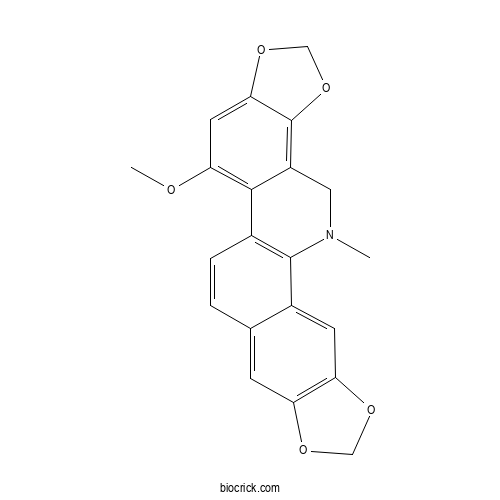
DihydrochelirubineCAS# 28342-26-9 |
| Cas No. | 28342-26-9 | SDF | File under preparation. |
| PubChem ID | 440589.0 | Appearance | Powder |
| Formula | C21H17NO5 | M.Wt | 363.1 |
| Type of Compound | Quinolines/Isoquinolines | Storage | Desiccate at -20°C |
| Solubility | Soluble in Chloroform,Dichloromethane,Ethyl Acetate,DMSO,Acetone,etc. | ||
| Chemical Name | 15-methoxy-24-methyl-5,7,18,20-tetraoxa-24-azahexacyclo[11.11.0.02,10.04,8.014,22.017,21]tetracosa-1(13),2,4(8),9,11,14,16,21-octaene | ||
| SMILES | CN1CC2=C3C(=CC(=C2C4=C1C5=CC6=C(C=C5C=C4)OCO6)OC)OCO3 | ||
| Standard InChIKey | JPXUJRDPZQUCNV-UHFFFAOYSA-N | ||
| Standard InChI | InChI=1S/C21H17NO5/c1-22-8-14-19(17(23-2)7-18-21(14)27-10-26-18)12-4-3-11-5-15-16(25-9-24-15)6-13(11)20(12)22/h3-7H,8-10H2,1-2H3 | ||
| General tips | For obtaining a higher solubility , please warm the tube at 37 ℃ and shake it in the ultrasonic bath for a while.Stock solution can be stored below -20℃ for several months. We recommend that you prepare and use the solution on the same day. However, if the test schedule requires, the stock solutions can be prepared in advance, and the stock solution must be sealed and stored below -20℃. In general, the stock solution can be kept for several months. Before use, we recommend that you leave the vial at room temperature for at least an hour before opening it. |
||
| About Packaging | 1. The packaging of the product may be reversed during transportation, cause the high purity compounds to adhere to the neck or cap of the vial.Take the vail out of its packaging and shake gently until the compounds fall to the bottom of the vial. 2. For liquid products, please centrifuge at 500xg to gather the liquid to the bottom of the vial. 3. Try to avoid loss or contamination during the experiment. |
||
| Shipping Condition | Packaging according to customer requirements(5mg, 10mg, 20mg and more). Ship via FedEx, DHL, UPS, EMS or other couriers with RT, or blue ice upon request. | ||
Quality Control & MSDS
3D structure
Package In Stock

Number of papers citing our products


Dihydrochelirubine Dilution Calculator
Dihydrochelirubine Molarity Calculator

| 1 mg | 5 mg | 10 mg | 20 mg | 25 mg | |
| 1 mM | 2.7541 mL | 13.7703 mL | 27.5406 mL | 55.0812 mL | 68.8516 mL |
| 5 mM | 0.5508 mL | 2.7541 mL | 5.5081 mL | 11.0162 mL | 13.7703 mL |
| 10 mM | 0.2754 mL | 1.377 mL | 2.7541 mL | 5.5081 mL | 6.8852 mL |
| 50 mM | 0.0551 mL | 0.2754 mL | 0.5508 mL | 1.1016 mL | 1.377 mL |
| 100 mM | 0.0275 mL | 0.1377 mL | 0.2754 mL | 0.5508 mL | 0.6885 mL |
| * Note: If you are in the process of experiment, it's necessary to make the dilution ratios of the samples. The dilution data above is only for reference. Normally, it's can get a better solubility within lower of Concentrations. | |||||
- Evodiamide
Catalog No.:BCX2825
CAS No.:116965-70-9
- Kuwanon L
Catalog No.:BCX2824
CAS No.:88524-65-6
- Kalopanaxsaponin G
Catalog No.:BCX2823
CAS No.:57539-70-5
- Astin J
Catalog No.:BCX2822
CAS No.:163136-31-0
- Dracorubin
Catalog No.:BCX2821
CAS No.:6219-63-2
- Stemoninine
Catalog No.:BCX2820
CAS No.:69772-72-1
- Rorifamide
Catalog No.:BCX2819
CAS No.:53078-91-4
- Esculentoside L
Catalog No.:BCX2818
CAS No.:130364-33-9
- Gweicurculactone
Catalog No.:BCX2817
CAS No.:123914-43-2
- 3-Phenylpropyl Acetate
Catalog No.:BCX2816
CAS No.:122-72-5
- Auramine O
Catalog No.:BCX2815
CAS No.:2465-27-2
- Cadalene
Catalog No.:BCX2814
CAS No.:483-78-3
- Protodioscin
Catalog No.:BCX2827
CAS No.:60478-69-5
- Parthenin
Catalog No.:BCX2828
CAS No.:508-59-8
- (+)-(R)-Ribalinine
Catalog No.:BCX2829
CAS No.:62928-56-7
- Rorifone
Catalog No.:BCX2830
CAS No.:53078-90-3
- Esculentoside F
Catalog No.:BCX2831
CAS No.:95263-31-3
- Trans-resveratrol-3-O-β-D-glucuronide
Catalog No.:BCX2832
CAS No.:387372-17-0
- Molephantin
Catalog No.:BCX2833
CAS No.:50656-66-1
- Molephantinin
Catalog No.:BCX2834
CAS No.:56221-98-8
- 3-Butylidene-7-hydroxyphthalide
Catalog No.:BCX2835
CAS No.:93236-67-0
- (7S)-Hellicoside
Catalog No.:BCX2836
CAS No.:132278-04-7
- Cistanoside C
Catalog No.:BCX2837
CAS No.:94492-22-5
- β-Curcumene
Catalog No.:BCX2838
CAS No.:451-56-9
[Chemical Constituents from the Roots of Macleaya cordata].[Pubmed:30204380]
Zhong Yao Cai. 2016 Aug;39(8):1767-70.
OBJECTIVE: To investigate the chemical constituents from the roots of Macleaya cordata. METHODS: The compounds were isolated and purified by silica gel,recrystallization and semi-preparative HPLC, their structures were eclucidated by physicochemistry properties, MS and NMR. RESULTS: Seven compounds were isolated and identified as 6-cyanodihydrochelerythrine (1),6-cyanodihydrochelilutine (2),Dihydrochelirubine (3),6-methoxynorchelerythrine (4),dihydrosanguinarine (5),6-actonyldihydrosanguinarine (6) and stigmasterol (7). CONCLUSION: Compounds 1,2 are new natural compounds and compound 4 is obtained from Macleaya cordata for the first time.
Analysis of benzo[c]phenanthridine alkaloids in Eschscholtzia californica cell culture using HPLC-DAD and HPLC-ESI-MS/MS.[Pubmed:25229843]
Biosci Biotechnol Biochem. 2014;78(7):1103-11.
Effective HPLC-DAD and HPLC-ESI-MS/MS methods have been developed for the analysis of eight benzo[c]phenanthridine alkaloids (sanguinarine, chelirubine, macarpine, chelerythrine, dihydrosanguinarine, Dihydrochelirubine, dihydromacarpine and dihydrochelerythrine), which are important metabolites in Eschscholtzia californica cell culture. By adopting a ternary gradient pump system, the dihydro-form alkaloids hardly separable from each other could be successfully separated, and all the target alkaloids could be simultaneously quantified with the LOD values of 0.01-0.79 mug/mL and the LOQ values of 0.03-3.59 mug/mL. This HPLC-DAD method was further confirmed by HPLC-ESI-MS/MS system in multiple reaction monitoring mode. Each separated HPLC peak was identified as the target alkaloid, showing its relevant ionized molecule and selected fragment ion. By applying the established method, alkaloid production during the E. californica cell culture could be successfully monitored and some valuable information on its metabolism could be deduced.
Gene transcript and metabolite profiling of elicitor-induced opium poppy cell cultures reveals the coordinate regulation of primary and secondary metabolism.[Pubmed:17077972]
Planta. 2007 Apr;225(5):1085-106.
Elicitor-induced sanguinarine accumulation in opium poppy (Papaver somniferum) cell cultures provides a responsive model system to profile modulations in gene transcripts and metabolites related to alkaloid biosynthesis. An annotated expressed sequence tag (EST) database was assembled from 10,224 random clones isolated from an elicitor-treated opium poppy cell culture cDNA library. The most abundant ESTs encoded defense proteins, and enzymes involved in alkaloid metabolism and S-adenosylmethionine-dependent methyl transfer. ESTs corresponding to 40 enzymes involved in the conversion of sucrose to sanguinarine were identified. A corresponding DNA microarray was probed with RNA from cell cultures collected at various time-points after elicitor treatment, and compared with RNA from control cells. Several diverse transcript populations were coordinately induced, with alkaloid biosynthetic enzyme and defense protein transcripts displaying the most rapid and substantial increases. In addition to all known sanguinarine biosynthetic gene transcripts, mRNAs encoding several upstream primary metabolic enzymes were coordinately induced. Fourier transform-ion cyclotron resonance-mass spectrometry was used to characterize the metabolite profiles of control and elicitor-treated cell cultures. Principle component analysis revealed a significant and dynamic separation in the metabolome, represented by 992 independent detected analytes, in response to elicitor treatment. Identified metabolites included sanguinarine, dihydrosanguinarine, and the methoxylated derivatives Dihydrochelirubine and chelirubine, and the alkaloid pathway intermediates N-methylcoclaurine, N-methylstylopine, and protopine. Some of the detected analytes showed temporal changes in abundance consistent with modulations in the profiles of alkaloid biosynthetic gene transcripts.
New hydroxylated benzo[c]phenanthridine alkaloids from Eschscholtzia californica cell suspension cultures.[Pubmed:2213031]
J Nat Prod. 1990 May-Jun;53(3):579-86.
From cell cultures of Eschscholtzia californica and their spent medium, three new benzo[c]phenanthridine alkaloids--namely 10-hydroxysanguinarine [2a], 12-hydroxychelirubine [4a], and 10-hydroxychelerythrine [7a]--and two new dihydrobenzo[c]phenanthridine alkaloids--10-hydroxydihydrosanguinarine [2b] and 12-hydroxyDihydrochelirubine [4b]--together with the known constituents sanguinarine [1a], chelirubine [3a], macarpine [5a], dihydrosanguinarine [1b], Dihydrochelirubine [3b], and dihydromacarpine [5b], were isolated and characterized. Structure elucidations were done by 1H nmr, decoupling experiments, and NOESY spectra. Isolated microsomes from E. californica, the site of hydroxylation activity within the cells, contained the whole set 1b to 8b of 5,6-dihydrobenzo[c]phenanthridines. A scheme for the biosynthesis of macarpine [5a] from protopine [9] via dihydrosanguinarine [1b] is presented.

Calcutta University

University of Minnesota

University of Maryland School of Medicine

University of Illinois at Chicago

The Ohio State University

University of Zurich

Harvard University

Colorado State University

Auburn University

Yale University

Worcester Polytechnic Institute

Washington State University

Stanford University

University of Leipzig

Universidade da Beira Interior

The Institute of Cancer Research

Heidelberg University

University of Amsterdam

University of Auckland

TsingHua University

The University of Michigan

Miami University

DRURY University

Jilin University

Fudan University

Wuhan University

Sun Yat-sen University

Universite de Paris

Deemed University

Auckland University

The University of Tokyo

Korea University



