
CadaleneCAS# 483-78-3 |
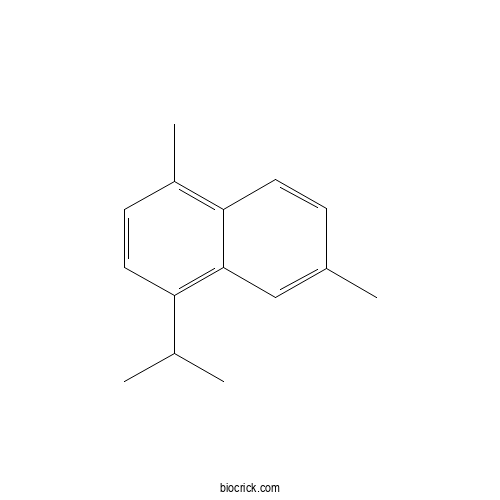
| Cas No. | 483-78-3 | SDF | File under preparation. |
| PubChem ID | 10225.0 | Appearance | Powder |
| Formula | C15H18 | M.Wt | 198.3 |
| Type of Compound | Sesquiterpenoids | Storage | Desiccate at -20°C |
| Solubility | Soluble in Chloroform,Dichloromethane,Ethyl Acetate,DMSO,Acetone,etc. | ||
| Chemical Name | 1,6-dimethyl-4-propan-2-ylnaphthalene | ||
| SMILES | CC1=CC2=C(C=CC(=C2C=C1)C)C(C)C | ||
| Standard InChIKey | VMOJIHDTVZTGDO-UHFFFAOYSA-N | ||
| Standard InChI | InChI=1S/C15H18/c1-10(2)13-8-6-12(4)14-7-5-11(3)9-15(13)14/h5-10H,1-4H3 | ||
| General tips | For obtaining a higher solubility , please warm the tube at 37 ℃ and shake it in the ultrasonic bath for a while.Stock solution can be stored below -20℃ for several months. We recommend that you prepare and use the solution on the same day. However, if the test schedule requires, the stock solutions can be prepared in advance, and the stock solution must be sealed and stored below -20℃. In general, the stock solution can be kept for several months. Before use, we recommend that you leave the vial at room temperature for at least an hour before opening it. |
||
| About Packaging | 1. The packaging of the product may be reversed during transportation, cause the high purity compounds to adhere to the neck or cap of the vial.Take the vail out of its packaging and shake gently until the compounds fall to the bottom of the vial. 2. For liquid products, please centrifuge at 500xg to gather the liquid to the bottom of the vial. 3. Try to avoid loss or contamination during the experiment. |
||
| Shipping Condition | Packaging according to customer requirements(5mg, 10mg, 20mg and more). Ship via FedEx, DHL, UPS, EMS or other couriers with RT, or blue ice upon request. | ||
Quality Control & MSDS
3D structure
Package In Stock

Number of papers citing our products


Cadalene Dilution Calculator
Cadalene Molarity Calculator
| 1 mg | 5 mg | 10 mg | 20 mg | 25 mg | |
| 1 mM | 5.0429 mL | 25.2143 mL | 50.4286 mL | 100.8573 mL | 126.0716 mL |
| 5 mM | 1.0086 mL | 5.0429 mL | 10.0857 mL | 20.1715 mL | 25.2143 mL |
| 10 mM | 0.5043 mL | 2.5214 mL | 5.0429 mL | 10.0857 mL | 12.6072 mL |
| 50 mM | 0.1009 mL | 0.5043 mL | 1.0086 mL | 2.0171 mL | 2.5214 mL |
| 100 mM | 0.0504 mL | 0.2521 mL | 0.5043 mL | 1.0086 mL | 1.2607 mL |
| * Note: If you are in the process of experiment, it's necessary to make the dilution ratios of the samples. The dilution data above is only for reference. Normally, it's can get a better solubility within lower of Concentrations. | |||||
- Glycocholic acid
Catalog No.:BCX2813
CAS No.:475-31-0
- 2-Deoxokanshone M
Catalog No.:BCX2250
CAS No.:3062873-62-2
- Z-isogeranic acid
Catalog No.:BCX2249
CAS No.:85916-85-4
- 6,11,12,16-Tetrahydroxy-5,8,11,13-abitetetraen-7-one
Catalog No.:BCX2248
CAS No.:1295650-67-7
- 3-(2-Hydroxyphenyl)propionic acid
Catalog No.:BCX2247
CAS No.:495-78-3
- Oxypeucedanin hydrate-3-ethyl ether
Catalog No.:BCX2246
CAS No.:90686-46-7
- 4'-Demethyldeoxypodophyllotoxin beta-D-glucopyranoside
Catalog No.:BCX2245
CAS No.:78178-42-4
- Dihydromelilotoside
Catalog No.:BCX2244
CAS No.:24696-05-7
- 7-Feruloylloganic acid
Catalog No.:BCX2243
CAS No.:178666-92-7
- rel-(7S,8S,7''R,8''R)-3,3'',4'',5''-hexamethoxy-7-O-7'',8,8''-lignan
Catalog No.:BCX2242
CAS No.:50394-05-3
- Neoligustilide
Catalog No.:BCX2241
CAS No.:179382-45-7
- threo-1-C-Syringylglycerol 4-O-beta-D-glucopyranoside
Catalog No.:BCX2240
CAS No.:942304-08-7
- Auramine O
Catalog No.:BCX2815
CAS No.:2465-27-2
- 3-Phenylpropyl Acetate
Catalog No.:BCX2816
CAS No.:122-72-5
- Gweicurculactone
Catalog No.:BCX2817
CAS No.:123914-43-2
- Esculentoside L
Catalog No.:BCX2818
CAS No.:130364-33-9
- Rorifamide
Catalog No.:BCX2819
CAS No.:53078-91-4
- Stemoninine
Catalog No.:BCX2820
CAS No.:69772-72-1
- Dracorubin
Catalog No.:BCX2821
CAS No.:6219-63-2
- Astin J
Catalog No.:BCX2822
CAS No.:163136-31-0
- Kalopanaxsaponin G
Catalog No.:BCX2823
CAS No.:57539-70-5
- Kuwanon L
Catalog No.:BCX2824
CAS No.:88524-65-6
- Evodiamide
Catalog No.:BCX2825
CAS No.:116965-70-9
- Dihydrochelirubine
Catalog No.:BCX2826
CAS No.:28342-26-9
Evaluation of Hydrocarbon Generation Potential and Geochemical Characteristics of Aromatic Hydrocarbons in Carboniferous-Permian Coal-Measure Source Rocks of Marine-Continental Transitional Facies in Fuyang Sag, Southern North China Basin.[Pubmed:42077902]
ACS Omega. 2026 Apr 13;11(16):24121-24150.
The Carboniferous-Permian marine-continental transitional coal-measured source rocks are key targets for unconventional hydrocarbon exploration in China. However, the recent WFD-1 well drilled in the Fuyang Sag, Southern North China Basin, showed no promising hydrocarbons from these strata. To investigate this, geochemical analysesincluding aromatic hydrocarbon GC-MS were performed on coal-measured rocks from the Shihezi, Shanxi, and Taiyuan Formations in WFD-1. The geochemical characteristics and geological significance of aromatic hydrocarbons in the Carboniferous-Permian coal-measure source rocks of the marine-continental transitional facies in the Fuyang Sag were revealed, and their hydrocarbon-generating potential was evaluated. The results show that the "front peak" characteristics of the aromatic hydrocarbon chromatograms, along with detected biomarkers (e.g., retene, Cadalene, pyrene, and benzopyrene), 1,2,5-TMN/trimethyl naphthalene ratio, and relative 1-MP content (average 21.46%), indicate mixed organic source input from terrestrial higher plants and aquatic organisms, and the proportion of aquatic-derived organic matter controls effective source rock development. This interpretation aligns with the depositional environment, as indicated by the trifluorene series compounds and triaromatic sterane parameters, which were dominated by coal-measure swamp facies. Both the Shanxi and Taiyuan Formations exhibit stable sedimentary environments characteristic of such swamps. The complex and variable sedimentary environment of the Shihezi Formation influences organic matter preservation and transformation, so the Shanxi Formation source rocks are relatively superior. R (o) and aromatic parameters indicate mature samples (some in the wet gas-condensate oil stage), equivalent vitrinite reflectance (R (c)) from MPI-1, K (1), and K (2) is 0.37-0.58% lower than R (o), likely due to the transitional setting and thermal events. The parameters of polycyclic aromatic hydrocarbons (Flr/(Flr + Py), BaA/(BaA + Chy), and DMPI) confirmed that there were multiple ancient wildfire events in the Shihezi and Shanxi Formations. Total organic carbon (TOC), pyPAHs, and R (o) increased simultaneously, indicating that ancient wildfires not only enhanced the burial of organic matter but also promoted the thermal evolution of source rocks through thermal effects. The evaluation results of hydrocarbon generation potential indicate that the organic matter abundance of source rocks in different layers and lithologies of the Carboniferous-Permian in WFD-1 is significantly different. TOC values are high in coal (44.62-79.95%, avg. 60.83%) and carbonaceous mudstone (6.46-38.52%, avg. 21.29%), but low in general mudstone (<2%, avg. 1.09%). The delta(13)C values (-26.47 per thousand to -17.15 per thousand) indicate predominantly Type III organic matter. Combined with the total thickness and single-layer thickness of effective source rocks in different layers, the quality of source rocks in the Shanxi Formation is slightly better. The overall thickness of effective source rocks in the Shihezi Formation is comparable to that of the Shanxi Formation. Still, frequent changes in sedimentary facies result in dispersed, discontinuous, high-quality layers. Consequently, the Shanxi Formation contains slightly better source rocks than the Shihezi Formation, with the Taiyuan Formation being the poorest. In summary, the hydrocarbon generation potential of the Carboniferous-Permian coal-bearing source rocks in the marine-continental transitional facies of the Fuyang Sag is generally low, and oil is the primary source. Effective hydrocarbon source rocks are characterized by thin thicknesses and a discontinuous distribution, which make it difficult to develop adequate hydrocarbon expulsion capacity and large-scale oil and gas accumulation. This explains the root cause of the low gas measurement value and the lack of a good oil and gas display in WFD-1 from a geochemical perspective.
Multivariate analysis of chemical markers to distinguish "Ceylon" and "Cassia" cinnamon in the Spanish market.[Pubmed:40491701]
Food Chem X. 2025 May 15;28:102484.
Cinnamon adulteration represents a significant threat to food authenticity, consumer health and market integrity. This study aimed to analyse the presence of Ceylon and Cassia cinnamon in supermarkets across the province of Alicante (Spain) and identify markers to distinguish these species using spectrophotometry, chromatography, and sensory analysis. Cinnamomum zeylanicum, was characterized by malic, butyric, sugars and monoterpenes, while C. cassia by aldehydes, sesquiterpenes and coumarin. C. zeylanicum was mainly associated with "citrus" aroma and high intensity, while C. cassia with "sweet" aroma. Four out of 52 volatiles (beta-phellandrene, d-3-carene, cryptone, and eugenol) were exclusive to C. zeylanicum and 9 (limonene, eucalyptol, endo-fenchol, Delta-elemene, cyclosativene, 7-epi-sesquithujene, bisabolene, alpha-calacorene, and Cadalene) were exclusive to C. cassia ground cinnamon. Multivariate analysis revealed that only one of the 16 ground cinnamon samples from the Spanish market closely resembled C. zeylanicum, one was a mix of both, and the remaining were identified as C. cassia.
Widely Targeted Volatilomics and Metabolomics Analysis Reveal the Metabolic Composition and Diversity of Zingiberaceae Plants.[Pubmed:37367858]
Metabolites. 2023 May 27;13(6):700.
Zingiberaceae plants are widely used in the food and pharmaceutical industries; however, research on the chemical composition and interspecific differences in the metabolome and volatilome of Zingiberaceae plants is still limited. In this study, seven species of Zingiberaceae plants were selected, including Curcuma longa L., Zingiber officinale Rosc., Alpinia officinarum Hance, Alpinia tonkinensis Gagnep, Amomum tsaoko Crevost et Lemarie, Alpinia hainanensis K. Schum. and Amomum villosum Lour. Myristica fragrans Houtt. was also selected due to its flavor being similar to that of the Zingiberaceae plant. The metabolome and volatilome of selected plants were profiled by widely targeted approaches; 542 volatiles and 738 non-volatile metabolites were detected, and beta-myrcene, alpha-phellandrene and alpha-cadinene were detected in all the selected plants, while chamigren, thymol, perilla, acetocinnamone and cis-alpha-bisabolene were exclusively detected in certain Zingiberaceae plants. Differential analysis showed that some terpenoids, such as Cadalene, Cadalene-1,3,5-triene, Cadalene-1,3,8-triene and (E)-beta-farnesene, and some lipids, including palmitic acid, linoleic acid and oleic acid were amongst the most varied compounds in Zingiberaceae plants. In conclusion, this study provided comprehensive metabolome and volatilome profiles for Zingiberaceae plants and revealed the metabolic differences between these plants. The results of this study could be used as a guide for the nutrition and flavor improvement of Zingiberaceae plants.
The cytotoxicity effect of 7-hydroxy-3,4-dihydrocadalene from Heterotheca inuloides and semisynthetic cadalenes derivates towards breast cancer cells: involvement of oxidative stress-mediated apoptosis.[Pubmed:37361049]
PeerJ. 2023 Jun 20;11:e15586.
BACKGROUND: Heterotheca inuloides, traditionally employed in Mexico, has demonstrated anticancer activities. Although it has been proven that the cytotoxic effect is attributed to cadinane-type sesquiterpenes such as 7-hydroxy-3,4-dihydroCadalene, the mechanism of action by which these agents act in tumor lines and their regulation remain unknown. This study was undertaken to investigate for first time the cytotoxic activity and mechanism of action of 7-hydroxy-3,4-dihydroCadalene and two semi-synthetic cadinanes derivatives towards breast cancer cells. METHODS: Cell viability and proliferation were assayed by thiazolyl blue tetrazolium bromide (MTT) assay and Trypan blue dye exclusion assay. Cell migration measure was tested by wound-healing assay. Moreover, the reactive oxygen species (ROS) and lipid peroxidation generation were measured by 2',7'-dichlorofluorescein diacetate (DCFH-DA) assay and thiobarbituric acid reactive substance (TBARS) assay, respectively. Furthermore, expression of caspase-3, Bcl-2 and GAPDH were analyzed by western blot. RESULTS: The results showed that 7-hydroxy-3,4-dihydroCadalene inhibited MCF7 cell viability in a concentration and time dependent manner. The cytotoxic potency of semisynthetic derivatives 7-(phenylcarbamate)-3,4-dihydroCadalene and 7-(phenylcarbamate)-Cadalene was remarkably lower. Moreover, in silico studies showed that 7-hydroxy-3,4-dihydroCadalene, and not so the semi-synthetic derivatives, has optimal physical-chemical properties to lead a promising cytotoxic agent. Further examination on the action mechanism of 7-hydroxy-3,4-dihydroCadalene suggested that this natural product exerted cytotoxicity via oxidative stress as evidenced in a significantly increase of intracellular ROS levels and in an induction of lipid peroxidation. Furthermore, the compound increased caspase-3 and caspase-9 activities and slightly inhibited Bcl-2 levels. Interestingly, it also reduced mitochondrial ATP synthesis and induced mitochondrial uncoupling. CONCLUSION: Taken together, 7-hydroxy-3,4-dihydroCadalene is a promising cytotoxic compound against breast cancer via oxidative stress-induction.
Gene B(5) in Cotton Confers High and Broad Resistance to Bacterial Blight and Conditions High Amounts of Sesquiterpenoid Phytoalexins.[Pubmed:37059968]
Phytopathology. 2023 May;113(5):812-823.
Bacterial blight resistance gene B(5) has received little attention since it was first described in 1950. A near-isogenic line (NIL) of Gossypium hirsutum cotton, AcB(5), was generated in an otherwise bacterial-blight-susceptible 'Acala 44' background. The introgressed locus B(5) in AcB(5) conferred strong and broad-spectrum resistance to bacterial blight. Segregation patterns of test crosses under Oklahoma field conditions indicated that AcB(5) is likely homozygous for resistance at two loci with partial dominance gene action. In controlled-environment conditions, two of the four copies of B(5) were required for effective resistance. Contrary to expectations of gene-for-gene theory, AcB(5) conferred high resistance toward isogenic strains of Xanthomonas citri subsp. malvacearum carrying cloned avirulence genes avrB4, avrb7, avrBIn, avrB101, and avrB102, respectively, and weaker resistance toward the strain carrying cloned avrb6. The hypothesis that each B gene, in the absence of a polygenic complex, triggers sesquiterpenoid phytoalexin production was tested by measurement of Cadalene and lacinilene phytoalexins during resistant responses in five NILs carrying different B genes, four other lines carrying multiple resistance genes, as well as susceptible Ac44E. Phytoalexin production was an obvious, but variable, response in all nine resistant lines. AcB(5) accumulated an order of magnitude more of all four phytoalexins than any of the other resistant NILs. Its total levels were comparable to those detected in OK1.2, a highly resistant line that possesses several B genes in a polygenic background.
Chemical Composition and In Vitro Antiplasmodial Activity of the Ethanolic Extract of Cyperus articulatus var. nodosus Residue.[Pubmed:33120980]
Pathogens. 2020 Oct 27;9(11):889.
Cyperus articulatus L. is popularly known as priprioca. Its rhizomes are used as a medicine in the treatment of malaria in traditional medicine. Since priprioca oil is extracted for commercial purpose, we evaluated if the components from the priprioca residue can be a source of antiplasmodial active molecules. This study aimed to determine the in vitro antiplasmodial and cytotoxicity activities of the ethanolic extract of C. articulatus as an in vitro antiplasmodial agent. From the solid residue of the plant rhizomes, 40 g samples were removed and subjected to hot extraction using a Soxhlet extractor. The in vitro antiplasmodial activity was determined using the W2 and 3D7 strains of P. falciparum. The phytochemical study identified the following main compounds: corymbolone (14.25%), cyclocolorenone (9.75%), and Cadalene (8.36%). The extract exhibited moderate IC(50) (inhibitory concentration) against the two strains of P. falciparum: 1.21 +/- 0.01 against the W2 strain and 1.10 +/- 0.06 microg/mL against the 3D7 strain. Our results show the therapeutic potential of priprioca residue as a low-cost antiplasmodial agent.
Characterization and hepatoprotective evaluation of sesquiterpenes and diterpenes from the aerial parts of Juniperus sabina L.[Pubmed:31997898]
Saudi Pharm J. 2019 Nov;27(7):920-929.
Previously, we reported on the hepatoprotective activity of the total extract of Juniperus sabina L. against CCl(4) induced liver toxicity in experimental animals. Biologically directed phytochemical study was conducted to identify the active compounds. Male Wistar rats and the standard drug silymarin were used in the study. Hepatoprotective activity was evaluated via serum biochemical parameters such as aspartate amino transferase (AST), alanine aminotransferase (ALT), gamma glutamyl transpeptidase (GGT), alkaline phosphatase (ALP) and total bilirubin. Tissue parameters including non-protein sulfhydryl groups (NP-SH), malonaldehyde (MDA) and total protein (TP) were also determined. Histopathological study was conducted utilizing Mayer's hematoxylin stain, Periodic Acid Schiff - Hematoxylin (PAS-H) and Masson trichrome technique on light microscope. Electron microscope images were also generated for the study. The activity of the total extract was trapped to the petroleum ether fraction after liquid-liquid fractionation where 51% reduction in the levels of AST, bilirubin and 44% in the levels of ALT were observed. Chromatographic purification of the petroleum ether fraction resulted in the isolation of nine compounds namely: trans-calamenene (1), Cadalene (cadalin) (2), epi-cubenol (3), manool (4), calamenene-10beta-ol (5), calamenene-10alpha-ol (6), 4-epi-abietic acid (7), sandaracopimaric acid (8) and isopimaric acid (9). Compounds 1-3, 5 and 6 are belonging to cadinane sesquiterepenes, while compounds 4, 7-9 were of diterpene skeleton. The major compounds were tested for their hepatoprotective effect. Compounds 3 showed marked improvement in the levels of AST and ALT, compound 4 was effective in improving the levels of AST, ALT, GGT, ALP and bilirubin, while compound 7 showed significant improvement in GGT, ALP and bilirubin levels.
Further terpenoids from Euphorbia tirucalli.[Pubmed:30995563]
Fitoterapia. 2019 Jun;135:44-51.
The phytochemical investigation of Euphorbia tirucalli L. (Euphorbiaceae) yielded four new compounds, including a rare Cadalene-type sesquiterpene (tirucadalenone), two tirucallane triterpenoids, euphorol L and euphorol M, with the latter being described as an epimeric mixture, and a euphane triterpene, namely, euphorol N, together with 7 known compounds. Their structures and absolute configurations were elucidated from analysis of 1D (1H, J-modulated (13)C) and 2D NMR (HSQC, HMBC and NOESY), high-resolution mass spectrometry (HRESIMS), optical rotation, and GIAO NMR shift calculation followed by CP3 analysis, along with comparison with literature reports. All these compounds were tested for cytotoxicity against K562, MCF-7 and/or and HepG2 tumor cell lines. Only tirucadalenone displayed a mild cytotoxic activity.
Gas Chromatography-Mass Spectrometry (GC-MS) Analysis of Essential Oils from AgNPs and AuNPs Elicited Lavandula angustifolia in vitro Cultures.[Pubmed:30744099]
Molecules. 2019 Feb 9;24(3):606.
The aim of this study was to determine how the addition of gold and silver nanoparticles to culture media affects the composition of essential oils extracted from Lavandula angustifolia propagated on MS media with the addition of 10 and 50 mg*dm-3 of gold (24.2 +/- 2.4 nm) and silver (27.5 +/- 4.8 nm) nanocolloids. The oil extracted from the lavender tissues propagated on the medium with 10 mg*dm-3 AgNPs (silver nanoparticles) differed the most with respect to the control; oil-10 compounds were not found at all, and 13 others were detected which were not present in the control oil. The addition of AuNPs (gold nanoparticles) and AgNPs to the media resulted in a decrease of lower molecular weight compounds (e.g., alpha- and beta-pinene, camphene, delta-3-carene, p-cymene, 1,8-cineole, trans-pinocarveol, camphoriborneol), which were replaced by those of a higher molecular weight (tau- and alpha-cadinol 9-cedranone, Cadalene, alpha-bisabolol, cis-14-nor-muurol-5-en-4-one, (E,E)-farnesol).
Antifeedant Effects of Essential Oil, Extracts, and Isolated Sesquiterpenes from Pilgerodendron uviferum (D. Don) Florin Heartwood on Red Clover Borer Hylastinus obscurus (Coleoptera: Curculionidae).[Pubmed:29861480]
Molecules. 2018 May 27;23(6):1282.
The beetle Hylastinus obscurus Marsham (Coleoptera: Curculionidae), endemic to Europe and Northern Africa, is one of the most important red clover pests in Chile. As commercial insecticides are less effective against this pest, plant secondary metabolites have been considered as an alternative for its control. Here, we have investigated the chemical composition of essential oil (EO), petroleum ether extract (PEE), and dichloromethane extract (DCME) from Pilgerodendron uviferum heartwood. Additionally, the effects of EO and extracts on the feeding behavior (% of weight shift) of H. obscurus have been evaluated. The composition of EO, PEE, and DCME were analyzed using gas chromatography (GC) and gas chromatography/mass spectrometry (GC/MS). The results showed the presence of a similar mixture of sesquiterpenes in the essential oil and in both of the extracts, which accounted for circa 60% of the total mixture. Sesquiterpenes were further isolated using chromatographic methods and were structurally characterized by optical rotation, GC(-)MS, FTIR, and 1D and 2D NMR experiments. The physicochemical properties of the isolated sesquiterpenes, including lipophilicity and vapor pressure, were also determined. The sesquiterpenes were identified as the following: (-)-trans-calamenene (1), Cadalene (2), (-)-cubenol (3), (-)-epi-cubenol (4), (-)-torreyol (5), and (-)-15-copaenol (6). The antifeedant activity of EO, extracts, and isolated sesquiterpenes were evaluated using artificial diets in a non-choice test. Relative to the control, the EO, DCME extract, and the isolated sesquiterpenes, namely, (-)-trans-calamenene (1), Cadalene (2), and (5) torreyol, were found to be the most effective treatments against H. obscurus. Our study showed that the compounds occurring in P. uviferum heartwood were effective in reducing the adult growth of H. obscurus. The physicochemical properties of the isolated sesquiterpenes might have been associated with antifeedant effects.
Experimental and theoretical description of the optical properties of Myrcia sylvatica essential oil.[Pubmed:28589463]
J Mol Model. 2017 Jul;23(7):196.
We present an extensive study of the optical properties of Myrcia sylvatica essential oil with the goal of investigating the suitability of its material system for uses in organic photovoltaics. The methods of extraction, experimental analysis, and theoretical modeling are described in detail. The precise composition of the oil in our samples is determined via gas chromatography, mass spectrometry, and X-ray scattering techniques. The measurements indicate that, indeed, the material system of Myrcia sylvatica essential oil may be successfully employed for the design of organic photovoltaic devices. The optical absorption of the molecules that compose the oil are calculated using time-dependent density functional theory and used to explain the measured UV-Vis spectra of the oil. We show that it is sufficient to consider the alpha-bisabolol/Cadalene pair, two of the main constituents of the oil, to obtain the main features of the UV-Vis spectra. This finding is of importance for future works that aim to use Myrcia sylvatica essential oil as a photovoltaic material.
Effect of natural and semi-synthetic cadinanes from Heterotheca inuloides on NF-kappaB, Nrf2 and STAT3 signaling pathways and evaluation of their in vitro cytotoxicity in human cancer cell lines.[Pubmed:28410869]
Bioorg Med Chem. 2017 Jun 15;25(12):3135-3147.
The effects of ten natural cadinane sesquiterpenoids isolated from Heterotheca inuloides on the pathways of the NF-kappaB, Nrf2 and STAT3 transcription factors were studied for the first time. The main constituent in this species, 7-hydroxy-3,4-dihydroCadalene (1), showed anti-NF-kappaB activity and activated the antioxidant Nrf2 pathway, which may explain the properties reported for the traditional use of the plant. In addition to the main metabolite, a structurally similar compound, 7-hydroxy-Cadalene (2), also displayed anti-NF-kappaB activity. Thus, both natural compounds were used as templates for the preparation of a novel semi-synthetic derivative set, including esters and carbamates, which were evaluated for their potential in vitro antiproliferative activities against six human cancer cell lines. Carbamate derivatives 32 and 33 were found to exhibit potent activity against human colorectal adenocarcinoma and showed important selectivity in cancer cells. Among ester derivatives, compound 13 was determined to be a more potent NF-kappaB inhibitor and Nrf2 activator than its parent, 7-hydroxy-3,4-dihydroCadalene (1). Furthermore, this compound decreases levels of phospho-IkappaBalpha, a protein complex involved in the NF-kappaB activation pathway. Molecular simulations suggest that all active compounds interact with the activation loop of the IKKbeta subunit in the IKK complex, which is the responsible of IkappaBalpha phosphorylation. Thus, we identified two natural, and one semi-synthetic, NF-kappaB and Nrf2 modulators and two new promising cytotoxic compounds.
The Essential Oils of Rhaponticum carthamoides Hairy Roots and Roots of Soil-Grown Plants: Chemical Composition and Antimicrobial, Anti-Inflammatory, and Antioxidant Activities.[Pubmed:28074117]
Oxid Med Cell Longev. 2016;2016:8505384.
The essential oils were isolated by hydrodistillation from the hairy roots (HR) and roots of soil-grown plants (SGR) of Rhaponticum carthamoides and were analyzed by GC-MS method. In the both essential oils 62 compounds were identified. The root essential oils showed the differences in the qualitative and quantitative composition. The sesquiterpene hydrocarbons (55-62%) dominated in both essential oils. The major compounds of HR essential oil were cyperene, 13-norcypera-1(5),11(12)-diene, and Cadalene while aplotaxene, nardosina-1(10),11-diene, and dauca-4(11),8-diene dominated in SGR essential oil. Both essential oils showed antibacterial activity especially against Enterococcus faecalis (ATCC 29212) and Pseudomonas aeruginosa (ATCC 27853) (MIC value = 125 microg/mL). HR and SGR essential oils also decreased the expression of IL-1beta, IL-6, and TNF-alpha and the ROS level in LPS-treatment astrocytes. This is the first report to describe the chemical composition of R. carthamoides essential oil from hairy roots, its protective effect against LPS-induced inflammation and ROS production in astrocytes, and its antimicrobial potential. The results show that R. carthamoides hairy roots may be a valuable source of the essential oil and may be an alternative to the roots of soil-grown plants.
In vitro acaricide activity of Ocotea aciphylla (Nees) Mez. (Lauraceae) extracts and identification of the compounds from the active fractions.[Pubmed:27916582]
Ticks Tick Borne Dis. 2017 Feb;8(2):275-282.
The in vitro acaricide activity of hexane, ethyl acetate and ethanol extracts of Ocotea aciphylla leaves was investigated by means of an immersion tests using Rhipicephalus (Boophilus) microplus engorged females and larvae. All extracts were shown effective against the different stages of the parasite, and the ethanol extract (50mg/mL concentration) was the most active (more than 90% efficacy in both assays). The ethanolic extract was fractionated using column chromatography with silica gel as stationary phase to furnish several fractions that were tested against larvae of R. (B.) microplus. Three fractions showed high acaricidal activity (50mg/mL), causing between 84.2% and 100% mortality of the larvae. The anticholinesterase effect of these fractions was determined spectrophotometrically using a microtiter assay. The chemical investigation of the active fractions led to the characterization of terpenoids (Cadalene 1 and squalene 2), a phenylpropanoid (dillapiole 3) and a phenolic mixture containing five proanthocyanidins (4-8) and a flavonoid(vitexin-2"-O-rhamnoside 9). Our findings suggest that the O. aciphylla has potent acaricidal activity in vitro against R. (B.) microplus, and that different secondary metabolites are responsible for this effect.
Chemical Composition of Essential Oils of Xanthium spinosum L., an Invasive Species of Corsica.[Pubmed:27545965]
Chem Biodivers. 2017 Jan;14(1).
Xanthium spinosum L. is a highly invasive plant originated from South America throughout the world as well as in Corsica Island. The chemical composition of X. spinosum essential oils from 25 Corsican locations was investigated using GC-FID and GC/MS. Seventy-four components, which accounted for 96.2% of the total amount, were reported for the first time in the essential oil from aerial parts. The main compounds were eudesma-4(14),7-dien-1beta-ol (61; 21.3%), germacrene D (36; 8.8%) and Cadalene (60; 8.7%). Comparison with the literature highlighted the originality of the Corsican essential oil and eudesma-4(14),7-dien-1beta-ol could be used as taxonomical marker to the systematics of the Xanthium genus. The essential oils obtained from separate organs and during the plant vegetative cycle were also studied to gain more knowledge about the correlations between the volatile production and the phenological states of this weed. The production of oxygenated sesquiterpenes was predominant during the plant-flowering process. The study focuses on direct correlation between the chemical composition of individual 25 oil samples and the morphological differences of the plant. Our results have gained more knowledge about the secondary metabolite production that occurs during the plant life, they could be interesting in order to manage the dispersal of X. spinosum.

Calcutta University

University of Minnesota

University of Maryland School of Medicine

University of Illinois at Chicago

The Ohio State University

University of Zurich

Harvard University

Colorado State University

Auburn University

Yale University

Worcester Polytechnic Institute

Washington State University

Stanford University

University of Leipzig

Universidade da Beira Interior

The Institute of Cancer Research

Heidelberg University

University of Amsterdam

University of Auckland

TsingHua University

The University of Michigan

Miami University

DRURY University

Jilin University

Fudan University

Wuhan University

Sun Yat-sen University

Universite de Paris

Deemed University

Auckland University

The University of Tokyo

Korea University



