
StemoninineCAS# 69772-72-1 |
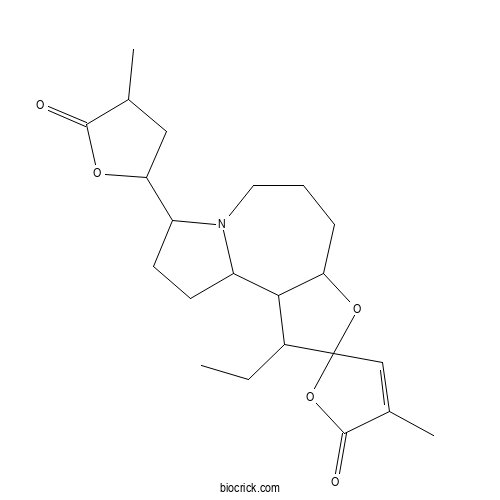
| Cas No. | 69772-72-1 | SDF | File under preparation. |
| PubChem ID | 155331.0 | Appearance | Powder |
| Formula | C22H31NO5 | M.Wt | 389.5 |
| Type of Compound | Other Alkaloids | Storage | Desiccate at -20°C |
| Solubility | Soluble in Chloroform,Dichloromethane,Ethyl Acetate,DMSO,Acetone,etc. | ||
| Chemical Name | 3-ethyl-3\'-methyl-11-(4-methyl-5-oxooxolan-2-yl)spiro[5-oxa-10-azatricyclo[8.3.0.02,6]tridecane-4,5\'-furan]-2\'-one | ||
| SMILES | CCC1C2C3CCC(N3CCCC2OC14C=C(C(=O)O4)C)C5CC(C(=O)O5)C | ||
| Standard InChIKey | UINUUSQOLRQGNF-UHFFFAOYSA-N | ||
| Standard InChI | InChI=1S/C22H31NO5/c1-4-14-19-16-8-7-15(18-10-12(2)20(24)26-18)23(16)9-5-6-17(19)27-22(14)11-13(3)21(25)28-22/h11-12,14-19H,4-10H2,1-3H3 | ||
| General tips | For obtaining a higher solubility , please warm the tube at 37 ℃ and shake it in the ultrasonic bath for a while.Stock solution can be stored below -20℃ for several months. We recommend that you prepare and use the solution on the same day. However, if the test schedule requires, the stock solutions can be prepared in advance, and the stock solution must be sealed and stored below -20℃. In general, the stock solution can be kept for several months. Before use, we recommend that you leave the vial at room temperature for at least an hour before opening it. |
||
| About Packaging | 1. The packaging of the product may be reversed during transportation, cause the high purity compounds to adhere to the neck or cap of the vial.Take the vail out of its packaging and shake gently until the compounds fall to the bottom of the vial. 2. For liquid products, please centrifuge at 500xg to gather the liquid to the bottom of the vial. 3. Try to avoid loss or contamination during the experiment. |
||
| Shipping Condition | Packaging according to customer requirements(5mg, 10mg, 20mg and more). Ship via FedEx, DHL, UPS, EMS or other couriers with RT, or blue ice upon request. | ||
Quality Control & MSDS
3D structure
Package In Stock

Number of papers citing our products


Stemoninine Dilution Calculator
Stemoninine Molarity Calculator
| 1 mg | 5 mg | 10 mg | 20 mg | 25 mg | |
| 1 mM | 2.5674 mL | 12.837 mL | 25.6739 mL | 51.3479 mL | 64.1849 mL |
| 5 mM | 0.5135 mL | 2.5674 mL | 5.1348 mL | 10.2696 mL | 12.837 mL |
| 10 mM | 0.2567 mL | 1.2837 mL | 2.5674 mL | 5.1348 mL | 6.4185 mL |
| 50 mM | 0.0513 mL | 0.2567 mL | 0.5135 mL | 1.027 mL | 1.2837 mL |
| 100 mM | 0.0257 mL | 0.1284 mL | 0.2567 mL | 0.5135 mL | 0.6418 mL |
| * Note: If you are in the process of experiment, it's necessary to make the dilution ratios of the samples. The dilution data above is only for reference. Normally, it's can get a better solubility within lower of Concentrations. | |||||
- Rorifamide
Catalog No.:BCX2819
CAS No.:53078-91-4
- Esculentoside L
Catalog No.:BCX2818
CAS No.:130364-33-9
- Gweicurculactone
Catalog No.:BCX2817
CAS No.:123914-43-2
- 3-Phenylpropyl Acetate
Catalog No.:BCX2816
CAS No.:122-72-5
- Auramine O
Catalog No.:BCX2815
CAS No.:2465-27-2
- Cadalene
Catalog No.:BCX2814
CAS No.:483-78-3
- Glycocholic acid
Catalog No.:BCX2813
CAS No.:475-31-0
- 2-Deoxokanshone M
Catalog No.:BCX2250
CAS No.:3062873-62-2
- Z-isogeranic acid
Catalog No.:BCX2249
CAS No.:85916-85-4
- 6,11,12,16-Tetrahydroxy-5,8,11,13-abitetetraen-7-one
Catalog No.:BCX2248
CAS No.:1295650-67-7
- 3-(2-Hydroxyphenyl)propionic acid
Catalog No.:BCX2247
CAS No.:495-78-3
- Oxypeucedanin hydrate-3-ethyl ether
Catalog No.:BCX2246
CAS No.:90686-46-7
- Dracorubin
Catalog No.:BCX2821
CAS No.:6219-63-2
- Astin J
Catalog No.:BCX2822
CAS No.:163136-31-0
- Kalopanaxsaponin G
Catalog No.:BCX2823
CAS No.:57539-70-5
- Kuwanon L
Catalog No.:BCX2824
CAS No.:88524-65-6
- Evodiamide
Catalog No.:BCX2825
CAS No.:116965-70-9
- Dihydrochelirubine
Catalog No.:BCX2826
CAS No.:28342-26-9
- Protodioscin
Catalog No.:BCX2827
CAS No.:60478-69-5
- Parthenin
Catalog No.:BCX2828
CAS No.:508-59-8
- (+)-(R)-Ribalinine
Catalog No.:BCX2829
CAS No.:62928-56-7
- Rorifone
Catalog No.:BCX2830
CAS No.:53078-90-3
- Esculentoside F
Catalog No.:BCX2831
CAS No.:95263-31-3
- Trans-resveratrol-3-O-β-D-glucuronide
Catalog No.:BCX2832
CAS No.:387372-17-0
Renoprotective effects of Stemona sessilifolia via suppression of the c-Myc/c-Fos/MAPK pathway in hyperuricemic nephropathy.[Pubmed:41317808]
J Ethnopharmacol. 2026 Mar 1;358:120969.
ETHNOPHARMACOLOGICAL RELEVANCE: Stemona sessilifolia (Miq.) Miq. has been employed in traditional medicine for its potential renal benefits, including anti-edema, diuretic, and anti-jaundice properties. However, the renoprotective effects related to these traditional uses remain to be fully elucidated. AIM OF THE STUDY: To investigate the therapeutic efficacy of S. sessilifolia against hyperuricemic nephropathy and elucidate its underlying signaling pathway. MATERIALS AND METHODS: A hyperuricemic nephropathy mouse model, induced by potassium oxonate and hypoxanthine, was employed to evaluate the renal protection of the extract of S. sessilifolia through biochemical tests and histopathological observation. Transcriptomic analysis was applied to explore potential signaling pathways. Subsequently, bioassay-guided isolation was conducted during phytochemical investigation. Uric acid-induced HK-2 cells were then employed to validate the renal cytoprotective effects of the isolated compounds. RESULTS: Treatment with S. sessilifolia extract significantly reduced serum uric acid, creatinine, and urea nitrogen levels by 65.15 %, 47.95 %, and 49.1 %, respectively. Additionally, it decreased urinary protein excretion, and ameliorated renal injury and fibrosis in mice. The protective effects might be exerted by inhibiting the c-Myc/c-Fos/MAPK signaling pathway to maintain the homeostasis of renal tissue. Moreover, the bioactive compound Stemoninine protected HK-2 cells against uric acid-induced oxidative stress, inflammatory response, proliferation, migration, and apoptosis. CONCLUSION: The S. sessilifolia extract and its major bioactive compound, Stemoninine, protected against hyperuricemic nephropathy by suppressing the c-Myc/c-Fos/MAPK signaling pathway.
Asymmetric Total Synthesis of Four Stemona Alkaloids.[Pubmed:36966439]
Org Lett. 2023 Apr 7;25(13):2213-2217.
Asymmetric total syntheses of four Stemona alkaloids were accomplished, and among them, bisdehydroStemoninine A and Stemoninine A were synthesized for the first time. Notably, these four alkaloids were divergently synthesized from a common tetracyclic intermediate, which was easily obtained from a known compound. Friedel-Crafts acylation was employed to introduce the key side chain at position C3 of Stemona alkaloids.
Exploration in the Mechanism of Zhisou San for the Treatment of Cough Variant Asthma Based on Network Pharmacology.[Pubmed:35815290]
Evid Based Complement Alternat Med. 2022 Jun 29;2022:1698571.
BACKGROUND: Cough variant asthma (CVA) has no definitive diagnosis or pathogenic causes, and there is currently no effective and safe treatment. METHODS: The network pharmacology was employed to investigate possible targets of Zhisou San (ZSS) in CVA treatment. The main chemical constituents of seven herbs in ZSS were collected based on the TCMSP. To explain the main mechanism, we sequentially screened the targets of each active ingredient and constructed the network of "herb-ingredient-target-disease." The core targets of ZSS were further confirmed by the molecular docking analysis. Furthermore, pulmonary function, histopathology, and biochemical assays in mice were used to investigate the effect of ZSS on the treatment of CVA. RESULTS: A total of 137 active ingredients and 86 potential targets for the ZSS in the treatment of CVA were screened, which were connected with the regulation of inflammatory response and immune balance, such as IL-17 signaling pathway, Th17 cell differentiation, TNF signaling pathway, Toll-like receptor signaling pathway, MAPK signaling pathway, T-cell receptor signaling pathway, Th1 and Th2 cell differentiation, and other signaling pathways closely related to the pathogenesis of CVA. Thereinto, 29 core targets contained 8 of the highest scores and could evidently bind to components such as stigmasterol, quercetin, Stemoninine B, luteolin, and beta-sitosterol predicted by molecular docking. Furthermore, experiments in vivo were conducted for further validation that ZSS had essential effects on lung function and histopathology as well as the inflammatory state in CVA mice, which was significantly related to regulating the Th17/Treg immune balance to reduce inflammation as the important pharmacological mechanism. CONCLUSION: This study revealed that ZSS has multicomponent and multipathway characteristics of ZSS in the treatment of CVA, which was primarily associated with inflammation and Th17/Treg immune balance. This study provides a scientific foundation for systematically elaborating the pharmacological activities and mechanism of ZSS, as well as explaining the reliability of the TCM compatibility theory.
Morphological and chemical variation of Stemona tuberosa from southern China - Evidence for heterogeneity of this medicinal plant species.[Pubmed:28580601]
Plant Biol (Stuttg). 2017 Sep;19(5):835-842.
The occurrence of bioactive alkaloids and tocopherols was studied in 15 different provenances of Stemona tuberosa Lour. collected in southern China, to examine chemical variation of individuals that show notable differences in flower characteristics. Morphological variations stimulated examination of chemical characteristics of these individuals. Methanolic root extracts of 15 individuals of S. tuberosa were comparatively assessed with HPLC-UV-DAD/ELSD. Five of seven compounds were co-chromatographically identified. Two compounds were isolated and their structure elucidated using NMR and MS. Amounts of alkaloids and tocopherols were determined using HPLC-UV-DAD/ELSD with the external standard method. Five alkaloids, tuberostemonine (1), tuberostemonine A (2), neotuberostemonine (3), tuberostemonine N (4), Stemoninine (5) and two 3,4-dehydrotocopherol derivatives were identified. Within S. tuberosa alkaloid accumulation tends either towards tuberostemonine (1) or Stemoninine (5). All individuals show a notable co-occurrence of compounds 1 or 5 and 3,4-dehydro-delta-tocopherol (6). These results coincide with differences in flower morphology of S. tuberosa. Stemona tuberosa, as defined in the Flora of China, shows a remarkable variation in flower morphology and additionally in the accumulation of alkaloids. The obtained data show the need for future species delimitation to either species or subspecies level.
[Comparative study of four alkaloids contents and antitussive activities of Stemona tuberosa from different habitats of Guangxi Province].[Pubmed:26027114]
Zhong Yao Cai. 2014 Nov;37(11):1956-60.
OBJECTIVE: To compare the contents of four alkaloids and antitussive activities of Stemona tuberosa from different habitats of Guangxi Province. METHODS: The HPLC separation was performed on a Merck Purospher STAR RP18 (250 mm x 4. 6 mm, 5 microm) column by gradient elution using 0. 05% ammonia-acetonitrile as the mobile phase. The flow rate was 1. 0 mL/min, the dectection wave-length was set at 210 nm,and the column temperature was 40 degrees C. The antitussive potency of total alkaloids of Stemonae Radix from different habitats was evaluated on guinea pigs with citric acid aerosol to induce cough. RESULTS: The range of recoveries of this mehtod was 98. 24% ~ 101. 21%, with all the constituents showing good linearity(the correlation coefficents above 0. 999). The major chemotype of Stemonae Radix in Guangxi was Stemoninine, following by tuberostemonine and croomine, and finally neotuberostemonine. The antitussive activitiy of Stemona tuberosa was in a concentration-dependent manner. CONCLUSION: Stemonae Radix from Dongxing, Fangcheng can reduce cough times and prolong cough incubation period, and thus Dongxing, Fangcheng is the best habitat in Guangxi in the present experiments.
Development and validation of a high-performance liquid chromatographic method for the determination of stemoninine in rat plasma after administration of Stemona tuberosa extracts.[Pubmed:20641003]
Biomed Chromatogr. 2011 Apr;25(4):498-502.
For the first time, an HPLC method was developed and validated for the determination of Stemoninine in plasma after oral and intravenous administration of the extract of the roots of Stemona tuberosa to rats. Plasma samples were analyzed on a Waters reversed-phase C(18) column using a gradient mobile-phase of eluent A (water containing 0.1% formic acid and 0.2% triethylamine, pH 3.68) and eluent B (acetonitrile-water, 50:50, v/v). The flow rate was 1.0 mL/min and the detector wavelength was 210 nm. The Waters Oasis solid-phase extraction cartridge was applied for the preparation of plasma samples with high recovery. A good linear relationship was obtained in the concentration range of 1.55-124 microg/mL (r = 0.9995). The limits of quantification and detection were 1.55 and 0.42 microg/mL, respectively. The average recoveries ranged from 91.11 to 96.43% in plasma at Stemoninine concentrations of 3.10, 62.0 and 99.2 microg/mL. Intra- and inter-batch coefficient of variations were 3.27-5.37% and 2.49-3.92%, respectively. This method was successfully applied to pharmacokinetic studies after oral and intravenous administration of Stemona tuberosa extract in rats.
Antitussive and central respiratory depressant effects of Stemona tuberosa.[Pubmed:20219659]
J Ethnopharmacol. 2010 Apr 21;128(3):679-84.
AIMS OF THE STUDY: Stemona alkaloids with distinctly different chemical skeletons are recently reported as the active components in the antitussive herb Baibu derived from the root-tubers of Stemona tuberosa. This study aims to determine if alkaloids of this herb contribute equally to the antitussive functions, act on the same sites of cough reflex, and play any role in inducing central respiratory depressant effects. MATERIALS AND METHODS: Antitussive potency of four major alkaloids was evaluated on guinea pigs with citric acid aerosol to induce cough. The action sites of the alkaloids on cough reflex pathway were tested with electrical stimulation of the superior laryngeal nerve in guinea pigs. The central respiratory effects of croomine were also tested on guinea pigs. RESULTS: Croomine, neotuberostemonine and Stemoninine showed similar antitussive potency, while tuberostemonine showed much weaker antitussive potency. Neotuberostemonine, tuberostemonine and Stemoninine acted on the peripheral cough reflex pathway, while croomine acted on the central part. Croomine also showed obvious central respiratory depressant effects. CONCLUSIONS: The four major Stemona alkaloids in Stemona tuberosa do not contribute equally to antitussive potency in guinea pigs. Neotuberostemonine, tuberostemonine and Stemoninine target on peripheral cough reflex pathway. Croomine acts on central sites in the cough reflex pathway and demonstrates central respiratory depressant effects, which can partly account for the adverse reactions reported for the herb.
Antitussive stemoninine alkaloids from the roots of Stemona tuberosa.[Pubmed:18452334]
J Nat Prod. 2008 Jun;71(6):1107-10.
Investigation of the roots of Stemona tuberosa afforded five minor constituents, stemoenonine (1), 9a- O-methylstemoenonine (2), oxystemoenonine (3), 1,9a- seco-stemoenonine (4), and oxyStemoninine (5), along with the known compound stemoninoamide (6). Their structures were elucidated by 1D and 2D NMR spectra and other spectroscopic studies. Alkaloids 1, 2, and 6, as well as the representative Stemoninine-type alkaloid, Stemoninine (7), were screened for antitussive activity in the citric acid-induced guinea pig cough model. Compounds 6 and 7 exhibited strong antitussive activity after oral and intraperitoneal administrations.
New stemona alkaloids from the roots of Stemona sessilifolia.[Pubmed:18421751]
Chem Biodivers. 2008 Apr;5(4):598-605.
From the roots of Stemona sessilifolia, three new stemona-type alkaloids, namely stemosessifoine (1), isooxymaistemonine (2), and isomaistemonine (3), along with eight known alkaloids (bisdehydroStemoninine, isobisdehydroStemoninine, tuberostemonine, bisdehydrotuberostemonine, bisdehydroStemoninine, isobisdehydroStemoninine, Stemoninine, and protostemonine), were isolated. Their structures were determined on the basis of extensive 2D-NMR spectroscopic-data analysis and by comparison with reported values in the literature. Compound 1 is a structurally unprecedented alkaloid, and it is depicted to be bioconverted from tuberostemonine as the precursor. Isooxymaistemonine (2) showed a positive effect on the human high-density lipoprotein (HDL) receptor gene CD36 and LIMP II analogous-1 (CLA-1) at the dosage of 10 microg/ml.
Stemoninine-type alkaloids from the roots of Stemona sessilifolia.[Pubmed:18348060]
J Asian Nat Prod Res. 2008 Mar-Apr;10(3-4):355-9.
Two new Stemoninine-type alkaloids, Stemoninine A (1) and B (2), along with two known Stemona alkaloids, bisdehydroStemoninine (3) and bisdehydroStemoninine A (4), were isolated from the roots of Stemona sessilifolia, and their structures and relative configurations were determined on the basis of spectrometric data analysis.
Quality evaluation of Radix Stemonae through simultaneous quantification of bioactive alkaloids by high-performance liquid chromatography coupled with diode array and evaporative light scattering detectors.[Pubmed:17583876]
Biomed Chromatogr. 2007 Oct;21(10):1088-94.
A high-performance liquid chromatography coupled with diode array detection and evaporative light scattering detection (HPLC-DAD-ELSD) method was developed to simultaneously quantify six major bioactive alkaloids belonging to different structure types in Radix Stemonae, Bai-Bu in Chinese, a traditionally used antitussive and insecticidal medicinal material in China and other countries of Southeast Asia. Diode array detector (DAD) with the wavelengths at 307 and 260 nm was used to monitor the conjugated system of protostemonine (2) and maistemonine (4), respectively, whereas evaporative light scattering detector (ELSD) was employed to detect croomine (1), Stemoninine (3), neotuberostemonine (5) and tuberostemonine (6), the other four analytes with no or poor chromophores. The assay was validated to be sensitive, precise and accurate, with a detection limit of 3.64-0.04 microg/mL depending on the individual analytes. The overall intra- and inter-day variations were less than 9.3%, and the overall recoveries higher than 91.2%, respectively. The correlation coefficients of the calibration curves were better than 0.996 for all analytes. The newly established method was successfully utilized to determine six major components in the genuine sources of Radix Stemonae: Stemona japonica, S. sessilifolia and S. tuberosa. Significant variations of contents of these components were demonstrated in samples of these three species. This simple, rapid, low-cost and reliable method is suitable for the routine quality control of herbal medicines containing bioactive components with different structure types such as Radix Stemonae.
Stemoninines from the roots of Stemona tuberosa.[Pubmed:16872143]
J Nat Prod. 2006 Jul;69(7):1051-4.
Five new Stemoninine-type alkaloids, bisdehydroStemoninine (1), isobisdehydroStemoninine (2), bisdehydroneoStemoninine (3), and bisdehydroStemoninines A (4) and B (5), were isolated from the crude-alkaloid extract of the roots of Stemona tuberosa. Their structures were elucidated on the basis of one- and two-dimensional NMR and other spectroscopic studies. The relative configuration of 4 was determined by X-ray diffraction. Alkaloid 1 displayed significant antitussive activity in the citric acid-induced guinea pig cough model.

Calcutta University

University of Minnesota

University of Maryland School of Medicine

University of Illinois at Chicago

The Ohio State University

University of Zurich

Harvard University

Colorado State University

Auburn University

Yale University

Worcester Polytechnic Institute

Washington State University

Stanford University

University of Leipzig

Universidade da Beira Interior

The Institute of Cancer Research

Heidelberg University

University of Amsterdam

University of Auckland

TsingHua University

The University of Michigan

Miami University

DRURY University

Jilin University

Fudan University

Wuhan University

Sun Yat-sen University

Universite de Paris

Deemed University

Auckland University

The University of Tokyo

Korea University



