
GweicurculactoneCAS# 123914-43-2 |
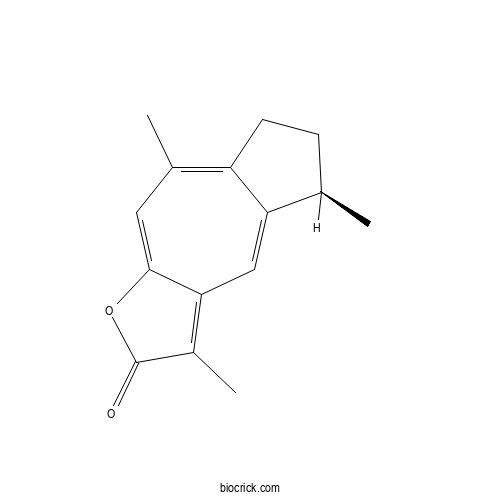
| Cas No. | 123914-43-2 | SDF | File under preparation. |
| PubChem ID | 130117.0 | Appearance | Powder |
| Formula | C15H16O2 | M.Wt | 228.3 |
| Type of Compound | Sesquiterpenoids | Storage | Desiccate at -20°C |
| Solubility | Soluble in Chloroform,Dichloromethane,Ethyl Acetate,DMSO,Acetone,etc. | ||
| Chemical Name | (8R)-1,5,8-trimethyl-7,8-dihydro-6H-azuleno[6,5-b]furan-2-one | ||
| SMILES | CC1CCC2=C(C=C3C(=C(C(=O)O3)C)C=C12)C | ||
| Standard InChIKey | OGJFTQVVQQMGJG-MRVPVSSYSA-N | ||
| Standard InChI | InChI=1S/C15H16O2/c1-8-4-5-11-9(2)6-14-13(7-12(8)11)10(3)15(16)17-14/h6-8H,4-5H2,1-3H3/t8-/m1/s1 | ||
| General tips | For obtaining a higher solubility , please warm the tube at 37 ℃ and shake it in the ultrasonic bath for a while.Stock solution can be stored below -20℃ for several months. We recommend that you prepare and use the solution on the same day. However, if the test schedule requires, the stock solutions can be prepared in advance, and the stock solution must be sealed and stored below -20℃. In general, the stock solution can be kept for several months. Before use, we recommend that you leave the vial at room temperature for at least an hour before opening it. |
||
| About Packaging | 1. The packaging of the product may be reversed during transportation, cause the high purity compounds to adhere to the neck or cap of the vial.Take the vail out of its packaging and shake gently until the compounds fall to the bottom of the vial. 2. For liquid products, please centrifuge at 500xg to gather the liquid to the bottom of the vial. 3. Try to avoid loss or contamination during the experiment. |
||
| Shipping Condition | Packaging according to customer requirements(5mg, 10mg, 20mg and more). Ship via FedEx, DHL, UPS, EMS or other couriers with RT, or blue ice upon request. | ||
Quality Control & MSDS
3D structure
Package In Stock

Number of papers citing our products


Gweicurculactone Dilution Calculator
Gweicurculactone Molarity Calculator
| 1 mg | 5 mg | 10 mg | 20 mg | 25 mg | |
| 1 mM | 4.3802 mL | 21.901 mL | 43.802 mL | 87.604 mL | 109.505 mL |
| 5 mM | 0.876 mL | 4.3802 mL | 8.7604 mL | 17.5208 mL | 21.901 mL |
| 10 mM | 0.438 mL | 2.1901 mL | 4.3802 mL | 8.7604 mL | 10.9505 mL |
| 50 mM | 0.0876 mL | 0.438 mL | 0.876 mL | 1.7521 mL | 2.1901 mL |
| 100 mM | 0.0438 mL | 0.219 mL | 0.438 mL | 0.876 mL | 1.0951 mL |
| * Note: If you are in the process of experiment, it's necessary to make the dilution ratios of the samples. The dilution data above is only for reference. Normally, it's can get a better solubility within lower of Concentrations. | |||||
- 3-Phenylpropyl Acetate
Catalog No.:BCX2816
CAS No.:122-72-5
- Auramine O
Catalog No.:BCX2815
CAS No.:2465-27-2
- Cadalene
Catalog No.:BCX2814
CAS No.:483-78-3
- Glycocholic acid
Catalog No.:BCX2813
CAS No.:475-31-0
- 2-Deoxokanshone M
Catalog No.:BCX2250
CAS No.:3062873-62-2
- Z-isogeranic acid
Catalog No.:BCX2249
CAS No.:85916-85-4
- 6,11,12,16-Tetrahydroxy-5,8,11,13-abitetetraen-7-one
Catalog No.:BCX2248
CAS No.:1295650-67-7
- 3-(2-Hydroxyphenyl)propionic acid
Catalog No.:BCX2247
CAS No.:495-78-3
- Oxypeucedanin hydrate-3-ethyl ether
Catalog No.:BCX2246
CAS No.:90686-46-7
- 4'-Demethyldeoxypodophyllotoxin beta-D-glucopyranoside
Catalog No.:BCX2245
CAS No.:78178-42-4
- Dihydromelilotoside
Catalog No.:BCX2244
CAS No.:24696-05-7
- 7-Feruloylloganic acid
Catalog No.:BCX2243
CAS No.:178666-92-7
- Esculentoside L
Catalog No.:BCX2818
CAS No.:130364-33-9
- Rorifamide
Catalog No.:BCX2819
CAS No.:53078-91-4
- Stemoninine
Catalog No.:BCX2820
CAS No.:69772-72-1
- Dracorubin
Catalog No.:BCX2821
CAS No.:6219-63-2
- Astin J
Catalog No.:BCX2822
CAS No.:163136-31-0
- Kalopanaxsaponin G
Catalog No.:BCX2823
CAS No.:57539-70-5
- Kuwanon L
Catalog No.:BCX2824
CAS No.:88524-65-6
- Evodiamide
Catalog No.:BCX2825
CAS No.:116965-70-9
- Dihydrochelirubine
Catalog No.:BCX2826
CAS No.:28342-26-9
- Protodioscin
Catalog No.:BCX2827
CAS No.:60478-69-5
- Parthenin
Catalog No.:BCX2828
CAS No.:508-59-8
- (+)-(R)-Ribalinine
Catalog No.:BCX2829
CAS No.:62928-56-7
[Prediction of material basis and mechanism of Curcumae Rhizoma in treatment of coronary heart disease].[Pubmed:35851121]
Zhongguo Zhong Yao Za Zhi. 2022 Jun;47(12):3270-3284.
Coronary heart disease(CHD) is a common cardiovascular disease in clinical practice. Curcumae Rhizoma(CR), an important herbal medicine for breaking blood stasis and resolving mass, is often used for the treatment of CHD caused by blood stasis syndrome. However, the anti-CHD components, targets, and mechanism are still unclear. Therefore, in this study, the chemical components of CR were separated and identified by ultra high performance liquid chromatography-quadrupole-time-of-flight mass spectrometry(UPLC-Q-TOF-MS/MS). Based on the identified components, network pharmacology analysis, including target prediction and functional enrichment, was applied to screen out the main active components against CHD, and the potential mechanism was discussed. Finally, molecular docking was performed to verify the binding between the active components and the targets. The results showed that among the 52 chemical components identified in CR, 28 were related to CHD, involving 75 core targets. The core components included(4S)-4-hydroxy-Gweicurculactone, curcumadione, and curcumenone, and the core targets included phosphatidylinositol-4,5-bisphosphate 3-kinase, catalytic subunit alpha(PIK3 CA), mitogen-activated protein kinase 1(MAPK1), and mitogen-activated protein kinase 3(MAPK3). In summary, through the active components, such as(4S)-4-hydroxy-Gweicurculactone, curcumadione, and curcumenone, CR regulates the nerve repair, vasoconstriction, lipid metabolism, and inflammatory response, thereby exerts therapeutic effect on CHD.
Preparation and characterization of immobilized 5-HT(1A) receptor stationary phase for high throughput screening of the receptor-binding ligands from complex systems like Curcuma wenyujin Y. H. Chen et C. Ling extract.[Pubmed:35131672]
J Pharm Biomed Anal. 2022 Mar 20;211:114632.
The incidence of depression has increased significantly during the COVID-19 pandemic. This disease is closely associated with serotonin (1A) (5-HT(1A)) receptor and often treated by complex prescription containing Curcuma wenyujin Y. H. Chen et C. Ling. Therefore, we hypothesized that this herb contains bioactive compounds specially binding to the receptor. However, the rapid discovery of new ligands of 5-HT(1A) receptor is still challenging due to the lack of efficient screening methods. To address this problem, we developed and characterized a novel approach for the rapid screening of ligands by using immobilized 5-HT(1A) receptor as the chromatographic stationary phase. Briefly, haloalkane dehalogenase was fused at the C-terminal of 5-HT(1A) receptor, and the modified 5-HT(1A) receptor was immobilized on amino-microspheres by the reaction between haloalkane dehalogenase and 6-chlorohexanoic acid linker. Scanning electron microscope and X-ray photo-electron were used to characterize the morphology and element of the immobilized receptor. The binding of three specific ligands to 5-HT(1A) receptor was investigated by two different methods. Moreover, we examined the feasibility of 5-HT(1A) receptor colume in high throughput screening of new ligands from complex systems as exemplified by Curcuma wenyujin Y. H. Chen et C. Ling. Gweicurculactone, 2-hydroxy-1-(3,4-dihydroxybenzene)-7-(4'-hydroxybezene)-heptane and curcuminol F were identified as the ligands of 5-HT(1A) receptor with the binding energies of -7.06 kcal/mol, -7.77 kcal/mol and -5.26 kcal/mol, respectively. Collectively, these results indicated that the immobilized 5-HT(1A) receptor was capable of screening bioactive compound from complex system, providing an effective methodology for high throughput screening.
Antiinflammation constituents from Curcuma zedoaroides.[Pubmed:30109745]
Phytother Res. 2018 Nov;32(11):2312-2320.
Curcuma zedoaroides, a Zingiberaceae species, has been used for snake bite antidote and wound care in Thailand. Seven compounds were isolated from the bioactive chloroform extract consisted of one new guaiane sesquiterpene lactone, 5-epiphaeocaulisin A (4) and one new diarylheptanoid, 1,2,3,5-tetrahydroxy-1-(4-hydroxy-3-methoxyphenyl)-7-(4-hydroxyphenyl) heptane (7), together with five known guaiane-type sesquiterpene lactones including Gweicurculactone (1), zedoalactone B (2), phaeocaulisin C (3), zedoalactone H (5), and zedoalactone E (6). The antiinflammation was investigated on NO and TNF-alpha production using RAW264.7 cells. In addition, the expressions of genes involved in inflammation including iNOS, COX-2, and TNF-alpha were assessed. The results found that Compounds 1-7 presented their antiinflammation against NO production. The most potential effects were demonstrated on Compounds 1 and 7 with IC(50) of 27.3 and 32.6 muM, respectively. Although, Compounds 1 and 7 did not inhibit TNF-alpha production, their suppression on iNOS and COX-2 mRNA expression were revealed. These results support the ability of chloroform fraction, Compounds 1 and 7 on antiinflammation, whereas others exhibited moderate and mild effect.
Divergent pathways to furosesquiterpenes: first total syntheses of (+)-zedoarol and (Rac)-gweicurculactone.[Pubmed:25564049]
Chem Commun (Camb). 2015 Feb 11;51(12):2364-7.
A non-natural hydroxy-elemane was found amenable to divergent transformations, producing either polyunsaturated guaianes under basic, oxygen-free conditions, or oxidized furogermacranes when anionic oxy-Cope reaction quenched by an oxidant is employed. Based on these findings, the first total syntheses of zedoarol and Gweicurculactone are reported.
Cytotoxic constituents from the rhizomes of Curcuma zedoaria.[Pubmed:25126594]
ScientificWorldJournal. 2014;2014:321943.
Curcuma zedoaria also known as Temu putih is traditionally used in food preparations and treatment of various ailments including cancer. The cytotoxic activity of hexane, dichloromethane, ethyl acetate, methanol, and the methanol-soxhlet extracts of Curcuma zedoaria rhizomes was tested on two human cancer cell lines (Ca Ski and MCF-7) and a noncancer cell line (HUVEC) using MTT assay. Investigation on the chemical components in the hexane and dichloromethane fractions gave 19 compounds, namely, labda-8(17),12 diene-15,16 dial (1), dehydrocurdione (2), curcumenone (3), comosone II (4), curcumenol (5), procurcumenol (6), germacrone (7), zerumbone epoxide (8), zederone (9), 9-isopropylidene-2,6-dimethyl-11-oxatricyclo[6.2.1.0(1,5)]undec-6-en-8-ol (10), furanodiene (11), germacrone-4,5-epoxide (12), calcaratarin A (13), isoprocurcumenol (14), germacrone-1,10-epoxide (15), zerumin A (16), curcumanolide A (17), curcuzedoalide (18), and Gweicurculactone (19). Compounds (1-19) were evaluated for their antiproliferative effect using MTT assay against four cancer cell lines (Ca Ski, MCF-7, PC-3, and HT-29). Curcumenone (3) and curcumenol (5) displayed strong antiproliferative activity (IC50 = 8.3 +/- 1.0 and 9.3 +/- 0.3 mug/mL, resp.) and were found to induce apoptotic cell death on MCF-7 cells using phase contrast and Hoechst 33342/PI double-staining assay. Thus, the present study provides basis for the ethnomedical application of Curcuma zedoaria in the treatment of breast cancer.
Three new guaiane sesquiterpene lactones from rhizomes of Curcuma wenyujin.[Pubmed:23679107]
J Asian Nat Prod Res. 2013 Jul;15(7):723-30.
Three new guaiane sesquiterpene lactones (4S)-4-hydroxy-Gweicurculactone (1), zedoalactone G (2), and (1R, 4R, 5S, 10S)-zedoalactone B (3), and three known guaiane sesquiterpene lactones, including zedoarolide B (4), zedoalactone B (5), and a new natural product (+)-zedoalactone A (6), were isolated from the rhizomes of Curcuma wenyujin Y.H. Chen et C. Ling. The structures were elucidated by spectroscopic methods including 1D and 2D NMR and HR-ESI-MS. The absolute configuration of 2 was determined via the calculated electronic circular dichroism (ECD), whereas the absolute configurations of 1 and 3 were determined via the ECD data of the [Rh2(OCOCF3)4] complex and [Mo2(OAc)4] complex, respectively. The inhibitory effects of compounds 1-6 on nitric oxide production in lipopolysaccharide-activated macrophages were evaluated. All of them exhibited weak anti-inflammatory activity.
[Studies on the chemical constituents of Curcuma kwangsiensis].[Pubmed:2609970]
Yao Xue Xue Bao. 1989;24(5):357-9.
A new sesquiterpene lactone named Gweicurculactone, along with beta-sitosterol, germacrone, daucosterin and palmitic acid, was isolated from Curcuma kwangsiensis. Its structure has been confirmed by means of spectral and X-ray diffraction analysis.

Calcutta University

University of Minnesota

University of Maryland School of Medicine

University of Illinois at Chicago

The Ohio State University

University of Zurich

Harvard University

Colorado State University

Auburn University

Yale University

Worcester Polytechnic Institute

Washington State University

Stanford University

University of Leipzig

Universidade da Beira Interior

The Institute of Cancer Research

Heidelberg University

University of Amsterdam

University of Auckland

TsingHua University

The University of Michigan

Miami University

DRURY University

Jilin University

Fudan University

Wuhan University

Sun Yat-sen University

Universite de Paris

Deemed University

Auckland University

The University of Tokyo

Korea University



