
DracorubinCAS# 6219-63-2 |
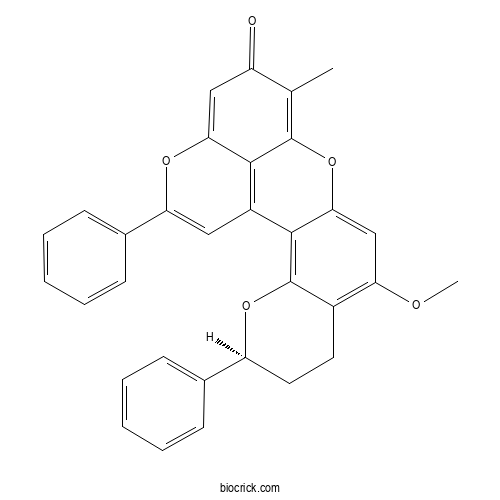
| Cas No. | 6219-63-2 | SDF | File under preparation. |
| PubChem ID | 160270.0 | Appearance | Powder |
| Formula | C32H24O5 | M.Wt | 488.2 |
| Type of Compound | Other Flavonoids | Storage | Desiccate at -20°C |
| Solubility | Soluble in Chloroform,Dichloromethane,Ethyl Acetate,DMSO,Acetone,etc. | ||
| Chemical Name | (5S)-9-methoxy-14-methyl-5,19-diphenyl-4,12,18-trioxapentacyclo[11.7.1.02,11.03,8.017,21]henicosa-1(21),2,8,10,13,16,19-heptaen-15-one | ||
| SMILES | CC1=C2C3=C(C=C(OC3=CC1=O)C4=CC=CC=C4)C5=C6C(=C(C=C5O2)OC)CCC(O6)C7=CC=CC=C7 | ||
| Standard InChIKey | FWKBXSPDFCAHFN-DEOSSOPVSA-N | ||
| Standard InChI | InChI=1S/C32H24O5/c1-18-23(33)16-27-29-22(15-25(35-27)20-11-7-4-8-12-20)30-28(37-31(18)29)17-26(34-2)21-13-14-24(36-32(21)30)19-9-5-3-6-10-19/h3-12,15-17,24H,13-14H2,1-2H3/t24-/m0/s1 | ||
| General tips | For obtaining a higher solubility , please warm the tube at 37 ℃ and shake it in the ultrasonic bath for a while.Stock solution can be stored below -20℃ for several months. We recommend that you prepare and use the solution on the same day. However, if the test schedule requires, the stock solutions can be prepared in advance, and the stock solution must be sealed and stored below -20℃. In general, the stock solution can be kept for several months. Before use, we recommend that you leave the vial at room temperature for at least an hour before opening it. |
||
| About Packaging | 1. The packaging of the product may be reversed during transportation, cause the high purity compounds to adhere to the neck or cap of the vial.Take the vail out of its packaging and shake gently until the compounds fall to the bottom of the vial. 2. For liquid products, please centrifuge at 500xg to gather the liquid to the bottom of the vial. 3. Try to avoid loss or contamination during the experiment. |
||
| Shipping Condition | Packaging according to customer requirements(5mg, 10mg, 20mg and more). Ship via FedEx, DHL, UPS, EMS or other couriers with RT, or blue ice upon request. | ||
Quality Control & MSDS
3D structure
Package In Stock

Number of papers citing our products


Dracorubin Dilution Calculator
Dracorubin Molarity Calculator
| 1 mg | 5 mg | 10 mg | 20 mg | 25 mg | |
| 1 mM | 2.0483 mL | 10.2417 mL | 20.4834 mL | 40.9668 mL | 51.2085 mL |
| 5 mM | 0.4097 mL | 2.0483 mL | 4.0967 mL | 8.1934 mL | 10.2417 mL |
| 10 mM | 0.2048 mL | 1.0242 mL | 2.0483 mL | 4.0967 mL | 5.1209 mL |
| 50 mM | 0.041 mL | 0.2048 mL | 0.4097 mL | 0.8193 mL | 1.0242 mL |
| 100 mM | 0.0205 mL | 0.1024 mL | 0.2048 mL | 0.4097 mL | 0.5121 mL |
| * Note: If you are in the process of experiment, it's necessary to make the dilution ratios of the samples. The dilution data above is only for reference. Normally, it's can get a better solubility within lower of Concentrations. | |||||
- Stemoninine
Catalog No.:BCX2820
CAS No.:69772-72-1
- Rorifamide
Catalog No.:BCX2819
CAS No.:53078-91-4
- Esculentoside L
Catalog No.:BCX2818
CAS No.:130364-33-9
- Gweicurculactone
Catalog No.:BCX2817
CAS No.:123914-43-2
- 3-Phenylpropyl Acetate
Catalog No.:BCX2816
CAS No.:122-72-5
- Auramine O
Catalog No.:BCX2815
CAS No.:2465-27-2
- Cadalene
Catalog No.:BCX2814
CAS No.:483-78-3
- Glycocholic acid
Catalog No.:BCX2813
CAS No.:475-31-0
- 2-Deoxokanshone M
Catalog No.:BCX2250
CAS No.:3062873-62-2
- Z-isogeranic acid
Catalog No.:BCX2249
CAS No.:85916-85-4
- 6,11,12,16-Tetrahydroxy-5,8,11,13-abitetetraen-7-one
Catalog No.:BCX2248
CAS No.:1295650-67-7
- 3-(2-Hydroxyphenyl)propionic acid
Catalog No.:BCX2247
CAS No.:495-78-3
- Astin J
Catalog No.:BCX2822
CAS No.:163136-31-0
- Kalopanaxsaponin G
Catalog No.:BCX2823
CAS No.:57539-70-5
- Kuwanon L
Catalog No.:BCX2824
CAS No.:88524-65-6
- Evodiamide
Catalog No.:BCX2825
CAS No.:116965-70-9
- Dihydrochelirubine
Catalog No.:BCX2826
CAS No.:28342-26-9
- Protodioscin
Catalog No.:BCX2827
CAS No.:60478-69-5
- Parthenin
Catalog No.:BCX2828
CAS No.:508-59-8
- (+)-(R)-Ribalinine
Catalog No.:BCX2829
CAS No.:62928-56-7
- Rorifone
Catalog No.:BCX2830
CAS No.:53078-90-3
- Esculentoside F
Catalog No.:BCX2831
CAS No.:95263-31-3
- Trans-resveratrol-3-O-β-D-glucuronide
Catalog No.:BCX2832
CAS No.:387372-17-0
- Molephantin
Catalog No.:BCX2833
CAS No.:50656-66-1
Discovery of drug candidate to inhibit bronchogenic carcinoma genes biomarkers based on drug repurposing.[Pubmed:41391063]
Discov Oncol. 2025 Dec 14;17(1):114.
OBJECTIVE: Lung cancer is one of the most common and challenging cancers to treat. Advances in research have led to the development of targeted drug therapies that provide suitable options for patients with bronchogenic lung cancer. The aim of the current study is to inhibit genes that have been introduced as biomarkers for the diagnosis of bronchogenic lung cancer. METHODS: This study leverages computational methods to identify repurposable drugs targeting key biomarkers-MLKL, YWHAG, OAS3, TFRC, NXA2, CDK6, NTN1, CD59, RRAS2, and CYP51A1-for cancer treatment. As a primary screening tool, AutoDock Vina was employed for molecular docking to evaluate the binding affinity of existing drugs against these targets. Following the initial screening, molecular dynamics simulations were utilized to select the most stable and ideal drug candidates with specific inhibitory therapeutic properties from the pool identified by docking. This integrated workflow demonstrates an efficient path for discovering new therapeutic uses for existing drugs against a defined panel of cancer biomarkers. RESULTS: For the ten genes under investigation, structurally reliable PDB entries were chosen as the basis for subsequent analyses. The herbal compound Dracorubin, along with 2,299 ligands collected from the PubChem database, was assessed. Molecular dynamics simulations indicated that Dracorubin sustained stable and meaningful inhibitory interactions with the proposed biomarkers. CONCLUSION: The study aimed to find new uses for existing drugs for Bronchogenic lung cancer. Using computational methods like molecular docking and dynamics, researchers prioritized compounds that bind strongly to target proteins. These candidate drugs, prioritize a computational lead requiring experimental validation of Bronchogenic lung cancer progression.
Chemical Profiling and Molecular Docking Study of Agathophora alopecuroides.[Pubmed:36430987]
Life (Basel). 2022 Nov 11;12(11):1852.
Natural products continue to provide inspiring chemical moieties that represent a key stone in the drug discovery process. As per our previous research, the halophyte Agathophora alopecuroides was noted as a potential antidiabetic plant. However, the chemical profiling and highlighting the metabolite(s) responsible for the observed antidiabetic activity still need to be investigated. Accordingly, the present study presents the chemical profiling of this species using the LC-HRMS/MS technique followed by a study of the ligand-protein interaction using the molecular docking method. LC-HRMS/MS results detected twenty-seven compounds in A. alopecuroides extract (AAE) belonging to variable chemical classes. Among the detected compounds, alkaloids, flavonoids, lignans, and iridoids were the most prevailing. In order to highlight the bioactive compounds in AAE, the molecular docking technique was adopted. Results suggested that the two alkaloids (Eburnamonine and Isochondrodendrine) as well as the four flavonoids (Narirutin, Pelargonidin 3-O-rutinoside, Sophora isoflavanone A, and Dracorubin) were responsible for the observed antidiabetic activity. It is worth mentioning that this is the first report for the metabolomic profiling of A. alopecuroides as well as the antidiabetic potential of Isochondrodendrine, Sophora isoflavanone A, and Dracorubin that could be a promising target for an antidiabetic drug.

Calcutta University

University of Minnesota

University of Maryland School of Medicine

University of Illinois at Chicago

The Ohio State University

University of Zurich

Harvard University

Colorado State University

Auburn University

Yale University

Worcester Polytechnic Institute

Washington State University

Stanford University

University of Leipzig

Universidade da Beira Interior

The Institute of Cancer Research

Heidelberg University

University of Amsterdam

University of Auckland

TsingHua University

The University of Michigan

Miami University

DRURY University

Jilin University

Fudan University

Wuhan University

Sun Yat-sen University

Universite de Paris

Deemed University

Auckland University

The University of Tokyo

Korea University



