
EvodiamideCAS# 116965-70-9 |
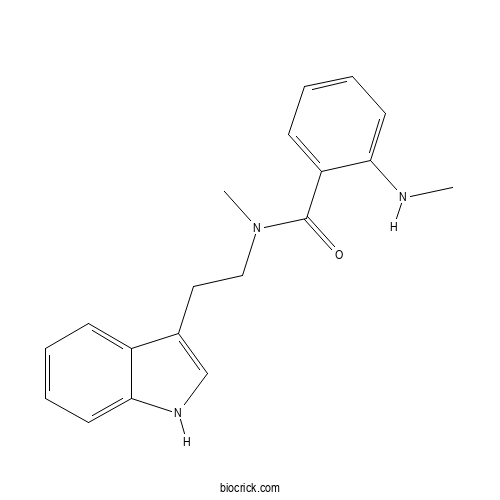
| Cas No. | 116965-70-9 | SDF | File under preparation. |
| PubChem ID | 189454.0 | Appearance | Powder |
| Formula | C19H21N3O | M.Wt | 307.2 |
| Type of Compound | Amides | Storage | Desiccate at -20°C |
| Solubility | Soluble in Chloroform,Dichloromethane,Ethyl Acetate,DMSO,Acetone,etc. | ||
| Chemical Name | N-[2-(1H-indol-3-yl)ethyl]-N-methyl-2-(methylamino)benzamide | ||
| SMILES | CNC1=CC=CC=C1C(=O)N(C)CCC2=CNC3=CC=CC=C32 | ||
| Standard InChIKey | KDRYLUSBBOOWIC-UHFFFAOYSA-N | ||
| Standard InChI | InChI=1S/C19H21N3O/c1-20-17-9-5-4-8-16(17)19(23)22(2)12-11-14-13-21-18-10-6-3-7-15(14)18/h3-10,13,20-21H,11-12H2,1-2H3 | ||
| General tips | For obtaining a higher solubility , please warm the tube at 37 ℃ and shake it in the ultrasonic bath for a while.Stock solution can be stored below -20℃ for several months. We recommend that you prepare and use the solution on the same day. However, if the test schedule requires, the stock solutions can be prepared in advance, and the stock solution must be sealed and stored below -20℃. In general, the stock solution can be kept for several months. Before use, we recommend that you leave the vial at room temperature for at least an hour before opening it. |
||
| About Packaging | 1. The packaging of the product may be reversed during transportation, cause the high purity compounds to adhere to the neck or cap of the vial.Take the vail out of its packaging and shake gently until the compounds fall to the bottom of the vial. 2. For liquid products, please centrifuge at 500xg to gather the liquid to the bottom of the vial. 3. Try to avoid loss or contamination during the experiment. |
||
| Shipping Condition | Packaging according to customer requirements(5mg, 10mg, 20mg and more). Ship via FedEx, DHL, UPS, EMS or other couriers with RT, or blue ice upon request. | ||
Quality Control & MSDS
3D structure
Package In Stock

Number of papers citing our products


Evodiamide Dilution Calculator
Evodiamide Molarity Calculator
| 1 mg | 5 mg | 10 mg | 20 mg | 25 mg | |
| 1 mM | 3.2552 mL | 16.276 mL | 32.5521 mL | 65.1042 mL | 81.3802 mL |
| 5 mM | 0.651 mL | 3.2552 mL | 6.5104 mL | 13.0208 mL | 16.276 mL |
| 10 mM | 0.3255 mL | 1.6276 mL | 3.2552 mL | 6.5104 mL | 8.138 mL |
| 50 mM | 0.0651 mL | 0.3255 mL | 0.651 mL | 1.3021 mL | 1.6276 mL |
| 100 mM | 0.0326 mL | 0.1628 mL | 0.3255 mL | 0.651 mL | 0.8138 mL |
| * Note: If you are in the process of experiment, it's necessary to make the dilution ratios of the samples. The dilution data above is only for reference. Normally, it's can get a better solubility within lower of Concentrations. | |||||
- Kuwanon L
Catalog No.:BCX2824
CAS No.:88524-65-6
- Kalopanaxsaponin G
Catalog No.:BCX2823
CAS No.:57539-70-5
- Astin J
Catalog No.:BCX2822
CAS No.:163136-31-0
- Dracorubin
Catalog No.:BCX2821
CAS No.:6219-63-2
- Stemoninine
Catalog No.:BCX2820
CAS No.:69772-72-1
- Rorifamide
Catalog No.:BCX2819
CAS No.:53078-91-4
- Esculentoside L
Catalog No.:BCX2818
CAS No.:130364-33-9
- Gweicurculactone
Catalog No.:BCX2817
CAS No.:123914-43-2
- 3-Phenylpropyl Acetate
Catalog No.:BCX2816
CAS No.:122-72-5
- Auramine O
Catalog No.:BCX2815
CAS No.:2465-27-2
- Cadalene
Catalog No.:BCX2814
CAS No.:483-78-3
- Glycocholic acid
Catalog No.:BCX2813
CAS No.:475-31-0
- Dihydrochelirubine
Catalog No.:BCX2826
CAS No.:28342-26-9
- Protodioscin
Catalog No.:BCX2827
CAS No.:60478-69-5
- Parthenin
Catalog No.:BCX2828
CAS No.:508-59-8
- (+)-(R)-Ribalinine
Catalog No.:BCX2829
CAS No.:62928-56-7
- Rorifone
Catalog No.:BCX2830
CAS No.:53078-90-3
- Esculentoside F
Catalog No.:BCX2831
CAS No.:95263-31-3
- Trans-resveratrol-3-O-β-D-glucuronide
Catalog No.:BCX2832
CAS No.:387372-17-0
- Molephantin
Catalog No.:BCX2833
CAS No.:50656-66-1
- Molephantinin
Catalog No.:BCX2834
CAS No.:56221-98-8
- 3-Butylidene-7-hydroxyphthalide
Catalog No.:BCX2835
CAS No.:93236-67-0
- (7S)-Hellicoside
Catalog No.:BCX2836
CAS No.:132278-04-7
- Cistanoside C
Catalog No.:BCX2837
CAS No.:94492-22-5
Identifying plant-derived antiviral alkaloids as dual inhibitors of SARS-CoV-2 main protease and spike glycoprotein through computational screening.[Pubmed:39086396]
Front Pharmacol. 2024 Jul 17;15:1369659.
COVID-19 is currently considered the ninth-deadliest pandemic, spreading through direct or indirect contact with infected individuals. It has imposed a consistent strain on both the financial and healthcare resources of many countries. To address this challenge, there is a pressing need for the development of new potential therapeutic agents for the treatment of this disease. To identify potential antiviral agents as novel dual inhibitors of SARS-CoV-2, we retrieved 404 alkaloids from 12 selected medicinal antiviral plants and virtually screened them against the renowned catalytic sites and favorable interacting residues of two essential proteins of SARS-CoV-2, namely, the main protease and spike glycoprotein. Based on docking scores, 12 metabolites with dual inhibitory potential were subjected to drug-likeness, bioactivity scores, and drug-like ability analyses. These analyses included the ligand-receptor stability and interactions at the potential active sites of target proteins, which were analyzed and confirmed through molecular dynamic simulations of the three lead metabolites. We also conducted a detailed binding free energy analysis of pivotal SARS-CoV-2 protein inhibitors using molecular mechanics techniques to reveal their interaction dynamics and stability. Overall, our results demonstrated that 12 alkaloids, namely, adouetine Y, Evodiamide C, ergosine, hayatinine, (+)-homoaromoline, isatithioetherin C, N,alpha-L-rhamnopyranosyl vincosamide, pelosine, reserpine, toddalidimerine, toddayanis, and zanthocadinanine, are shortlisted as metabolites based on their interactions with target proteins. All 12 lead metabolites exhibited a higher unbound fraction and therefore greater distribution compared with the standards. Particularly, adouetine Y demonstrated high docking scores but exhibited a nonspontaneous binding profile. In contrast, ergosine and Evodiamide C showed favorable binding interactions and superior stability in molecular dynamics simulations. Ergosine demonstrated exceptional performance in several key pharmaceutical metrics. Pharmacokinetic evaluations revealed that ergosine exhibited pronounced bioactivity, good absorption, and optimal bioavailability. Additionally, it was predicted not to cause skin sensitivity and was found to be non-hepatotoxic. Importantly, ergosine and Evodiamide C emerged as superior drug candidates for dual inhibition of SARS-CoV-2 due to their strong binding affinity and drug-like ability, comparable to known inhibitors like N3 and molnupiravir. This study is limited by its in silico nature and demands the need for future in vitro and in vivo studies to confirm these findings.
Three new quinazolines from Evodia rutaecarpa and their biological activity.[Pubmed:29454021]
Fitoterapia. 2018 Jun;127:186-192.
In this research, we investigated the profile and bioactivities of quinazoline alkaloids, a class of natural products boasting multiple bioactivities, from the unripe fruit of Evodia rutaecarpa (Juss.) Benth. Three new quinazoline alkaloids, Evodiamide A (1), Evodiamide B (2), and Evodiamide C (3), as well as eight known quinazolines, were isolated from the MeOH extract of E. rutaecarpa. The new compounds are rare quinazolinedione derivatives with linked heterocyclic nuclei. Among these quinazolines, rhetsinine (8) showed potential as a pesticide and exhibited excellent inhibition against Xanthomonas oryzae pv. oryzae, Xanthomonas oryzae pv. oryzicola, and Xanthomonas campestris pv. campestris, with respective EC(50) values of 3.13, 14.32, and 32.72 nmol.
Evodiamide.[Pubmed:22346943]
Acta Crystallogr Sect E Struct Rep Online. 2012 Feb 1;68(Pt 2):o305.
The title compound, C(19)H(21)N(3)O, was isolated from the fruits of Evodia rutaecarpa. The indole and benzene rings are both essentially planar with mean derivations of 0.0094 (4) A and 0.0077 (3) A, respectively. The dihedral angle between these two planes is 78.24 (9) degrees . The amide carbonyl plane is roughly parallel to the indole ring with a dihedral angle of 7.0 (2) degrees , but makes a dihedral angle of 82.9 (3) degrees with the benzene ring. Inter-molecular N-Hcdots, three dots, centeredO hydrogen-bonding inter-actions involving the amino and carbonyl groups give rise to a three-dimensional network.
[TLC-SERS study on evodiamine in evodia rutaecarpa].[Pubmed:17655110]
Guang Pu Xue Yu Guang Pu Fen Xi. 2007 May;27(5):944-7.
A new method for analyzing the ingredients of evodiamine (EV), rutaecarpine (RU), hydroxyevodiamine (HYD), Evodiamide (ED), dihydrorutaecarpine (DRU) and 14-formyldihydrorutaecarpine (FDRU) in evodia rutaecarpa using high performance thin layer chromatography (TLC) and surface enhanced Raman spectroscopy (SERS) technique is reported. The character of this method is that standard samples are not needed. The results show that the characteristic spectral bands of EV, RU, HYD, and ED can be obtained from the TLC spot with microgramme of sample. The spectral band at 1562 cm(-1) was obtained with great enhancement. Molecule absorbed in surface silver sol by nr electrons in ring. The spectral bands of EV, RU, HYD and ED are obviously different due to their differences in structure. The TLC and SERS techniques standard samples are a convenient and speedy method to analyze chemical ingredients with high sensitivity for the study of the Chinese traditional medicine.
Quantitative analyses of indoloquinazoline alkaloids in Fructus Evodiae by high-performance liquid chromatography with atmospheric pressure chemical ionization tandem mass spectrometry.[Pubmed:16986209]
Rapid Commun Mass Spectrom. 2006;20(20):3111-8.
Fructus Evodiae (Wuzhuyu), the fruits of Evodia rutaecarpa and related varieties, is widely used in traditional Chinese medicine. The bioactive constituents include the indoloquinazoline alkaloids rutaecarpine, evodiamine and dehydroevodiamine. A new assay based on high-performance liquid chromatography/atmospheric pressure chemical ionization tandem mass spectrometry (HPLC/UV/APCI-MS/MS) was developed for the measurement of the indoloquinazoline alkaloids in commercial Fructus Evodiae products. Initially, the MS/MS fragmentation pathways of indoloquinazoline alkaloids were investigated to identify fragment ions that might be useful for the sensitive and selective detection of trace indoloquinazoline alkaloids during LC/MS/MS. Then, quantitative MS analysis of five indoloquinazoline alkaloids in 12 commercial Fructus Evodiae products from different geographical sources was performed. Analyte recovery was in the range of 97.5-105.3% for all with relative standard deviations (RSDs) below 6%, the intra-assay and inter-assay RSDs were less than 7%, and good linear relationships were shown with correlation coefficients for the analytes exceeding 0.999. Therefore, this LC/MS/MS assay facilitated the rapid quantitative analysis of rutaecarpine, evodiamine, Evodiamide, 14-formyldihydrorutaecarpine and dehydroevodiamine in 12 commercial Fructus Evodiae products with excellent recovery, repeatability, accuracy and sensitivity. This method is simple and specific and can be used for identification and quality control of this traditional Chinese remedy.

Calcutta University

University of Minnesota

University of Maryland School of Medicine

University of Illinois at Chicago

The Ohio State University

University of Zurich

Harvard University

Colorado State University

Auburn University

Yale University

Worcester Polytechnic Institute

Washington State University

Stanford University

University of Leipzig

Universidade da Beira Interior

The Institute of Cancer Research

Heidelberg University

University of Amsterdam

University of Auckland

TsingHua University

The University of Michigan

Miami University

DRURY University

Jilin University

Fudan University

Wuhan University

Sun Yat-sen University

Universite de Paris

Deemed University

Auckland University

The University of Tokyo

Korea University



