
MolephantinCAS# 50656-66-1 |
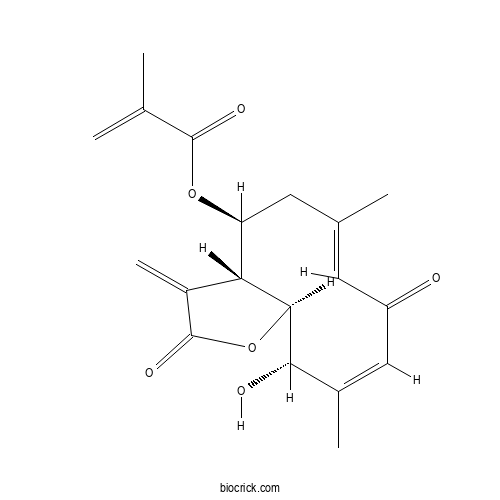
| Cas No. | 50656-66-1 | SDF | File under preparation. |
| PubChem ID | 5281484.0 | Appearance | Powder |
| Formula | C19H22O6 | M.Wt | 346.4 |
| Type of Compound | Sesquiterpenoids | Storage | Desiccate at -20°C |
| Solubility | Soluble in Chloroform,Dichloromethane,Ethyl Acetate,DMSO,Acetone,etc. | ||
| Chemical Name | [(3aR,4S,6E,9Z,11S,11aS)-11-hydroxy-6,10-dimethyl-3-methylidene-2,8-dioxo-4,5,11,11a-tetrahydro-3aH-cyclodeca[b]furan-4-yl] 2-methylprop-2-enoate | ||
| SMILES | CC1=CC(=O)C=C(C(C2C(C(C1)OC(=O)C(=C)C)C(=C)C(=O)O2)O)C | ||
| Standard InChIKey | LXINRHXYVUTAMQ-UKKSPWLWSA-N | ||
| Standard InChI | InChI=1S/C19H22O6/c1-9(2)18(22)24-14-7-10(3)6-13(20)8-11(4)16(21)17-15(14)12(5)19(23)25-17/h6,8,14-17,21H,1,5,7H2,2-4H3/b10-6+,11-8-/t14-,15+,16-,17-/m0/s1 | ||
| General tips | For obtaining a higher solubility , please warm the tube at 37 ℃ and shake it in the ultrasonic bath for a while.Stock solution can be stored below -20℃ for several months. We recommend that you prepare and use the solution on the same day. However, if the test schedule requires, the stock solutions can be prepared in advance, and the stock solution must be sealed and stored below -20℃. In general, the stock solution can be kept for several months. Before use, we recommend that you leave the vial at room temperature for at least an hour before opening it. |
||
| About Packaging | 1. The packaging of the product may be reversed during transportation, cause the high purity compounds to adhere to the neck or cap of the vial.Take the vail out of its packaging and shake gently until the compounds fall to the bottom of the vial. 2. For liquid products, please centrifuge at 500xg to gather the liquid to the bottom of the vial. 3. Try to avoid loss or contamination during the experiment. |
||
| Shipping Condition | Packaging according to customer requirements(5mg, 10mg, 20mg and more). Ship via FedEx, DHL, UPS, EMS or other couriers with RT, or blue ice upon request. | ||
Quality Control & MSDS
3D structure
Package In Stock

Number of papers citing our products


Molephantin Dilution Calculator
Molephantin Molarity Calculator
| 1 mg | 5 mg | 10 mg | 20 mg | 25 mg | |
| 1 mM | 2.8868 mL | 14.4342 mL | 28.8684 mL | 57.7367 mL | 72.1709 mL |
| 5 mM | 0.5774 mL | 2.8868 mL | 5.7737 mL | 11.5473 mL | 14.4342 mL |
| 10 mM | 0.2887 mL | 1.4434 mL | 2.8868 mL | 5.7737 mL | 7.2171 mL |
| 50 mM | 0.0577 mL | 0.2887 mL | 0.5774 mL | 1.1547 mL | 1.4434 mL |
| 100 mM | 0.0289 mL | 0.1443 mL | 0.2887 mL | 0.5774 mL | 0.7217 mL |
| * Note: If you are in the process of experiment, it's necessary to make the dilution ratios of the samples. The dilution data above is only for reference. Normally, it's can get a better solubility within lower of Concentrations. | |||||
- Trans-resveratrol-3-O-β-D-glucuronide
Catalog No.:BCX2832
CAS No.:387372-17-0
- Esculentoside F
Catalog No.:BCX2831
CAS No.:95263-31-3
- Rorifone
Catalog No.:BCX2830
CAS No.:53078-90-3
- (+)-(R)-Ribalinine
Catalog No.:BCX2829
CAS No.:62928-56-7
- Parthenin
Catalog No.:BCX2828
CAS No.:508-59-8
- Protodioscin
Catalog No.:BCX2827
CAS No.:60478-69-5
- Dihydrochelirubine
Catalog No.:BCX2826
CAS No.:28342-26-9
- Evodiamide
Catalog No.:BCX2825
CAS No.:116965-70-9
- Kuwanon L
Catalog No.:BCX2824
CAS No.:88524-65-6
- Kalopanaxsaponin G
Catalog No.:BCX2823
CAS No.:57539-70-5
- Astin J
Catalog No.:BCX2822
CAS No.:163136-31-0
- Dracorubin
Catalog No.:BCX2821
CAS No.:6219-63-2
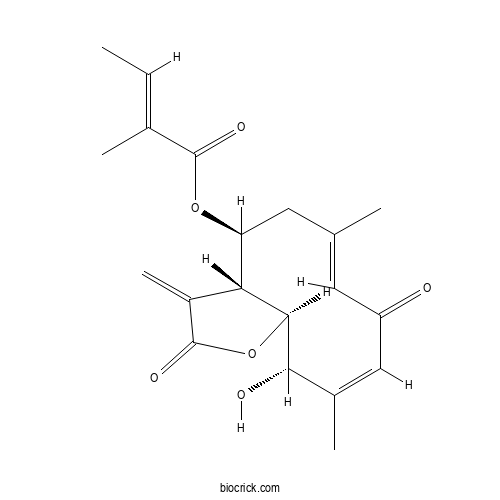
- Molephantinin
Catalog No.:BCX2834
CAS No.:56221-98-8
- 3-Butylidene-7-hydroxyphthalide
Catalog No.:BCX2835
CAS No.:93236-67-0
- (7S)-Hellicoside
Catalog No.:BCX2836
CAS No.:132278-04-7
- Cistanoside C
Catalog No.:BCX2837
CAS No.:94492-22-5
- β-Curcumene
Catalog No.:BCX2838
CAS No.:451-56-9
- (E)-Ligustilide
Catalog No.:BCX2839
CAS No.:81944-08-3
- Apigenin-7-O-(6′′-E-p-coumaroyl-β-D-glucopyranoside)
Catalog No.:BCX2840
CAS No.:105815-90-5
- Xanthalin
Catalog No.:BCX2841
CAS No.:21800-48-6
- Benzyl β-gentiobioside
Catalog No.:BCX2842
CAS No.:56775-64-5
- Amygdalinic acid
Catalog No.:BCX2843
CAS No.:66427-92-7
- 1,2-Dilinoleoyl-3-palmitin
Catalog No.:BCX2844
CAS No.:2190-15-0
- Acanthoic acid
Catalog No.:BCX2845
CAS No.:119290-87-8
ROS-driven mitophagy arrest mediates the anti-glioblastoma activity of Molephantin.[Pubmed:42089469]
Autophagy. 2026 Aug;22(8):2038-2040.
Mitophagy, the selective autophagic degradation of mitochondria, often acts as a pro-survival mechanism in tumor cells, including Glioblastoma (GBM), by clearing damaged mitochondria and mitigating oxidative stress. GBM is a highly aggressive brain tumor characterized by profound resistance to conventional therapies. Our recent study identified Molephantin (EM-5), a natural small molecule capable of crossing the blood-brain barrier, as a potent anti-GBM agent. Mechanistically, EM-5 triggers severe mitochondrial dysfunction and massive reactive oxygen species (ROS) production in GBM. Crucially, we discovered that EM-5 acts as a novel late-stage mitophagy inhibitor. It specifically blocks the fusion of mitophagosomes with lysosomes without affecting early autophagosome formation or lysosomal acidification. This ROS-driven fusion defect leads to the toxic accumulation of damaged mitochondria, thereby amplifying oxidative stress and driving GBM cells into apoptosis. Collectively, our work establishes that targeting late-stage mitophagy flux via ROS modulation is a valuable paradigm for the discovery and development of therapeutic agents against GBM.
Small-molecule Molephantin induces apoptosis and mitophagy flux blockage through ROS production in glioblastoma.[Pubmed:38697460]
Cancer Lett. 2024 Jun 28;592:216927.
Glioblastoma (GBM), one of the most malignant brain tumors in the world, has limited treatment options and a dismal survival rate. Effective and safe disease-modifying drugs for glioblastoma are urgently needed. Here, we identified a small molecule, Molephantin (EM-5), effectively penetrated the blood-brain barrier (BBB) and demonstrated notable antitumor effects against GBM with good safety profiles both in vitro and in vivo. Mechanistically, EM-5 not only inhibits the proliferation and invasion of GBM cells but also induces cell apoptosis through the reactive oxygen species (ROS)-mediated PI3K/Akt/mTOR pathway. Furthermore, EM-5 causes mitochondrial dysfunction and blocks mitophagy flux by impeding the fusion of mitophagosomes with lysosomes. It is noteworthy that EM-5 does not interfere with the initiation of autophagosome formation or lysosomal function. Additionally, the mitophagy flux blockage caused by EM-5 was driven by the accumulation of intracellular ROS. In vivo, EM-5 exhibited significant efficacy in suppressing tumor growth in a xenograft model. Collectively, our findings not only identified EM-5 as a promising, effective, and safe lead compound for treating GBM but also uncovered its underlying mechanisms from the perspective of apoptosis and mitophagy.
Collective Synthesis of Highly Oxygenated (Furano)germacranolides Derived from Elephantopus mollis and Elephantopus tomentosus.[Pubmed:38488804]
Angew Chem Int Ed Engl. 2024 May 6;63(19):e202402050.
Germacranolides, secondary metabolites produced by plants, have garnered academic and industrial interest due to their diverse and complex topology as well as a wide array of pharmacological activities. Molephantin, a highly oxygenated germacranolide isolated from medicinal plants, Elephantopus mollis and Elephantopus tomentosus, has exhibited antitumor, inflammatory, and leishmanicidal activities. Its chemical structure is based on a highly strained ten-membered macrocyclic backbone with an (E,Z)-dienone moiety, which is fused with an alpha-methylene-gamma-butyrolactone and adorned with four successive stereogenic centers. Herein, we report the first synthesis of Molephantin in 12 steps starting from readily available building blocks. The synthesis features the highly diastereoselective intermolecular Barbier allylation of the beta,gamma-unsaturated aldehyde with optically active 3-bromomethyl-5H-furan-2-one intermediate and ensuing Nozaki-Hiyama-Kishi (NHK) macrocyclization for the construction of the highly oxygenated ten-membered macrocyclic framework. This synthetic route enabled access to another germacranolide congener, tomenphantopin F. Furthermore, cycloisomerization of Molephantin into 2-deethoxy-2beta-hydroxyphantomolin could be facilitated by irradiation with ultraviolet A light (lambda(max)=370 nm), which opened a versatile and concise access to the related furanogermacranolides such as EM-2, phantomolin, 2-O-demethyltomenphantopin C, and tomenphantopin C.
HSQC-based small molecule accurate recognition technology discovery of diverse cytotoxic sesquiterpenoids from Elephantopus tomentosus L. and structural revision of molephantins A and B.[Pubmed:36526100]
Phytochemistry. 2023 Feb;206:113562.
Elephantopus tomentosus L. is a perennial herb taxonomically belonging to the family Asteraceae, which has been used as a folk medicine for the treatment of hepatobiliary diseases. Sesquiterpenoids from this plant have broad biological activities, including anti-tumor, anti-inflammatory, and antibacterial effects. In this study, fifteen structurally diverse sesquiterpenoids comprised 11 germacrane-type and 4 eudesmane-type sesquiterpenoids were prioritized to isolated from Elephantopus tomentosus L. based on the HSQC-based Small Molecule Accurate Recognition Technology (SMART) strategy. Among them, ten sesquiterpenoids were previously unreported, and their structures were elucidated by spectroscopic data, computational methods, single-crystal X-ray diffraction crystallographic data or electronic circular dichroism calculations. In addition, the structures of two known sesquiterpenoids, Molephantin A and B, which were reported to possess E-geometry for the Delta(1(10)) double bond, were revised by reanalyzing their spectroscopic and X-ray crystallographic data. Some sesquiterpenoids exhibited significant cytotoxic activities against Hep3B and HepG2 cell lines.
Sesquiterpene lactones from Elephantopus mollis and their anti-inflammatory activities.[Pubmed:28179060]
Phytochemistry. 2017 May;137:81-86.
Seven sesquiterpene lactones, 8-O-methacryloylelephanpane, 2,4-bis-O-methyl-8-O-methacryloylelephanpane, 4-O-ethyl-8-O-methacryloylelephanpane, 8-O-methacryloylisoelephanpane, 2-O-demethyltomenphantopin C, Molephantin A, Molephantin B, along with ten known ones, were isolated from Elephantopus mollis (Asteraceae). Their structures were elucidated by extensive analysis of spectroscopic data (IR, UV, HRESIMS, 1D and 2D NMR). The isolates were evaluated for their anti-inflammatory activities on LPS-stimulated RAW 264.7 cells, and all tested compounds exhibited potent anti-inflammatory effects with IC(50) values of 0.57 +/- 0.17 to 14.34 +/- 1.61 muM, except that compound tomenphantopin C exhibited moderate anti-inflammatory activity with IC(50) values of 59.97 +/- 1.53 muM.
[Chemical constituents from Elephantopus tomentosus].[Pubmed:24010290]
Zhongguo Zhong Yao Za Zhi. 2013 Jun;38(11):1751-6.
OBJECTIVE: To study the chemical constituents of Elephantopus tomentosus. METHOD: The compounds were isolated by repeated HP20 macro porous adsorption resin column combined with Sephadex LH-20, ODS and silica gel chromatographies. The structures were identified on the basis of extensive spectroscopic data analysis and by comparison of their spectral data reported. RESULT: Eighteen compounds were identified as 2-deethoxy-2beta-hydroxyphantomolin (1), 2beta-hydroxy-2-deethoxy-8-O-deacylphantomolin-8-O-tiglinate (2), 2beta-methoxy-2-deethoxyphantomolin (3), 2beta-methoxy-2-deethoxy-8-O-deacylphantomolin-8-O-tiglinate (4), Molephantin (5), Molephantinin (6), tricin (7), luteolin (8), quercetin (9), 3beta-friedelinol (10), 3beta-hydroxyolean-12-en-28-oic acid (11), 3, 5-di-O-caffeoyl quinic acid (12), 3,4-di-O-caffeoyl quinic acid (13), syringaresinol-4-beta-D-glucopyranoside (14), xylogranatinin (15), byzantionoside B (16), 2'-hydroxycinnamaldehyde (17), and caffeic acid ethyl ester (18). CONCLUSION: Compounds 9, 11, 14-18 were separated from Elephantopus for the first time.
New sesquiterpene lactones from Elephantopus mollis and their leishmanicidal activities.[Pubmed:11582544]
Planta Med. 2001 Oct;67(7):647-53.
The leishmanicidal compounds isolated from whole plants of Elephantopus mollis H.B.K. were identified as follows. Three new sesquiterpenoid lactones, 2,5-epoxy-2beta-hydroxy-8alpha-(2-methylpropenoyloxy)-4(15),10(14),11(13)-germacratrien-12,6alpha-olide, (4betaH)-8alpha-(2-methylpropenoyloxy)-2-oxo-1(5),10(14), 11(13)-guaiatrien-12,6alpha-olide and (4betaH)-5alpha-hydroxy-8alpha-(2-methylpropenoyloxy)-1(10),11(13)-guaiadiene-12,6alpha-olide, were isolated from Peruvian and Brazilian collections together with four known sesquiterpenoids, Molephantin, elephantopin, isoelephantopin and 2-deethoxy-2beta-methoxyphantomolin. They exhibited potent in vitro leishmanicidal activities against Leishmania major. The alpha-methylene-gamma-butyrolactone moiety was found to be essential to the potent leishmanicidal effect observed.
A new sesquiterpene lactone from Elephantopus mollis.[Pubmed:17252483]
Planta Med. 1996 Oct;62(5):474-6.
A methanolic extract of the whole plant of Elephantopus mollis was found to contain lupeol, lupeol acetate, epifriedelinol, Molephantin, and 2-de-ethoxy-2-methoxyphantomolin, as well as a new sesquiterpene lactone determined to be 2-de-ethoxy-2-hydroxyphantomolin.
Antitumor agents XXXVIII: Isolation and structural elucidation of novel germacranolides and triterpenes from Elephantopus mollis.[Pubmed:7411406]
J Pharm Sci. 1980 Sep;69(9):1050-6.
The ethanolic extract of Elephantopus mollis yielded three novel cytotoxic antitumor germacranolides, Molephantin, Molephantinin, and phantomolin. The extract also yielded three inactive known triterpenes, beta-amyrin acetate, lupeol acetate, and epifriedelanol, as well as stigmasterol. The structure and stereochemistry of the cytotoxic antitumor agents Molephantin, Molephantinin, and phantomolin were determined on the basis of chemical transformations and spectral evidence. Preliminary in vivo tumor assays indicated that Molephantinin and phantomolin were potent inhibitors of Ehrlich ascites carcinoma and Walker 256 carcinosarcoma. Molephantinin also showed significant antileukemic activity in the P-388 lymphocytic leukemia screen.

Calcutta University

University of Minnesota

University of Maryland School of Medicine

University of Illinois at Chicago

The Ohio State University

University of Zurich

Harvard University

Colorado State University

Auburn University

Yale University

Worcester Polytechnic Institute

Washington State University

Stanford University

University of Leipzig

Universidade da Beira Interior

The Institute of Cancer Research

Heidelberg University

University of Amsterdam

University of Auckland

TsingHua University

The University of Michigan

Miami University

DRURY University

Jilin University

Fudan University

Wuhan University

Sun Yat-sen University

Universite de Paris

Deemed University

Auckland University

The University of Tokyo

Korea University



