
(E)-LigustilideCAS# 81944-08-3 |
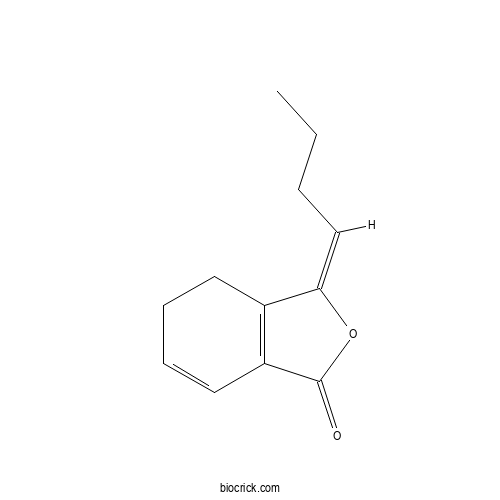
| Cas No. | 81944-08-3 | SDF | File under preparation. |
| PubChem ID | 5877292.0 | Appearance | Powder |
| Formula | C12H14O2 | M.Wt | 190.2 |
| Type of Compound | N/A | Storage | Desiccate at -20°C |
| Solubility | Soluble in Chloroform,Dichloromethane,Ethyl Acetate,DMSO,Acetone,etc. | ||
| Chemical Name | (3E)-3-butylidene-4,5-dihydro-2-benzofuran-1-one | ||
| SMILES | CCCC=C1C2=C(C=CCC2)C(=O)O1 | ||
| Standard InChIKey | IQVQXVFMNOFTMU-DHZHZOJOSA-N | ||
| Standard InChI | InChI=1S/C12H14O2/c1-2-3-8-11-9-6-4-5-7-10(9)12(13)14-11/h5,7-8H,2-4,6H2,1H3/b11-8+ | ||
| General tips | For obtaining a higher solubility , please warm the tube at 37 ℃ and shake it in the ultrasonic bath for a while.Stock solution can be stored below -20℃ for several months. We recommend that you prepare and use the solution on the same day. However, if the test schedule requires, the stock solutions can be prepared in advance, and the stock solution must be sealed and stored below -20℃. In general, the stock solution can be kept for several months. Before use, we recommend that you leave the vial at room temperature for at least an hour before opening it. |
||
| About Packaging | 1. The packaging of the product may be reversed during transportation, cause the high purity compounds to adhere to the neck or cap of the vial.Take the vail out of its packaging and shake gently until the compounds fall to the bottom of the vial. 2. For liquid products, please centrifuge at 500xg to gather the liquid to the bottom of the vial. 3. Try to avoid loss or contamination during the experiment. |
||
| Shipping Condition | Packaging according to customer requirements(5mg, 10mg, 20mg and more). Ship via FedEx, DHL, UPS, EMS or other couriers with RT, or blue ice upon request. | ||
Quality Control & MSDS
3D structure
Package In Stock

Number of papers citing our products


(E)-Ligustilide Dilution Calculator
(E)-Ligustilide Molarity Calculator

| 1 mg | 5 mg | 10 mg | 20 mg | 25 mg | |
| 1 mM | 5.2576 mL | 26.2881 mL | 52.5762 mL | 105.1525 mL | 131.4406 mL |
| 5 mM | 1.0515 mL | 5.2576 mL | 10.5152 mL | 21.0305 mL | 26.2881 mL |
| 10 mM | 0.5258 mL | 2.6288 mL | 5.2576 mL | 10.5152 mL | 13.1441 mL |
| 50 mM | 0.1052 mL | 0.5258 mL | 1.0515 mL | 2.103 mL | 2.6288 mL |
| 100 mM | 0.0526 mL | 0.2629 mL | 0.5258 mL | 1.0515 mL | 1.3144 mL |
| * Note: If you are in the process of experiment, it's necessary to make the dilution ratios of the samples. The dilution data above is only for reference. Normally, it's can get a better solubility within lower of Concentrations. | |||||
- β-Curcumene
Catalog No.:BCX2838
CAS No.:451-56-9
- Cistanoside C
Catalog No.:BCX2837
CAS No.:94492-22-5
- (7S)-Hellicoside
Catalog No.:BCX2836
CAS No.:132278-04-7
- 3-Butylidene-7-hydroxyphthalide
Catalog No.:BCX2835
CAS No.:93236-67-0
- Molephantinin
Catalog No.:BCX2834
CAS No.:56221-98-8
- Molephantin
Catalog No.:BCX2833
CAS No.:50656-66-1
- Trans-resveratrol-3-O-β-D-glucuronide
Catalog No.:BCX2832
CAS No.:387372-17-0
- Esculentoside F
Catalog No.:BCX2831
CAS No.:95263-31-3
- Rorifone
Catalog No.:BCX2830
CAS No.:53078-90-3
- (+)-(R)-Ribalinine
Catalog No.:BCX2829
CAS No.:62928-56-7
- Parthenin
Catalog No.:BCX2828
CAS No.:508-59-8
- Protodioscin
Catalog No.:BCX2827
CAS No.:60478-69-5
- Apigenin-7-O-(6′′-E-p-coumaroyl-β-D-glucopyranoside)
Catalog No.:BCX2840
CAS No.:105815-90-5
- Xanthalin
Catalog No.:BCX2841
CAS No.:21800-48-6
- Benzyl β-gentiobioside
Catalog No.:BCX2842
CAS No.:56775-64-5
- Amygdalinic acid
Catalog No.:BCX2843
CAS No.:66427-92-7
- 1,2-Dilinoleoyl-3-palmitin
Catalog No.:BCX2844
CAS No.:2190-15-0
- Acanthoic acid
Catalog No.:BCX2845
CAS No.:119290-87-8
- Penicillide
Catalog No.:BCX2846
CAS No.:55303-92-9
- Gingerglycolipid B
Catalog No.:BCX2847
CAS No.:88168-90-5
- Atractylodinol
Catalog No.:BCX2848
CAS No.:61642-89-5
- Dendronobiloside A
Catalog No.:BCX2849
CAS No.:370557-49-6
- N-Methylhernovine
Catalog No.:BCX2850
CAS No.:5550-65-2
- Hosenkoside L
Catalog No.:BCX2851
CAS No.:161016-50-8
Life cycle, seasonal- and tissue-dependent metabolite composition, and high (E)-Ligustilide content characterize the ethnobotany of a Native American medicinal plant, Lomatium foeniculaceum.[Pubmed:42329341]
J Nat Med. 2026 Jul;80(4):1209-1221.
Native Americans have historically used roots, shoots, and seeds of Lomatium species for various dietary and medicinal purposes. Lomatium foeniculaceum is a perennial parsley or biscuitroot species endemic to the Great Plains and western U.S. Its seeds are reported to be used as a "love medicine," a unique use compared to other Lomatium species, which are primarily used as a root food and for broad health improvement. We harvested L. foeniculaceum plants from their natural habitat throughout the year and analyzed tissue and seasonal variations in their chemical composition to elucidate the relationship between traditional usage and the plant's metabolism and time of year, and how this might relate to its traditional usage. This species grew vegetatively from March to May and flowered in May and June. The aerial tissues senesced in July, and the root remained dormant from July to March. Leaves and flowers contained significantly higher levels of metabolites than roots. We detected two major essential oil constituents, (E)- and (Z)-ligustilide, and the furanocoumarin, bergapten, at high levels in leaves and flowers. L. foeniculaceum is an uncommon species accumulating less-stable E-form at higher concentrations than the Z-form. This characteristic essential oil composition is probably related to the fragrance of flowers and seeds. On the other hand, the roots of this species contained lower levels of bioactive compounds and nutrients, which, coupled with their toughness and stringiness, make them less desirable as food than those of other Lomatium species.
Thuja sutchuenensis Franch. Essential Oil Ameliorates Atopic Dermatitis Symptoms in Mice by Modulating Skin Microbiota Composition and Reducing Inflammation.[Pubmed:41471858]
Microorganisms. 2025 Nov 22;13(12):2653.
Atopic dermatitis (AD) is a chronic inflammatory skin disorder characterized by dysregulated immunity, skin barrier dysfunction, and cutaneous microbiome dysbiosis. While current therapies face limitations, Thuja sutchuenensis essential oil (TEO) shows promise due to its multi-target potential. We sought to explore the beneficial effects of TEO and delve into its mechanistic actions in a mouse model of AD. We combined network pharmacology with in vivo validation to evaluate the therapeutic efficacy and mechanisms of TEO in an AD model, and confirmed network-predicted targets in an in vitro inflammatory cell model. In AD mice, TEO alleviated pruritus and epidermal hyperplasia, suppressed systemic IL-4/TNF-alpha and IgE, and partially normalized serum ALB, LDL-C, and HDL-C. Microbial diversity increased after treatment, although potentially pathogenic taxa (Arthrobacter sp. and Corynebacterium mastitidis) remained enriched. Machine-learning analysis indicated the highest predicted metabolic activity in CK controls, whereas the AD and TEO groups showed elevated pathogenic phenotype scores. Network pharmacology prioritized active compounds [(E)-Ligustilide, senkyunolide A, 3-butylisobenzofuran-1(3H)-one, butylated hydroxytoluene, Z-buthlidenephthalide, and beta-Myrcene] and core targets (TNF, PTPRC, CCR5, JAK1), implicating T-cell receptor signaling, Staphylococcus aureus infection, and STAT3 pathways. Docking and molecular dynamics supported strong, stable binding of major constituents to JAK1, and Western blotting confirmed TEO-mediated inhibition of the JAK1/STAT3 axis. TEO effectively alleviates atopic dermatitis symptoms by modulating immune responses and enhancing microbial diversity. It targets key signaling pathways, such as JAK1/STAT3, highlighting its potential as a therapeutic option for AD.
E-Nose and HS-SPME-GC-MS unveiling the scent signature of Ligusticum chuanxiong and its medicinal relatives.[Pubmed:40129745]
Front Plant Sci. 2025 Mar 10;16:1476810.
INTRODUCTION: To explore the origin and evolution of Ligusticum Chuanxiong, we conducted a component analysis of Ligusticum Chuanxiong and its medicinal relatives. METHODS: This study encompassed seven species from various origins, including Chuanxiong (Ligusticum chuanxiong Hort.), Gansu Chuanxiong (Ligusticum chuanxiong cv. Gansu), Yunnan Chuanxiong (Ligusticum chuanxiong cv. Yunnan), Japanese Chuanxiong (Cnidium officinale Makino), Fuxiong (Ligusticum sinense 'Fuxiong'), Gaoben (Ligusticum sinense), and Liaogaoben (Ligusticum jeholense), comprising 27 distinct materials. We employed headspace solid-phase microextraction-gas chromatography-mass spectrometry (HS-SPME-GC-MS) to identify various odor profiles from these species using electronic nose technology (E-nose). The method effectively identified volatile constituents in the leaves of these seven species. RESULTS: Results indicated that odor differences between L. chuanxiong and its medicinal relatives were predominantly observed in sensors W1W and W1S. Linear discriminant factor analysis (LDA) successfully distinguished five of the relatives; however, L. chuanxiong and L. sinense exhibited high odor similarity, limiting complete differentiation in some samples. HS-SPME-GC-MS identified a total of 118 volatile constituents, with eight differential volatiles identified: trans-Neocnidilide, beta-Caryophyllene, beta-Selinene, 5-Pentylcyclohexa-1,3-diene, (E)-Ligustilide, Butylphthalide, Neophytadiene, and Senkyunolide. Hierarchical cluster analysis (HCA) grouped L. chuanxiong, L. sinense, L. jeholense, and L. chuanxiong cv. Gansu together, highlighting the close relationship between L. chuanxiong and L. sinense. Joint analysis revealed a significant positive correlation between sensor W1W and the differential volatile component beta-Caryophyllene, suggesting its potential for distinguishing closely related species. DISCUSSION: This study provides a foundational understanding of volatile components in the leaves of L. chuanxiong and its medicinal relatives using E-nose combined with HS-SPME-GC-MS, contributing to the discussion on their interspecific odor characteristics and relationships.
Essential oil of Ligusticum chuanxiong Hort. Regulated P-gp protein and tight junction protein to change pharmacokinetic parameters of temozolomide in blood, brain and tumor.[Pubmed:36031103]
J Ethnopharmacol. 2022 Nov 15;298:115646.
ETHNOPHARMACOLOGICAL RELEVANCE: The existence of the blood-brain barrier/blood tumor barrier (BBB/BTB) severely restricts the effectiveness of anti-tumor drugs, thus glioma is still an incurable disease with a high fatality rate. Chuanxiong (Ligusticum chuanxiong Hort., Umbelliferae) was used as a messenger drug to increase the distribution of drugs in brain tissue, and its application in Chinese herbal formula for treating glioma was also the highest. AIM OF THE STUDY: Our previous researches showed that essential oil (EO) of chuanxiong could promote temozolomide (TMZ) entry into glioma cells in vitro and enhance TMZ-induced anticancer efficiency in vivo, and therefore, the aim of this study was to investigate whether EO could increase the concentration accumulation of TMZ in brain or tumor of C6 glioma rats and the related mechanisms. MATERIALS AND METHODS: The pharmacokinetics were conducted in C6 glioma rats by administering either TMZ alone or combined with EO through oral routes. TMZ concentration in blood, brain and tumor was detected using liquid chromatography-mass spectrometry/mass spectrometry (LC-MS/MS) and then pharmacokinetic parameters were calculated. The changed expressions of P-gp protein, tight junction occludin, claudin-5 and zonula occludens-1 (ZO-1) in brain of glioma rats were studied by Western blot to clarify the mechanism. Finally, the chemical composition of EO was analyzed by gas chromatography-massspectrometry (GC-MS). RESULTS: The results showed that EO significantly affected the pharmacokinetic parameters such as T(max), C(max) and CL (p < 0.01), but did not significantly change the AUC((0-->infinity)) of TMZ in blood (p > 0.05). However, EO markedly improved the AUC((0-->infinity))of TMZ in brain and tumor (p < 0.01). The calculate drug targeting index was greater than 1, indicating that EO could promote the distribution of TMZ to the brain and tumor. Western blot analysis showed that EO significantly inhibited the expression of P-gp, tight junction protein claudin-5, occludin and ZO-1. And meanwhile, the expressions of P-gp, claudin-5 and occludin also markedly down-regulated in EO-TMZ co-administration treatment. GC-MS analysis of the TIC component of EO was (E)-Ligustilide (36.93%), Terpinolene (7.245%), gamma-terpinene (7.225%) etc. CONCLUSION: EO could promote the distribution of TMZ in the brain and tumor of C6 glioma rats, which may attribute to down-regulate the expression of P-gp, claudin-5 and occludin.
Discovery of characteristic chemical markers for inspecting sulfur-fumigated Radix Angelicae Sinensis by ultra-high performance liquid chromatography-quadrupole/time-of-flight mass spectrometry based metabolomics and chemical profiling approach.[Pubmed:28455018]
Food Res Int. 2015 Oct;76(Pt 3):387-394.
An UHPLC-QTOF-MS/MS based metabolomics and chemical profiling approach was developed to identify the characteristic chemical markers for inspecting sulfur-fumigated Radix Angelicae Sinensis (S-RAS). Two sulfur-containing compounds in S-RAS were discovered and deduced to be (3Z)-6-sulfite-ligustilide and (3E)-6-sulfite-ligustilide. Furthermore, utilizing extraction ion method with the typical ion (m/z 271.06) of (3Z)-6-sulfite-ligustilide/(3E)-6-sulfite-ligustilide as the diagnostic ion, another six sulfur-containing components were determined in S-RAS, and identified as 6, 8-disulfite-ligustilide and 8-sulfite-ligustilide or their isomers. The generation mechanisms of these compounds were proposed as the addition reaction of sulfurous acid with (Z)-ligustilide and/or (E)-Ligustilide, two major naturally occurring components in RAS, at the double bonds of C6C7 and C3C8 positions. Using (3Z)-6-sulfite-ligustilide and (3E)-6-sulfite-ligustilide as the chemical markers, fourteen of sixteen batches of commercial RAS samples were inspected to be S-RAS, suggesting that the newly generated sulfur-containing compounds could be used as characteristic chemical markers for inspecting S-RAS among commercial RAS samples.

Calcutta University

University of Minnesota

University of Maryland School of Medicine

University of Illinois at Chicago

The Ohio State University

University of Zurich

Harvard University

Colorado State University

Auburn University

Yale University

Worcester Polytechnic Institute

Washington State University

Stanford University

University of Leipzig

Universidade da Beira Interior

The Institute of Cancer Research

Heidelberg University

University of Amsterdam

University of Auckland

TsingHua University

The University of Michigan

Miami University

DRURY University

Jilin University

Fudan University

Wuhan University

Sun Yat-sen University

Universite de Paris

Deemed University

Auckland University

The University of Tokyo

Korea University



