
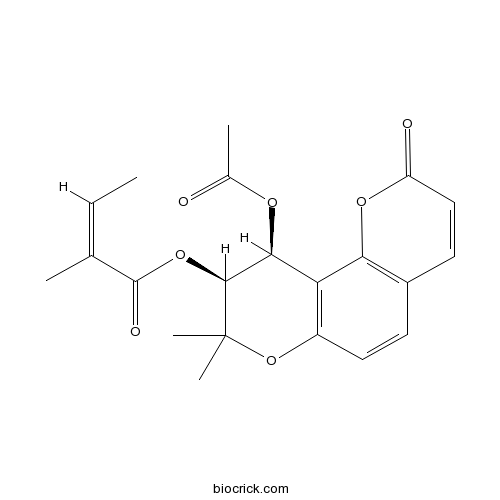
XanthalinCAS# 21800-48-6 |
| Cas No. | 21800-48-6 | SDF | File under preparation. |
| PubChem ID | 6450241.0 | Appearance | Powder |
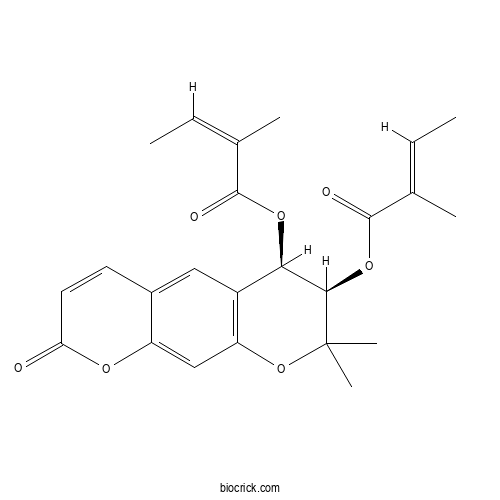
| Formula | C24H26O7 | M.Wt | 426.5 |
| Type of Compound | Flavanes/Isoflavans/Flavanols | Storage | Desiccate at -20°C |
| Solubility | Soluble in Chloroform,Dichloromethane,Ethyl Acetate,DMSO,Acetone,etc. | ||
| Chemical Name | [(3R,4R)-2,2-dimethyl-3-[(E)-2-methylbut-2-enoyl]oxy-8-oxo-3,4-dihydropyrano[3,2-g]chromen-4-yl] (Z)-2-methylbut-2-enoate | ||
| SMILES | CC=C(C)C(=O)OC1C(C(OC2=C1C=C3C=CC(=O)OC3=C2)(C)C)OC(=O)C(=CC)C | ||
| Standard InChIKey | LBKPHBYDOWPFMZ-ACVPTOMQSA-N | ||
| Standard InChI | InChI=1S/C24H26O7/c1-7-13(3)22(26)29-20-16-11-15-9-10-19(25)28-17(15)12-18(16)31-24(5,6)21(20)30-23(27)14(4)8-2/h7-12,20-21H,1-6H3/b13-7-,14-8+/t20-,21-/m1/s1 | ||
| General tips | For obtaining a higher solubility , please warm the tube at 37 ℃ and shake it in the ultrasonic bath for a while.Stock solution can be stored below -20℃ for several months. We recommend that you prepare and use the solution on the same day. However, if the test schedule requires, the stock solutions can be prepared in advance, and the stock solution must be sealed and stored below -20℃. In general, the stock solution can be kept for several months. Before use, we recommend that you leave the vial at room temperature for at least an hour before opening it. |
||
| About Packaging | 1. The packaging of the product may be reversed during transportation, cause the high purity compounds to adhere to the neck or cap of the vial.Take the vail out of its packaging and shake gently until the compounds fall to the bottom of the vial. 2. For liquid products, please centrifuge at 500xg to gather the liquid to the bottom of the vial. 3. Try to avoid loss or contamination during the experiment. |
||
| Shipping Condition | Packaging according to customer requirements(5mg, 10mg, 20mg and more). Ship via FedEx, DHL, UPS, EMS or other couriers with RT, or blue ice upon request. | ||
Quality Control & MSDS
3D structure
Package In Stock

Number of papers citing our products


Xanthalin Dilution Calculator
Xanthalin Molarity Calculator
-
 Decursitin DCatalog No.: BCN3908CAS No.: 245446-61-1
-
 Decursinol angelateCatalog No.: BCC9222CAS No.: 130848-06-5
-
 Praeruptorin BCatalog No.: BCN4988CAS No.: 81740-07-0
-
 Praeruptorin DCatalog No.: BCN4990CAS No.: 73069-28-0
-
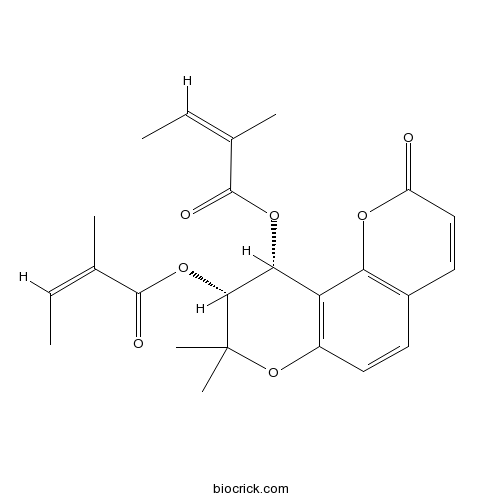 (-)-Praeruptorin BCatalog No.: BCN7665CAS No.: 4970-26-7
-
 Pd-C-IICatalog No.: BCN4599CAS No.:
-
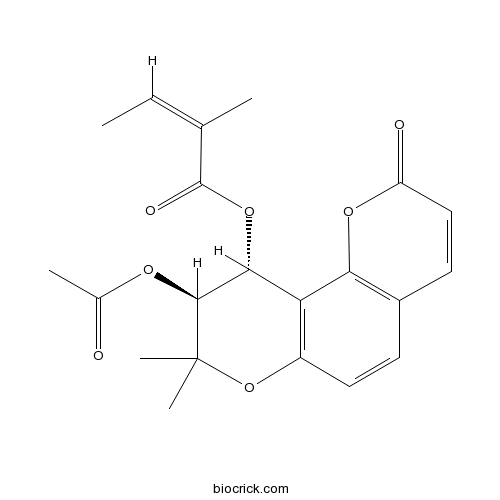 Peucedanocoumarin IICatalog No.: BCN3435CAS No.: 130464-56-1
-
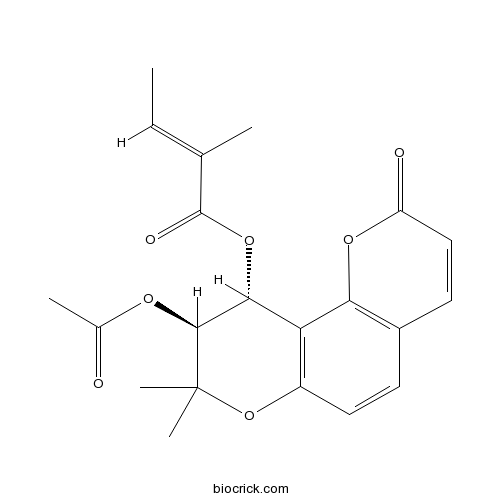 Peucedanocoumarin IIICatalog No.: BCN3471CAS No.: 130464-57-2
-
 Praeruptorin ACatalog No.: BCN4987CAS No.: 73069-25-7
-
 (+)-Praeruptorin ACatalog No.: BCN4989CAS No.: 73069-27-9
-
 (+)-PteryxinCatalog No.: BCN3470CAS No.: 13161-75-6
-
 (-)-Praeruptorin ACatalog No.: BCN7664CAS No.: 14017-71-1
| 1 mg | 5 mg | 10 mg | 20 mg | 25 mg | |
| 1 mM | 2.3447 mL | 11.7233 mL | 23.4467 mL | 46.8933 mL | 58.6166 mL |
| 5 mM | 0.4689 mL | 2.3447 mL | 4.6893 mL | 9.3787 mL | 11.7233 mL |
| 10 mM | 0.2345 mL | 1.1723 mL | 2.3447 mL | 4.6893 mL | 5.8617 mL |
| 50 mM | 0.0469 mL | 0.2345 mL | 0.4689 mL | 0.9379 mL | 1.1723 mL |
| 100 mM | 0.0234 mL | 0.1172 mL | 0.2345 mL | 0.4689 mL | 0.5862 mL |
| * Note: If you are in the process of experiment, it's necessary to make the dilution ratios of the samples. The dilution data above is only for reference. Normally, it's can get a better solubility within lower of Concentrations. | |||||
- Apigenin-7-O-(6′′-E-p-coumaroyl-β-D-glucopyranoside)
Catalog No.:BCX2840
CAS No.:105815-90-5
- (E)-Ligustilide
Catalog No.:BCX2839
CAS No.:81944-08-3
- β-Curcumene
Catalog No.:BCX2838
CAS No.:451-56-9
- Cistanoside C
Catalog No.:BCX2837
CAS No.:94492-22-5
- (7S)-Hellicoside
Catalog No.:BCX2836
CAS No.:132278-04-7
- 3-Butylidene-7-hydroxyphthalide
Catalog No.:BCX2835
CAS No.:93236-67-0
- Molephantinin
Catalog No.:BCX2834
CAS No.:56221-98-8
- Molephantin
Catalog No.:BCX2833
CAS No.:50656-66-1
- Trans-resveratrol-3-O-β-D-glucuronide
Catalog No.:BCX2832
CAS No.:387372-17-0
- Esculentoside F
Catalog No.:BCX2831
CAS No.:95263-31-3
- Rorifone
Catalog No.:BCX2830
CAS No.:53078-90-3
- (+)-(R)-Ribalinine
Catalog No.:BCX2829
CAS No.:62928-56-7
- Benzyl β-gentiobioside
Catalog No.:BCX2842
CAS No.:56775-64-5
- Amygdalinic acid
Catalog No.:BCX2843
CAS No.:66427-92-7
- 1,2-Dilinoleoyl-3-palmitin
Catalog No.:BCX2844
CAS No.:2190-15-0
- Acanthoic acid
Catalog No.:BCX2845
CAS No.:119290-87-8
- Penicillide
Catalog No.:BCX2846
CAS No.:55303-92-9
- Gingerglycolipid B
Catalog No.:BCX2847
CAS No.:88168-90-5
- Atractylodinol
Catalog No.:BCX2848
CAS No.:61642-89-5
- Dendronobiloside A
Catalog No.:BCX2849
CAS No.:370557-49-6
- N-Methylhernovine
Catalog No.:BCX2850
CAS No.:5550-65-2
- Hosenkoside L
Catalog No.:BCX2851
CAS No.:161016-50-8
- 1,3-Dioleoyl-2-linoleoylglycerol
Catalog No.:BCX2852
CAS No.:2190-19-4
- (-)-3-O -Acetylcatechin
Catalog No.:BCX2853
CAS No.:116935-88-7
Analysis of Saposhnikoviae Radix and Libonotidis Radix Based on "Characteristic Ion Set" and Chemometrics.[Pubmed:40794015]
J Mass Spectrom. 2025 Sep;60(9):e5164.
To enrich detection methods of Saposhnikoviae Radix (SR) adulterated Libonotidis Radix (LR) and improve the screening efficiency, this paper conducted an analysis of SR and LR based on chemometrics and "characteristic ion set." Firstly, the samples were analyzed by liquid chromatography-mass spectrometer and converted into data matrix. After feature algorithm extraction, the "characteristic ion set" of SR and LR was obtained to match the test and blind market samples for feedback matching index (MI). In addition, the LR proprietary component was extracted to verify the MI analysis based on "characteristic ion set." Three percent LR adulteration was identified based on "characteristic ion set," and two market blind samples were identified as adulterated samples. Xanthalin was the LR proprietary component. Moreover, the analysis based on "characteristic ion set" is reliable through chemometric analysis and extraction of proprietary ions. "Characteristic ion set" and chemometrics can enrich the detection methods of SR and LR and improve the screening efficiency.
Identifying the compounds that can distinguish between Saposhnikovia root and its substitute, Peucedanum ledebourielloides root, using LC-HR/MS metabolomics.[Pubmed:32333306]
J Nat Med. 2020 Jun;74(3):550-560.
Previously, we established a (1)H NMR metabolomics method using reversed-phase solid-phase extraction column (RP-SPEC), and succeeded in distinguishing wild from cultivated samples of Saposhnikoviae radix (SR), and between SR and its substitute, Peucedanum ledebourielloides root (PR). Herein, we performed LC-HR/MS metabolomics using fractions obtained via RP-SPEC to identify characteristic components of SR and PR. One and three characteristic components were respectively found for SR and PR; these components were isolated with their m/z values and retention times as a guide. The characteristic component of SR was identified as 4'-O-beta-D-glucosyl-5-O-methylvisamminol (1), an indicator component used to identify SR in the Japanese Pharmacopoeia. In contrast, the characteristic components of PR were identified as Xanthalin (2), 4'-O-beta-D-apiosyl (1 --> 6)-beta-D-glucosyl-5-O-methylvisamminol (3), and 3'-O-beta-D-apiosyl (1 --> 6)-beta-D-glucosylhamaudol (4) based on spectroscopic data such as 1D- and 2D-NMR, MS, and specific optical rotation. Among them, 4 is a novel compound. For the correlation between the NMR metabolomics results in the present and our previous report, only 1 and 2 were found to correlate with the chemical shifts, and the other compounds had no correlation. As the chemical shifts for compounds 1, 3, and 4 were similar to each other, especially for the aglycone moiety, they could not be distinguished because of the sensitivity and resolution of (1)H NMR. Accordingly, combining NMR and LC/MS metabolomics with their different advantages is considered useful for metabolomics of natural products. The series of methods used in our reports could aid in quality evaluations of natural products and surveying of marker components.
Botanical origin and chemical constituents of commercial Saposhnikoviae radix and its related crude drugs available in Shaanxi and the surrounding regions.[Pubmed:29149424]
J Nat Med. 2018 Jan;72(1):267-273.
Saposhnikoviae radix (SR) is described in the Japanese Pharmacopoeia as a crude drug derived from the root of Saposhnikovia divaricata Schischkin (Umbelliferae). According to Flora of China, the root of Peucedanum ledebourielloides K. F. Fu is used as a regional substitute for SR. Therefore, we surveyed the botanical origin of the drug used in China, especially Shaanxi and the surrounding regions, through nucleotide sequence analysis of the internal transcribed spacer region of rDNA. As a result, several samples from Shaanxi () and Shanxi () provinces were identified as Peucedanum ledebourielloides. To prevent this substitute from being distributed as genuine SR, we developed a thin-layer chromatography analysis condition to enable a specific compound of this species to be easily detected. The specific compound was identified as Xanthalin, based on 1D- and 2D-NMR and high-resolution mass spectrometry data. The established TLC conditions were as follows-extraction solvent, n-hexane; applied volume, 5 microL; chromatographic support, silica gel; developing solvent, n-hexane:ethyl acetate:acetic acid (20:10:1); developing length, 7 cm; detection, UV (365 nm); R (f) value, 0.4 (blue fluorescence; Xanthalin).

Calcutta University

University of Minnesota

University of Maryland School of Medicine

University of Illinois at Chicago

The Ohio State University

University of Zurich

Harvard University

Colorado State University

Auburn University

Yale University

Worcester Polytechnic Institute

Washington State University

Stanford University

University of Leipzig

Universidade da Beira Interior

The Institute of Cancer Research

Heidelberg University

University of Amsterdam

University of Auckland

TsingHua University

The University of Michigan

Miami University

DRURY University

Jilin University

Fudan University

Wuhan University

Sun Yat-sen University

Universite de Paris

Deemed University

Auckland University

The University of Tokyo

Korea University



