
Gingerglycolipid BCAS# 88168-90-5 |
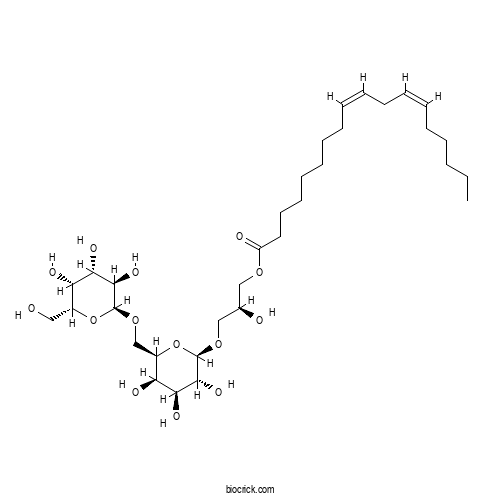
| Cas No. | 88168-90-5 | SDF | File under preparation. |
| PubChem ID | 10009754.0 | Appearance | Powder |
| Formula | C33H58O14 | M.Wt | 678.6 |
| Type of Compound | — | Storage | Desiccate at -20°C |
| Solubility | Soluble in Chloroform,Dichloromethane,Ethyl Acetate,DMSO,Acetone,etc. | ||
| Chemical Name | [(2S)-2-hydroxy-3-[(2R,3R,4S,5R,6R)-3,4,5-trihydroxy-6-[[(2S,3R,4S,5R,6R)-3,4,5-trihydroxy-6-(hydroxymethyl)oxan-2-yl]oxymethyl]oxan-2-yl]oxypropyl] (9Z,12Z)-octadeca-9,12-dienoate | ||
| SMILES | CCCCCC=CCC=CCCCCCCCC(=O)OCC(COC1C(C(C(C(O1)COC2C(C(C(C(O2)CO)O)O)O)O)O)O)O | ||
| Standard InChIKey | UHISGSDYAIIBMO-UMLSMIIMSA-N | ||
| Standard InChI | InChI=1S/C33H58O14/c1-2-3-4-5-6-7-8-9-10-11-12-13-14-15-16-17-25(36)43-19-22(35)20-44-32-31(42)29(40)27(38)24(47-32)21-45-33-30(41)28(39)26(37)23(18-34)46-33/h6-7,9-10,22-24,26-35,37-42H,2-5,8,11-21H2,1H3/b7-6-,10-9-/t22-,23-,24-,26+,27+,28+,29+,30-,31-,32-,33+/m1/s1 | ||
| General tips | For obtaining a higher solubility , please warm the tube at 37 ℃ and shake it in the ultrasonic bath for a while.Stock solution can be stored below -20℃ for several months. We recommend that you prepare and use the solution on the same day. However, if the test schedule requires, the stock solutions can be prepared in advance, and the stock solution must be sealed and stored below -20℃. In general, the stock solution can be kept for several months. Before use, we recommend that you leave the vial at room temperature for at least an hour before opening it. |
||
| About Packaging | 1. The packaging of the product may be reversed during transportation, cause the high purity compounds to adhere to the neck or cap of the vial.Take the vail out of its packaging and shake gently until the compounds fall to the bottom of the vial. 2. For liquid products, please centrifuge at 500xg to gather the liquid to the bottom of the vial. 3. Try to avoid loss or contamination during the experiment. |
||
| Shipping Condition | Packaging according to customer requirements(5mg, 10mg, 20mg and more). Ship via FedEx, DHL, UPS, EMS or other couriers with RT, or blue ice upon request. | ||
Quality Control & MSDS
3D structure
Package In Stock

Number of papers citing our products


Gingerglycolipid B Dilution Calculator
Gingerglycolipid B Molarity Calculator


| 1 mg | 5 mg | 10 mg | 20 mg | 25 mg | |
| 1 mM | 1.4736 mL | 7.3681 mL | 14.7362 mL | 29.4724 mL | 36.8406 mL |
| 5 mM | 0.2947 mL | 1.4736 mL | 2.9472 mL | 5.8945 mL | 7.3681 mL |
| 10 mM | 0.1474 mL | 0.7368 mL | 1.4736 mL | 2.9472 mL | 3.6841 mL |
| 50 mM | 0.0295 mL | 0.1474 mL | 0.2947 mL | 0.5894 mL | 0.7368 mL |
| 100 mM | 0.0147 mL | 0.0737 mL | 0.1474 mL | 0.2947 mL | 0.3684 mL |
| * Note: If you are in the process of experiment, it's necessary to make the dilution ratios of the samples. The dilution data above is only for reference. Normally, it's can get a better solubility within lower of Concentrations. | |||||
- Penicillide
Catalog No.:BCX2846
CAS No.:55303-92-9
- Acanthoic acid
Catalog No.:BCX2845
CAS No.:119290-87-8
- 1,2-Dilinoleoyl-3-palmitin
Catalog No.:BCX2844
CAS No.:2190-15-0
- Amygdalinic acid
Catalog No.:BCX2843
CAS No.:66427-92-7
- Benzyl β-gentiobioside
Catalog No.:BCX2842
CAS No.:56775-64-5
- Xanthalin
Catalog No.:BCX2841
CAS No.:21800-48-6
- Apigenin-7-O-(6′′-E-p-coumaroyl-β-D-glucopyranoside)
Catalog No.:BCX2840
CAS No.:105815-90-5
- (E)-Ligustilide
Catalog No.:BCX2839
CAS No.:81944-08-3
- β-Curcumene
Catalog No.:BCX2838
CAS No.:451-56-9
- Cistanoside C
Catalog No.:BCX2837
CAS No.:94492-22-5
- (7S)-Hellicoside
Catalog No.:BCX2836
CAS No.:132278-04-7
- 3-Butylidene-7-hydroxyphthalide
Catalog No.:BCX2835
CAS No.:93236-67-0
- Atractylodinol
Catalog No.:BCX2848
CAS No.:61642-89-5
- Dendronobiloside A
Catalog No.:BCX2849
CAS No.:370557-49-6
- N-Methylhernovine
Catalog No.:BCX2850
CAS No.:5550-65-2
- Hosenkoside L
Catalog No.:BCX2851
CAS No.:161016-50-8
- 1,3-Dioleoyl-2-linoleoylglycerol
Catalog No.:BCX2852
CAS No.:2190-19-4
- (-)-3-O -Acetylcatechin
Catalog No.:BCX2853
CAS No.:116935-88-7
- 4-Hydroxy-3-butylphthalide
Catalog No.:BCX2854
CAS No.:74459-23-7
- (Z)-α-Santalol
Catalog No.:BCX2855
CAS No.:115-71-9
- Tenuifoliose Q
Catalog No.:BCX2856
CAS No.:662166-93-0
- (-)-Epigallocatechin 3'-O-methylether gallate
Catalog No.:BCX2857
CAS No.:298700-56-8
- α-Calacorene
Catalog No.:BCX2858
CAS No.:21391-99-1
- (-)-δ-Cadinene
Catalog No.:BCX2859
CAS No.:13061-82-0
Metabolites of blueberry roots at different developmental stages strongly shape microbial community structure and intra-kingdom interactions at the root-soil interface.[Pubmed:38945231]
Sci Total Environ. 2024 Oct 15;947:174333.
The rhizosphere microorganisms of blueberry plants have long coexisted with their hosts under distinctively acidic soil conditions, exerting a profound influence on host performance through mutualistic symbiotic interactions. Meanwhile, plants can regulate rhizosphere microorganisms by exerting host effects to meet the functional requirements of plant growth and development. However, it remains unknown how the developmental stages of blueberry plants affect the structure, function, and interactions of the rhizosphere microbial communities. Here, we examined bacterial communities and root metabolites at three developmental stages (flower and leaf bud development stage, fruit growth and development stage, and fruit maturation stage) of blueberry plants. The results revealed that the Shannon and Chao 1 indices as well as community composition varied significantly across all three developmental stages. The relative abundance of Actinobacteria significantly increased by 10 % (p < 0.05) from stage 1 to stage 2, whereas that of Proteobacteria decreased significantly. The co-occurrence network analysis revealed a relatively complex network with 1179 edges and 365 nodes in the stage 2. Niche breadth was highest at stage 2, while niche overlap tended to increase as the plant developed. Furthermore, the untargeted metabolome analysis revealed that the number of differential metabolites of vitamins, nucleic acids, steroids, and lipids increased between stage 1 to stage2 and stage 2 to stage 3, while those for differential metabolites of carbohydrates and peptides decreased. Significant changes in expression levels of levan, L-glutamic acid, indoleacrylic acid, oleoside 11-methyl ester, threo-syringoylglycerol, Gingerglycolipid B, and bovinic acid were highly correlated with the bacterial community structure. Collectively, our study reveals that significant alterations in dominant bacterial taxa are strongly correlated with the dynamics of root metabolites. These findings lay the groundwork for developing prebiotic products to enhance the beneficial effects of root microorganisms and boosting blueberry productivity via a sustainable approach.
Molecular mechanisms of Tetrastigma hemsleyanum Diels&Gilg against lung squamous cell carcinoma: From computational biology and experimental validation.[Pubmed:38750988]
J Ethnopharmacol. 2024 Sep 15;331:118326.
ETHNOPHARMACOLOGICAL RELEVANCE: Tetrastigma hemsleyanum (T. hemsleyanum), valued in traditional medicine for its potential to boost immunity and combat tumors, contains uncharacterized active compounds and mechanisms. This represents a significant gap in our understanding of its ethnopharmacological relevance. AIM OF THE STUDY: To involve the mechanism of anti-lung cancer effect of T. hemsleyanum by means of experiment and bioinformatics analysis. MATERIALS AND METHODS: The anticancer mechanism of T. hemsleyanum against lung squamous carcinoma (LUSC) in zebrafish was investigated. The LUSC model was established by injecting NCI-H2170 cells in the zebrafish and evaluating its anti-tumor efficacy. Next, component targets and key genes were obtained by molecular complex detection (MCODE) analysis and protein-protein interaction (PPI) network analysis. Component analysis of T. hemsleyanum was performed by UPLC-Q-TOF-MS. Molecular docking was used to simulate the binding activities of key potential active components to core targets were simulated using. Prognostic and pan-cancer analyses were then performed to validate the signaling pathways involved in the prognostic genes using gene set enrichment analysis (GSEA). Subsequently, Molecular dynamics simulations were then performed for key active components and core targets. Finally, cellular experiments were used to verify the expression of glutamate metabotropic receptor 3 (GRM3) and glutamate metabotropic receptor 7 (GRM7) in the anticancer effect exerted of T. hemsleyanum. RESULTS: We experimentally confirmed the inhibitory effect of T. hemsleyanum on LUSC by transplantation of NCI-H2170 cells into zebrafish. There are 20 main compounds in T. hemsleyanum, such as procyanidin B1, catechin, quercetin, and kaempferol, etc. A total of 186 component targets of T. hemsleyanum and sixteen hub genes were screened by PPI network and MCODE analyses. Molecular docking and molecular dynamics simulation results showed that Gingerglycolipid B and Rutin had higher affinity with GRM3 and GRM7, respectively. Prognostic analysis, Pan-cancer analysis and verification experiment also confirmed that GRM3 and GRM7 were targets for T. hemsleyanum to exert anti-tumor effects and to participate in immune and mutation processes. In vitro experiments suggested that the inhibitory effect of T. hemsleyanum on cancer cells was correlated with GRM3 and GRM7. CONCLUSION: In vivo, in vitro and in silico results confirmed the potential anticancer effects against LUSC of T. hemsleyanum, which further consolidated the claim of its traditional uses.
The key metabolites associated with nutritional components in purple glutinous rice.[Pubmed:36076393]
Food Res Int. 2022 Oct;160:111686.
nutrients are closely related to consumer health. In this study, the contents of 22 amino acids in four glutinous rice varieties were quantified by LC-MS-targeted metabolomics, and the relationships between nutritional components and metabolites were analysed. The results demonstrated that Gingerglycolipid B and pantothenic acid were significantly negatively correlated with Ala. The Lys and Cys-Cys contents of ZN18 and YZN were significantly higher than those of YCN and ZN20. Citric acid was significantly positively correlated with Lys and Cys-Cys. The ascorbic acid content of YZN and ZN18 was significantly higher than that of YCN and ZN20. YZN had the highest Mn, Zn, Ca, and crude fat contents. Gingerglycolipid B and pantothenic acid were significantly negatively correlated with Mn and Zn. Gingerglycolipid B and pantothenic acid are closely related to other nutritional components, and they are important metabolites formed by the nutrient components of purple glutinous rice.
Secondary metabolites from the fungus Emericella nidulans.[Pubmed:24273867]
Nat Prod Commun. 2013 Sep;8(9):1285-8.
A new polyketide derivative koninginin H (1), has been isolated from the fungus Emericella nidulans, together with koninginin E (2), koninginin A (3), trichodermatide B (4), citrantifidiol (5), (4S,5R)-4-hydroxy-5-methylfuran-2-one (6), the glycerol derivatives Gingerglycolipid B (7), (2S)-bis[9Z,12Z]-1-O, 2-O-dilinoleoyl-3-O-[alpha-D-galactopyranosyl-(1" --> 6') beta-D-galactopyranosyl]glycerol (8), (2S)-bis[9Z,12Z]-1-O, 2-O-dilinoleoyl-3-O-beta-D-galactopyranosylglycerol (9), the cerebroside flavuside B (10), and the known sterols beta-sitosterol glucoside and ergosta-5,7,22-trien-3-ol. Their structures were established by extensive NMR studies (1H NMR, 13C NMR, DEPT, 1H-1H COSY, HSQC, HMBC) and mass spectrometry. The antibacterial, antimalarial, antifungal and antileishmanial activities of compounds 1-10 were examined and the results indicated that compound 4 showed good antifungal activity against Cryptococcus neoformans with an IC50 value of 4.9 microg/mL.
Inhibitory effect on TNF-alpha-induced IL-8 secretion in HT-29 cell line by glyceroglycolipids from the leaves of Ficus microcarpa.[Pubmed:23263807]
Arch Pharm Res. 2012 Dec;35(12):2135-42.
Bioassay-guided fractionation based on the anti-inflammatory activity of a methanol extract of Ficus microcarpa leaves led to the isolation of seven galactolipids: 2(S)-3-O-octadeca-9Z,12Z,15Z-trienoylglyceryl-O-beta-D-galactopyranoside (1), (2S)-2,3-O-dioctadeca-9Z,12Z,15Z-trienoylglyceryl-O-beta-D-galactopyranoside (2), (2S)-2,3-O-dioctadeca-9Z,12Z-dienoylglyceryl-O-beta-D-galactopyranoside (3), (2S)-3-O-octadeca-9Z,12Z,15Z-trienoylglyceryl-6'-O-(alpha-D-galactopyranosyl)-beta-D-galactopyranoside (4), (2S)-2,3-O-dioctadeca-9Z,12Z,15Z-trienoylglyceryl-6'-O-(alpha-D-galactopyranosyl)-beta-D-galactopyranoside (5), Gingerglycolipid B (6), and (2S)-2,3-O-dioctadeca-9Z,12Z-dienoylglyceryl-6'-O-(alpha-D-galactopyranosyl)-beta-D-galactopyranoside (7). Their chemical structures were elucidated by mass, 1D-, and 2D-NMR spectroscopic methods as well as chemical methods. The antiinflammatory effect of these compounds on TNF-alpha induced IL-8 secretion in the HT-29 cell line was evaluated. All above galactolipids showed significant inhibition ranging 40% at a concentration of 50 muM. The results suggest that galactolipids from the leaves of F. microcarpa may be used as potent anti-inflammatory agents.

Calcutta University

University of Minnesota

University of Maryland School of Medicine

University of Illinois at Chicago

The Ohio State University

University of Zurich

Harvard University

Colorado State University

Auburn University

Yale University

Worcester Polytechnic Institute

Washington State University

Stanford University

University of Leipzig

Universidade da Beira Interior

The Institute of Cancer Research

Heidelberg University

University of Amsterdam

University of Auckland

TsingHua University

The University of Michigan

Miami University

DRURY University

Jilin University

Fudan University

Wuhan University

Sun Yat-sen University

Universite de Paris

Deemed University

Auckland University

The University of Tokyo

Korea University



