
3-Phenylpropyl AcetateCAS# 122-72-5 |
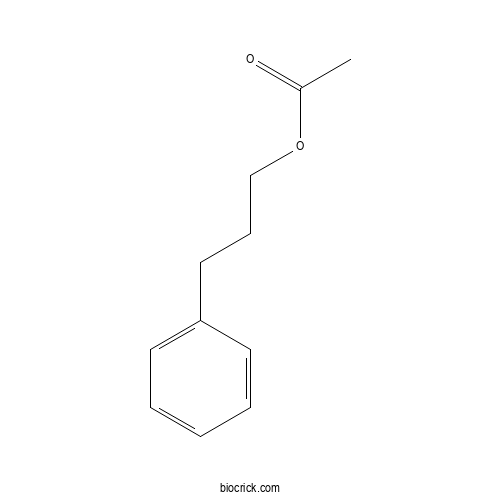
| Cas No. | 122-72-5 | SDF | File under preparation. |
| PubChem ID | 31226.0 | Appearance | Powder |
| Formula | C11H14O2 | M.Wt | 178.2 |
| Type of Compound | Simple Phenylpropanoids | Storage | Desiccate at -20°C |
| Solubility | Soluble in Chloroform,Dichloromethane,Ethyl Acetate,DMSO,Acetone,etc. | ||
| Chemical Name | 3-phenylpropyl acetate | ||
| SMILES | CC(=O)OCCCC1=CC=CC=C1 | ||
| Standard InChIKey | JRJGKUTZNBZHNK-UHFFFAOYSA-N | ||
| Standard InChI | InChI=1S/C11H14O2/c1-10(12)13-9-5-8-11-6-3-2-4-7-11/h2-4,6-7H,5,8-9H2,1H3 | ||
| General tips | For obtaining a higher solubility , please warm the tube at 37 ℃ and shake it in the ultrasonic bath for a while.Stock solution can be stored below -20℃ for several months. We recommend that you prepare and use the solution on the same day. However, if the test schedule requires, the stock solutions can be prepared in advance, and the stock solution must be sealed and stored below -20℃. In general, the stock solution can be kept for several months. Before use, we recommend that you leave the vial at room temperature for at least an hour before opening it. |
||
| About Packaging | 1. The packaging of the product may be reversed during transportation, cause the high purity compounds to adhere to the neck or cap of the vial.Take the vail out of its packaging and shake gently until the compounds fall to the bottom of the vial. 2. For liquid products, please centrifuge at 500xg to gather the liquid to the bottom of the vial. 3. Try to avoid loss or contamination during the experiment. |
||
| Shipping Condition | Packaging according to customer requirements(5mg, 10mg, 20mg and more). Ship via FedEx, DHL, UPS, EMS or other couriers with RT, or blue ice upon request. | ||
Quality Control & MSDS
3D structure
Package In Stock

Number of papers citing our products


3-Phenylpropyl Acetate Dilution Calculator
3-Phenylpropyl Acetate Molarity Calculator
| 1 mg | 5 mg | 10 mg | 20 mg | 25 mg | |
| 1 mM | 5.6117 mL | 28.0584 mL | 56.1167 mL | 112.2334 mL | 140.2918 mL |
| 5 mM | 1.1223 mL | 5.6117 mL | 11.2233 mL | 22.4467 mL | 28.0584 mL |
| 10 mM | 0.5612 mL | 2.8058 mL | 5.6117 mL | 11.2233 mL | 14.0292 mL |
| 50 mM | 0.1122 mL | 0.5612 mL | 1.1223 mL | 2.2447 mL | 2.8058 mL |
| 100 mM | 0.0561 mL | 0.2806 mL | 0.5612 mL | 1.1223 mL | 1.4029 mL |
| * Note: If you are in the process of experiment, it's necessary to make the dilution ratios of the samples. The dilution data above is only for reference. Normally, it's can get a better solubility within lower of Concentrations. | |||||
- Auramine O
Catalog No.:BCX2815
CAS No.:2465-27-2
- Cadalene
Catalog No.:BCX2814
CAS No.:483-78-3
- Glycocholic acid
Catalog No.:BCX2813
CAS No.:475-31-0
- 2-Deoxokanshone M
Catalog No.:BCX2250
CAS No.:3062873-62-2
- Z-isogeranic acid
Catalog No.:BCX2249
CAS No.:85916-85-4
- 6,11,12,16-Tetrahydroxy-5,8,11,13-abitetetraen-7-one
Catalog No.:BCX2248
CAS No.:1295650-67-7
- 3-(2-Hydroxyphenyl)propionic acid
Catalog No.:BCX2247
CAS No.:495-78-3
- Oxypeucedanin hydrate-3-ethyl ether
Catalog No.:BCX2246
CAS No.:90686-46-7
- 4'-Demethyldeoxypodophyllotoxin beta-D-glucopyranoside
Catalog No.:BCX2245
CAS No.:78178-42-4
- Dihydromelilotoside
Catalog No.:BCX2244
CAS No.:24696-05-7
- 7-Feruloylloganic acid
Catalog No.:BCX2243
CAS No.:178666-92-7
- rel-(7S,8S,7''R,8''R)-3,3'',4'',5''-hexamethoxy-7-O-7'',8,8''-lignan
Catalog No.:BCX2242
CAS No.:50394-05-3
- Gweicurculactone
Catalog No.:BCX2817
CAS No.:123914-43-2
- Esculentoside L
Catalog No.:BCX2818
CAS No.:130364-33-9
- Rorifamide
Catalog No.:BCX2819
CAS No.:53078-91-4
- Stemoninine
Catalog No.:BCX2820
CAS No.:69772-72-1
- Dracorubin
Catalog No.:BCX2821
CAS No.:6219-63-2
- Astin J
Catalog No.:BCX2822
CAS No.:163136-31-0
- Kalopanaxsaponin G
Catalog No.:BCX2823
CAS No.:57539-70-5
- Kuwanon L
Catalog No.:BCX2824
CAS No.:88524-65-6
- Evodiamide
Catalog No.:BCX2825
CAS No.:116965-70-9
- Dihydrochelirubine
Catalog No.:BCX2826
CAS No.:28342-26-9
- Protodioscin
Catalog No.:BCX2827
CAS No.:60478-69-5
- Parthenin
Catalog No.:BCX2828
CAS No.:508-59-8
Multiomics analysis revealed that the metabolite profile of raw milk is associated with the lactation stage of dairy cows and could be affected by variations in the ruminal microbiota.[Pubmed:38876221]
J Dairy Sci. 2024 Oct;107(10):8709-8721.
The nutritional components and quality of milk are influenced by the rumen microbiota and its metabolites at different lactation stages. Hence, rumen fluid and milk samples from 6 dairy cows fed the same diet were collected during peak lactation, early mid-lactation, and later mid-lactation. Untargeted metabolomics and 16S rRNA sequencing were applied for analyzing milk and rumen metabolites, as well as rumen microbial composition, respectively. The levels of lipid-related metabolites, l-glutamate, glucose-1-phosphate, and acetylphosphate in milk exhibited lactation-dependent attenuation. Maltol, N-acetyl-d-glucosamine, and choline, which are associated with milk flavor or coagulation properties, as well as l-valine, lansioside A, clitocine, and ginsenoside La, increased significantly in early mid-lactation and later mid-lactation, especially in later mid-lactation. The obvious increase in rumen microbial diversities (ACE and Shannon indices) were observed in early mid-lactation compared with peak lactation. Twenty-one differential bacterial genera of the rumen were identified, with Succinivibrionaceae_UCG-001, Candidatus Saccharimonas, Fibrobacter, and SP3-e08 being significantly enriched in peak lactation. Rikenellaceae_RC9_gut_group, Eubacterium_ruminantium_group, Lachnospira, Butyrivibrio, Eubacterium_hallii_group, and Schwartzia were most significantly enriched in early mid-lactation. In comparison, only 2 bacteria (unclassified_f__Prevotellaceae and Prevotellaceae_UCG-001) were enriched in later mid-lactation. For rumen metabolites, LysoPE(16:0), l-glutamate, and l-tyrosine had higher levels in peak lactation, whereas PE(17:0/0:0), PE(16:0/0:0), PS(18:1(9Z)/0:0), l-phenylalanine, dulcitol, 2-(methoxymethyl)furan, and 3-Phenylpropyl Acetate showed higher levels in early mid-lactation and later mid-lactation. Multiomics-integrated analysis revealed that a greater abundance of Fibrobacter contributed to phospholipid content in milk by increasing ruminal acetate, l-glutamate, and LysoPE(16:0). Prevotellaceae_UCG-001 and unclassified_f_Prevotellaceae provide substrates for milk metabolites of the same category by increasing ruminal l-phenylalanine and dulcitol contents. These results demonstrated that milk metabolomic fingerprints and critical functional metabolites during lactation, and the key bacteria in rumen related to them. These findings provide new insights into the development of functional dairy products.
Metabolic Engineering of Escherichia coli for the Biosynthesis of 3-Phenylpropionic Acid and 3-Phenylpropyl Acetate.[Pubmed:37146254]
J Agric Food Chem. 2023 May 17;71(19):7451-7458.
3-Phenylpropionic acid (3PPA) and its derivative 3-Phenylpropyl Acetate (3PPAAc) are important aromatic compounds with broad applications in the cosmetics and food industries. In this study, we constructed a plasmid-free 3PPA-producing Escherichia coli strain and designed a novel 3PPAAc biosynthetic pathway. A module containing tyrosine ammonia lyase and enoate reductase, evaluated under the control of different promoters, was combined with phenylalanine-overproducing strain E. coli ATCC31884, enabling the plasmid-free de novo production of 218.16 +/- 43.62 mg L(-1) 3PPA. The feasibility of the pathway was proved by screening four heterologous alcohol acetyltransferases, which catalyzed the transformation of 3-phenylpropyl alcohol into 3PPAAc. Afterward, 94.59 +/- 16.25 mg L(-1) 3PPAAc was achieved in the engineered E. coli strain. Overall, we have not only demonstrated the potential of de novo synthesis of 3PPAAc in microbes for the first time but also provided a platform for the future of biosynthesis of other aromatic compounds.
RIFM fragrance ingredient safety assessment, 3-phenylpropyl acetate, CAS Registry Number 122-72-5.[Pubmed:35460830]
Food Chem Toxicol. 2022 May;163 Suppl 1:113055.
Therefore, the phenethyl formate MOE for the fertility endpoint can be calculated by dividing the phenethyl alcohol NOAEL in mg/kg/day by the total systemic exposure to phenethyl formate, 1000/0.00062 or 1612903.
Synthesis and Biological Evaluation of Matijin-Su Derivatives as Potential Antihepatitis B Virus and Anticancer Agents.[Pubmed:27451105]
Chem Biodivers. 2016 Nov;13(11):1584-1592.
A series of Matijin-Su (MTS, (2S)-2-[(2S)-2-benzamido-3-phenylpropanoyl]amino-3-Phenylpropyl Acetate) derivatives were synthesized and evaluated for their anti-HBV and cytotoxic activities in vitro. Six compounds (4g, 4j, 5c, 5g, 5h and 5i) showed significant inhibition against HBV DNA replication with the IC(50) values in range of 2.18 - 8.55 mum, which were much lower than that of positive control lamivudine (IC(50) 82.42 mum). In particular, compounds 5h (IC(50) 2.18 mum; SI 151.59) and 5j (IC(50) 5.65 mum; SI 51.16) displayed relatively low cytotoxicities, resulting in high SI values. Notably, besides the anti-HBV DNA replication activity, compound 4j also exhibited more potent in vitro cytotoxic activity than 5-fluorouracil in two hepatocellular carcinoma cell (HCC) lines (QGY-7701 and SMMC-7721), indicating that 4j may be a promising lead for the exploration of drugs with dual therapeutic effects on HBV infection and HBV-induced HCC.
Fragrance material review on 3-phenylpropyl acetate.[Pubmed:22414651]
Food Chem Toxicol. 2012 Sep;50 Suppl 2:S457-61.
A toxicologic and dermatologic review of 3-Phenylpropyl Acetate when used as a fragrance ingredient is presented. 3-Phenylpropyl Acetate is a member of the fragrance structural group Aryl Alkyl Alcohol Simple Acid Esters (AAASAE). The AAASAE fragrance ingredients are prepared by reacting an aryl alkyl alcohol with a simple carboxylic acid (a chain of 1-4 carbons) to generate formate, acetate, propionate, butyrate, isobutyrate and carbonate esters. This review contains a detailed summary of all available toxicology and dermatology papers that are related to this individual fragrance ingredient and is not intended as a stand-alone document. Available data for 3-Phenylpropyl Acetate were evaluated, then summarized, and includes: physical properties, acute toxicity, skin irritation, skin sensitization, and toxicokinetics data. A safety assessment of the entire AAASAE will be published simultaneously with this document. Please refer to Belsito et al., 2012 for an overall assessment of the safe use of this material and all AAASAE in fragrances.
Characterization of odor-active compounds in guava wine.[Pubmed:21417409]
J Agric Food Chem. 2011 May 11;59(9):4885-90.
The volatile compounds of guava wine were isolated by continuous solvent extraction and analyzed by GC-FID and GC-MS. A total of 124 volatile constituents were detected, and 102 of them were positively identified. The composition of guava wine included 52 esters, 24 alcohols, 11 ketones, 7 acids, 6 aldehydes, 6 terpenes, 4 phenols and derivatives, 4 lactones, 4 sulfur-compounds, and 5 miscellaneous compounds. The aroma-active areas in the gas chromatogram were screened by application of the aroma extract dilution analysis and by odor activity values. Twelve odorants were considered as odor-active volatiles: (E)-beta-damascenone, ethyl octanoate, ethyl 3-phenylpropanoate, ethyl hexanoate, 3-methylbutyl acetate, 2-methyltetrahydrothiophen-3-one, 2,5-dimethyl-4-methoxy-3(2H)-furanone, ethyl (E)-cinnamate, ethyl butanoate, (E)-cinnamyl acetate, 3-Phenylpropyl Acetate, and ethyl 2-methylpropanoate.

Calcutta University

University of Minnesota

University of Maryland School of Medicine

University of Illinois at Chicago

The Ohio State University

University of Zurich

Harvard University

Colorado State University

Auburn University

Yale University

Worcester Polytechnic Institute

Washington State University

Stanford University

University of Leipzig

Universidade da Beira Interior

The Institute of Cancer Research

Heidelberg University

University of Amsterdam

University of Auckland

TsingHua University

The University of Michigan

Miami University

DRURY University

Jilin University

Fudan University

Wuhan University

Sun Yat-sen University

Universite de Paris

Deemed University

Auckland University

The University of Tokyo

Korea University



